Ed Schoenfeld, CoastAlaska

Southeast economy down, with a few bright spots

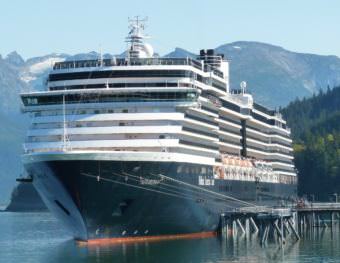
The cruise ship Noordam brought close to 2,000 passengers to Haines on Sept. 20, 2017. It and other ships carried more than 1 million passengers this summer, helping increase the region's tourism economy. (Ed Schoenfeld/CoastAlaska News)
The cruise ship Noordam brought close to 2,000 passengers to Haines on Sept. 20, 2017. It and other ships carried more than 1 million passengers this summer, helping increase the region’s tourism economy. (Ed Schoenfeld/CoastAlaska News)

The loss of state jobs is hitting Southeast Alaska hard.

Tourism has overtaken fishing as the region’s largest private industry. That’s the word from a new report released in September detailing the region’s economic booms and busts.

The region’s total wages and job numbers are down, according to Southeast Alaska by the Numbers, a report covering the 2016 calendar year.

Meilani Schijvens wrote the report for the Southeast Conference, an economic development organization. She presented her findings at its annual meeting in Haines.

The biggest hit is to government jobs.

She said about 30 percent of the region’s 45,000 jobs are in state and local government. Add to that more than a third of its $2.2 billion in wages.

What jobs do Southeast residents have? This pie chart splits up the sectors for 2016. (Graphic courtesy Rain Coast Data.)
What jobs do Southeast residents have? This pie chart splits up the sectors for 2016. (Graphic courtesy Rain Coast Data)

“A lot of people say, ‘Well, people, you know, are retiring,’ or ‘They’ve left their job and it’s not being replaced.’ It doesn’t matter if the actual individual leaving the job isn’t impacted,” she said. “It ends up being a huge hit to our economy.”

Schijvens said Southeast lost 250 state jobs last year and three-quarters that many so far this year.

That’s a total of 750 lost jobs over three or so years, a nearly 15 percent drop.

“The loss of 750 state jobs is equivalent in terms of wages to a large mine being shut down in Southeast Alaska. It’s actually slightly bigger,” she said. “It’s more wages than if we shut down one of our mines in Southeast Alaska. So it is an enormous economic hit.”

Mining jobs, by the way, are up, but only slightly.

Southeast tourism continued to grow in 2016.

The number of jobs went up 5 percent, providing nearly a quarter of the region’s business earnings.

“Our visitor industry, in terms of wages, is now our most important private sector industry for the first time ever,” she said.

Tourism’s relative economic standing rose, in part, because the region’s seafood industry declined.

Schijvens said fisheries jobs dropped by more than 10 percent, and earnings went down by almost twice that amount. The fisheries business is cyclical, so one or two years may not predict a longer trend.

The report shows hits to businesses on land and sea.

“In 2016, shore-based seafood facilities processed 30 percent fewer pounds of seafood than in 2015. And Southeast Alaska state fisheries tax revenue fell by more than 50 percent. These losses are also directly affecting our communities,” she said.

Schijvens said Southeast lost residents in 2016, as it did the previous year. About 650 people moved away.

“Juneau really bore the brunt of those losses. If you look at Juneau, they had their third largest population decline in the history of that community, because they’re really ground zero for state jobs and state wages,” she said.

The biggest population increases were in several small Prince of Wales Island cities, which ranged from 10 percent to 30 percent growth. Gustavus, Skagway, Tenakee, Klukwan and Wrangell also picked up new residents.

Schijvens made some future projections too.

She expects continued decline in government and construction jobs, tied to the lower price and quantity of oil.

Local stores, those not targeting tourists, also will lose some ground, as will timber.

But it’s not all bad.

“We do expect our visitor industry to continue to expand tremendously. We expect our health care (sector) to continue to grow, we expect our mining industry to continue their positive trends. We expect seafood to be a lot better moving forward than it was in 2016. And we expect our maritime industrial jobs to continue to expand as well,” she said.

And how do the region’s industries view the future?

A survey included in the report shows about half of business owners and managers expect things to be the same. A third say it will be better. And the rest say it will be worse.

Ferry plan calls for smaller ships, public management

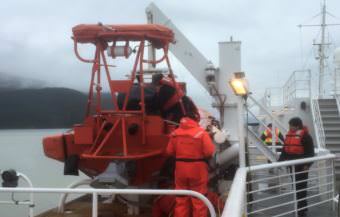
Crew members wrap up a safety drill on the deck of the ferry Malaspina during a sailing from Juneau to Haines Sept. 18, 2017. The ferry system faces changes to its fleet as part of a larger reform plan. (Photo by Ed Schoenfeld/CoastAlaska News)
Crew members wrap up a safety drill on the deck of the ferry Malaspina during a sailing from Juneau to Haines on Sept. 18. The ferry system faces changes to its fleet as part of a larger reform plan. (Photo by Ed Schoenfeld/CoastAlaska News)

A plan to reform the Alaska Marine Highway System calls for replacing some ferries with smaller, more efficient vessels. Backers want it to be run by an independent corporation and negotiate its own labor contracts.

Many Alaska Marine Highway ferries are showing signs of age. Fares are rising and sailings have become less frequent. Most importantly, funding is dropping, pointing to what could be dark times ahead.

“We can continue to admire the problem, and the resulting report, like has happened so many times in the past. Or, we can do something,” said Marc Luiken, commissioner of the state Department of Transportation, which includes the ferry system.

And the report he’s talking about? It’s a near-final draft of a plan to change how the marine highway is managed, and in some cases, operated.

“I strongly suggest crafting legislation necessary to move this effort forward and create a public corporation that will take over governance of the system,” he said at the Southeast Conference annual meeting Sept. 20 in Haines.

The report was produced by consultants for a statewide committee planning for the ferry system’s future. It’s a cooperative effort involving government and the Southeast Conference. The regional development organization formed in the 1950s to lobby for the ferry system’s creation.

The new corporation would continue to receive state and federal funds. But backers say it would provide a buffer between the ferry system and shifting political priorities.

Jim Calvin of the McDowelll Group speaks as part of a panel on reforming the Alaska Marine Highway System Sept. 19, 2017, in Haines. (Photo by Ed Schoenfeld/CoastAlaska News)

“It’s not a complete divorce from state government,” said Susan Bell, a former state commerce commissioner who is with the McDowell Group, which contributed to the report.

“There’s a lot of ways that the public has accountability. There’s a lot of ways that other agencies, like departments of transportation, law and administration, can continue to support it,” she said during a panel discussion and presentation at the Southeast Conference meeting.

The corporation would have its own staff, overseen by a seven-member board appointed by the governor. It’s modeled, in part, on the Alaska Railroad Corp.

Former Transportation Commissioner Mark Hickey was part of the effort to create that corporation in the mid-1980s.

“If I were in charge of the world, I would do a bill where I’m as far away from all the rest of state government as I possibly can be. Have your own lawyers, do your own labor negotiations. You can’t do that completely; you’re going to be tied. But generally, push to have freedom and autonomy,” he said.

Another major change is how and when the system would be funded.

Jim Calvin is senior economic analyst for the McDowell Group.

“The reason that you want this sort of advanced planning opportunity, the forward funding that can support this advance planning, is so people can plan accordingly. Particularly businesses that need long lead times to plan their business operations around the service that the marine highway can provide,” he said.

The state Legislature would have to agree for the plan to work. That’s been a difficult battle for the education budget, which has had much broader support.

An onboard diagram illustrates what's on the ferry Matanuska's Bridge Deck on Sept. 20, 2017. (Photo by Ed Schoenfeld/CoastAlaska News)
An onboard diagram illustrates what’s on the ferry Matanuska’s bridge deck on Sept. 20. (Photo by Ed Schoenfeld/CoastAlaska News)

“Forward funding at a year in advance, in this budgetary climate? I think it’s a bridge too far,” said Sen. Bert Stedman, a Sitka Republican.

He said the whole reform plan could leave the system open to deeper budget cuts.

He called forward funding “a novel idea.” But he pointed to a recently identified budget switch that could leave the ferries without operational funds this spring.

“I think you’re on the wrong track. I think the forward funding issue should be to try to get it funded through June of this year,” he said.

Rep. Sam Kito III, a Juneau Democrat, had a different take. He said he’ll introduce legislation to forward fund the system.

A third significant operational change is labor relations.

Bell said the corporation would take over contract negotiations. That would allow it to change work rules, which could reduce staff and bring operational savings.

“We think that the system would benefit from a more direct relationship between marine highway governance and the unions. We believe not only the change to the corporate structure, but direct negotiations will enhance that,” she said.

The report said wages and benefits make up about 60 percent of the ferry system’s costs. It recommends moving toward smaller and simpler ships, with fewer staff.

“We’re not going to be helping the workforce,” said Capt. Joan Sizemore, a marine pilot working in Southeast Alaska and a former ferry employee. “It seems to be that the impetus right now is to cut costs by removing people. And if you have fewer people working on those ferries, that’s fewer dollars spent in Alaska.”

The ferry reform plan calls for the fleet to remain at nine ships, the current number of active vessels.

But two large ferries, the Columbia and the Kennicott, would be gone. The same could happen to the fast ferries.

Capt. John Reeves of the Elliott Bay Design Group said several ships could be phased out and replaced.

“Some of the shorter routes, you don’t necessarily need to have a crew on board 24/7 because the vessel is just making shorter runs. So we can have a different vessel (that) has a smaller crew, it’s cheaper to operate, but still provides the same service to the communities,” he said.

The ferry reform report also includes what it calls a minimal service model.

That would reduce the fleet from nine to seven ships and the annual weeks of service by about 20 percent.

The committee overseeing the ferry reform project is gathering public comments through Oct. 6.

More information is available at Alaska Marine Highway Reform Project website.

Budget glitch could leave ferries without funding

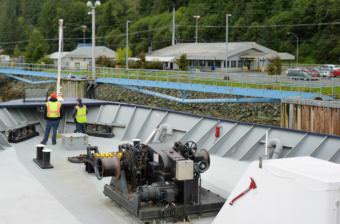
9-18-17 Crew members stand of the front deck of the ferry Malaspina as it pulls away from Juneau's Auke Bay ferry terminal Sept. 18, 2017. Photo by Ed Schoenfeld
Crew members stand on the front deck of the ferry Malaspina as it pulls away from Juneau’s Auke Bay Ferry Terminal Sept. 18, 2017. (Photo by Ed Schoenfeld/CoastAlaska News)

One Southeast senator said that the possibility that the Alaska Marine Highway System could shut down this spring is an intentional attempt to damage the ferries.
A little-known budget provision to make up for a shortfall in state health-care funding will pull about $23 million out of the system’s spending for this fiscal year.

The governor’s budget director Pat Pitney described the problem in a Sept. 19 letter to House and Senate finance leaders.

Sen. Bert Stedman, R-Sitka, argues against Senate Bill 6, which would eliminate daylight saving time in Alaska, during an Alaska Senate floor session, March 11, 2015. The Senate passed it 16-4. (Photo by Skip Gray/360 North)
Sitka Republican Sen. Bert Stedman says the ferry system is in financial trouble  because of actions by his Senate colleagues. (Photo by Skip Gray/360 North)

Sitka Republican Sen. Bert Stedman told those attending the Southeast Conference’s annual meeting in Haines that lawmakers should fix the problem.

Otherwise, the ferry system will run out of money in April.

“They will not have the authority to run the system if the Legislature does not appropriate the money, period,” he said.

The ferry system will have to wait until the new budget year, which begins in July, to resume sailings if the funding isn’t replaced.

Transportation Commissioner Marc Luiken doesn’t expect that to happen.

“I think what we need to really focus on – and this is certainly what the administration is going to be focusing on – is how do we restore that funding. How do we make sure that that funding is there, so we can continue to fulfill that commitment that we have to coastal Alaskans?” he said.

Pitney detailed the shortfall in her letter.

She said a spending bill meant to plug budget holes called for a marine highway account to fill those gaps if there wasn’t enough money.

When Medicaid spending was higher than planned, the $30 million ferry account lost around three-quarters of its balance.

Pitney’s letter doesn’t assign blame.

But Stedman pointed to Senate budget-writers who think the ferry system is too expensive.

“Two years ago, roughly, there was some language put in the operating budget. I’ve got to hand it to the guys. They were very creative in the skullduggery and the downright sleazy budgeting that went on,” he said. “It got by the Department of Law, it got by the administration, it got by my office and it was triggered this year.”

Stedman said the $23 million cut represents about a third of the direct ferry funding provided by the Legislature.

Other monies come from ticket sales and other revenues.

Pitney said the governor will seek to restore the funding through a supplemental budget bill when the Legislature convenes early next year.

Stedman said it will take a strong effort by the governor and the state House to get the funds past the ferry system’s enemies in the Senate.

“We need two people with some balls to tell them in the House majority they’re not going to support the budget if they don’t put the damn money in the marine highway,” he said. “If they don’t do that, my colleagues in the Senate will cut our throat. And I can’t put it any more plainly than that.”

Southeast’s four representatives are members of the House majority coalition. That caucus has a slim majority that needs all members’ votes to pass a budget.

Ferry Taku sold, will become floating hotel

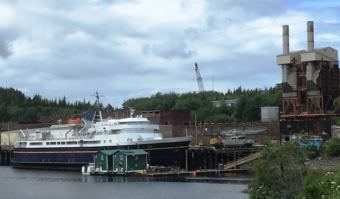
The Alaska Marine Highway System ferry Taku is in storage at Ketchikan's Ward Cove. The former Ketchikan Pulp Co. mill site, including ferry headquarters, is in the background. (Photo by Leila Kheiry/KRBD)
The Alaska Marine Highway System ferry Taku is in storage at Ketchikan’s Ward Cove. It’s been sold to a Portland company that wants to turn it into a hotel. (Photo by Leila Kheiry/KRBD)

The Alaska ferry Taku’s next life will be as a floating hotel.

Portland-based KeyMar LLC made the winning bid of $300,000 for the 54-year-old ship.
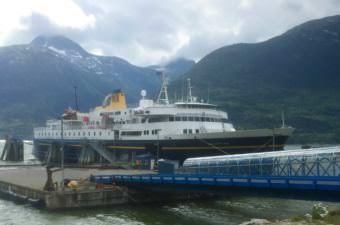
Marine Highway System General Manager Capt. John Falvey said KeyMar beat out two other bidders, who wanted to scrap the ship.

“Their plan is to do some renovation on the Taku and turn it into a destination hotel and waterfront activities center,” he said.

The competing companies offered $50,000 each. The bidding deadline was Sept. 15.

The ferry Taku's solarium and upper back deck was, at times, home to a tent city. (Photo by Lonnie Walters/Alaska Department of Transportation)
The ferry Taku’s solarium and upper back deck were, at times, home to a tent city. The ferry has been tied up since 2015. (Photo by Lonnie Walters/Alaska Department of Transportation)

The Taku is tied up at Ketchikan’s Ward Cove. Falvey said it will be towed to Portland after the sale goes through and the new owner takes possession. That date has not been set.

Falvey said the ferry system has removed the Taku’s art and safety gear.

“Half a million dollars’ worth of equipment is being distributed to active ships in the fleet as needed, as we speak. Some of the equipment will be used for the two Alaska Class ferries,” he said.

Those new, smaller ships are being built at the Ketchikan Shipyard.

State officials have been trying to sell the Taku since spring of this year. It was first priced at $1.5 million, then at $700,000.

The latest minimum price was not made public. Falvey said it was $350,000, more than the winning bid, but close enough.

The Taku was built in 1963. It was tied up in 2015 as the ferry system looked for ways to balance its budget.

The ship can carry about 350 passengers and 50 vehicles. It has 40 staterooms, a cafeteria, observation lounges and a covered solarium.

Falvey has run the ferry system since 2004, overseeing the Taku and other ships in the fleet.

He said selling the Taku is a little bittersweet.

“It’s sad, but I’m very happy it’s going to live on as a destination hotel,” he said. “That makes me happy.”

The fast ferry Chenega also is in storage. But Falvey said there are no immediate plans to sell it.

Ferry reform’s next step at Southeast Conference meeting

The ferry Malaspina docks in Skagway Aug. 25, 2017. The Alaska Marine Highway is being studied as part of a reform effort, which will be discussed at the Southeast Conference meeting Sept. 19-21 in Haines. (Photo by Ed Schoenfeld/CoastAlaska News)
The ferry Malaspina docks in Skagway on Aug. 25, 2017. The Alaska Marine Highway is being studied as part of a reform effort, which will be discussed at the Southeast Conference meeting Sept. 19-21 in Haines. (Photo by Ed Schoenfeld/CoastAlaska News)

An effort to reform the Alaska Marine Highway System takes another step this month.

The latest version of a reform plan will be presented at the Southeast Conference’s annual meeting. Members of the regional development organization gather Sept. 19-21 in Haines.

Executive Director Robert Venables said the effort has been underway for about two years.

“We’re going to be rolling out the major recommendations in a draft, kind of a strategic operations business plan,” he said.

Southeast Conference and the state ferry system are examining ways to save money while maintaining service to port communities.
Venables said the state’s fiscal crisis is just part of the discussion.

“There’s also the way the fleet itself is structured, the way the terminals are constructed and just kind of the overall way we can bring more standardization to operations,” he said.

He said the plan should be finished by the end of the year.

The conference is leading the effort, which included public meetings around the state. The organization formed in 1958 to push for establishing the ferry system.

Venables said the reform effort fits into this year’s meeting theme, which is Navigating the Southeast Economy.

“We all are very well versed in the economic challenges that the state is having, communities are having and businesses are having. (There are) just challenges on every front. And we know with some stick-to-itiveness and working together and some good navigating skills, we can get through this next period of time we have ahead of us,” he said.

About 60 speakers are scheduled to discuss timber, tourism, mining, fisheries and workforce development. Venables expects 200 or more attendees.

Can a Southeast mine battle lead to a trade war?

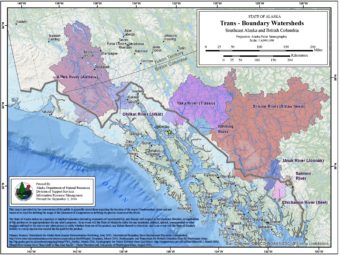
The state has identified eight transboundary watersheds feeding Southeast Alaska rivers. (Map by Alaska Department of natural Resources.)
The state has identified eight transboundary watersheds feeding Southeast Alaska rivers. A coalition of tribal governments is pushing the federal government to protect their fisheries.(Map by Alaska Department of Natural Resources.)

Could a cross-boundary mining battle lead to a trade war with Canada?

A Southeast Alaska tribal organization is using that possibility to push federal officials into providing stronger protections for regional fisheries.

A coalition of 16 Southeast tribal governments has filed paperwork that could lead to trade sanctions against British Columbia, which borders the region.

Southeast Alaska Indigenous Transboundary Commission chairman Frederick Olsen Jr. said about half the region’s tribal governments have signed a petition to the federal Department of the Interior.

“The goal is to get federal involvement in our transboundary mining issue,” he said. “So, we are getting some more of our member tribes to sign on.”

What’s called a Pelly Petition is allowed under a provision of the federal Fishermen’s Protective Act.

Southeast Alaska Conservation Council also opposes transboundary mining.

“If another country is found to be violating the tenets of the Fisherman’s Act, the other country can institute trade sanctions against that country,” council staff scientist Guy Archibald said.

Frederick Olsen Jr. is chairman of the Southeast Alaska Indigenous Transboundary Commission. (Photo courtesy SAITC)

A number of advocacy groups and local governments are concerned about mines on or near British Columbia rivers that flow through Southeast. They said silt, minerals and acidic water from the mines will damage fish stocks on both sides of the border.

British Columbia’s mineral-extraction industry said it develops and operates its mines safely, with limited environmental impacts. But it’s had to defend itself after the Mount Polley Mine tailings dam collapse.

Archibald said trade sanctions are not the petition’s real goal.

Instead, the groups want federal officials to put their concerns before the International Joint Commission, which moderates disputes involving U.S.-Canada boundary waters.

“Nobody really wants to start a trade war with British Columbia,” Archibald said. “Basically, what they’re saying, is that if neither country wants to refer this matter to the International Joint Commission, we as the people on this side have another options. And that maybe the International Joint Commission would be the less onerous of the two options.”

Interior Department officials did not immediately respond to inquiries about the petition. Archibald said they’ve told petitioners they’re looking into it, but that’s all.

Earlier efforts trying to get the State Department to involve the joint commission were unsuccessful.

The Southeast Alaska Indigenous Transboundary Commission is the new name for the United Tribal Transboundary Mining Work Group.

Kasaan resident and commission chairman Olsen said the new name addresses the wider scope of the group’s work.

Tis Peterman is coodinator of the Southeast Alaska Indigenous Transboundary Commission, formerly the United Tribal Transboundary Mining Work Group. (Photo by KSTK-FM)

“Transboundary issues are far beyond mining alone,” he said. “There’s oil tankers, there’s radioactive debris, there’s fish farms breaking apart, there’s cruise ships dumping their bad water.”

Another change: The nonprofit organization hired its first employee in August.

“We’ve never had a staff person,” said new coordinator Tis Peterman, who is also a  Wrangell resident and activist. “Trying to get everybody coordinated and meeting and coordinating meetings with First Nations in B.C. is one of my tasks.”

The organization also is reaching out to Alaska Native groups facing similar issues. Olsen said that includes the United Tribes of Bristol Bay.

“We completely back them up in their fight against the Pebble Mine and to protect Bristol Bay and all the watersheds up there,” he said.

He said hiring a coordinator will help develop and formalize such relationships.

Site notifications
Update notification options
Subscribe to notifications