Ed Schoenfeld, CoastAlaska

Ferry Malaspina out of service for an extra month

ferry Malaspina
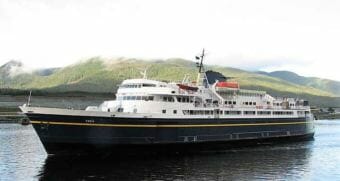
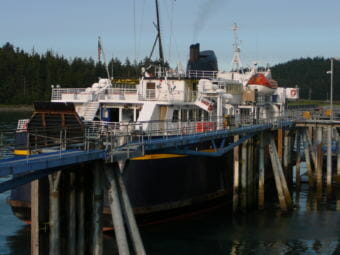
The ferry Malaspina makes a rare appearance near downtown Sitka in 2010. The 450-passenger ship will return to service a month later than scheduled this spring. (Photo by Ed Schoenfeld/CoastAlaska News)

The state ferry Malaspina will return to service about a month later than expected. That will affect nine Southeast port communities.

The 450-passenger ship was supposed to come out of a scheduled overhaul at Ketchikan’s Vigor Marine dry dock March 31. Instead, it will resume sailing April 28.

It usually travels a route between Prince Rupert in British Columbia and Haines, with seven other port calls along the way.

Alaska Marine Highway System spokeswoman Aurah Landau said no other ships are available to fill in.

“The Malaspina is the community boat for Southeast Alaska. It gets into smaller ports that the mainliners can’t get into. And impacts to the Malaspina, we understand, are significant for passengers and communities,” she said.

The ferries Columbia and LeConte will sail to and from those ports as scheduled. But service will be less frequent without the Malaspina.

The delay is due to a scheduling problem, not the need for additional repairs. A barge used as a floating cruise ship berth in Ketchikan will be in the Vigor Marine dry dock longer than expected. City Ports and Harbors Director Steve Corporon said it’s being overhauled.

“It’s in dry dock for routine maintenance to clean it, recoat it and put new zincs on it. And being Southeast Alaska, whenever you’re trying to essentially paint something this time of year, sometimes it can take a little longer to get it done than you would hope,” he said.

The berth and its supporting structures were struck by a cruise ship in 2016. Corporon said most of those repairs have been completed.

Landau said the Malaspina work is routine, part of the marine highway system’s regular maintenance plan.

“The Malaspina in overhaul is going to get painted on its underside, the propeller hubs will be reconditioned and there will be some steel inserts on the car deck to replace wasted steel. And they’ll go through with normal annual inspections,” she said.

In addition to Prince Rupert and Haines, the Malaspina stops at Juneau, Ketchikan, Wrangell, Petersburg, Kake, Hoonah and Sitka.

State agencies provide stopgap timber for Southeast industry

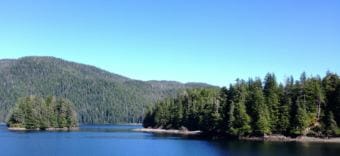
Forests along Peril Strait shine on a sunny Sept. 15, 2015. Several government agencies are selling timber to Southeast Alaska mills until larger stands of trees are made available. (Photo by Ed Schoenfeld/CoastAlaska News)
Forests along Peril Strait shine on a sunny Sept. 15, 2015. Several government agencies are selling timber to Southeast Alaska mills until larger stands of trees are made available. (Photo by Ed Schoenfeld/CoastAlaska News)

The state just sold timber from its Southeast Alaska forest to the region’s largest mill.

It’s part of a multi-agency effort to keep the area’s logging industry alive. But some say it’s time to let it go.
Klawock’s Viking Lumber was the only buyer interested in the North Hollis timber sale, about 230 acres on Prince of Wales Island, the center of what’s left of Southeast’s timber industry.

But it wasn’t sold under the usual bid program.

It was a negotiated sale based on more than the price, State Forester Chris Maisch said.

“The kind of things we’re looking for (are) would the wood be used to manufacture products in the state, how many jobs … will be created from the project,” he said. “Of course, the price being offered for the timber is also a consideration.”

The state Division of Forestry said Viking is paying $375,000.00 for mostly Sitka spruce, hemlock and red cedar.

It’s not huge acreage as timber sales go, but it’s one of several small state sales aimed at keeping Viking and other parts of the industry alive.

“We have stepped up our timber sale program because of the shortfall of federal volume here over the last several years,” he said.

The North Hollis sale was finalized in December.

The state forest also sold a second parcel to Viking last year, near Coffman Cove, also on Prince of Wales Island.

(Read Tongass in transition: Striking a chord with old growth trees.)

Another agency also plans to provide stopgap timber.

The Alaska Mental Health Trust Land Office is trading some controversial timberlands near cities for acreage in the Tongass National Forest.

Executive Director Wyn Menefee said the office is planning for sales this year and next.

“That’s going to be very vital for the timber industry down there because they’re short on timber supply and we are the ones that probably can provide, after we get the land through the lands exchange, the necessary fiber to market,” he said.

The first will be near Naukati, which also is on the island.

About 11,000 acres are involved, but it won’t all be sold at the same time.

“We will be putting that old-growth available for timber markets in Southeast, which hopefully will give them enough breathing room to allow the Forest Service enough time to get timber on the markets,” he said.

About 2,400 acres will be in the first sale, which will be offered this spring. Public comments on the overall plan are due by Jan. 15.

(Read Tongass in transition: An uncertain future for Alaska’s last big mill.)

The Tongass National Forest has been the largest source of timber on public lands for decades. But management changes, lawsuits and a shortage of older timber has slowed its sales.

Tongass officials will offer three sales this year totaling about 1,200 acres.

Spokesman Paul Robbins Jr. said two are old growth while one is young growth.

“We’re also working on environmental impact statements for sales on the Petersburg and Wrangell Ranger districts, as well as multiple sales as part of the Prince of Wales landscape level analysis,” he said.

Robbins said the Forest Service is working with other timber owners, including the state, the land trust, Sealaska regional Native corporation and the University of Alaska.

“We convened about four or five years ago to coordinate timber sales and improve economies of scale, reduce overall costs and help the economics of timber sales for Southeast Alaska,” he said.

“They just want to continue to do business the way they have been doing business,” said Bob Claus, a Prince of Wales Island resident and a member of the Southeast Alaska Conservation Council.

He and others question sales that continue supplying old-growth timber to what he calls a dying industry. He said they’re damaging the environment, including salmon, deer and wolf habitat.

“Yyou have Sealaska, you have mental health trust, you have state lands and you have the Forest Service … all pushing for more old-growth harvests out of a place that just can’t take it anymore,” he said. “They’ve already taken all the old growth that they can take. And probably more than was acceptable.”

Viking Lumber continues logging old-growth trees from a previous Forest Service sale.

What’s called Big Thorne involves about 6,000 acres between Thorne Bay and Coffman Cove.

The Tongass is being managed under a plan to move away from harvesting old-growth trees. It calls for a new industry based on younger timber, also called second growth.

But a federal agency last fall determined Congress has the right to review – and possibly overturn – the plan.

If that happens, the Tongass could resume selling larger stands of older trees, which is what the industry wants.

Storm, steering problem hit Southeast ferry service

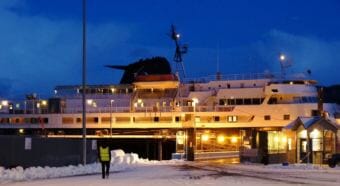
The ferry LeConte docks at Juneau’s Auke Bay terminal in 2010. Rough weather will keep it from sailing Jan. 9 to Haines. The ferry Columbia is also delayed through Jan. 11 because of a mechanical problem. (Photo by Ed Schoenfeld/CoastAlaska News)

Rough weather and a mechanical breakdown are affecting Alaska Marine Highway service in Southeast Alaska.

Fifty-knot winds and high seas predicted for upper Lynn Canal will prevent the small ferry LeConte from making its Jan. 9 sailings between Juneau and Haines, part of its route.

Officials said it will resume scheduled sailings with a trip to Kake that night.

The ferry Columbia also is sailing a modified schedule through much of the week, because the system’s largest vessel was sidelined for much of Jan. 7 due to a mechanical problem.

Alaska Marine Highway spokeswoman Aurah Landau said the ship won’t skip any port calls.

“It’s running about 12 hours late. It will be on a modified schedule through Thursday,” she said. “It’ll resume its normal schedule with a northbound schedule leaving Bellingham on Friday.”

The Columbia sails weekly roundtrips from Bellingham, Washington, to Skagway.

It stops in Haines, Juneau, Sitka, Petersburg, Wrangell and Ketchikan along the way.

The problem occurred as the Columbia sailed from Bellingham to Ketchikan. Landau said what’s called a steering-indicator rod stopped working.

“That’s the piece that when the wheel gives the command to the rudders to move, through the electrical system, tells the steering mechanism that the rudder has moved,” Landau said.

A technician had to fly into Ketchikan to make the repairs, she said. This problem took less than a day to fix, much faster than a previous breakdown.

The Columbia returned to service in late October after being sidelined for about a year after a propeller struck a submerged object.

Parts weren’t available and had to be built from scratch.

The Columbia carries about 500 passengers and more than 130 vehicles. It also has about 100 cabins.

The LeConte carries fewer than half as many passengers and about a quarter as many cars and trucks. It has no staterooms.

Ferry Taku sale set for Jan. 19, but its future is uncertain

The state ferry Taku will be sold to Jabal Al Lawz Trading Jan. 19. It's 352 feet long and  designed to carry 350 passengers and about 50 vehicles. (Photo courtesy Alaska Marine Highway System)
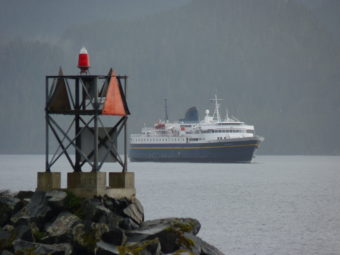
The state ferry Taku will be sold to Jabal Al Lawz Trading Jan. 19. It’s 352 feet long and  designed to carry 350 passengers and about 50 vehicles. (Photo courtesy Alaska Marine Highway System)

The state ferry Taku will keep its name – and possibly its job – after it leaves Alaska.

But it could also be cut up for scrap.
Jabal Al Lawz Trading is the company buying the 55-year-old ferry. The company is based in Dubai, in the United Arab Emirates, on the Persian Gulf, but its owners are in India and New Zealand.

“My partner and I buy scrap ships all around the world and mobilize them to India, where there’s quite a strong market for older vessels and they chop them up and recycle the steel,” Capt. Barrymore “Ben” Evans said.

And that’s where the Taku may end up.

Evans doesn’t want to send it there, because it’s not at the end of its life, so he and his partner are looking elsewhere.

“There’s some people in the Philippines looking at a coastal ferry service … and similarly in Indonesia, the same scenario. And we also have inquiries from Papua New Guinea,” he said. “They have a coastal shipping service because they don’t have very much road infrastructure there.”

Evans’ partner, Rishi Aggarwal of Mumbai, India, is more optimistic. In an email exchange, Aggarwal said he expects the ship to remain a ferry. If it does, he said it will keep the name Taku.

Mumbai is a center for businesses that dismantle and recycle large ships.

The industry is known for low wages and hazardous working conditions.

The Taku has been docked since June of 2015, when it was taken out of service because of its age, as well as budget cuts.

It would need substantial improvements and updated certifications to rejoin the fleet.

Evans said the nations interested in the ship don’t have the same requirements.

“These are the sort of countries that can use an older ferry. Because their regulations are safe, but they are, how can I say it? More flexible than the United State or Europe would be,” he said.

Evans will fly to Ketchikan on Jan. 18 for a final inspection. The next day, he and Alaska Marine Highway System General Manager John Falvey will sign the final paperwork.

Falvey said that’s the end of state ownership, which began in 1963.

“We, in essence, are going to switch over the docking fees on the day that we make the sale,” Falvey said.

The partnership already has made a $25,000 deposit. The remainder of the $171,000 price will be paid before the documents are signed.

Evans said he’ll bring in a crew the day after the sale.

They’ll spend about 20 days preparing the Taku for the voyage. It will first sail to Seattle, then across the Pacific to the Philippines and on to its final destination.

He expects the trip to take about a month.

Evans gives the ship about a 50 percent chance of continuing to sail.

“I just sincerely hope we do find a buyer because she’s an absolutely beautiful vessel. And when we buy ships, they are reaching the end of their life cycle,” Evans said. “It’s quite nice when you come across one that’s in such lovely condition, but also very, very sad to put it up on the beach. So I do hope that doesn’t happen,” Evans said.

State officials put the Taku up for sale last March. The original minimum bid was $1.5 million. But it took several tries, each with a lower price.

At one point, a Portland-based group planned to turn it into a floating hotel. But neighbors objected and the offer was withdrawn

Evans’ company’s winning bid was a little more than a tenth of the original minimum price.

Feds jump into transboundary mining dispute

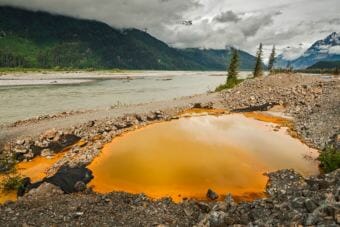
Acid drainage from the Tulsequah Chief Mine, northeast of Juneau, discolors a leaking containment pond next to the Tulsequah River in British Columbia in 2013. The U.S. State Department is addressing concerns that other B.C. mines will pollute Alaska rivers. (Photo courtesy Chris Miller/Trout Unlimited)

The federal government is taking on the transboundary mining issue.

The U.S. State Department now acknowledges Alaskans’ concerns about pollution from British Columbia mines. And it’s committed to engaging Canadian officials to protect salmon-rich, cross-boundary watersheds.

In November, the State Department issued a statement saying it was aware of Alaskans’ environmental concerns. And it said it was raising the issue with its Canadian counterparts.

But details were scarce.

Then, the department sent a letter to Lt. Gov. Byron Mallott, who released it Dec. 28. He’s headed up the administration’s efforts to address potential pollution from mineral prospects across the border in British Columbia.

Barbara Blake, special assistant to Lt. Gov. Byron Mallott, answers a question about transboundary mining while Tlingit-Haida Central Council Rob Sanderson Jr. listens at a Native Issues Form March 9, 2016, in Juneau. (Photo by Ed Schoenfeld/CoastAlaska News)
Mines adviser Barbara Blake and tribal leader Rob Sanderson Jr. participate in a forum March 9, 2016, in Juneau. (Photo by Ed Schoenfeld/CoastAlaska News)

“We’re very excited to see the federal government engaged in this issue and their response that they’ve made to us and to see the actions going forward,” said Barbara Blake, the Walker-Mallott administration’s senior transboundary mines adviser.

She said one important promise is to research what the two governments can do to protect Southeast Alaska watersheds.

“They’re looking at the gaps and limitations of cooperation between our two countries right now,” Blake said. “And so we’re anxious to see what comes about from their analysis or their review of any gaps or limitations as they currently stand.”

The State Department will release its findings at an April meeting of the International Joint Commission, the panel that addresses transboundary water concerns.

The department earlier said it would not get involved with the issue.

The federal agency’s letter came in response to a November request from the Walker-Mallott administration and Alaska’s congressional delegation to address transboundary mining.

Mine critics have repeatedly called for commission involvement.

One is Frederick Olsen Jr., who chairs the SouthEast Alaska Indigenous Transboundary Commission. He’s also tribal president of the Organized Village of Kasaan, on Prince of Wales Island.

“It looks like it’s a good first step,” Olsen said. “Of course, as it said in the letter, to have the International Joint Commission, you still have to have the Canadians support that.”

This aerial image from a British Columbia emergency office video shows the Mount Polley dam breaks and some of the damage downstream.

Heather Hardcastle of Salmon Beyond Borders agrees. She’s encouraged, but said there’s a lot more work to be done.

“I think first and foremost we’re looking at some sort of financial-assurances mechanism to be set up so that those of us downstream of these mega-mines know that appropriate bonding has been required of these mining companies,” she said.

Two mines are operating in transboundary watersheds that flow into Alaska, the Brucejack and the Red Chris. Another, the Tulsequah Chief, is closed and leaking polluted water.

Several others are in the exploration phase.

Developers and owners have said their operations are or will be safe and won’t damage the environment.

She said officials also need to press for better technology, including changes in the way waste rock from ore-processing is stored.

Mines commonly put them underwater behind earthen dams. Hardcastle said that will lead to spills of polluted water that will harm fish and people downstream.

That’s what happened in 2014, when an eastern British Columbia storage dam broke.

Observers estimated enough water, mud and rock escaped to fill 2,000 Olympic-sized swimming pools.

Southeast Alaska Indigenous Transboundary Commission Chairman Frederick Olsen Jr.,, left, and United Tribes of Bristol Bay President Robert Heyano hold the agreement their groups signed Oct. 19. (Photo by Molly Dischner)
Southeast tribal leader Frederick Olsen Jr., left, and Bristol Bay tribal leader Robert Heyano pose after signing an agreement to work together on mining issues Oct. 19, 2017. (Photo by United Tribes of Bristol Bay)

Olsen said words can’t prevent that from happening closer to home.

“Not to be rude, but it’s just a letter. That little piece of paper, if you printed it out, would not stop a lake of poison debacle like Mount Polley or something like that,” Olsen said.

The State Department’s letter mentions tribal concerns. But it doesn’t say anything about tribal involvement.

Rob Sanderson Jr. is first vice president of the Central Council of Tlingit and Haida Indian Tribes of Alaska.

“At the end of the day we are government. The tribes are government,” he said. “So we need to be able to use that leverage moving forward. Not just the state, but the tribes too.”

Walker-Mallott mines adviser Blake said officials are looking forward to learning more about the State Department’s plans.

But she said the administration is not turning the whole issue over to the federal government.

“We’re going to continue be engaged with them as necessary and wherever possible. The lieutenant governor would like the state to remain involved in this process,” she said.

She said Mallott will travel to Washington, D.C., for a federal interdepartmental work group led by the Environmental Protection Agency. He’ll also meet with Canadian officials in Ottawa.

His office also will continue following up on a cooperative agreement Alaska and British Columbia signed last year.

Southeast’s year: Taku sold, Chinooks crash, mines petitioned and a Tongass turnaround

A Petersburg fishing boat passes the ferry Taku near the entrance of Wrangell Narrows in August, 2013. (Ed Schoenfeld/CoastAlaska News)
A Petersburg fishing boat passes the ferry Taku near the entrance of Wrangell Narrows in August, 2013. The ship was put on the market in 2017. (Photo by Ed Schoenfeld/CoastAlaska News)

Southeast Alaska saw some major trends and events in 2017. They ranged from cruise ship passenger increases to budget decreases to labor battles to murder investigations.

Here are our top picks:

State ferry sold

In March, the Alaska Marine Highway System put the ferry Taku up for sale. The 54-year-old ship already had been tied up for about two years.

The Taku went out for bid for a minimum of $1.5 million. But it took several tries, each with a lower price.

General Manager John Falvey said the final offer was $171,000, a little more than a tenth of the original price.

“The winner was the Jabal Al Lawz Trading Co., from the (United Arab) Emirates,” he said.

It will become a ferry in the Philippines – or be sold for scrap.

An earlier offer to turn the ship into lodging in Portland fell through.

“Their plan is to do some renovation on the Taku and turn it into a destination hotel and waterfront activities center,” Falvey said at the time.

Officials hoped to finalize the sale by the end of the year. But the closing date is now Jan. 19.

Chinook shortage hits Southeast

David Turner Jr. won 2016's Spring King Salmon Derby with a 29.25-pound salmon. (Image courtesy Central Council of Tlingit and Haida Indian Tribes of Alaska)
David Turner Jr. won 2016’s Spring King Salmon Derby. This year’s derby was canceled. (Image courtesy Central Council of Tlingit and Haida Indian Tribes of Alaska)

2017 was a lousy year for king salmon fishing in Southeast waters.

Chinook runs here and in British Columbia saw historically low returns.

That prompted a Southeast-wide closure for kings in both sport and commercial fisheries.

That’s unprecedented, at least in recent memory.

In Juneau, the low numbers meant canceling one sport fishing derby and eliminating kings from another.

State biologist Daniel Teske said the problem is in the ocean, not the rivers where kings spawn and hatch.

“Something’s happening out there, whether it be less prey available or more predators and we are seeing it throughout a bunch of different systems here,” he said.

Proposals to further restrict the region’s catch will go before the state Board of Fisheries at a January meeting in Sitka.

Tongass plan targeted

At the start of 2017, Tongass National Forest managers planned to move away from logging old-growth timber. They wanted to transition to a new industry using younger trees.

But timber businesses – and some politicians – worked to reverse that direction.

Industry leader Owen Graham said the plan was bad news.

“It’s literally going to put our industry completely out of business,” he said.

In October, a federal agency ruled the plan was subject to congressional review. And the next month, Sen. Lisa Murkowski added a measure overturning the plan to an appropriations bill.

Both discouraged environmentalists, who pushed for the transition, including Southeast Alaska Conservation Council’s Meredith Trainor. 

She said when she heard that Congress can decide the Tongass’ fate her “heart sank a little.”

Final decisions could be made in the new year.

Transboundary mines challenged

The Brucejack Mine pours its first gold bar in June of 2017. The mine is about 25 miles from the Alaska border. (Photo courtesy Pretivm Resources)

Fisheries, tribal and environmental activists continued battling mineral development across the border in British Columbia in 2017.

They worried it could poison salmon-rich waterways that flow through Southeast.

In September, tribal activists petitioned for trade sanctions. Leader Frederick Olsen Jr. wanted more done to protect Alaska fisheries.

“The goal is to get federal involvement in our transboundary mining issue,” he said.

It was followed by a November joint letter from the Walker-Mallott administration and Alaska’s Congressional Delegation. It lobbied the State Department to engage with Canadian officials.

It’s not yet clear whether the effort will get the results its authors want.

But the U.S. State Department’s Bureau of Western Hemisphere Affairs said the agency is aware of the concerns.

“This is an issue we have raised with our Canadian counterparts at a number of levels with both provincial and federal governments, and we will continue to engage with them on it,” a spokesperson wrote in an email.

Site notifications
Update notification options
Subscribe to notifications