Ed Schoenfeld, CoastAlaska

Former Unalaska mayor to run state ferry system

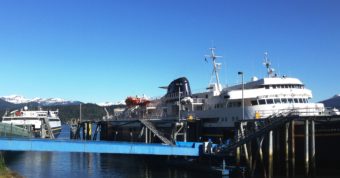
The ferry Malaspina sails out of Juneau's Auke Bay terminal in 2012. It's one of 10 active vessels in the Alaska Marine Highway fleet. The system's new executive director, Shirly Marquardt, will begin work June 1.
The ferry Malaspina sails out of Juneau’s Auke Bay terminal in 2012. It’s one of 10 active vessels in the Alaska Marine Highway fleet. The system’s new executive director, Shirley Marquardt, will begin work June 1. (Photo by Ed Schoenfeld/CoastAlaska News)

The Alaska Marine Highway has a new top official.

State Transportation Commissioner Marc Luiken on Tuesday appointed Shirley Marquardt as executive director of the ferry system.

Marquardt served as mayor of Unalaska, the ferry system’s westernmost port. She represented her region on the state’s Marine Transportation Advisory Board for more than a decade. She’s also worked for seafood processors and a barge line.

Shirley Marquardt was named executive director of the Alaska Marine Highway System May 15. (Photo courtesy State of Alaska)

Marquardt will oversee an initiative to change the system from a state agency to a public corporation. She said that’s part of what attracted her to the job.

“It’s such a different way to look at operating the ferry system, but clearly what we’ve been doing in the past almost 20 years is not working real well,” she said.

The executive director’s job is new. It replaces the deputy commissioner of marine transportation, which has been open for about a year.

Marine Transportation Advisory Board Chairman Robert Venables said Marquardt will bring business experience to the system, as well as what’s called the Ferry Reform Project.

“She really understands the maritime industry and she understands the community importance of the marine transportation mission of the Alaska Marine Highway System. And so, she’s very well rounded and I think she’s going to bring a great depth of expertise and executive decision making,” he said.

Venables said transportation officials discussed the new hire with the advisory board Monday. He said support was unanimous.

Marquardt will begin her job in early June. She’ll move to Ketchikan from Anchorage, where she’s been the governor’s director of boards and commissions.

General Manager Capt. John Falvey will continue to oversee marine highway operations, as he has for more than a decade.

“He will continue to be the ferry whisperer. That’s his bailiwick. That’s his wheelhouse,” she said.

The marine highway system has reduced service and dropped vessels in recent years as budgets have become tighter.

Its 10 ferries serve 35 communities from Bellingham, Washington, to Unalaska-Dutch Harbor.

Legislature resurrects Juneau Access Project, sort of

A sign at the end of Glacier Highway in October 2016. The Juneau Access Improvements Project extension would begin here.
A sign at the end of Glacier Highway in October 2016. The Juneau Access Improvements Project extension would begin here. (Photo by Andrew Kitchenman/KTOO)

The Legislature passed a spending bill that funds several projects throughout Southeast Alaska.

For decades, backers have pushed for a closer connection to Haines and Skagway, which have road links to the mainland highway system.

Gov. Bill Walker halted the Juneau Access Project two years ago, saying it was among a group of large projects that Alaska could no longer afford.

Juneau Sen. Dennis Egan, a Democrat, said that was a mistake.

“Everybody you talk to in the Railbelt, especially, says, ‘Why can’t you drive to the capital?” Well, unlike Honolulu, we could make a way to drive to Juneau,” he said.

Egan and other state senators put a little more than $20 million in the capital budget.

It’s money Walker reallocated to other projects in the same general area.

So rather than new spending, it’s shifted back.

First Things First Foundation executive director Denny DeWitt points to a recent survey suggesting more than half of capital city residents support the project. Fewer than 40 percent of respondents opposed it.

“It’s not the whole package, but it will continue moving the process through the decision-making process,” he said. “Hopefully what we’ve done in terms of looking at what Juneau wants in its transportation policies, hopefully it will have some impact on elected officials.”

Opponents say the project would damage the ocean and shore where the approximately 50-mile road would be built.

Travelers also would still have to take a short ferry ride to connect to the mainland road system.

The governor could possibly veto the reappropriation.

Diesel generators in the Kake Powerhouse provide electricity to the town’s residents. The Gunnuk Creek hydroproject would replace about two-thirds of the power. (Photo courtesy Inside Passage Electric Authority)

The Legislature’s capital budget funds a hydropower project near Kake, a small Southeast city dependent on diesel generators.

Inside Passage Electrical Cooperative CEO Jodi Mitchell said it plans to build at Gunnuk Creek.

“The project will actually provide an estimated two-thirds of the current Kake load,” she said. “At times, we’ll be able to turn the diesels off, which is kind of the gold standard for hydro.”

Close to $4 million is appropriated to the project. The nonprofit also hopes to win a $3 million federal grant, Mitchell said, which would complete the funding.

But if it doesn’t, the cooperative could take out a loan.

Gunnuk Creek is the second of at least four hydroprojects planned for Hoonah, Kake and Angoon.

Mitchell said each one will lower rates – and pollution – in all communities the cooperative serves.

“I really am excited to find out when all these projects are done how much of our load is covered by renewable energy,” she said.

Young salmon are raised in concrete raceways at Blind Slough about 17 miles south of Petersburg. (Alexis Kenyon/KFSK)
Young salmon are raised in concrete raceways at the Crystal Lake Hatchery about 17 miles south of Petersburg. Funding in the capital budget will repair parts of the hatchery. (Alexis Kenyon/KFSK)

Another project in the capital budget would upgrade the king and coho salmon hatchery at Crystal Lake, near Petersburg, which Southern Southeast Regional Aquaculture Association runs.

Production Manager Bill Gass said in an interview earlier this year the $1.5 million will replace raceways that have been leaking for several years.

“The danger now is that we’re afraid that this leak could turn into a catastrophic failure, at which point we could lose the whole thing,” he said. “It buys us continued time to operate,” he said.

The budget also includes $5 million to help dispose of lead-contaminated soil from an old junkyard in Wrangell. The state plans to store it locally, but leaders want it shipped south.

Other Southeast Alaska capital project funding includes:

  • Operating funds for Inter-Island Ferry Authority – $250,000
  • Ketchikan cruise ship berths expansion – $3 million
  • Ketchikan Houghtaling Elementary School roof – $2.4 million
  • Ketchikan Pioneer Home structural upgrade – $1.25 million
  • Craig Middle School gym floor replacement – $418,000
  • Craig Elementary School door and flooring replacement – $111,000
  • Craig Middle School siding and windows – $119,000
  • Wrangell junkyard contaminated site cleanup – $5 million
  • Petersburg Middle/High School entry renovation – $30,000
  • Petersburg Middle/High School underground storage tank replacement -$115,000
  • Crescent Boat Harbor improvements, Sitka – $5 million
  • Hoonah central boiler replacement – $183,000
  • Rebuild tender dock at Icy Strait Point tourist attraction in Hoonah to accommodate more ships – $1.1 million
  • Juneau Court Plaza Building exterior improvements – $1 million
  • Alaska Office Building roof – $900,000

Editor’s note: An earlier version of this report incorrectly reported several Southeast cities would receive matching funds for boat harbor replacement or improvement. Only one project, in Sitka, was funded.


Sealaska board election short on independents

A Sealaska corporate logo adorns the roof of the Southeast Alaska Native corportation's headquarters in Juneau on May 2, 2018.
A Sealaska corporate logo adorns the roof of the Southeast Alaska Native corportation’s headquarters in Juneau on May 2, 2018. The logo has representations of the Eagle and Raven moieties of the Tlingit, Haida and Tsimshian cultures. (Photo by Jeremy Hsieh/KTOO)

Only three independent candidates are running for the Sealaska Board of Directors this spring. That’s a smaller number than most recent years. Why?

Sealaska is holding community meetings this month in nine Southeast Alaska and Washington state cities.

They’re an opportunity for some of its more than 22,000 shareholders to hear about the regional Native corporation’s business progress. The meetings are also a chance to hear from incumbents and challengers running for Sealaska’s board of directors.

Five of the board’s 13 incumbents are on this year’s ballot. They’re endorsed by the board and run as a slate. Shareholders can cast ballots for them as a group through a process called discretionary voting.

Only three independent candidates are challenging the incumbents. That’s a third to a half of the number in some elections this decade. Shareholders cast ballots for each individual candidate through what’s called directed voting.

Ray Austin of Albuquerque, New Mexico, has run as an independent in several elections. But not this time around.

“What’s been happening in the past years is too many people run, sometimes almost 10. And what happens then is that they dilute the voting power of the shareholders that vote directed,” he said.

Two of the three independent candidates have run before. They are Nicole Hallingstad of Arlington, Virginia, Sealaska’s former corporate secretary; Karen Taug of Juneau, Bartlett Regional Hospital Controller; and Edwell John Jr. of Juneau, a state business analyst.

The incumbents include board president Joe Nelson of Juneau and his predecessor, Albert Kookesh of Angoon. Also running are former lawmaker Bill Thomas of Haines, fisheries business owner Barbara Cadiente-Nelson of Juneau and attorney Tate London of Bothell, Washington.

Nelson, in a prepared statement, said the thin independent slate could be the result of several factors.

One is that two strong independents won board elections over the past three years. Another is that several other incumbents first ran as independents.

Sealaska CEO Anthony Mallott said it also could be due to the corporation’s business success. A recently released annual report showed last year’s earnings triple the amount of the previous year.

“The excitement we have around the financial performance, I would guess, should drive a lot of decision-making for our shareholders in this process. We want to be very clear and transparent that 2017 is a milestone year and there’s more to come,” he said.

In past years, some critics have suggested a coordinated campaign to limit the number of independents.

That happened in 2014, when a group called 4 Shareholders for Sealaska ran its own slate. It succeeded in putting one person on the board.

Candidate Hallingstad said social media postings show there’s still interest in coordination.

“I’ve seen a lot of conversation about shareholders wanting to unite behind one or two qualified candidates to get an independent elected,” she said.

But she, Austin and another former candidate say there’s no coordinated effort this year.

Austin said that’s in part because campaigns begin before the official list of candidates is made public.

“I think that’s always been a disadvantage for any shareholder because you cannot plan a strategy if you don’t know who’s running as an independent,” he said.

Shareholders have been voting online and by mail since early this month.

Election results will be announced at Sealaska’s annual meeting June 23 at the Wrangell High School Gymnasium.

Sealaska offers burial, cremation assistance to shareholders

Sealaska Board Chairman Joe Nelson poses at corporate headquarters in Juneau after he was elected to the position in June of 2014. Nelson announced a new shareholder burial assistance program May 7. (Photo by Ed Schoenfeld/CoastAlaska News)
Sealaska Board Chairman Joe Nelson poses at corporate headquarters in Juneau after he was elected to the position in June 2014. Nelson announced a new shareholder burial assistance program on Monday. (Photo by Ed Schoenfeld/CoastAlaska News)

Sealaska is helping its shareholders with burial and cremation costs. The Southeast regional Native corporation’s board voted Monday to offer bereavement benefits of up to $1,000.
Losing a loved one is difficult enough on its own. Add the cost of a funeral, burial or cremation and it can be too much to handle.

A thousand dollars isn’t enough to cover all expenses, which can easily top $10,000. But it can help.

Sealaska Board of Directors Chairman Joe Nelson said the corporation’s increased earnings allow it to offer the benefit.

“This is one that’s been out there for a long time and we haven’t been able to get there. But this year, because of our financial performance and our anticipated continued solid performance, that I think everybody in the company’s just excited that we’re able to move on this one this year,” he said.

Survivors will receive $1,000 when an original shareholder dies. That covers those enrolled in the corporation since it formed in the early 1970s.

Descendants of original shareholders, and those who inherited or were given stock, will receive up to that amount. The corporation said payments will be based on the number of voting shares at the time of the shareholder’s death.

Nelson said the board took action now because it has a new source of revenue.

“It’s a function of being in a healthy financial position and then having the specific carbon project where we want to associate that carbon program to a benefit that all shareholders will feel for generations to come,” he said.

That project allows Sealaska to sell carbon offset credits through a program based in California. It’s complicated, but basically, the corporation keeps some of its forests intact, in exchange for payments from polluters.

Shareholder bereavement benefits began May 7, the day Sealaska’s board of directors approved the new program.

“I think this is fantastic news for shareholders,” said Nicole Hallingstad, a former Sealaska corporate secretary who’s running for the board as an independent candidate.

She’s among other candidates and corporate critics who’ve called for bereavement benefits.

“The most important thing about this announcement is that it just proves that when shareholders are united and are persistent in their voice in raising an issue, that we can actually accomplish the change that we’re asking for,” she said.

Nelson said a recent survey showed the benefit among shareholders’ top priorities. It was outranked by scholarships and dividends.

“Whenever we go out in the communities, just in our regular shareholder engagement, it is a regular theme — that a lot of folks could use help with burial assistance. And it’s also part of our cultural values, especially in Southeast, where we come together and support each other during times when someone passes,” he said.

Some other regional Native corporations already provide a similar benefit.

Nelson said the mechanics of payments are being worked out, but applications will be available sometime in June.

Sealaska estimates around 300 shareholders die every year. The corporation has between 22,000 and 23,000 shareholders.

Alaska recyclers find new overseas markets

Cardboard and plastics pile up at the Juneau Recycling Center on March 28, 2018. Some recyclables are no longer accepted by China, one of the world's largest buyers. (Photo by Ed Schoenfeld/CoastAlaska News)
Cardboard and plastics pile up at the Juneau Recycling Center on April 28. Some recyclables are no longer accepted by China, one of the world’s largest buyers. (Photo by Ed Schoenfeld/CoastAlaska News)

Almost a year ago, recycling businesses in China announced plans to stop buying mixed paper and some types of plastic containers. That worried Alaska and West Coast businesses that collect, sort and ship those materials overseas.

At least one major wholesaler said it would remove the paper and plastics from its recycling stream and dump it in its landfill. But so far, that’s not happening much.

China began restricting its recycling intake Jan. 1.

Waste Management Communications Manager Jackie Lange said it was a big deal.

“In the broader region and across the country and in fact, around the world, there are a lot of changes that are being driven by what China is doing,” she said.

Waste Management operates about 150 recycling centers around the nation, including Juneau’s. It’s the biggest garbage company in the U.S.

Republic Services is another large recycler and trash collector. It takes reusable materials from Ketchikan, Sitka and Petersburg, along with more than 60 other U.S. cities.

Washington state General Manager Don Tibbets said his company continues to collect and sort the same things it did before Jan. 1. But not all newspapers, magazines, junk mail and other mixed paper is being shipped.

“We’re having to stockpile and store this material until we can find markets that are able to accept all of it,” he said.

Tibbets said Republic found new markets in India, Malaysia and Vietnam. But those nations don’t have as much capacity as China.

“Unfortunately, paper degrades rather fast and rather quickly in the natural environment. So after some time of being stored, it degrades to the point where it’s just no longer marketable,” he said.

Tibbets said about three-quarters of Republic’s mixed paper is being recycled and the rest is being thrown away.

Republic Services’ Don Tibbets looks over piles of garbage at the Roosevelt Regional Landfill in Washington state on Sept. 22, 2017. Tibbets served as general manager of the landfill, which takes in about 22,000 tons of Southeast Alaska garbage each year.
Republic Services’ Don Tibbets looks over piles of garbage at the Roosevelt Regional Landfill in Washington state on Sept. 7, 2017. Tibbets served as general manager of the landfill, which takes in about 22,000 tons of Southeast Alaska garbage each year. (Photo by Tom Banse/Northwest News Network)

Tibbets said plastics are less of a problem.

“They’re actually a small portion of the recycle stream. So that amount of material, we’re still able to move overseas,” he said.

China still accepts most plastic bottles and containers marked Nos. 1 and 2, but not Nos. 3-7. But few local recycling centers accept that material.

Learn about other garbage issues and solutions in Southeast Alaska through CoastAlaska’s Talking Trash series.

The new restrictions have sent worldwide recycling wholesalers searching for new markets. In some cases, that’s driven prices down.

It’s of concern, especially in the 49th state.

“In Southeast Alaska, recycling is a very financially based enterprise,” said Petersburg Utility Director Karl Hagerman.

He’s also been active in the Southeast Alaska Regional Solid Waste Authority, a regional organization of cities that barge recycling and garbage south.

He said selling recyclables lower the expense.

“If the cost to recycle exceeds the cost to ship as solid waste, then it doesn’t really pencil out financially and we may have to look at doing something differently,” he said.

Juneau residents drop off cardboard, paper, aluminum and plastics at the Juneau Recycling Center on March 28, 2018. (Photo by Ed Schoenfeld/CoastAlaska News)
Juneau residents drop off cardboard, paper, aluminum and plastics at the city’s recycling center on April 28. It’s operated by Waste Management. (Photo by Ed Schoenfeld/CoastAlaska News)

While the worldwide market has changed, many collection sites have not.

Tibbets of Republic Services said it’s a bad idea to alter recycling habits.

“We don’t advise that because the consumer curve or learning curve can be very steep. So, we don’t want to change any practices. We don’t know if this is going to be a long-term or a short-term market correction,” he said.

Recycling companies and buyers do want to see one change. That’s less food, liquids and non-recyclables mixed into the stream.

Waste Management calls it “WishCycling.” That’s when customers put what they think should be recycled in bins and at collection sites.

The company said the problem means an estimated one-quarter of what its customers recycle has to be thrown out.

New bill would change ferry system management

The ferry Malaspina sails out of Juneau’s Auke Bay terminal in 2012. It’s one ship in a shrinking, aging marine highway fleet. A new bill would turn over management to a public corporation. (Photo by Ed Schoenfeld/CoastAlaska News)

Legislation changing the way the Alaska Marine Highway System is run was introduced Friday.

House Bill 412 calls for ferry management and operations to be transferred to a publicly owned corporation. Ships and terminals would remain state property.

Southeast Conference Executive Director Robert Venables worked with legislative staff writing the bill. He said it would take control of the ferry system away from politicians and political appointees.

“It provides an executive board that has deep maritime and business expertise into a model of governance that brings labor and management together working towards common causes and common goals of delivering the best predictable service to the state and the traveling public,” he said.

Southeast Conference pushed for development of the marine highway in the 1950s. It’s continued its strong involvement in the system since then.

The state-funded ferry system has reduced its fleet and sailings over several years due to budget cuts. The age of the fleet also means frequent interruptions in the schedule.

The state Department of Transportation and the Southeast Conference agreed to begin working on the idea about two years ago.

The legislation is based on studies done for what’s called the Alaska Marine Highway Reform Project. Its research includes a review of other ferry systems. It also gathered information from community leaders, passengers and businesses that use the ferries.

“We’ve been talking a lot of concepts lately and this is an opportunity now to have and to hold the actual statutory language that would create the public corporation,” Venables said.

The bill has been assigned to the House Transportation Committee. Co-chairwoman Louise Stutes’ office led the effort to write the measure. She was not immediately available for comment.

No action is expected this year, so the bill will have to be reintroduced for the next legislative session. But backers expect field hearings before then.

Site notifications
Update notification options
Subscribe to notifications