Aging Southeast

Aging Southeast: Senior vets face extra challenges

Being an older veteran in remote Southeast Alaska isn’t easy. Access to health care, transportation limitations and the high cost of living are a few of the big reasons why. But in Haines, services – from housing to therapy – are becoming easier to find, in part because of support from the local American Legion post.

As part of CoastAlaska’s Aging Southeast series, we visited with some senior veterans at the Lynn Canal Post 12 in Haines to learn more about how they work together.

Ralph Strong, a 78-year-old Alaska Native veteran from Klukwan, poses outside the American Legion Hall in nearby Haines. (Photo by Jillian Rogers/KHNS).jpg
Ralph Strong, a 78-year-old Alaska Native veteran from Klukwan, poses outside the American Legion Hall in nearby Haines. (Photo by Jillian Rogers/KHNS)

Ralph Strong is a 78-year-old Alaska Native veteran from Klukwan, a village outside of Haines.

“I was in the Army, and I served a year in Korea and two years in California,” he said.

Strong is one of 300 veterans in the Haines Borough: Population 2,000.

He moved from Klukwan to Haines to a veteran’s apartment complex after his eyesight went bad. And between the recently-opened Veterans’ Village and his volunteer duties at the local American Legion post, he can’t complain.

“Some of us who are a little bit older, I don’t want to say old veterans, but a little bit older, we would appreciate the younger ones coming out and participating and helping us out,” he said.

Strong’s been a member of the American Legion for 32 years. In Haines, the Legion is the only veterans’ organization in town. It offers events and helps veterans and active military however it can.

He’s also among the 73,000-plus military veterans living in Alaska, which boasts the nation’s highest percentage of former armed services members. Twenty thousand, close to a third, are 65 or older, according to the U.S. Department of Veterans’ Affairs.

The Haines Borough, north of Juneau, is among the top five municipalities with the largest percentage of vets in the state. And many are in their golden years.

“I think it’s really telling that these folks are survivors,” said Paul Gaines Jr., a behavioral clinician with the Southeast Alaska Regional Health Consortium. “And so what we have is a high number of Vietnam-era veterans who have served who are approaching 70 and sometimes older.”

Gaines has worked with veterans across the country for years.

“How do we care for them? What services, what resources do we have in rural Alaska that can adequately support that population,” he said.

In the past few months, the local post has enlisted Gaines to host informal meetings. He runs what he calls a process group at the local Legion hall. He said veterans can pick a topic to chat about or simply get together and watch a movie. He added that isolation after time in the service can often lead to depression, alcoholism and more.

Haines-area veterans meet at Lynn Canal American Legion Post 2. (Photo by Jillian Rogers/KHNS)

“They learn to trust one another in the service. You learn to trust someone else with your life and you’re ready to lay your life down on someone else,” he said.

“When they come home, that sense of camaraderie isn’t shared with civilians. They don’t know us, they don’t trust us. They have no reason to. And so they go into survival mode. And because of that, they learn to trust themselves and very few others.”

Local Legion commander John Newton said only about a third of vets living in the area are members of Lynn Canal Post 12.

“We’ve got four members of World War II, several Korean members and then we have quite a few Vietnam members. But after Vietnam, we don’t get too many young people. For some reason, the younger generation doesn’t want to get involved in the military organizations yet,” he said.

The reason, Newton surmised, is because the younger soldiers are trying to forget. Newton, who is 72, is himself a Vietnam veteran of the U.S. Army.

“I was the same way when I got out after being in ‘Nam. You come home, you just don’t want to remember it and you just don’t feel like you’re not welcome anywhere,” he said.

But sometimes simply getting to the myriad of events hosted by the Legion can be challenging. Newton said the taxi service is no longer running and the senior van service only runs during daylight hours. Legion members chip in and help.

But transportation further away to Juneau, where vets can access VA medical care, is whole different ball of wax. With stripped-down ferry service and weather-delayed flights, getting to the state’s capital for doctors’ appointments can be a week-long affair. And the costs associated with that add up quickly. Access to care is a theme that runs throughout Southeast Alaska.

Patterson served for most of the ‘70s overseas as a code-maker and breaker and he said establishments like the Legion offer a safe outlet for vets. Or just a friendly place to have a beer.

“As we know, it only takes one generation to skip something and it’s done, it’s history. And we could be that key generation,” he said.

Through increased outreach efforts, Newton and other Legionnaires are hoping to attract more members. They know they’re out there and they’re getting older.

Read and hear other reports in our Aging Southeast series.

Aging Southeast: Seniors find purpose, friendship at The Bridge

The Bridge in Juneau is only one of two formalized adult day programs in Southeast. (Photo by Elizabeth Jenkins)
The Bridge in Juneau is one of two formalized adult day programs in Southeast. The program costs $180 a day and accepts Medicaid waivers. (Photo by Elizabeth Jenkins/KTOO)

Health care and housing options are limited for seniors in Southeast, but a few adult day programs are offering relief for care providers, families and friends. They’re often a stop-gap solution until space opens up in a home.
At Juneau’s Bridge Adult Day Program, it isn’t all bingo and reruns of Lawrence Welk. Kelsey Wood, the program supervisor, says the aging adults go on field trips. They play Nintendo Wii –virtual bowling is a favorite. And they do what some might describe as contemporary exercises. The seniors recently learned a pop-culture dance phenomenon known as the Nae Nae.

“There’s some leg movements that go to it. There’s like a stanky leg thing or something like that. … They’re like, ‘This how people dance right now?’ And they’re like, ‘Oh, we remember when the twist was popular,’” Wood said.

Like a lot of things at The Bridge, Wood says the exercises can be adapted for seniors with limited mobility. And that same thoughtfulness is given to people with memory loss, which most of The Bridge’s clients experience.

This morning, Wood is playing 7-up with some of The Bridge’s clients.

“It helps if you put all of the suits together,” Wood explains. 

Later there’s a party planned in celebration of Wood’s upcoming wedding. But for now, she’s helping Beth Fletcher play her best game. And after a few minutes playing cards, Fletcher is throwing down winning hands. It’s an activity she’s nostalgic for. She grew up playing Buck Euchre with her siblings in Minnesota and says she loves the attention she gets from Wood.

“Boy, my memory isn’t very good you know, I’m 90 something. So I can’t remember a lot of what I did when I retired,” Fletcher said. “When I was young, I rode horseback. Before I could walk, I rode horseback. … My mind doesn’t hold things very well. But anyway, I had a great life.”

Fletcher comes to The Bridge four times a week. The difference between a program like this and a nursing home or assisted living facility is she goes home to family at the end of the day. For some seniors, it’s the best option.

“For folks that are waiting to get into a (Pioneer Home), are waiting to get into nursing-level care, it fills that gap,” Wood said.

Depending on the location, state-run Pioneer Homes screen applicants on application date and other criteria. In Juneau, it’s first-come-first-serve. In Sitka, it’s based on date and level of care. Still, the wait can sometimes be years before a space becomes available. And Juneau’s Wildflower Court, which is a nursing home, doesn’t admit clients–based on memory loss alone. So are there enough adult day programs to help fill the gap in Southeast?

“No, there are not,” says Maryanne Mills, the director of Southeast Senior Services.

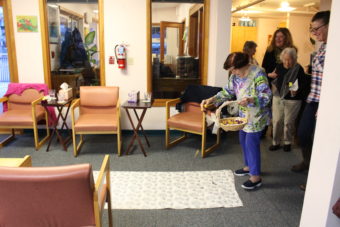
Kelsey Wood's flower girl drops petals before Wood's walks down the aisle. The pretend wedding was organized so members of The Bridge could see Wood's get married before her weekend nuptials.
Kelsey Wood’s “flower girl” tosses petals down the aisle. The pretend wedding was organized so clients of The Bridge could celebrate Wood’s upcoming nuptials. (Photo by Elizabeth Jenkins/KTOO)

“In fact, a couple of years ago, we worked with Centers for Community to submit a proposal to Alaska Department of Health and Social Services for a program in Sitka,” Mills said.

There are only a few formalized adult day programs in the region, like Ketchikan’s Rendezvous Senior Day Services. The grant intended for Sitka wound up going to the Matanuska-Susitna Valley.

“And of course right now, with Alaska’s fiscal crisis, getting state general funds to start such a program is probably not going to happen in the immediate future. We trying to hold on to what we have.”

Mills says keeping the doors open for adult day programs saves money when you consider the alternative. Remember, most of the people at The Bridge have some form of memory loss, which could mean expensive full-time care.

So for those who do stay at home, Mills thinks the time to socialize is important.

“It’s sometimes not the natural way to be,” Mills said. “A lot of people tend to isolate when they get older, but that’s not what they should be doing if they want to live a long independent life for as long as possible.”

Back at The Bridge, the cozy living room atmosphere has been transformed into a pretend wedding. The seniors wear frilly corsages and sip sparkling grape juice.

The bridge
“People aren’t always going to remember your name, but they remember if you do something nice for them and treat them kindly,” said Kelsey Wood.  (Photo by Elizabeth Jenkins/KTOO)

And after a while, Wood and her fiance are ready to walk down the aisle. She’s wearing jeans, clutching a bouquet made out of sparkling brooches — the one she’ll carry on her actual wedding day.

DeeAnn Grummett and her 78-year-old husband are looking on. Grummett brings him to The Bridge four days a week.

“You know I pop in and out at different times and they’re always engaged in an activity. They’re not just sitting around staring at the walls,” Grummett said. “They seem to enjoy each other’s company, and the staff is wonderful.”

Both Grummett and her spouse are on the waitlist for the Pioneers’ Home, but she wants to keep him with her as long as she can. She says The Bridge plays a crucial role in helping her do that.

“At this point for us, it’s much better than even in-home services because what we need is a social experience. My husband has reached the point where he can’t plan and carry out his own social life, and he needs a social life,” Grummett said.

She says when she drops her husband off in the morning, and if he’s in a not-so-great-mood, he’s always feeling better by the end of the day.

Aging Southeast: Region’s senior population growing quickly

Mary Lou Spartz discussing aging issues in the parlor of Fireweed Place, , a seniors’ apartment building in downtown Juneau. She among Southeast Alaska's growing older population. (Photo by Ed Schoenfeld/CoastAlaska News)
Mary Lou Spartz discusses aging issues in the parlor of Fireweed Place, a seniors’ apartment building in downtown Juneau. She’s among Southeast Alaska’s growing older population. (Photo by Ed Schoenfeld/CoastAlaska News)

Southeast Alaska is growing older faster than any other region in the state. This so-called “Silver Tsunami” is expanding the need for housing, transportation, healthcare and social services.

CoastAlaska public radio stations are presenting a series of reports talking to our older community members – and those they work with – about many of the issues they face. In our first Aging Southeast report, we explore why our senior population is growing.

Mary Lou Spartz sits in the parlor of Fireweed Place, a seniors’ apartment building in downtown Juneau.

Spartz, in her mid-80s, chats about aging in the city that’s been home for most of her life. Not long ago, she ran into a friend at a concert. Both noticed something that’s becoming more and more common.

“We looked around the room and he said, ‘You know, these are the same people that were going to concerts 20 years ago, 25 years ago. Except they’re all turning gray or white’,” she said.

Spartz is part of the fastest growing demographic group in Southeast Alaska.

She and about 9,200 others make up a little more than 12 percent of the region’s population. That’s almost a one-third increase over five years ago. It puts Southeast’s average age at about five years older than Alaska as a whole.

But it hasn’t always been that way. Spartz remembers when cold winters and limited medical care sent more Alaskans south.

“When I was a young person growing up, it was just accepted that you would leave Juneau once you reached retirement age,” she said.

More housing, improved health care and other factors provided seniors with more options as the state grew.

Analyst Meilani Schijvens stands by Sitka's Crescent Harbor and lightering dock. She told the Southeast Conference fishing and tourism are growing in the region. (Ed Schoenfeld/CoastAlaska News photo)
Meilani Schijvens of Rain Coast Data stands by Sitka’s Crescent Harbor and lightering dock. She’s been tracking demographic changes in Southeast. (Photo by Ed Schoenfeld/CoastAlaska News)

Meilani Schijvens, director of Juneau-based Rain Coast Data, said today’s growing population has roots dating back almost 50 years.

“In Alaska and in Southeast Alaska, you had this huge cohort of the baby boomer generation coming in in the 1970s,” she said.

Boomers are defined as those born after World War II, primarily between 1946 and 1964.

Some began their lives here. Others came to work in newly developed oil fields and on the trans-Alaska pipeline. With a recession hitting the Lower 48, still others moved for retail, construction or government jobs created as oil revenue increased.

“And that generation has really aged in place. So you’ve seen this really big bubble of baby boomers moving across the aging spectrums. And now that age bubble is moving into their older years. So they continue to dominate the demographic shifts in Southeast Alaska,” she said.

Some people still head south for an easier climate, advanced medical care or to be closer to family. But Alaska Commission on Aging Executive Director Denise Daniello said it’s now easier to grow older without moving.

“Alaska has a really strong base of supports: Senior meals, transportation for seniors, homemaker services, along the continuum of care, which has really helped to support seniors being able to continue living in their homes and in the community longer,” she said.

But that doesn’t cover everyone. Older small-city and village residents often can’t find advanced care without moving to Juneau, Sitka, Ketchikan or beyond. And if they do, they find a shortage of nursing home and assisted living beds, as well as specialists familiar with their problems.

“We don’t have a pulmonary doctor. We don’t have a cardiologist,” said Dr. Susan Hunter-Joerns, the only neurologist in Southeast. She helps diagnose dementia, among other disorders.

“We don’t have rheumatology, don’t have a plastic surgeon anyone, do have orthopedic and physical medicine rehab, but many times there are surgeries that need to be done that are not done frequently enough up here and have to be done down south,” she said.

Southeast Senior Services Director Marianne Mills poses with a list of other organizations it works with. (Photo by Ed Schoenfeld,/CoastAlaska News)
Southeast Senior Services Director Marianne Mills poses with a partial list of other organizations it works with. (Photo by Ed Schoenfeld/CoastAlaska News)

Still, the region has seen growth in senior centers, housing, meal programs, village clinics and home-care services. Southeast Senior Services Director Marianne Mills said her organization works with everyone it can.

“No single agency provides all the continuum of care for older Alaskans. So we need to be really on top of what services are out there,” she said.

She said one goal is to help people live independently as long as possible.

That can be as complicated, with a home monitoring system and regular visits from nurses and house-cleaners. Or it can be simple as rebuilding a doorway to make a bathroom accessible – or making sure a floor isn’t too slippery.

“When someone breaks a hip, often times they’ll go to the hospital and then live the remainder of their days in the nursing home and their lifespan will be decreased,” she said.

She said institutional care can cost nearly $250,000 dollars a year in Alaska. Home and community-based care costs around $30,000.

While the growing older population stretches services, those programs are facing challenges as state and other government budgets shrink. Mills notes an outreach program — targeting some of the most vulnerable people – recently got the ax.

“Last July, we had a program to identify seniors that are having problems with substance abuse or mental illness. And then, all the grantees were notified the program was closing,” she said.

Fireweed Place, a 67-unit seniors' apartment building in downtown Juneau. (Photo by Ed Schoenfeld/CoastAlaska News)
Fireweed Place, a 67-unit seniors’ apartment building in downtown Juneau. (Photo by Ed Schoenfeld/CoastAlaska News)

Back at Juneau’s Fireweed Place, Mary Lou Spartz ponders some of the frustrations of growing older in her hometown. She’s worked most of her eight-plus decades, including as a senior advocate. And she’s watched as older residents’ benefits and exemptions have shrunk or gone away.

“The attitude is people who grow old, what are we supposed to do with them? They’re just a burden. That’s not the way I think we should be thought of,” she said.

And it should be no secret to anyone that the numbers are growing. Researcher Meilani Schijvens said we’ve known about this trend for a good 40 years.

KTOO’s Elizabeth Jenkins contributed to this report.


Aging Southeast: Finding a home in assisted living, if there’s space

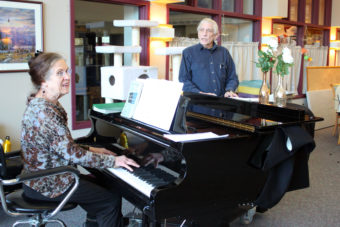
Jacque Farnsworth and Jack Brandt lead a music activity at the Juneau Pioneers' Home. Farnsworth says she's been singing and playing piano there since 2003. (Photo by Lisa Phu/KTOO)
Jacque Farnsworth and Jack Brandt lead a music activity at the Juneau Pioneers’ Home. Farnsworth says she’s been singing and playing piano there since 2003. (Photo by Lisa Phu/KTOO)

Due to a shortage of assisted living homes, some of Southeast Alaska’s aging residents can’t stay in their home communities. Residences in Juneau, Ketchikan, Sitka and Petersburg provide assistance to seniors needing help with daily activities, such as cooking, dressing and medication management.

The region isn’t keeping up with the demand for assisted living, and that demand is only expected to grow.

On a recent Tuesday morning, Jacque Farnsworth and Jack Brandt play piano and sing at the state-run Juneau Pioneers’ Home. A number of residents seated in a semi-circle of couches and chairs in front of the piano join in. They have music stands in front of them so they can follow along. A few play maracas.

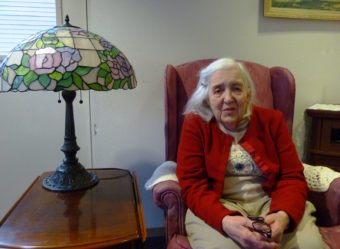
Down the hall, Irene Cashen sits in a recliner watching TV. The 87-year-old moved in last March and doesn’t miss living alone.

“Look at me. I have my room over there and I do beading. I could do things by myself. I could come over here in my lounge and watch the news and go out in the other room and there’s always something,” Cashen says.

Group activities scheduled for later that day include a history talk, card games, exercise called “Fun & Fit” and more music. Cashen can join in or do her own thing.

“I made up my own mind to come in because I know I have beginning Alzheimer’s and I know about it and I don’t want my children to have to take care of me at home. I can take care of myself here and it’s been a wonderful experience,” Cashen says.

Irene Cashen sits in her room at the state-run Juneau Pioneers' Home. One of her hobbies is beading. (Photo by Lisa Phu/KTOO)
Irene Cashen sits in her room at the state-run Juneau Pioneers’ Home. One of her hobbies is beading. (Photo by Lisa Phu/KTOO)

Up to 90 percent of Juneau Pioneers’ Home residents experience memory loss. Memory loss can lead to behavior changes that make living at home unsafe. Assisted living is sought out when a person’s care needs exceed the support and resources available at home.

Cashen has spent almost her whole life in Juneau. Kids, grandkids, great grandkids also live here. It’s where she wants to remain, and the home means she can.

That’s not the case for many of Southeast Alaska’s senior citizens. The demand outweighs supply and many communities in the region don’t offer any assisted living options.

The region’s geography and rapidly aging population creates challenges that don’t exist in more populated parts of the state.

“We’re not connected so if somebody from Prince of Wales needs help, they’re basically giving up their home and having to move and may never go back,” said Dee Wright.

Wright runs The Manor in Ketchikan, the only licensed assisted living home in Southeast run by a private individual. She says some of its dozen residents are from Prince of Wales Island, Metlakatla, Sitka and Juneau.

She said people who can’t find placement in Southeast often have to leave.

“There are people up north and down south that could come home if we have the housing,” Wright said.

Haines and Petersburg also have assisted living homes and Sitka and Ketchikan have pioneers’ homes. Altogether, they house about 210 older adults. All have long waiting lists.

“The calls that I’m fielding, at this point, I’m saying to people, if you haven’t applied to the pioneer home and you’re 86 years old and you need to move in right now, there’s the possibility that I will not be able to serve you in your lifetime, and that’s very hard to say, ” Julie Sande, administrator at the Ketchikan Pioneers’ Home. “For individuals who just get on the waitlist, it can be years before they move to the top of my list.”

In Juneau, a nonprofit is working to build a new assisted living community to meet some of the need.

Senior Citizens Support Services Inc. President Sioux Douglas is among those tired of seeing people leave because of the shortage of assisted living options.

Sioux Douglas is president of Senior Citizens Support Services Inc., which hopes to build a new assisted living community in Juneau. (Photo by Lisa Phu/KTOO)

“That’s the last thing we want (happening) in our community. … They want to age here and they want to die here,” Douglas said.

A recent market demand study on Juneau senior housing said the city needs an additional 327 assisted living beds over the next 30 years to meet projected demand.

Douglas expects residents to come from all over Southeast, with most from Juneau.

She said the nonprofit has secured land in Vintage Park in Juneau’s populous Mendenhall Valley, close to amenities. The project would have about 90 apartment-like units with a projected monthly cost between $5,000 and $7,000.

A developer is helping the group move forward. One of the major hurdles is finalizing the financing. Douglas said it could cost up to $30 million.

“The biggest message to the people in Southeast Alaska right now is just knowing and feeling confident that this project will get completed. We will do this. We’ll have it available,” Douglas said.

Back at the Juneau Pioneers’ Home, Irene Cashen says she’s happy she chose to move into assisted living. Her mother had lived in the pioneers’ home in Sitka, so she knew it was a good option. And she thinks others will make a similar choice if they can.

“It’s fun. It’s real life and it’s still your life. You’re not taking away from your own children’s lives. I see them as much as I did before and they don’t have to worry about me,” Cashen says.

A new assisted living community in Juneau could be complete as soon as fall 2017. The Manor in Ketchikan also hopes to build a new assisted living home that could house up to 28 people.

Site notifications
Update notification options
Subscribe to notifications