
Elizabeth Jenkins, Alaska's Energy Desk - Juneau
Masked man attempts kidnapping at gunpoint in Mendenhall Valley

The Juneau Police are searching for a masked man who attempted to kidnap a woman at gunpoint on Wednesday as she walked to her car. The incident happened at 6:30 p.m. on Dunn Street, a commercial area in the valley.

This may not have been the first time the 32-year-old woman’s family had been harassed by the man. A week before, according to police press release, the victim’s husband heard a noise behind their residence on Delta Drive. When he went to check it out, he discovered a man wearing a camo hoodie and a black ski mask. The assailant pulled a gun on him, and he ran back inside.

Police searched the area but could not find the suspect, who appeared to be on foot.

Lt. David Campbell said, during Wednesday’s attack, the assailant approached the woman from behind.

“She was put into a bear hug and she resisted. She resisted and fought back,” Campbell said “When she turned around was when she noticed the guy was wearing the same mask. And he displayed a pistol. At this point, it’s only being described as a black pistol.”

The man told the woman to get into her car. When she refused, he struck her with the gun and fled towards Glacier Highway.

The police are hoping to find the assailant by his distinctive black ski mask.

“Like the knit style ski mask with something white around the mouth, like the opening. On the second incident, the gentleman was wearing a black hoodie, and the same black ski mask with white around the mouth opening,” Campbell said.

Lt. Campbell said the victim doesn’t know who her attacker is. He is described as being between 5 feet 7 and 5 feet 9 inches, skinny, with a dark complexion and large dark brown eyes.

Call the Juneau Police Department at 586-0600 if you have information.

Angoon mayor unsatisfied with state response to tainted subsistence seal

Hawk Inlet is healthy according to state officials. That’s the message Angoon received about three weeks after concerns were raised about high levels of mercury found in a subsistence seal. But Angoon’s mayor doesn’t feel comforted by the report.

In the 20-page document, the state agencies say they appreciate the “citizen science” used to determine the seal had high levels of mercury.

The letter cautions children, the elderly and pregnant woman against eating certain parts of of an older seal, like the liver. For everyone else, the department recommends limiting consumption. Other traditional foods, it says, are safe to eat.

But Angoon’s Mayor Albert Howard said he doesn’t feel heard by the agencies, and the information isn’t practical.

“When you spend 40-something dollars for gas in Angoon to go hunting, you’re going to make the most of it,” Albert said. “If you see one seal and it happens to be the older one, that’s a risk people are taking and no one’s going to eat only 4 ounces of seal meat.”

Ali Hamad, an environmental public health program manager with the health department, said older seals store up more mercury in their organs. They can swim far distances.

“So chances are that seal picked up some of the mercury from Hawk Inlet and from outside Hawk Inlet, depending on where that seal spent its life,” Hamad said. “Most of the mercury leaves the body but some of it stays in the body and with age it keeps accumulating.”

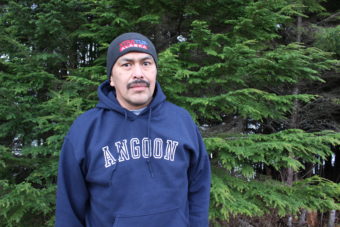
Angoon's Mayor Albert Howard is trying to protect his village's way of life. (Photo by Elizabeth Jenkins/KTOO)
Angoon’s Mayor Albert Howard is trying to protect his village’s way of life. (Photo by Elizabeth Jenkins/KTOO)

The place where the seal was harvested is also home to Hecla’s Greens Creek Mine, which, according to the letter, is meeting its permitted conditions. But it doesn’t discount the origin of the metals could have came from there — historical mining could be a factor. So could natural occurrences, like drainages and streams.

K.J. Metcalf says he found some parts of the letter puzzling. He’s part of the environmental advocacy group that took the tissue sample of the seal. And he said some of his concerns weren’t addressed. His group and Angoon questioned why a 1981 baseline study, before the mine was up and running, isn’t being reproduced to test the quality of the water.

“And I’m really curious as to why there’s such reluctance to use it because I think it’s the gold standard that’s going to be the gold standard that’s going to give a definitive determination as to the health of the inlet,” Metcalf said.

Metcalf said the study, which was lost and rediscovered in an old Forest Service files, offers a better glimpse of the pre-mining conditions.

“I’m not discounting the value of a baseline study of this nature,” said Allan Nakanishi. He oversees wastewater discharge permitting for mining facilities for the state’s water division.

He said the testing that’s done now is more streamlined, less broad. The 1981 version would require more resources, and the state could have difficulty imposing and monitoring it under the mine’s current permit.

“And at this point we feel that, based on the data that we have on hand, that the environmental monitoring required under that permit is adequate to make the determination if harm is being caused,” Nakanishi said.

The small village of Angoon is the home to about 400 people.
The small village of Angoon is the home to about 400 people. (Photo by Elizabeth Jenkins/KTOO)

He said the 1981 baseline study wasn’t brought up in the letter because it’s been addressed in the past. The letter’s focal point was the safety of subsistence food, gathered near Hawk Inlet.

But when it comes to where the seal picked up so much mercury, Nakanishi isn’t sure.

“That’s a difficult question.”

He said yes, the most obvious source appears to be the Greens Creek mine. But mercury is persistent, and the mercury that ended up in this seal could have come from almost any discharge into the Pacific Ocean.

“Some of which probably isn’t under U.S. jurisdiction for regulation under the Clean Water Act. It’s difficult to say or pinpoint what is the source,” Nakanishi said. “It could be an accumulative source from other countries, from the United States, from illegal dumping, it’s difficult to pinpoint.”

The Alaska Environmental Public Health Program has offered hair sample tests to Angoon’s residents to determine their levels of mercury. The state is considering the possibility of testing more seals.

Juneau Assembly dismisses Planning Commission chair

The Juneau Assembly unanimously decided Monday to unseat the chair of the Planning Commission. Several assembly members said it was the first time such a decision was warranted during their time in office.

Nicole Grewe was dismissed because she didn’t disclose her relationship when her husband testified at a Feb. 9 Planning Commission meeting.

Her spouse, Todd Boris, spoke out about their neighborhood on North Douglas being zoned for marijuana cultivation. He asked the Planning Commission to consider postponing conditional use permits until all marijuana ordinances were adopted by the assembly.

Assembly member Jerry Nankervis commented that people who apply for conditional use permits didn’t spend as much time testifying as Grewe’s husband did.

“I think what we’re getting to now is (that) the trust and the confidence of the other members on the commission has been irrevocably damaged,” Nankervis said. “And it’s up to us to remedy that — as uncomfortable as that might be.”

Grewe couldn’t be reached for comment on whether her husband was given more time to testify than others.

Assembly member Debbie White said she had seen a number of complaints and worried about the long-term reputation of the Planning Commission. Meanwhile, assembly member Loren Jones said he was torn.

“Because I think potentially (there are) some remedies but at the same time, I think I agree with Ms. White, to her surprise I’m sure” Jones said. “There was some real damage done, and I’m not quite sure this is an action that repairs it.”

Grewe’s term on the Planning Commission was set to expire in 2017. The assembly must now appoint someone to fill the vacant seat.


Meet Jamie Bursell, the newest Juneau Assembly member

jamie bursell
(Photo courtesy of Jamie Bursell)

Jamie Bursell was recently sworn into the Juneau Assembly to replace Karen Crane after Crane stepped down to run for mayor. Bursell has lived in Juneau for 20 years. In 2001, she was awarded the Outstanding Faculty of the Year award from the University of Alaska Southeast, where she taught human anatomy and physiology. She now works at the Southeast Alaska Surgery Center as a fluoroscopy technician and owns a triathlon training business.

Bursell will serve in her District 2 seat until mid-October when the position is up for election.

KTOO’s Elizabeth Jenkins interviewed Bursell on Feb. 29. This interview has been edited for length and clarity.

On why she wanted to be on the Juneau Assembly:

Friends of mine encouraged me. I hadn’t really thought about it until fairly recently, but I had some friends that got together with me, and we talked it through, and I talked to my husband. And I felt like I was a good person for the position because I have a lot of time, and I really have the energy to put into looking at all of the issues–which I find to be very interesting. There’s a huge variety of issues that we have to tackle. I feel like I have a lot of good life experience, and I enjoy Juneau. I know a lot about the different aspects of Juneau: the facilities, the people and outdoors.

Her thoughts on education: 

I’ve actually worked at all the [grade] levels in Juneau. I worked from preschool, all the way through high school as a para-educator. So I had that experience. And then, because both of my boys were in school here in Juneau all of those years, I volunteered at whatever level they were in. I know firsthand, that we need to keep funding education to the max. We have to keep our kids in school, and we have to do everything we can to help them get a good education and to finish school.

I’m also very much in support of education for young children. At the preschool level, we really need to make sure that we get our kids in there and get them a good start in a good, healthy environment. And that early reading program is especially important in the mix.

How she wants to spend her time on the assembly:

We have to focus on all [of the issues] as assembly members. There are some very, very serious issues. The opioid problem is terrible, and there are groups that are addressing that right now. I’ll always be in support of finding ways that we can help our kids stay away from drugs and help the young adults — anybody who does become addicted — help them with the best resources that we have. And I think we have a need to grow those resources, too. We really need to get people help here in Juneau as soon as we can. We can’t just can’t take people who have very, very serious issues and shipping them out. I think we need to address them here, and we need to have the facilities and the funding available for that.

Her secret penchant for junk food:

I think people would be surprised to learn that I love baking, and I love eating sweets. Because — especially in my triathlon coaching business — I’m always promoting clean eating, trying to integrate the best foods into your diet. But one of my favorite things is to have roasted marshmallows.

Editor’s note: An earlier version stated Jamie Bursell works at Juneau Medical Center. She works at the Southeast Alaska Surgery Center. 

Without ferry service, a Southeast village considers $18 gallon of milk

ANGOON GROCERY
Perishable items were the hardest for the Angoon Trading Company to keep in stock, but even some of the snacks started to run out. (Photo by Elizabeth Jenkins/KTOO)

Three Southeast villages endured the longest ferry drought in recent memory. The LeConte didn’t arrive for more than a month, leaving communities such as Angoon to depend more on subsistence or the only grocery store in town. As lawmakers consider even deeper cuts to ferry services, some locals are already getting a taste of what that reality could be like.
Inside Angoon Trading Company, some of the shelves are starting to look bare. The potato chips are still well-stocked, but there’s only a few boxes of Ho Hos and Twinkies.

As for the produce, “there’s carrots, tomatoes, cabbage and green peppers.”

Albert Howard, Angoon’s mayor, says he’s concerned about the lack of ferry service because it means limited choices at the grocery store.

It’s not what we’re normally used to when we go to a store. There’s not much of a selection of anything,” Howard said.

To make things worse, a high concentration of mercury was recently found in a seal hunted for subsistence. The discovery has sparked concerns among residents about the safety of some local subsistence foods.

For the things you can’t get from the water or the land, you come here: laundry detergent, sugar, rice, canned goods and yes — the sweet, spongy delicacy of a Hostess cupcake.

Another Albert, Albert Kookesh III, is missing cold treats.

“You can walk to any store in any city and get a Popsicle. It’s not available at Angoon at this time,” Kookesh said. “It might not seem like a big deal … but even the milk is starting to go bad.”

Storeowners, Shayne and Sue Thompson, say perishable items have been the hardest to keep in stock. Although the LeConte is back online now, it had been about five weeks since the ferry’s last visit — five weeks since they received their regular shipment of groceries.

During the hiatus, they flew to Juneau to get fresh food.

“Shayne and I had been in town for a week, so we picked up a bunch of fresh produce for the store and brought it over in our luggage … (and) now we’re down to the wire,” Sue Thompson said.

It costs  $1.10 a pound to bring things over on Alaska Seaplanes.

“A gallon of milk weighing 8 pounds coming from Seattle? Normally, we’ve got it cut down as much as we can, but if we have to fly that over a dollar a pound? It’d be close to $15 to $18 depending, and that’s ridiculous for milk!” Sue Thompson said.

The Thompsons are proud to say they haven’t raised their prices yet. They knew the LeConte’s service gap would be temporary. But with proposed state cuts to the ferry system, reduced service to Angoon could become a reality.

“If that’s the case, everything’s gotta go up.”

Owner Sue Thompson is proud to say the Angoon Trading Post didn't raise their prices during the ferry drought. The grocery store has has been in her husband's family since the 1980s. (Photo by Elizabeth Jenkins/KTOO)
Owner Sue Thompson is proud to say the Angoon Trading Company didn’t raise their prices during the ferry drought. The grocery store has been in her husband’s family since the 1980s. (Photo by Elizabeth Jenkins/KTOO)

In 2010, Angoon’s ferry terminal received a $1.6 million upgrade. It was rebuilt to accommodate the fast ferries, which only run in the summer. Angoon relies on the LeConte year-round. The ferry also visits the communities of Tenakee Springs, Pelican and others farther away, but the LeConte needed maintenance this winter. Typically another ferry would take its place.

“… (but) due to budget reductions we’ve had to take a couple of ferries offline,” said Jeremy Woodrow, a representative for the Department of Transportation.

“When those ferries go into their overhaul period, there isn’t another ferry to provide that supplemental service.”

The Alaska Marine Highway System fleet has 11 vessels, and Woodrow compares a ferry overhaul to getting a tuneup on your car. Unfortunately, in this scenario, there’s no sporty rental option with a new car smell.

“We do the best we can with the budget we’re given. It really depends on what those limitations are and how we can schedule our ferries,” Woodrow said.

The budget for the Alaska Marine Highway System recently went through one round in the legislative process and came out with no changes to Gov. Walker’s proposed cuts. But it still has a way to go.

Albert Kookesh III hopes the cuts won’t be deeper. He says the ability to travel outside of Angoon is important. Flying to Juneau with a family of five could cost as much as $700 one way. The ferry is his — and many other small communities’ — lifeline to the outside world.

“I love living in Angoon, and I want to live in Angoon for the rest of my life. I want my kids to grow up in Angoon. But if the ferry system goes and the food’s no longer good, then I don’t have a choice.”

When the LeConte finally did arrive in mid-February, it carried boxes of groceries. So, Kookesh and his kids went to the store and bought Popsicles.

Editor’s Note: We clarified the Alaska Marine Highway System has 11 vessels–not the Alaska Marine Line fleet. We regret the error. 

Juneau’s League of Women Voters hosts mayoral debate

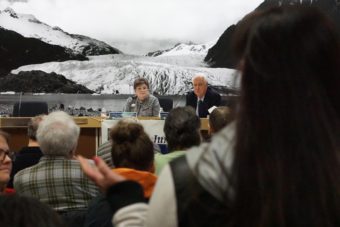
Mayoral candidates Karen Crane and Ken Koelsch at the Juneau League of Women Voters debate.
Mayoral candidates Karen Crane and Ken Koelsch at the Juneau League of Women Voters debate. (Photo by Jeremy Hsieh/KTOO)

Juneau’s mayoral hopefuls Ken Koelsch and Karen Crane attended a packed debate hosted by the League of Women Voters Wednesday. The program opened with two Thunder Mountain High School students introducing the candidates, who were questioned about the economy, housing, homelessness, addiction, marijuana ordinances and a growing senior population. Thunder Mountain High School and the League of Women Voters contributed to the crowd sourced list of questions.

Juneau voters will elect a new mayor in the special election March 15. If you missed the debate, you can listen to the full recording here:


Site notifications
Update notification options
Subscribe to notifications