Elizabeth Jenkins, Alaska's Energy Desk - Juneau
Dispatches from the Arctic Science Summit

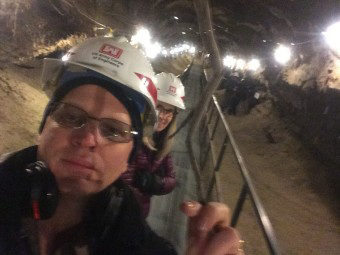
Matt Miller holds an 18,000 year old willow branch. Marie Thoms of UAF's Institute of Arctic Biology is the photobomber. (Photo by Matt Miller/KTOO)
Matt Miller holds an 18,000 year old willow branch. Marie Thoms of UAF’s Institute of Arctic Biology is the photobomber. (Photo by Matt Miller/KTOO)

Scientists, policy makers and environmental enthusiasts from around the world gathered last week in Fairbanks for Arctic Science Summit.

Climate change was a popular topic during the summit, particularly the long-term effects and how that impacts weather patterns down south. Warming temperatures have also limited subsistence hunting and fishing for those who depend the most on the resources.

KTOO’s Matt Miller was at the summit, which included a tour of a permafrost tunnel — a hole cut inside a layer of permafrost. Prehistoric fossils are sometimes found in the frozen ground below.

Hear more about the summit here:

Feds offer millions for Alaska rural energy efficiency competition

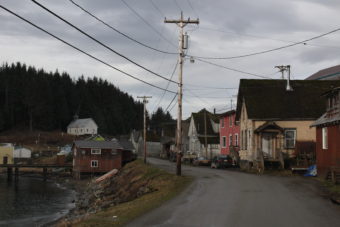
The small village of Angoon is the home to about 400 people.
The village of Angoon is the home to about 400 people. (Photo by Elizabeth Jenkins/KTOO)

Several small Southeast communities have pledged to reduce their energy use. That pledge also makes them eligible to compete for several million dollars in federal funds to help develop energy saving and renewable energy projects.

The U.S. Department of Energy is putting up the money for the Remote Alaska Community’s Energy Efficiency Competition. Pelican, Saxman, Haines, Klawock, Yakutat, Kasaan and Angoon have applied, along with 65 other communities.
The Alaska Energy Authority is helping oversee it. Emily Ford, the policy and outreach manager, said the competition is part of the state’s goal to cut energy use 15 percent by the year 2020.

“So these communities essentially pledged to do the same thing. To improve energy efficiency in their communities by 15 percent,” Ford said.

Initially, competing communities can get up to $100,000 to prep their projects. The communities that advance in that round can then compete for up to $1 million each.

Ford said the scale of the projects will vary.

“Everything from simple weatherization of windows to lighting to larger, more capital intensive projects,” she said.

The competition was first announced after President Barack Obama’s visit to Alaska in 2015. The first wave of winners will be decided sometime in April.

Commercial pot grows on North Douglas still a go

medical marijuana grow operation
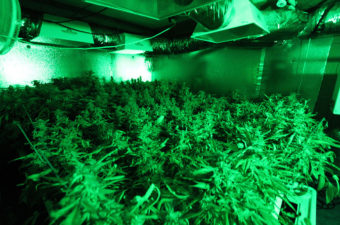
Flowering cannabis plants under green light in an air-conditioned, indoor hydroponic grow operation in Oakland, California. (Creative Commons photo by Rusty Blazenhoff)

The Juneau Assembly voted 7-2 on Monday night not to reopen discussion about zoning for commercial marijuana grows in low-density neighborhoods. That means the permitting process will proceed for potential grow houses like Paul Disdier and June Hall’s Fireweed Factory on North Douglas.

Back in November, the assembly outlined zoning rules for marijuana businesses. In some low-density neighborhoods, like North Douglas, grow houses up to 500 square feet could be permitted.

That sparked one petition opposed to neighborhood grow houses and one in support. 

Assemblymember Loren Jones, who’s also on the state marijuana control board, said the assembly has tried to deal with the issue as best it could.

Loren Jones
Loren Jones

“We have come to, from what I think is a fair solution in this community,” Jones said. “And the conditional use permit will be a process by which both the planning commission and the assembly will make some determinations about what is going to be allowable and what is not.”

While zoning is unlikely to change, Jones did say that the assembly plans to work on a new ordinance next week that could set additional requirements for marijuana operations, such as municipal licensing, limiting hours of operation, buffer zones and odor control.

You can listen to my conversation with Assemblymember Loren Jones here:

The Juneau Planning Commission is scheduled to consider Fireweed Factory’s conditional use permit — the commission’s first for a marijuana operation — on March 22.

North Douglas retirees seek backyard grow house, spur dueling pot petitions

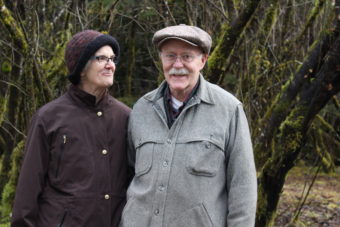
June and Paul Disdier hope to start their marijuana business in their backyard. (Photo by Elizabeth Jenkins/KTOO)
June Hall and Paul Disdier hope to start their marijuana business in their backyard on North Douglas. (Photo by Elizabeth Jenkins/KTOO)

The Juneau Assembly voted back in November to allow limited cultivation on parts of North Douglas and other low-density areas. After one red public notice sign went up at the end of a driveway, it caught some in that neighborhood off guard.

Paul Disdier and wife June Hall have lived at their North Douglas home for over 40 years. Paul’s a retired painter and state employee. June was an art teacher at the University of Alaska Southeast. They say they built a good life here, raised kids. In retirement, they were looking forward to starting something new.

“The size of this building? It’s just going to be a little bit bigger than a one car garage. And that’s about the size of it,” Disdier said. “You know, I’ve said it again, but it’s one eighty-seventh of an acre. We have an acre and a half here.”

Paul and June are building a commercial marijuana facility on their property. At least, they’re trying to. The maximum size allowed in the low-density area is 500 square-feet. They haven’t completed the city permitting process yet. They want the Fireweed Factory to be a family business that will eventually supply their off-site retail store.

They say some of their closest neighbors are OK with it. But they realize not all of the neighbors on North Douglas are.

Before we get to that, let’s go back to how the couple started growing marijuana. It started in the mid-’70s, after the Alaska Supreme Court ruled in Ravin v. the State. That decision made it legal to grow pot for personal use, which Paul and June did. Now, they say it’s helped them with arthritis and the other ailments of aging.

“I just had a knee replaced and wasn’t making no progress as long as I was taking Oxycodone,” Disdier said. “Got off of that and starting making pills out of marijuana.”

So after the Juneau Assembly outlined commercial marijuana zoning, they thought home would be the perfect spot to start the business.

“Since living on North Douglas always seemed to be a place where, you know, you could take advantage of a large residential lot where you had privacy,” Hall said. “And I guess we thought maybe neighbors wouldn’t be as upset as they seem to be.”

Merry Ellefson said she didn’t realize marijuana legalization meant “fighting” to keep her neighborhood “free of industrial cultivation.”

Ellefson, along with a group of other neighbors, submitted around 137 names to the Juneau Assembly. It’s a petition that asks the city to ban commercial marijuana grows in low-density neighborhoods, like theirs. The names were collected from all over Juneau.

Ellefson has lived in North Douglas for 23 years. She said she’s not ideologically opposed to someone growing commercial marijuana, but it doesn’t mix with residential areas.

“I think it’s an issue, like I said, of, we’re not growing tomatoes. And I think that a marijuana cultivation is just that. I’m a coach, a coach at the high school. I’ve coached Nordic skiers. I have a child,” Ellefson said. “I don’t think that it’s conducive to a healthy community where we all pass by on our bikes.”

A member of the state marijuana control board thought Juneau may be the only municipality in Alaska to allow commercial marijuana growth in neighborhoods. But in February, the Skagway Assembly also adopted an ordinance allowing it in low-density neighborhoods.

For Ellefson, the decision flies in the face of Juneau’s city code to “provide a healthy, safe, and pleasant environment” for residents.

The city has two commercial marijuana cultivation permits to consider: the Disdier's and Rainforest Farms, which could be in Lemon Creek.
A red sign outside Paul Disdier and June Hall’s home announces their intent to obtain a conditional use permit to start a commercial marijuana grow. (Photo by Elizabeth Jenkins/KTOO)

The petitioners are concerned about bright grow lights, the smell and a possible uptick in crime for the all-cash business.

“Personal use: that’s people’s choices. Industrial and commercial belongs in industrial areas,” Ellefson said.

It’s unknown how many 500-square-foot grow houses could eventually crop up in North Douglas. And Ellefson said she’s worried about the zoning tearing the community apart.

“We’re putting in a shop after 23 years of trying to stay out of the rain, and a neighbor came over and wondered if it was going to be a commercial cultivation site,” Ellefson said. “And I don’t know, it’s just that sort of suspicion. What are you doing? Having to be aware of what’s going on in your neighborhood. It shifts the energy and it shifts the connectivity.”

June Hall and Paul Disdier haven’t broken ground yet. They’re waiting to see if their permit gets approved. Recently, an online counter petition supporting commercial marijuana business on North Douglas received 118 endorsements.

And the couple said a lot of neighbors have approached them to show solidarity. They’ve even received cards.

“We’ve been really encouraged. We couldn’t have kept going, honestly,” June Hall said.

After a long pause, Paul Disdier added:

“Without our friends. You know, they’re helping us out. We know a lot of people in this town. We’re honest people, honest business people,” he said, his voice cracking.

They said their facility will be self-contained. Smells won’t emanate next door. There are no noisy generators. You won’t even be able to see the lights.

Quiet retirees may not be what you imagine when you think of pot entrepreneurs.

“But I think we’re typical. My husband and I. And I think the people out here on North Douglas are like us. They’re not scary, lurking individuals,” Hall said.

They hope, when the novelty wears off, the neighbors won’t worry as much about what’s going on in other people’s yards.

In the mean time, the Juneau Assembly has reopened discussion about marijuana zoning in neighborhoods. It plans to meet as a committee of the whole on the topic at 6:30 p.m. Monday. The Juneau Planning Commission will consider the Fireweed Factory’s conditional use permit March 22.

Editor’s Note: A previous version stated: “A member of the state marijuana control board said Juneau may be the only municipality in Alaska to allow commercial marijuana growth in neighborhoods.” In February, the Skagway Assembly also adopted an ordinance allowing it in low-density neighborhoods. The story has been updated to reflect the changes. 

Juneau School Board adds back one position for Native Success support

Alaska Native Sisterhood (Photo by Elizabeth Jenkins/KTOO)
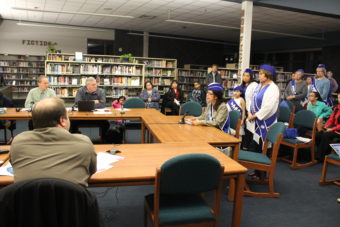
Alaska Native Sisterhood former Grand President Freda Westman testifies at the Juneau School Board meeting. About 20 people signed up to testify Tuesday night. (Photo by Elizabeth Jenkins/KTOO)

The Juneau School Board decided to add back one position Tuesday night that was on the cusp of being cut. The budget includes the Tlingit Culture Language and Literacy program, or TCLL. But some program support staff are below the school district’s cutoff for what the governor’s proposed budget will cover. For now, the $35,000 Middle School Native Success support position is safe. 

Members of the Alaska Native Sisterhood, parents and concerned community members told the school board the programs that help Native students graduate should be a higher priority. The school board was taking public comment on its budget — just as lawmakers in the Capitol worked late into the night on the state’s budget, which will affect what the school system can afford.

Here are four voices from Tuesday night’s public testimony to the Juneau School Board meeting: Lorraine DeAsis, Richard Peterson, Barbara Dude and young Kaija Guthrie.

The school board’s final approval for the budget is expected at the end of March. 

Juneau School Board to take public testimony on budget tonight

If the Alaska Legislature passes a budget with education cuts deeper than the governor’s, Juneau schools will see some essential programs disappear. That was the message the Juneau School District delivered to the Juneau Assembly last night.

Cuts could be made to cultural programs that help Native students graduate from Juneau schools. Superintendent Mark Miller said he testified in front of the legislature on Monday.

“I said, ‘Call heads or tails,’ and one of the senators said “heads.” And it was heads and I said, ‘Great, you graduated.’ I said, ‘Ten years ago the high school freshman who was an Alaska Native male graduating was 50-50. Now it’s 75 percent, 3 to 1. One of the key reasons for that is what these people do.”

Under the governor’s budget, they’d keep those positions, but they’re on the bubble. An elementary art specialist was prioritized above the cultural programs. Miller said the funding the schools receives from a Margaret A. Cargill Foundation grant is contingent on keeping that position.

“And the idea that I have to decide between a multimillion dollar art program or supporting our neediest kids with a program that we know works and has helped increase our graduation rate by 25 percent. Those are the kind of decisions that keep superintendents up way late at night,” Miller said.

The school district is asking the city for more money for next year. The school board will take public comment on its budget when it meets tonight. That starts at 6 at Thunder Mountain High School.

Final approval for the school district budget is expected at the end of March. 

Site notifications
Update notification options
Subscribe to notifications