Marijuana

Judge rules that Alaska may limit sales of intoxicating hemp products

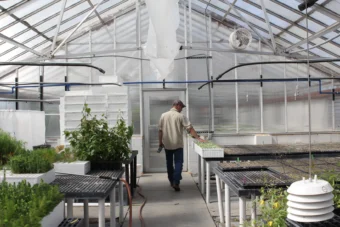
Rob Carter walks through a greenhouse at the Alaska Plant Materials Center outside of Palmer. He thinks an industrial hemp industry is viable for Alaska. (Photo by Erin McKinstry/AKPM)

A federal magistrate judge has ruled that the state of Alaska did not violate the U.S. Constitution when it acted to limit intoxicating hemp products in 2023.

In an order published May 23, Magistrate Judge Kyle Reardon granted summary judgment in favor of the state and against the Alaska Industrial Hemp Association, which sued two years ago in an attempt to overturn regulations imposed by the Alaska Department of Natural Resources.

The court order means intoxicating hemp products, common in many other states, will remain illegal in Alaska unless sold through a licensed marijuana retailer.

“It was rewarding to be part of the process developing the regulations, and I was happy when we successfully defended against the motion for a preliminary injunction in 2023,” said Assistant Attorney General Kevin Higgins, by email. Higgins represented the state in the case.

“I’m not patting myself on the back too hard though,” he said. “The Division of Agriculture was motivated by public safety concerns when it took measured action to regulate an emerging industry. This was an easy case to make, which is probably why the plaintiffs didn’t file an opposition to the motion for summary judgment.”

An attorney representing the plaintiff did not answer a request for comment on Wednesday.

Alaska legalized the sale and use of marijuana for recreational purposes in 2014. The state subsequently created a tightly regulated market in which only licensed businesses may grow, process and sell marijuana.

Under a 2018 federal law and a state law enacted in 2021, cannabis plants that contain less than 0.3% THC — a common psychoactive chemical — were considered hemp, not the more tightly regulated marijuana.

Even though those hemp products contain only small amounts of psychoactive chemicals, they could be extracted, processed and turned into intoxicating products that were available at convenience stores, gas stations and other stores not restricted by the state’s marijuana regulator.

While hemp products are federally legal, marijuana remains federally prohibited, and social media companies frequently restrict marijuana advertising, giving an advantage to the hemp market.

Marijuana retailers urged action, and a task force organized by Gov. Mike Dunleavy recommended that the state enact regulations to limit intoxicating hemp products.

The Alaska Division of Agriculture enacted those in 2023, leading to the lawsuit that was resolved this month.

Plaintiffs had argued that the division’s regulations violate the constitution’s supremacy clause, violate the dormant commerce clause, constitute a regulatory taking and are void for vagueness.

In each case, Reardon ruled against the plaintiffs and in favor of the state.

Early in the legal dispute, U.S. District Court Judge Sharon Gleason rejected a request for a preliminary injunction, allowing the state to enforce its regulations as the case progressed.

Already this year, enforcement officers from the Division of Agriculture and Alaska Alcohol and Marijuana Control Office have seized products from three businesses in Anchorage and one in Fairbanks.

Trevor Haynes, president of the Alaska Marijuana Industry Association and manager of a Fairbanks marijuana business, said that while the association has issues with the way the state is regulating hemp, it’s good that the state’s regulations for intoxicating hemp products were preserved in court.

“That is one way to stop the development of a gray area where people will … basically sell marijuana under the guise of hemp,” he said.

He was critical of the state’s decision to require hemp retailers to sell products that contain absolutely no psychoactive substances. Removing all traces requires costly, specialized equipment and generally isn’t economically feasible for small-scale Alaska businesses.

“I have a business that’s purely a hemp business and so I understand it from both sides. It’s unfortunate, and there might be a better solution, but (the regulations are) certainly a way to ensure that there’s no gray area where intoxicating hemp, aka marijuana under another name, can be produced in the state and sold in the state.”

Scientists welcome new rules on marijuana, but research will still face obstacles

For decades, researchers in the U.S. had to use only marijuana grown at a facility located in Oxford, Mississippi. A few other approved growers have been added in recent years. (Brad Horrigan/Hartford Courant/Tribune News Service via Getty Images)

As the Biden administration moves to reclassify marijuana as a less dangerous drug, scientists say the change will lift some of the restrictions on studying the drug.

But the change won’t lift all restrictions, they say, neither will it decrease potential risks of the drug or help users better understand what those risks are.

Marijuana is currently classified as a Schedule I controlled substance, which is defined as a substance with no accepted medical use and a high potential for abuse. The Biden administration proposed this week to classify cannabis as a Schedule III controlled substance, a category that acknowledges it has some medical benefits.

The current Schedule I status imposes many regulations and restrictions on scientists’ ability to study weed, even as state laws have made it increasingly available to the public.

“Cannabis as a Schedule I substance is associated with a number of very, very restrictive regulations,” says neuroscientist Staci Gruber at McLean Hospital and Harvard Medical School. “You have very stringent requirements, for example, for storage and security and reporting all of these things.”

These requirements are set by the Food and Drug Administration, the Drug Enforcement Administration, the Institutional Review Board and local authorities, she says. Scientists interested in studying the drug also have to register with the DEA and get a state and federal license to conduct research on the drug.

“It’s a burdensome process and it is certainly a process that has prevented a number of young and rather invested researchers from pursuing [this kind of work],” says Gruber.

Reclassifying the drug as Schedule III puts it in the same category as ketamine and Tylenol with codeine. Substances in this category have accepted medical use in the United States, have less potential for abuse than in higher categories and abuse could lead to low to moderate levels of dependence on the drug.

This reclassification is “a very, very big paradigm shift,” says Gruber. “I think that has a big trickle down effect in terms of the perspectives and the attitudes with regard to the actual sort of differences between studying Schedule III versus Schedule I substances.”

Gruber welcomes the change, particularly for what it will mean for younger colleagues. “For researchers who are looking to get into the game, it will be easier. You don’t have to have a Schedule I license,” she says. “That’s a big deal.”

The rescheduling of cannabis will also “translate to more research on the benefits and risks of cannabis for the treatment of medical conditions,” writes Dr. Andrew Monte in an email. He is associate director of Rocky Mountain Poison and Drug Safety and an emergency physician and toxicologist at the University of Colorado School of Medicine.

“This will also help improve the quality of the research since more researchers will be able to contribute,” he adds.

But the change in classification won’t significantly expand the number of sources for the drug for researchers, says Gruber. For 50 years, researchers were allowed to use cannabis from only one source – a facility at the University of Mississippi. Then, in 2021, the DEA started to add a few more companies to that list of approved sources for medical and scientific research.

While she expects more sources to be added in time, she and many of the researchers she knows have yet to benefit from the recently added sources, as most have limited products available.

“And what we haven’t seen is any ability for researchers –cannabis researchers, clinical researchers – to have the ability to study products that our patients and our recreational consumers or adult consumers are actually using,” she adds. “That remains impossible.”

There is very little known information about what is in cannabis products on the market today. Some studies show that the level of THC, the main intoxicant in marijuana, being sold to consumers today is significantly higher than what was available decades ago, and high THC levels are known to pose more health risks.

And Monte cautions that the reclassification itself doesn’t mean that cannabis has no health risks. Monte and his colleagues have been documenting some of those risks in Colorado by studying people who show up in the emergency room after consuming cannabis. Intoxication and cyclical vomiting (cannabinoid hyperemesis syndrome) and alarming psychiatric symptoms such as psychosis are among the top problems bringing some marijuana users to the hospital.

Research on cannabis has been lacking surveillance of these kinds of impacts for decades, he says. And rescheduling the drug will not fill that “gaping hole in risk surveillance,” he writes.

Copyright 2024 NPR. To see more, visit https://www.npr.org.

Alaska relaxes rules for marijuana ads, allows free samples

A jar of marijuana buds is seen at the Stoney Moose in Ketchikan. (KRBD photo by Leila Kheiry)

Alaska Lt. Gov. Nancy Dahlstrom has signed new regulations that allow the state’s legal marijuana businesses to advertise more widely and to distribute free samples of marijuana at retail stores.

The regulations, signed Sept. 8, go into effect Oct. 8, and are part of a broad wave of regulatory changes affecting the state’s marijuana industry.

After Alaska legalized the cultivation and sale of marijuana for recreational reasons in 2014, the state implemented tough rules to regulate the new industry.

Nine years on, the rules are beginning to loosen, with changes in tax policy, relaxed standards on edibles, drive-up windows, and other moves either already in effect or on the horizon.

Joan Wilson, director of the Alaska Alcohol and Marijuana Control Office, said the upcoming changes to advertising came out of a task force that has been working on updated regulations.

The original advertising rules were crafted to follow standards in place within the Municipality of Anchorage, she said, but most communities have laxer rules — or none at all — and licensees simply asked themselves why they should be following Anchorage standards when they don’t live in the city.

The changed rules require marijuana retailers to simply follow local signage restrictions and the state’s ban on billboards. That could result in more advertising signs springing up around marijuana businesses, she noted, and it will be local governments’ responsibility to regulate them, if they see fit.
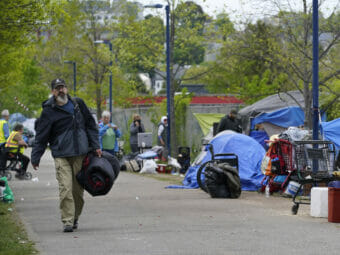
When the new regulations come into place, marijuana ads will be legal aboard buses, on bus stop shelters and on college campuses.

Promotional rules put in place when marijuana was legalized also forbade stores from giving away samples or coupons. Those restrictions have also been repealed.

“I’m not expecting bags of marijuana to go out the door,” Wilson said.

Instead, she and members of the marijuana industry envision small samples.

It’s a change that’s also coming to some alcohol businesses as well. Starting Jan. 1, liquor stores will be able to apply for a license endorsement that allows them to offer free samples of hard alcohol.

This story originally appeared in the Alaska Beacon and is republished here with permission.

Why can’t we stop homelessness? 4 reasons why there’s no end in sight

A man carries a sleeping bag at a homeless encampment in Portland, Maine, in May, before city workers arrived to clean the area. State officials say a lack of affordable housing is behind a sharp rise in chronic homelessness. (Robert F. Bukaty/AP)

When Los Angeles Mayor Karen Bass campaigned last year on reining in homelessness, she laid out bold proposals with a budget of hundreds of millions of dollars. In April, she told NPR she hoped for a “very significant reduction” this year, especially of people living on the street. But on Monday, Bass said it’s become clear that there’s simply no end in sight.

“We really need to normalize the fact, unfortunately, that we’re living in a crisis,” she said at a press conference announcing a renewal of her emergency declaration on homelessness.

The shift in tone comes after both LA and New York City recently declared a record level of homelessness, and other cities have also seen their numbers continue to climb despite considerable attention and spending to give people shelter. It’s part of a steady rise around the country since 2016, after years of successfully driving down the number of people without housing.

So what’s going on? Advocacy groups and researchers say a big driving force is the decline of affordable housing, a problem decades in the making but one that has grown significantly worse in the past few years. Here are a few ways it’s playing out.

1. More people than ever are being housed — but an even higher number are falling into homelessness

About a third of the U.S. homeless population is in California, and the state faces mounting questions about why billions of dollars spent in recent years hasn’t reduced the number of people living in cars and encampments. A bipartisan group of lawmakers has asked the state auditor to investigate. A key program in Los Angeles to move people from hotels into permanent housing appears to be struggling.

CalMatters reports that officials across the state are asking how they can do better, even traveling to Texas for guidance.

And yet, those in California and other places around the country can also argue they are helping more people than ever. The Los Angeles Homeless Services Authority says it has placed more than 20,000 into permanent housing for five years in a row — a significant boost from a decade ago — and that it’s doing this faster than it has in the past. Nationally over that time, the inventory of permanent housing available has increased 26% — and it’s more than doubled since 2007.

“We’ve done a lot” to improve how people are placed into housing, says Steve Berg, chief policy officer at the National Alliance to End Homelessness. But he says that’s only half the equation. “The other half is people losing their housing … and we have not had any kind of extensive or organized effort on that,” he says.

The upshot is that, in Los Angeles and elsewhere, even as record numbers of people are being housed, a greater number of them are falling into homelessness.

Berg says one key reason is that only 1 in 4 Americans who qualify for a federal housing subsidy actually get it, and that’s been the case since he was in law school decades ago. The vast majority of low-income renters must rely on market-rate housing, but the U.S. hasn’t built enough housing for more than a decade, since the market crash of 2008. And the shortage is most acute for the lowest income renters — by more than 7 million units, according to the National Low Income Housing Coalition.

That tight market, combined with the worst inflation in a generation last year, has led to double-digit rent spikes in many places around the U.S.

2. Rents are out of reach for many, and millions of affordable places have disappeared

A landmark new report surveyed thousands of people in California about how they came to be without housing, and researchers conducted in-depth interviews with hundreds of them. For most, high rental costs were crucial.

“People just ran out of the ability to pay, whether it happened quickly or slowly,” says lead investigator Margot Kushel of the University of California, San Francisco.

Some said they’d had their work hours cut. Others lost a job because of a health crisis. Many crowded in with relatives or friends, who were also likely to be poor and struggling. “And we found that those relationships, when they fell apart, fell apart quickly,” Kushel says. “People only had one day’s warning” to leave. Even those with their own lease had on average just 10 days to move out.

Their median monthly household income in the six months before they became homeless was $960, she says. The median rent for a one-bedroom apartment in California is $1,700. Around the country, Kushel says, homelessness rates are highest in places where there is both poverty and high housing costs.

That gap has been growing for decades, as rents have risen faster than wages. Nationally last year, the share of renters spending at least 30% or 50% of their income on housing reached a record high. And some markets have seen a major share of their low-cost rentals disappear.

Over the past decade, the number of rentals under $600 fell by nearly 4 million, according to an analysis by Harvard’s Joint Center for Housing Studies. The losses happened in every state, because either rents increased, the units were taken off the rental market or buildings were condemned and demolished. Among slightly higher priced rentals, up to $1,000 a month, some 2.5 million more units were lost.

Even with inflation cooling, rents remain too high for many — and are continuing to increase in some places.

3. Zoning laws and local opposition make it hard to build housing for low-income renters

Voters around the country approved spending for more affordable housing last year, and a record number of apartments are under construction. More places are also loosening zoning laws — some of which date back to segregation — to allow more multifamily buildings in residential neighborhoods. Housing experts say all this is needed to help ease the tight market and bring down prices over time.

With a shortage in the millions of units, though, that could take a very long time. And in most places it’s still a major challenge to build affordable housing. “Neighbors will say, ‘We don’t want low-income people living here,’ and they’ll stop the housing from being built,” says Berg, with the National Alliance to End Homelessness.

Even housing that does get built and is billed as affordable, he says, isn’t always cheap enough for those who need it most. “It’s really about having enough deeply affordable housing so that people with the lowest incomes can move into the housing,” Berg says. “And if they lose that housing, they can find another place to live.”

4. Pandemic aid programs that helped keep many people housed are winding down

An annual count last year did find a pause in the relentless rise of homelessness. Biden administration officials, among others, credit the sweeping array of pandemic aid programs that limited evictions, helped people pay rent and boosted other financial supports. Princeton’s Eviction Lab calculates such policies cut eviction filings in half.

Those programs have largely ended in many places and are winding down in others. Beyond having to pay current rent, it means some people also may be expected to pay down rental debt that accumulated during the COVID-19 emergency. Many link the end of such protections to a recent rise in evictions, well above pre-pandemic levels in some places.

Of course, there are other reasons. Some 19% of those surveyed in the UCSF study became homeless after leaving institutions such as prison, and finding employment and housing with a criminal record is difficult. Advocates say there’s also need for more addiction and mental health treatment, though it’s most effective once someone is safely housed.

But again, the overriding problem, they say, is the dire lack of places low-income people can afford to live.

“There’s really no way to solve homelessness without seriously addressing this,” says Kushel, the UCSF researcher. “Otherwise, we’re going to be compelled to continue to spend huge amounts of money managing an increasingly out of control crisis.”

Copyright 2023 NPR. To see more, visit https://www.npr.org.

Delta Junction couple faces federal charges for allegedly bilking ‘Bud and Breakfast’ investors

The Cortys told prospective investors that the value of their shares in Ice Fog Holdings — the company that would develop the marijuana theme park on the site of the old Midway Lodge — would grow rapidly. The structure is located at milepost 315 Richardson Highway in Salcha. (Alaska Alcohol And Marijuana Control Office)

The U.S. Attorney’s Alaska office has charged a Delta Junction couple with conspiracy and wire fraud for bilking investors out of more than $700,000 they thought would be used to develop a marijuana theme park in Salcha.

FBI investigators say Brian and Candy Corty used false and fraudulent claims to get 22 people around the country to invest a total of $722,000 in a project the Cortys referred to as a “marijuana theme park” they called “Bud and Breakfast.”

One of those people, a resident of New York City, invested $200,000 in the venture, according to a U.S. Attorney’s Office affidavit. A North Carolina resident invested $25,000.

The affidavit says that from 2017 to 2020, the Cortys enticed those prospective investors to buy shares of their company, Ice Fog Holdings, to finance development of a marijuana cultivation, processing and retail facility at the site of the old Midway Lodge in Salcha, which the couple bought in 2018.

The affidavit says the Cortys told investors the attraction would “include glass ceilings so Ice Fog’s customers could lie in bed and watch the northern lights.”.

Fairbanks-based assistant U.S. attorney and lead prosecutor Ryan Tansey says they take investment fraud extremely seriously.

“Our office, the U.S. Attorney’s Office, is going to use all the resources that we have to investigate and hold culpable parties accountable in cases like this,” he said in an interview Wednesday.

Brian Corty declined to comment about the case on tape Wednesday evening. But he said in a written response that, “An indictment is merely an allegation and all defendants are presumed innocent until proven guilty beyond a reasonable doubt in a court of law.”

Corty allegedly told investors beginning in mid-2017 that he expected the company’s profits would grow quickly, from $3.8 million in the first year to more than $23 million after three years. And he said their investments would grow 30-fold.

But the project never came to fruition. Investigators say the Cortys and as-yet unnamed co-conspirators knew the business had no real revenue potential, and little to no prospect of obtaining a license from the state Alcohol and Marijuana Control Office.

They also said the Cortys used the money from investors for personal purposes.

According to a news release issued Wednesday by the U.S. Attorney’s Alaska office, an FBI investigation into the case continues with assistance from the Alaska Department of Law.

The Cortys are scheduled to be arraigned on Monday at the federal courthouse in Fairbanks on charges that include three counts of wire fraud and one count of conspiracy to commit wire fraud.

Marijuana charges are leaving CourtView. A new bill would pull them from background checks, too

Rep. Stanley Wright (left) and an aide present HB 28 in the House Judiciary Committee on April 14, 2023. (Riley Board/KDLL)

In CourtView — the state’s public website for accessing court records — a marijuana possession charge shows up as something like “Misconduct – Controlled Substance 6A.” It isn’t immediately clear the charge is for something that has been legal now for eight years.

For people 21 and older with marijuana charges from 2014 or earlier, before the state legalized the substance recreationally, this can be a significant barrier to getting housing or a job. Employers and landlords can easily access CourtView to make decisions about applicants.

House Bill 28 is making its way through the Legislature and would remove marijuana convictions from the public record and some state background checks. The bill was introduced by East Anchorage Republican Rep. Stanley Wright.

“It came up during my campaign,” Wright said. “A lot of folks saying things like, ‘I can’t get out of my mom’s house, I can’t get an apartment because I have this marijuana charge. I’m being held back man, you guys need to do something about it. It’s not even illegal anymore.’”

Wright introduced the bill first thing this session, after a similar bill passed the House last year but didn’t make it out of the Senate.

Earlier this year, the Alaska Supreme Court announced a rule change that will remove marijuana charges from CourtView. That goes into effect in just a couple weeks and will scrub 750 names from the site.

Alaska was the third state to legalize recreational marijuana, by a ballot measure in 2014.

Wright’s bill, introduced just before the Supreme Court ruling in January, calls for removing minor marijuana charges from CourtView and also from non-federal background checks administered by the state Department of Public Service, or DPS.

Wright said even though parts of the bill may be redundant with the court ruling, his legislation is still an important additional step because it would codify the CourtView record-clearing in the law.

“If you could easily say that you are going to take it off the website, someone new could come and say ‘We’re gonna put it back on the website,’” he said. “So I think it’s important that we run the bill.”

The legislation also removes pre-2014 marijuana possession charges from background checks conducted by DPS, the kind that might be requested by an employer or landlord. DPS would need to examine 8,500 cases were the bill to pass.

Individuals will still be able to see marijuana records by going in person to a courthouse and requesting the documents, they just won’t be readily available online.

Wright said the bill isn’t really about weed: it’s about removing barriers for Alaskans.

“There are so many stories of people being stuck, folks trying to get jobs. Why would we want to keep people from reaching their full potential? I think this bill helps those individuals do it,” he said.

The bill has bipartisan sponsorship and support from the Alaska Marijuana Industry Association, whose board is headed by Ryan Tunseth, owner of East Rip in Kenai. The association’s legislative liaison submitted a letter of support, calling it an “incremental but important step in the right direction towards destigmatizing cannabis consumption.”

Wright said he’s hopeful about the bill this session.

“I just want people to reach their full potential in life. If this is gonna help you get one step closer to putting food on the table, to living in a better place, I’m all for it,” he said. “I think a lot of folks, once they realize that’s what this is all about, they’ll start to accept it.”

The bill moved out of the House Judiciary Committee last Friday and is waiting for a hearing in House Finance.

Site notifications
Update notification options
Subscribe to notifications