Marijuana

A look at Alaska’s cannabis industry, 6 years in

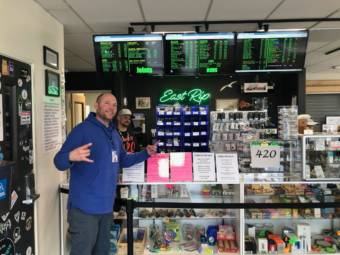
Ryan Tunseth opened East Rip in downtown Kenai in 2018. He sources his product locally, from Kenai Peninsula cultivators. (Sabine Poux/KDLL)

The Kenai Peninsula has been a key player in Alaska’s budding cannabis industry since the state legalized recreational marijuana use six years ago, with over 70 licenses in play for cultivators and retailers.

One of those licenses belongs to East Rip, off the Kenai Spur Highway. Ryan Tunseth opened the shop in 2018 and is treasurer of the Alaska Marijuana Industry Association.

KDLL’s Sabine Poux spoke to Tunseth about how the industry has changed since 2015 and where he thinks it’s going. He says what cannabis businesses need most now is access to normal banking.

“The industry needs a responsible and safe way to bank,” Tunseth said. “Everything’s in cash. We pay our employees in cash. We pay vendors in cash. We pay our taxes in cash. And because of that, it’s quite dangerous.”

Listen to the full interview here:

Rep. Young joins Democrats to pass marijuana legalization bill

Rep. Don Young in his Washington, D.C. office. (Liz Ruskin/Alaska Public Media)

Alaska Congressman Don Young was one of only five Republicans to vote for a bill that would decriminalize marijuana.

The bill passed 228-164 but is unlikely to go further before Congress adjourns.
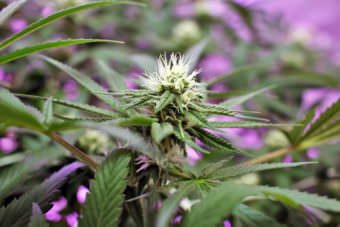
Rep. Young tweeted an explanation of his vote that included a photo of the congressman touring an Alaska grow operation, Raspberry Roots, in 2019.

Young, who does not advocate for marijuana use, is nonetheless co-chair of the House Cannabis Caucus.

“I’m a conservative, Republican … but I believe in state’s rights,” he said in 2017, when the caucus was announced. A caucus, in this sense, is a group of like-minded lawmakers who come together to advance a particular issue. Young said the federal government should not overrule the voters in his state.

Alaska and 14 other states have legalized cannabis for recreational use by adults. A majority of states allow it for medical purposes.

Passage of the House bill is a significant milestone for the movement to make cannabis legal nationwide, but the legislation is not likely to pass the Senate before the end of the 116th Congress. Sen. Kamala Harris, now vice president-elect, introduced a similar bill in 2019 that did not advance in the Senate.

If, as expected, both bills expire when Congress adjourns, supporters would have to introduce the legislation anew when Congress reconvenes in 2021.

‘Southeast has just been hammered’: Economists try to see what’s ahead for Alaska’s pandemic recession

Businesses all over Alaska have been shuttered due to the COVID-19 pandemic. (Photo courtesy Hannah Lies/Alaska Public Media)

Economic forecasting is always something of an exercise in prognostication — that is, gazing into a crystal ball and hoping to see Alaska’s future.  

But state economist Neal Fried said it’s particularly difficult to figure out what next year is going to look like. 

“If there’s someone out there that can forecast what’s COVID is going to do … and then, of course, guess what consumer behavior is going to be, that’s a tough one,” he said.

Alaska’s economy, much like the rest of the country, has taken a hit from COVID-19, though some of the impacts won’t be clear for a few years. 

Fried laid out some of those details at the Resource Development Council’s annual conference on Wednesday.  

“How does what’s going on now, this COVID recession compared to previous ones? It’s already lost more jobs than any of the previous ones,” he said. “Is it going to be the worst recession? I don’t know.”

The COVID-19 pandemic came at a particularly rough time for Alaska. The state was just beginning to climb out of its recession from the 2015 oil-crash, and Fried said everyone expected that growth to continue this year — especially in the tourism industry

Instead, as the pandemic unfolded and shut down the tourism season, businesses closed and a record number of Alaskans found themselves out of work. 

“If you look at April, we peaked at almost 70,000 individuals in Alaska receiving unemployment. And you know, when you think about a workforce of about 320-330,000, that’s a lot of folks,” he said. “The numbers have come down some but still remain sort of stubbornly high.”

Nearly every sector of the state’s economy lost jobs. One, federal employment, added jobs this year. That’s because of hiring for the U.S. Census.

There are indicators that the pandemic scared away some private investment. Fried said three new hotels that were supposed to open in Anchorage never materialized. 

And some parts of the state have felt the impacts of the downturn more than others. Interior Alaska has had a boost from the military. The Anchorage region has been buoyed by growth in the Mat-Su. 

But it’s a different story in Southeast. 

“Southeast has just been hammered,” Fried said. “It’s been hammered by two things. Of course their very big dependence on the cruise ship and visitor industry, and then to add insult to injury they had a lousy fisheries season. So they just got hit very, very hard.”

The pandemic was swift and, in some ways, surprising in how it impacted the state’s economy. 

We went basically from a near, if not record low unemployment rate … to record high the next month,” he said.

Fried said state economists have been looking for new ways to measure its impact and the health of specific sectors. 

For instance, Fried said they are looking at the number of people who have been stopped and frisked every week at the Anchorage International Airport for the last few years and comparing it to this year. They’re using it as a way to measure the drop in travel to Anchorage. 

“I didn’t even know this data exists,” Fried said. “But you can see transportation in Anchorage, passengers dropped as much as 86% and it stayed quite low. You know it’s still 50% below where it was a year ago up to the current period. It is beginning to improve. When you look at these numbers for Juneau, Fairbanks, they look very similar and in some cases even worse.” 

They’re also looking at cargo landings at the Anchorage airport. There has been a sharp increase in cargo traffic there during the pandemic. Fried and others have said it was the world’s busiest airport during parts of 2020. He attributed that volume, in part, to supplies coming in from China and other parts of the world, and to the explosive growth of e-commerce. 

There are a few bright spots in the state’s overall economic health. 

For one, the military is still growing in Alaska. Personnel are moving to the state along with the new F-35 jets. 

The marijuana industry is hitting record-high sales. 

And Fried said mining did well during the last recession and is still doing well during this one. Mineral prices are good right now, he said, and it’s an indicator that the state’s economy may be more diverse than many people think. 

Two people charged after ransacking a Dillingham pot shop

Image from Bristol Bay Bud Company security camera. September 14, 2020.

Updated post — 7:20 p.m.

On Wednesday, Dillingham Police charged an 18-year-old and a 13-year-old for breaking into the Bristol Bay Bud Company on Monday. The police contacted them at a Dillingham residence. Police say both admitted to committing the burglary. The 18-year-old is being charged with burglary and theft, and the police will send a report on the 13-year-old to the state Division of Juvenile Justice.

Items from the burglary were found in the woods near the marijuana store and near the residence. Police seized all items, as well as the clothing the two wore during the break in.

Original post — 2:00 p.m.

Two people broke into the Bristol Bay Bud Company just before 2 a.m. on Monday morning, according to the Dillingham Police Department and the company. The store’s security cameras show two people wearing hoodies and masks entering the building and ransacking the store’s shelves and refrigerator.

Dillingham police responded to the store’s alarm within minutes, but no one was there when they arrived.

This was the first break-in at the Dillingham marijuana store. Stolen items include marijuana gummies and soda as well as glass, rubber and gasmask bongs.
Heather Allen, one of company’s four owners, said the store has an extensive security system.

“I have no problem letting people know I have a security system that has facial recognition 20 feet away, tons of cameras, every inch of the store is covered on multiple angles, and I record in high-def,” she said.

Allen said they are also taking measures to increase security.

“I would be a fool not to shore up a few things that have been brought to light from my first break-in,” she said. “Absolutely you’ll notice there are some things up here already in place that happened overnight.”

Allen said she is now working with the Dillingham Police Department to identify the people in the camera footage.

“I have faith that this tight-knit community will rally together, and we’ll find who broke into the pot store and caused a big ‘ole hullabaloo,” she said.

Anyone with information about the incident can contact the Dillingham Police Department at (907) 842-5354.

Updated: Alaska marijuana shops can now apply to provide curbside pickup

A jar of marijuana buds is seen at the Stoney Moose in Ketchikan. (KRBD photo by Leila Kheiry)

Update (Monday, 8:45 p.m.) — Abbey Collins, Alaska Public Media

Emergency regulations allowing for curbside pickup of marijuana in Alaska are now in effect. Alaska’s Marijuana Control Board passed the regulations Friday. Lt. Gov. Kevin Meyer’s office signed off on them later that evening. (Read more)

Original story

Alaska’s Marijuana Control Board passed emergency regulations Friday that could ease restrictions on marijuana stores as owners navigate business during the COVID-19 pandemic.
While many businesses in the state have closed, pot shops are permitted to stay open under state health mandates. Right now, sales are only allowed to take place as they normally would — inside the store. But, if Gov. Mike Dunleavy approves the board’s emergency regulations, that will change.

Board member Bruce Schulte asked business owners to take health concerns seriously despite the regulation changes.

“Please do whatever you can to protect your staff and don’t bring any negative light to what we’ve done here,” said Schulte. “Because we’re trying to help you out. So help us help you, and good luck.”

The most contentious change would allow customers to place orders over the phone or online for curbside pickup. It would also allow customers to pick up products from an exterior window.

According to the board, the goal of these regulations is to allow for more distance between customers and employees.

Christopher Jaime holds the public safety seat on the board. He argued against the change. Jaime said he doesn’t think curbside pickup is necessary right now, and said he worries the change could create problems in the future.

“We’re opening the door for the future to allow this permanently,” said Jaime. “I don’t care what’s said, that’s the way I see it. I disagree with curbside deliveries when it comes to marijuana.”

Board member Nicholas Miller, who represents the marijuana industry, pushed back.

“I don’t believe we’re going to increase public risk,” said Miller. “Whether we’re handing a purchased cannabis product to someone over the counter, or we hand it to them through the window. Somehow I can’t correlate how that becomes more dangerous.”

If these changes go into effect, business owners will be required to submit operation plans to the state.

The regulation changes passed 4-2, with Jaime and Casey Dschaak opposed.

The board also unanimously passed regulations that would allow marijuana to be transported by commercial plane or boat. The regulations require the licensee, employees or agents of licensees with a marijuana handler permit to deliver and pick up products being transported.

The regulation changes still need to be approved by the lieutenant governor. If approved, they will last for 120 days, unless the board reconvenes to remove them sooner.

Correction: This story originally stated that the regulation changes need to be approved by the governor. Rather, they are approved by the lieutenant governor.

Ketchikan officials won’t oppose marijuana cafe north of town

A view of downtown Ketchikan, seen from the cruise ship Veendam. (Photo by Leila Kheiry/KRBD)

A proposed on-site marijuana cafe in Ketchikan won’t face opposition from local officials.

The Ketchikan Gateway Borough Assembly on Monday waived its right to protest a state license application from Cannabis Corner, a marijuana retailer in the Totem Bight area.

Assembly member David Landis said he didn’t see a legal reason for the borough to object.

“This is a legal industry in the state of Alaska, and this is a legal activity under Alaska law,” Landis said.

But not everyone was convinced. Assembly member Alan Bailey said he’s worried about stoned drivers on the road.

“Impaired drivers kill too many people in this community and around this state,” Bailey said.

As with a liquor license, marijuana licenses are up for annual renewal. So if there’s an uptick in stoned driving, Landis said, the Assembly would have another opportunity to protest.

“The way that I see it is that this business has a chance to prove itself,” Landis said. “This community, the consumers of this product have a chance to prove to us that this is a safe activity.”

Assembly members Sue Pickrell joined Bailey to oppose the motion. It passed 5-2.

State marijuana regulators are scheduled to consider the permit later this month. If approved, Cannabis Corner could be among the first marijuana cafes in Alaska.

Site notifications
Update notification options
Subscribe to notifications