Marijuana

Cannabis advocates wary of Dunleavy’s Marijuana Control Board appointments

Gov. Mike Dunleavy leaves the House chambers after delivering the annual State of the State address to the Alaska Legislature, Jan. 22, 2019. (Photo by Skip Gray/360 North)

Alaska’s marijuana industry and its advocates are concerned about Gov. Mike Dunleavy’s appointment of two people to the Marijuana Control Board. Advocates say the appointees could slow or halt the industry’s growth and hamper the state’s ability to regulate it. The appointments follow Dunleavy’s decision last week to replace the board vice chairman with a member who has a long history of opposing marijuana use and sale.

Marijuana Control Board Vice Chairman Brandon Emmett said Thursday that he was just beginning to recover from the shock of being informed over the weekend by a member of Dunleavy’s office that he had decided to not reappoint Emmett for another three-year term.

“They said that the governor thanked me for my service, but that they were going in another direction,” Emmett said.

Emmett said he was shocked all over again Wednesday when he found out that Dunleavy had appointed longtime anti-marijuana crusader Vivian Stiver to fill his seat beginning next month.

“I see now what the governor means when he said that they were going in another direction, appointing an abject prohibitionist,” Emmett said. “That is definitely a complete different direction.”

Stiver failed to return phone calls Thursday and said in a Facebook message this morning that she was traveling to Juneau and unavailable for comment. But she told the Fairbanks Daily News-Miner that if she’s confirmed by the Legislature on Feb. 28, she’ll ensure that the board operates under “a process that is fair and accessible to everyone.”

The ex-Fairbanks City Council member has played a leading role in organizations that opposed legalizing marijuana and that twice tried to ban sale of pot in the city and Fairbanks North Star Borough. Dunleavy spokesman Matt Shuckerow said the governor wanted someone on the board to represent that perspective.

“That’s a viewpoint that is certainly shared by many other Alaskans,” Shuckerow said.

Shuckerow said Dunleavy also chose Stiver to represent the general public, as allowed by state law. Emmett is a Fairbanks cannabis business partner and board president of the Alaska Marijuana Industry Association.

“So far, the only stakeholder group that hasn’t had representation on the Marijuana Control Board has been a member from the general public,” Shuckerow said.

Emmett acknowledges the public should be represented on the board. But he says Stiver’s anti-marijuana agenda should disqualify her for the job, because it conflicts with what the majority of Alaskans believe, as reflected in consecutive votes in favor of legalized commercial marijuana.

“The governor is definitely well within his rights to appoint a member of the public,” Emmett said. “What I think is somewhat disingenuous, though, is who they chose. If you look at Vivian Stiver’s record, she is truly an abject prohibitionist.”

Emmett said he’s heard many others worry out loud about those same issues.

“I am speaking to the concerns of every industry member that I know, and many members of the general public,” he said.

Emmett said the main concern is that Stiver will slow the board’s work, especially in reviewing new business applications and developing new regulations — like those it just approved that set rules for businesses that want to offer consumption of marijuana on-site. Emmett thinks the new board is unlikely to revisit those regulations.

“But what we could see, if we have got a majority of board members who are opposed to on-site consumption, we could see it being very difficult for those businesses to get that endorsement,” Emmett said.

Dunleavy’s other new board appointee, Chris Jaime, told CoastAlaska that he is concerned about on-site consumption. Jaime is an Alaska Wildlife Troopers lieutenant from Soldotna.

“I think we do need to re-evaluate the decision to allow on-site consumption,” Jaime said. “There’s a lot of issues with the way marijuana is metabolized by the body and such, and we don’t impaired drivers on the roadway.”

If the Legislature approves Dunleavy’s appointees, the board will be left with only one industry representative — Nicholas Miller of Anchorage.

Public comment closes on on-site consumption for marijuana retailers

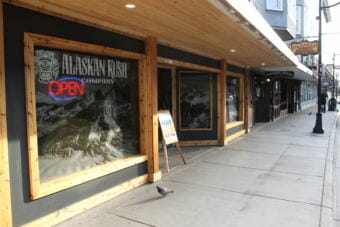
An open signs lights up the window of the Alaskan Kush Company in downtown Juneau. (Photo by Adelyn Baxter/KTOO)
An “open” sign lights up the window of the Alaskan Kush Company in downtown Juneau. (Photo by Adelyn Baxter/KTOO)

Public comment ended Thursday for the latest draft proposal to allow customers to smoke or consume marijuana products in licensed retail shops.

On-site consumption has been talked about since voters first approved a ballot initiative legalizing recreational marijuana in 2014. Alaska would be the first state to authorize public consumption of marijuana products.

Right now, people can only legally use marijuana in the privacy of their own homes.

That means tourists coming off the cruise ships have nowhere to go if they want to try Alaskan cannabis.

But the latest proposal to change state law has people in the marijuana industry like Herb Smythe feeling hopeful.

“We really need one, because the law continues to be violated with people smoking in public places because they don’t have a place to go,” Smythe said.

His new business, Alaskan Kush Company, soft-opened about a week ago in downtown Juneau.

Right now, it’s just a retail shop. But store manager Amy Herrick said they want the eventual layout of the space to include a cafe where customers can sample products.

Alaskan Kush Company manager Amy Herrick inside the retail portion of the store. The business also hopes to open a cafe area if and when on-site consumption is approved. (Photo by Adelyn Baxter/KTOO)
Alaskan Kush Company manager Amy Herrick inside the retail portion of the store. The business hopes to open a cafe area if and when on-site consumption is approved. (Photo by Adelyn Baxter/KTOO)

“A place where the community can come together and enjoy what they enjoy,” Herrick said. “A lot of people don’t appreciate alcohol, so the bar’s not the best setting.”

They plan to fully open at the end of November. Smythe says the cafe element was a part of his original business plan, but they’re prepared to be patient as the proposal moves forward.

“We positioned ourselves so that we could do that,” Smythe said. “We’ll use this space in other ways until that’s approved.”

Under the proposal, licensed retail stores interested in on-site consumption will apply for endorsements approved by the state’s Marijuana Control Board.

Erika McConnell with the Alcohol and Marijuana Control Office said this is the second on-site consumption proposal the board has considered.

The first proposal failed in 2017 with a two-to-three vote, but a new version was introduced shortly thereafter.

A couple of things have slowed down the process, such as a board vacancy this past year, but McConnell said the main thing is the lack of precedent.

“So the board is very cognizant that we’re sort of at the forefront of what public consumption might look like, and so they don’t want to rush and they want to try to be very thoughtful about it and … make sure that in the end they have the best proposal possible,” McConnell said.

The proposal also includes language that allows local governments to opt out of on-site consumption by ordinance or a ballot question.

According to McConnell, the proposal received feedback from more than 60 individuals during the 60-day public comment period.

The board will hear oral comments at a public hearing on Dec. 19. The next day, they will meet to consider approving the proposal.

If any substantial changes are made, McConnell said, the proposal will go back out for public comment.

Alaska plans changes to how it taxes marijuana

The state of Alaska is changing how it taxes marijuana in response to industry concerns.

The current tax is $50 an ounce for any part of the bud and flower and $15 an ounce for the remainder of the plant.

New rules, set to take effect Jan. 1, make distinctions between different types of bud.

So-called mature bud would be taxed at $50 an ounce, while immature or abnormal buds would be taxed at $25 an ounce. The tax rate for the rest of the plant would be unchanged.

Cultivators would continue paying the tax, imposed when marijuana is sold or transferred from a grow facility to a retail store or product manufacturing facility.

Some in the industry have sought a more extensive tax overhaul. That would require legislative action.

marijuana in hand
Marijuana. (Creative Commons photo by Katheirne Hitt)

CBD is getting more popular in Alaska. But is it legal?

Austin Schwartz, with a short beard, glasses and a baseball cap, holds a cup of coffee under the nozzle of an espresso machine
Austin Schwartz is one of the co-owners of Uncle LeRoy’s Coffee in Anchorage, a cafe that serves CBD as a supplement in some of its drinks (Photo by Zachariah Hughes, Alaska Public Media)

This week, Coca-Cola Co. announced it is exploring options for selling drinks containing a cannabis-based product generally referred to as CBD. Cannabidiol, a mild derivative from the Cannabis sativa plant has no intoxicating effects, and is championed as a natural remedy for all kinds of ailments.

In Alaska, CBD is already showing up in drinks at cafes and in stores. But there are simmering disagreements about its legality.

Behind the counter at Uncle LeRoy’s Coffee in Anchorage’s Spenard neighborhood, 22-year-old barista Madison McEnaney is assembling a special house drink.

“It’s got agave and vanilla syrup as a sweetener,” McEnaney said as she combined ingredients. “Then we’re gonna do almond milk with two shots of espresso, shaken and poured over ice.”

It’s the kind of decadent coffee drink one might splurge on as a treat. And for an extra $2, McEnaney tops it off with 10 milligrams of clear CBD oil from a small glass bottle.

“One dropper full essentially,” she said casually with a squeeze of her fingertips.

Uncle LeRoy’s sells CBD as an add-on in coffee and what they call “wellness drinks,” non-alcoholic cocktails of seltzer infused with ingredients like ginger root or apple-cider vinegar.

The cafe is well placed to capitalize on popular health trends: squeezed between a salad joint and a yoga studio. Across the street is a newly opened Kombucha taproom.

Madison McEnaney talks with customers at LeRoy’s Coffee, a cafe that serves CBD-infused drinks in Anchorage (Photo by Zachariah Hughes, Alaska Public Media)

CBD was barely on people’s radar five years ago. Now, there’s no shortage of blog posts, promotional videos and local news stories extolling its benefits as a remedy for epilepsy, pain, anxiety and insomnia.

Like other supplements and vitamins, these claims are anecdotal, rarely verified and not based on clinical trials. Last year, the U.S. Food and Drug Administration issued a warning to larger CBD producing companies untested claims in promotional material.

“The FDA has grown increasingly concerned at the proliferation of products claiming to treat or cure serious diseases like cancer,” the notice read.

Austin Schwartz is one of the co-owners of Uncle LeRoy’s, a business that started more than four years ago selling coffee out of a bus. When the cafe opened several months ago, Schwartz decided that having CBD on the menu was a good way to give customers something you would not find in most other coffee houses in Anchorage.

“I like that it does offer something a little bit different, it’s something new,” Schwartz said.

His business is hardly the only one selling CBD in Anchorage and beyond. Not only can you get it in coffee drinks, but at garden stores, at health and supplement shops — even as a topical cream at Walmart. Last year, according to the Hemp Business Journal, CBD sales in the U.S. were worth $190 million.

Schwartz uses a CBD oil made in Colorado, and is assured that there’s no legal or regulatory rules he’s breaking by selling it to customers.

“We’ve spoken to a few different distributors and it’s something that doesn’t require a different type of business license or regulation,” Schwartz said.

The business has never been approached by state enforcement officers or police about selling CBD.

But whether or not these kinds of CBD sales are legal in Alaska depends on who you ask.

For one thing, according to the U.S. Postal Service, you are not supposed to send CBD into Alaska through the mail.

Alternatively, you could buy in-state products. Except that “there is no industrial hemp that is actually legally produced in Alaska right now from which to extract CBD to sell legally in the state,” according to Erika McConnell, head of the Alcohol and Marijuana Control Office.

One might expect that as the state’s top official over marijuana policy McConnell would have authority over CBD. After all, it is extracted from the same essential plant that produces the buds, edibles and concentrates for sale in retail pot stores.

Wrong.

As a result of Senate Bill 6, which passed in the Legislature during the last session, there are now separate definitions for marijuana and hemp under Alaska law. Marijuana is defined as those parts of the Cannabis sativa plant with enough THC — the active ingredient in cannabis products — to have a psychoactive impact. Hemp is defined as those strains and pieces of the same plant with 0.3 percent or less THC. Essentially, it cannot make one feel high, but still has many of the other components unique to Cannabis sativa.AMCO is in charge of regulating marijuana. Under Senate Bill 6, industrial hemp products are supposed to be overseen by the Department of Natural Resources.

But it is not quite that simple. As laid out in S.B. 6, hemp in Alaska is supposed to be grown under a pilot program outlined under the Agriculture Act of 2014, the latest version of the federal farm bill. McConnell’s argument is that because Alaska has not set up that pilot program, the CBD that is showing up in stores and cafes cannot have been produced locally. So it’s not legal. But with a muddled understanding, scant resources and a low prioritization for relevant agencies, the law is not being enforced, according to McConnell.

McConnell also worries that there is no one watching out for quality standards over a little understood substance being sold for a wild variety of reasons.

“There’s just a lot of unknowns about these particular products, so I think we’re just in a buyer beware type situation,” McConnell said.

AMCO is not the only government entity with concerns. Through an email, Lorinda Lhotka with the state’s Department of Environmental Conservation, which runs a food safety program, wrote “there are no lawfully approved sources of CBD” available in Alaska. As a result, the substance cannot be “sold or used in permitted food establishments.”

The U.S. Postal Inspection Service said that under the Controlled Substances Act its still illegal to send marijuana extracts through the federal mail, even between states that have legal cannabis laws.

But Garrett Graff disagrees. He is an attorney with the Colorado-based Hoban Law Group, and handles cannabis issues in multiple states. According to Graff, much of the guidance about CBD from regulatory and enforcement agencies is outdated since a federal court ruling in April.

“The 9th Circuit Court of Appeals explicitly found that the farm bill preempts or supersedes the Controlled Substances Act,” Graff said in a phone interview.

According to Graff, the courts found if a state has a rule about industrial hemp, then that takes precedent over the older Controlled Substances Act. In his interpretation of the ruling, even though CBD might technically be a controlled substance under the earlier law, for states like Alaska that are abiding by the newer farm bill provisions there is no legal problem. That extends to transport and commerce.

“Practically speaking, as an emerging industry, there’s plenty of confusion,” Graff conceded.

Amid competing interpretations, confusion is something everybody agrees on.

McConnell was candid that regulation and enforcement of CBD is something every state with a legal cannabis framework is presently grappling with. DEC, DNR and AMCO are all currently discussing the matter with the Department of Law.

Industrial hemp could become Alaska’s next big crop

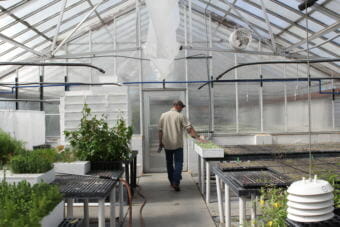
Rob Carter, head of the industrial hemp pilot program, walks through a greenhouse at the Alaska Plant Materials Center outside of Palmer. He thinks an industrial hemp industry is viable for Alaska. (Photo by Erin McKinstry/Alaska Public Media)

Marijuana and hemp are technically the same plant: cannabis sativa

The main difference is that hemp contains only trace amounts of tetrahydrocannabinol, the psychoactive drug in marijuana that gets you high.

So it’s surprising that while Alaska’s recreational marijuana industry has bloomed, growing hemp remains illegal.

Rob Carter, the head of a new industrial hemp pilot program, hopes to have hemp plants in the ground in Alaska in 2019.

More than 300 people from across the state have expressed interest.

But with Alaska’s cold soils and long summer days, is it a good fit for a hemp industry? Carter thinks so.

He’s the managing agronomist for the Alaska Plant Materials Center outside of Palmer.

The 400-acre experiment farm-and-seed cleaning facility is the epicenter of a soon-to-be industrial hemp pilot program that’ll enlist hemp growers from all over the state.

Carter gets one to two calls a day from people interested in participating.

“It’s kinda the gold rush thing,” Carter said. “Like a lot of people wanna come in, and it’s new, and they wanna be a participant.”

Rob Carter stands next to bins of wheat and barley at the Alaska Plant Materials Center outside of Palmer. He’s the managing agronomist and the head of Alaska’s soon-to-be industrial hemp pilot program. (Photo by Erin McKinstry/Alaska Public Media)

Hemp is used to feed livestock, for medicinal purposes, it’s even used by the oil industry to fill cracks and fissures that drilling causes in the earth.

Carter sees a lot of possibility from hemp-based oils like CBD, which people use to treat everything from epilepsy to inflammation.

Right now, the federal government doesn’t regulate them, and a tiny bottle of CBD oil can cost more than $100 online.

“You go to the natural health food store or the gas station, and you buy this CBD product, and you consume it,” he said. “You tell me what’s in it. You don’t know.”

Carter wants to design a pilot program that would increase transparency and more tightly regulate the growth of hemp and extraction of CBD oil.

He thinks Alaska’s pristine environment could offer something other places can’t.

“We have relatively clean soils and very clean water and an unbelievably clean growing environment in comparison to other states that have very large-scale industrial or mono-cropping agriculture around it,” Carter said. “I think that we have the opportunity to build a program that can be some of the cleanest industrial hemp anywhere in the world.”

Alaska Plant Materials Center experiments with new crops and growing techniques. They normally grow tomatoes in a greenhouse, but right now, they’re testing out growing them outside (Photo by Erin McKinstry/Alaska Public Media)

Hemp was illegal to grow in the U.S., even for research purposes, for more than 75 years.

Congress authorized state-sponsored industrial hemp pilot programs in the 2014 Farm Bill.

Alaska joined more than 30 other states when it legalized a program earlier this year.

The program provides a way to gather data about growing hemp in the state and figure out what works and what doesn’t.

But until the program is up and running, it’s still illegal to grow or import hemp in Alaska.

Despite Alaska’s harsh climate, Carter thinks a permanent industrial hemp industry is viable here.

He said whether illegal or legal, producers have been growing cannabis indoors and outdoors in Alaska for a long time and similar climates like Northern Europe have made it work.

“I think agriculturalists in Alaska in general when you tell ’em you can’t do something, we find ways to make it happen,” Carter said.

Most strains of hemp need warm soils for their deep root systems and a period of darkness each day to flower and produce seeds.

Alaskan summers offer neither, which is why University of Alaska Fairbanks agronomist Bob Van Veldhuizen has his doubts about the industry.

He thinks hemp would need to be grown indoors or in high tunnels, which is expensive.

He’s not against legalization, but he thinks developing an industry might not be worth it.

“I’m sure that somebody somewhere would be able to do it, but the likelihood of this becoming a major, viable crop for Alaska at this point, seems to be pretty small,” Van Veldhuizen said.

Talkeetna-based farmer and hemp product producer Ember Haynes thinks that there are some varieties of the plant that will grow well here.

“There are varieties that will flower on their own so that’s totally an option,” Haynes said.

Haynes hopes to participate in the pilot program and grow hemp on a small scale to feed to her animals and use for companies Silverbear Sundries and Denali Hemp Company.

“I look at hemp especially in Alaska as being a grassroots movement,” Haynes said. “It does not have to start with big agriculture, you know, that it can start on the small scale.”

Haynes isn’t alone. Carter has seen such an overwhelming interest in the pilot program that it’s taking longer than expected to draft program regulations.

They’ll open applications after the regulations go up for public comment.

The more people, the better, Carter said.

“The more plants we have in the ground and the more people that we have that participate,” Carter said, “the stronger the industry will be.”

Federal rules on marijuana ads delay Haines newspaper

The Winter Greens store is located on Beach Road in Haines.
The Winter Greens store is located on Beach Road in Haines. (Photo by Henry Leasia/KHNS)

Subscriptions to the Chilkat Valley News were delayed this week due to an advertisement in the newspaper for a new marijuana dispensary. The newspaper decided to delay mailing the current issue to subscribers after the Haines Post Office warned that the ad could cause problems because marijuana is still illegal federally.

The new marijuana dispensary Winter Greens placed an ad in the July 12 issue of the Chilkat Valley News, announcing the opening of the shop. The ad takes up roughly a quarter of the back page with a short message thanking supporters and encouraging people to stop by.

At the bottom, there is a gray box containing a disclaimer about the risks of marijuana and precautions about who should and shouldn’t use it. The language comes from the Alaska Marijuana Control Board and must be included in all promotional materials for marijuana dispensaries across the state.

According to Jasmine Taylor, the ad manager of the newspaper, the main legal concern that Winter Greens had when placing the ad was to make sure this disclaimer was included.

Nothing about the advertisement itself violates Alaska laws.

Taylor said when the papers were dropped off at the post office, the postmaster looked through a copy and informed the newspaper that the advertisement on the back could be an issue.

According to Dawn Peppinger, the U.S. Postal Service’s manager of marketing for the Alaska District, the publication ran into problems at the federal level.

“Basically advertisements for marijuana in the mail may be a violation of federal law,” Peppinger said. “Marijuana, while it may be recognized as legal in the state, it is not recognized as legal federally in that it is still considered a controlled substance. So it falls under the laws of the Controlled Substance Act.”

The act makes it a federal crime to place an ad in any publication for the purpose of seeking, buying or distributing a controlled substance.

In a 2015 memo distributed in Oregon, another state where recreational marijuana use is legal, the U.S. Postal Service explained that this rule on marijuana advertisements applies to mail.

When asked if the paper plans to run marijuana-related advertisements in the future, Taylor said she would like Winter Greens to be able to advertise because the Chilkat Valley News wants to help promote small businesses in Haines and Skagway. The problem is that the paper does rely on the post office for distribution to subscribers.

So how did the Chilkat Valley News deal with a stack of newspapers that couldn’t be mailed? Taylor said that the paper’s staff used scissors to cut the advertisement from the back pages of the copies they needed to mail out of town.

The current issue can be found in stores around Haines with the ad for Winter Greens included. Local subscribers can pick up a copy from the Chilkat Valley News office.

Site notifications
Update notification options
Subscribe to notifications