Associated Press

Jury finds ‘The New York Times’ did not libel former Alaska Gov. Sarah Palin

Former Alaska Gov. Sarah Palin leaves Manhattan federal court on Tuesday in New York. A jury has concluded The New York Times did not libel Palin in a 2017 editorial that contained an error that she says damaged her reputation.
Former Alaska Gov. Sarah Palin leaves Manhattan federal court on Tuesday in New York. A jury has concluded The New York Times did not libel Palin in a 2017 editorial that contained an error that she says damaged her reputation. (Larry Neumeister/AP)

NEW YORK — The New York Times did not libel former Alaska Gov. Sarah Palin in a 2017 editorial that contained an error she claimed had damaged her reputation, a jury concluded Tuesday.

The jury deliberated a little over two hours before reaching its verdict. A judge and a different jury had reached the same conclusion about Palin’s defamation claims in 2022, but her lawsuit was revived by an appeals court.

Palin was subdued as she left the courthouse and made her way to a waiting car, telling reporters: “I get to go home to a beautiful family of five kids and grandkids and a beautiful property and get on with life. And that’s nice.”

Later, she posted on the social platform X that she planned to “keep asking the press to quit making things up.”

Danielle Rhoades Ha, a Times spokesperson, said in a statement that the verdict “reaffirms an important tenet of American law: publishers are not liable for honest mistakes.”

Palin, who earned a journalism degree in college, sued the Times for unspecified damages in 2017, about a decade after she burst onto the national stage as the Republican vice-presidential nominee.

Her lawsuit stemmed from an editorial about gun control published after U.S. Rep. Steve Scalise, a Louisiana Republican, was wounded in 2017 when a man with a history of anti-GOP activity opened fire on a Congressional baseball team practice in Washington.

In the editorial, the Times wrote that before the 2011 mass shooting in Arizona that severely wounded former U.S. Rep. Gabby Giffords and killed six others, Palin’s political action committee had contributed to an atmosphere of violence by circulating a map of electoral districts that put Giffords and 19 other Democrats under stylized crosshairs.

The Times corrected the article less than 14 hours after it was published, saying it had “incorrectly stated that a link existed between political rhetoric and the 2011 shooting” and that it had “incorrectly described” the map.

During the trial, former Times editorial page editor James Bennet tearfully apologized to Palin, saying he was tormented by the error and worked urgently to correct it after readers complained to the newspaper.

Palin testified Monday that death threats against her increased and her spirits fell after the editorial was published.

In his closing argument Tuesday, Palin’s attorney, Kenneth Turkel, had urged the jury to find the Times liable for defamation on the grounds that Bennet either knew what he was publishing was wrong or acted with “reckless disregard” for the truth.

He asked the jury to award Palin compensatory damages for the harm done to her reputation and private mental anguish, adding that they should “find a number and let her get some closure to this thing.”

“To this day, there been no accountability,” he said. “That’s why we’re here.”

He told jurors not to be deceived by Palin’s “bouncy” persona on the witness stand.

“She doesn’t cry a lot,” Turkel said. “It may have been to them an honest mistake. For her, it was a life changer.”

Felicia Ellsworth, an attorney for the Times, told jurors in her closing that there was not “one shred of evidence showing anything other than an honest mistake.”

Ellsworth said Bennet and the Times “corrected the record loudly, clearly and quickly” once the error was discovered.

The lawyer pointed out that several Times editors testified consistently about the effort to correct the error and the importance they placed on accuracy while Palin’s claims were “supported by nothing other than her say so.”

“To Gov. Palin, this is just another opportunity to take on fake news. To James Bennet, the truth matters,” Ellsworth said.

In February 2022, Judge Jed S. Rakoff rejected Palin’s claims in a ruling issued while a jury deliberated. The judge then let jurors deliver their verdict, which also went against Palin.

The 2nd U.S. Circuit Court of Appeals in Manhattan restored the case last year.

The appeals court said Rakoff’s dismissal ruling improperly intruded on the jury’s work. It also cited flaws in the trial, saying there was erroneous exclusion of evidence, an inaccurate jury instruction and a mistaken response to a question from the jury.

Turkel said as he left the courthouse that the legal team will evaluate whether to appeal again.

Lyrissa Lidsky, a University of Florida constitutional law professor, told The Associated Press that the verdict Tuesday “was certainly not a sure thing” amid widespread distrust of news media.

And, Lidsky added, Palin put the newspaper’s mistake in the public eye.

“Even if Sarah Palin didn’t win a jury verdict, she did, by bringing suit, achieve some likely goals,” Lidsky said.

Pandemic causes housing headaches for Alaska lawmakers returning to Juneau for next legislative session

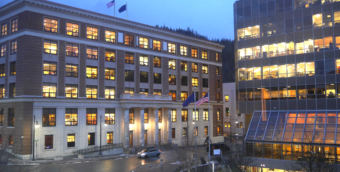
Alaska State Capitol building (left) and Dimond Courthouse, Juneau, Alaska, January. 23, 2017. (Photo by Skip Gray/360 North)

JUNEAU – Alaska lawmakers who each year relocate to a capital city accessible only by plane or boat are facing challenges in getting settled ahead of what is expected to be a difficult legislative session overshadowed by COVID-19.
The Baranof Hotel, a 1939 art deco showpiece in downtown Juneau with about 200 guest rooms, laundry service and a restaurant just blocks from the Capitol, is closed through the winter due to the pandemic.

Short-term housing rental offerings have been sluggish compared to last year, officials say, though they expect more places to become available as the session approaches and plenty of hotel options, as many events have been waylaid by the virus.

Still, with just over a month before session is set to begin, some lawmakers are waiting to lock down digs. One factor: uncertainty about how – and for how long – lawmakers plan to meet.

“If I need to, I’ll sleep in my office,” Sen. Scott Kawasaki, a Fairbanks Democrat, said with a laugh.

For years, he has shared a place with a fellow lawmaker. But he said the place they had last session is booked, and he was wary about signing a contract on a fallback option if lawmakers end up deciding to take an extended recess, as they did earlier this year.

Lawmakers would first have to meet in person if they wanted to change their rules to allow, for example, remote voting, said Jessica Geary, executive director of the Legislative Affairs Agency.

Kawasaki also wasn’t sure about bringing a car. Such a journey for lawmakers and staff on Alaska’s limited road system can involve crossing into Canada and driving across often brutally cold, treacherous landscapes to reach a ferry to get to Juneau.

Nonessential travel through Canada is restricted but Geary said a special arrangement with the Canadian Consulate allows legislators and staff passage on their way to Juneau.

Planning for how long to be in Juneau in recent years – outside the pandemic – has been a crapshoot, with lawmakers, facing ongoing budget deficits, often requiring special sessions beyond their constitutionally allowed four-month regular sessions.

In some cases, as the work dragged on, lawmakers had to scramble for alternative lodging as their leases expired and as Juneau’s tourist season began.

This year was different: Faced with the coronavirus threat, lawmakers passed a budget early, in late March, before taking an extended break. During part of the recess, they were automatically approved to claim a daily $287 allowance that some said helped pay lease and storage obligations.

Not all lawmakers took the allowance or took it for the full allowable period. The Legislature met again briefly in May before adjourning.

While there was an expectation lawmakers would return to consider Republican Gov. Mike Dunleavy’s appointments to boards and commissions and weigh an extended disaster declaration related to the pandemic, that never happened.

Legislative leaders have said they lacked the votes needed for lawmakers to call themselves into a special session, and they raised concern with Dunleavy unilaterally issuing a new declaration.

House Speaker Bryce Edgmon, an independent from Dillingham, about 860 miles from Juneau, said pandemic concerns come at a time when lawmakers will need to make tough budget decisions.

“I’m fairly anxious as to what this upcoming session could bring, on a number of fronts,” he said.

Rep. Mike Prax, a North Pole Republican who stayed at the Baranof during this year’s session, called its temporary closure a “bummer.” He said he doesn’t want to bring a car and hopes to find a place within walking distance to the Capitol. Several hotels are within a mile.

Lawmakers in other states are wrestling with how to conduct their upcoming sessions. In Washington, lawmakers plan a mix of virtual meetings and on-site votes. In New Mexico, lawmakers are debating a potential delay to the start of session in January or holding proceedings at a convention center with space to spread out.

In Alaska, a council that handles legislative business during the interim approved a contract for screening and testing at the Capitol for the upcoming session and proposed a code of conduct that includes testing before or upon arrival in Juneau and avoiding non-essential trips from the city. Geary said the next Legislature can decide whether to follow or change the policies.

Juneau City Manager Rorie Watt said he feels comfortable having the Legislature return, citing in part the protocols the council adopted.

He also said Juneau has good testing capacity and that residents have been good about wearing masks, keeping their distance and avoiding large groups.

Sen. Donny Olson, a Democrat, usually brings his wife and six children with him for session from the tiny community of Golovin, about 1,000 miles from Juneau.

He said finding a comfortable place with room for the kids to play is a factor as he and his wife weigh whether he should come alone, as is schooling. He said his children have had in-classroom instruction in Golovin. Juneau schools recently announced plans to resume in-person classes in January.

Olson, who is a doctor, said he was concerned some might not cooperate with the proposed protocols at the Capitol meant to guard against the virus.

“And because of that, trying to go ahead and safeguard myself and my children against the COVID is something that is high on my priority list,” he said.

Alaska joins Texas lawsuit to overturn presidential election

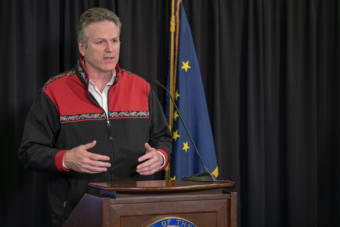
Alaska Gov. Mike Dunleavy speaks about the state’s COVID-19 response from the Atwood Building in Anchorage, Monday, April 20, 2020. (Creative Commons photo by Alaska Governor’s Office)

Alaska Gov. Mike Dunleavy announced his state will join a lawsuit attempting to overturn the results of the presidential election, days after Dunleavy said there is an “outside chance” Joe Biden will become the next U.S. president.

Dunleavy released a statement Thursday saying Alaska had joined a Texas case challenging election results in Pennsylvania, Georgia, Wisconsin and Michigan.
“While this case concerns election integrity, it also has an impact on state’s rights,” Dunleavy said.

Signing onto cases involving “the inner workings of other states” should not be taken lightly by Alaskans, Dunleavy said.

“However, the issue of election integrity impacts all of us, and the question of free and fair elections must be answered in order for all Americans to have confidence in our system,” Dunleavy said. “We hope for an expedited decision from the Supreme Court.”

The Texas lawsuit demands that the 62 total Electoral College votes from the four states be invalidated. That’s enough, if set aside, to swing the election to Trump. Texas Attorney General Ken Paxton’s lawsuit repeats a litany of false, disproven and unsupported allegations about mail-in ballots and voting in the four battlegrounds.

Legal experts dismissed Paxton’s filing as the latest and perhaps longest legal shot since Election Day, and officials in the four states sharply criticized Paxton.

Four Alaska House members and one representative-elect called on Alaska Acting Attorney General Ed Sniffen to file a brief supporting the Texas lawsuit. The Alaska Department of Law previously said a narrow timeline prevented Alaska from joining the lawsuit.

Dunleavy made the comment about Biden’s chance of becoming president Tuesday during an interview with the conservative political podcast Must Read Alaska, KTOO reported.

The Republican governor told hosts Suzanne Downing and John Quick that voter fraud accusations must be investigated and courts need to determine if fraud occurred.

“I’m just saying that I’m not there yet,” Dunleavy said. “But in the outside chance — and I’d like to word it that way — that there is a new administration, we will set up a relationship with that new administration and do the best we can to work with them.”

Court cases related to the 2000 presidential election were not resolved until well into December of that year, Dunleavy said.

The U.S. Supreme Court ruled on Bush v. Gore on Dec. 12, 2000.

“The people of America need to know that their vote counts,” Dunleavy said. “And if there is any suspicion of fraud, which there is, that really needs to be looked into.”

Voter fraud should be determined by courts, Dunleavy said.

“If it does exist, then that needs to be rectified. If it doesn’t exist, then that needs to be proven as well,” Dunleavy said.

Allies of President Donald Trump have filed dozens of lawsuits related to the election. No systemic fraud or consequential error has been established in an election that state monitors and courts have repeatedly found was run fairly.

Presidential electors are scheduled to cast their Electoral College votes Dec. 14.

33 inmates infected with COVID-19 in Fairbanks prison

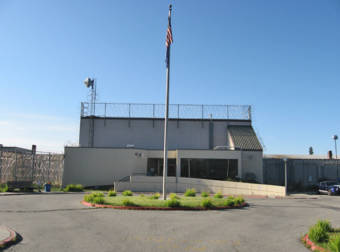
The Fairbanks Correctional Center (Photo from Department of Corrections)

An outbreak of coronavirus has infected 33 inmates at a prison in Fairbanks, causing the facility to go into quarantine for 14 days, state officials said Saturday.

Thirty-two of the cases at the Fairbanks Correctional Center are men and one is a woman, the Alaska Department of Corrections said in a statement. All of those infected were housed in the general population, the department said.

Other inmates are being tested for coronavirus, with results expected by Monday, the department said.

The inmates with coronavirus are being isolated in a separate unit of the prison. The facility serves northern Alaska and has male and female inmates. Some are serving sentences, others are awaiting trial.

The Department of Corrections “has been proactive in preventing the introduction and spread of COVID-19 in our facilities even before the first positive case was identified in Alaska,” said Nancy Dahlstrom, the department’s commissioner. “While we never wanted this day to come, the outbreak at FCC is an eventuality the Department has prepared for. Our focus at this point is on protecting those at the facility who are most vulnerable and identifying any additional cases in the institution.”

Alaska Air loses a nearly quarter of a billion dollars in second quarter

Alaska flight 64 takes off from Petersburg airport in July of 2018. (Joe Viechnicki/KFSK)
Alaska flight 64 takes off from Petersburg airport in July of 2018. The company lost $214 million in the second quarter of 2020. (Joe Viechnicki/KFSK)

SEATTLE (AP) – Alaska Air Group Inc. (ALK) on Thursday reported a second-quarter loss of $214 million, after reporting a profit in the same period a year earlier.

The Seattle-based company said it had a loss of $1.73 per share. Losses, adjusted for non-recurring gains, came to $3.54 per share.

The results fell short of Wall Street expectations. The average estimate of six analysts surveyed by Zacks Investment Research was for a loss of $3.39 per share.

The airline posted revenue of $421 million in the period, which topped Street forecasts. Four analysts surveyed by Zacks expected $307.7 million.

Alaska Air shares have decreased 46% since the beginning of the year. The stock has dropped 42% in the last 12 months.

Alaska census workers can disregard ‘no trespassing’ signs

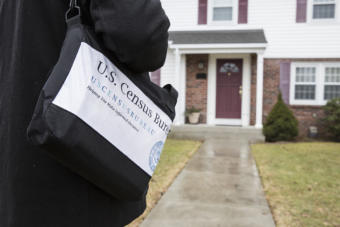
A man with a U.S. Census Bureau bag stands outside the front door of a suburban home.
(Photo by U.S. Census Bureau)

U.S. Census Bureau workers in Alaska will still approach properties and homes where signs warning against trespassing are posted, officials said.

The federal agency said workers canvassing communities to obtain resident information for the 2020 census are not bound by the warnings, The Fairbanks Daily News-Miner reported Thursday.

“The Census Bureau is allowed to disregard trespassing signs because we are by law required to give everyone the opportunity to respond to the census since it is a count mandated by the Constitution,” the bureau said in a statement.

The Census Bureau is the federal government’s largest statistical agency charged with accumulating national population and housing data once every decade. The bureau also conducts an economic census and a census of state and local governments every five years, according to its website.

Census employees in Alaska have been canvassing for about two months. The count in remote populations of the state is scheduled to begin in January, officials said.

Census workers are required to approach all properties but will comply with owners’ requests to leave, said Jeff Bottorff, an Alaska area census manager.

Canvassers who are told to leave will explain why they are there and leave census materials if the recipient wants them before departing, Bottorff said.

“If the homeowner, the residence owner, doesn’t want us there, we’ll leave,” Bottorff said.

Site notifications
Update notification options
Subscribe to notifications