Marijuana

With the rise of legal weed, drug education moves from ‘Don’t’ to ‘Delay’

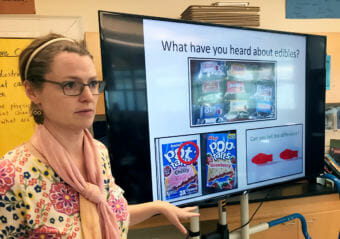
Dawn Charlton, an instructor with Being Adept, leads a discussion on marijuana for sixth-graders at Del Mar Middle School in Tiburon, California.
Dawn Charlton, an instructor with Being Adept, leads a discussion on marijuana for sixth-graders at Del Mar Middle School in Tiburon, California. (Photo by Carrie Feibel/KQED)

California legalized marijuana in 2016, and on Jan. 1, 2018, eager customers lined up in the darkness outside medical marijuana dispensaries across the state, ready to start shopping at the stroke of midnight.

The effect has gone beyond the cannabis cash register. Everyone has seen the ads or heard the chatter — and that includes minors, though marijuana remains illegal for those under 21.

“Coming out of SFO airport, there are billboards for Eaze [a weed delivery service] that say ‘Marijuana is here,'” says Danielle Ramo, a psychologist who conducts research at UCSF on adolescent drug use. “I’m not sure parents were expecting to see so many images of cannabis all over.”

The rollout of legal recreational marijuana in California and other states doesn’t appear to have led to any big changes in substance abuse prevention yet. But drug prevention education in schools has evolved significantly since the “Just Say No” days of the ’80s — and now typically takes an approach that’s more appropriate for the era of ubiquitous weed access. It’s one that emphasizes decision-making and critical thinking skills instead of abstinence.

To see it in action, I visited a school using the Being Adept curriculum — it’s an evidence-based curriculum that has been used in about 20 schools in the San Francisco Bay Area.

What I found was that drug abuse education today draws on decades of rigorous effectiveness research and the newest teaching techniques.

The PSAs that Gen-Xers may remember — the egg in a frying pan (“this is your brain on drugs”), or the boy calling out his dad’s drug use (“I learned it by watching you!”) — live on as memes, but they’re no longer used as messages.

“Those scare-tactic-based programs have tended to quite clearly not work, based on most of the research that evaluated its effectiveness,” Ramo says. “Today there is an entirely different mindset about school-based prevention.”

In a nutshell, the focus now is on facts, not fear. Also conspicuously absent are simplistic dictates like, “Just say no.” Instead, teachers spur students to examine data, speculate on motives, discuss risks, and deliberate on their own goals and values.

Ashley Brady, a Being Adept instructor, was completely open about her method when she stood in front of the eighth-graders at Marin Primary and Middle School, a private school in Larkspur.

Ashley Brady explains the increase over time in marijuana potency to a class of eighth-graders at Marin Primary and Secondary School in Larkspur, California.
Ashley Brady explains the increase over time in marijuana potency to a class of eighth-graders at Marin Primary and Secondary School in Larkspur, California. (Photo by Carrie Feibel/KQED)

“I’m not here to tell you what to do today. Not at all,” she begins. “I’m here to give you the most up-to-date information possible so that you can make your own healthy, informed decisions.”

Brady then jump-starts a fast-paced, fact-filled discussion on brain chemistry and physiology. She shows an animated video about how marijuana affects dopamine pathways in the brain. Then she leads a discussion about marijuana “edibles” and how the liver metabolizes them.

“It can take up to 30 minutes to maybe even an hour or two before it really hits you,” she says. “When somebody eats an edible and they don’t really feel the effects, what do you think happens?”

“They eat more!” a student called out.

“They eat more,” Brady nods. “Yeah, an hour, an hour and a half later? Boom! Like a freight train, they’ve been hit, and, you know, can barely move or can barely talk, that kind of thing. So they may have to go to the hospital.”

True, that sounds a little scary, but it’s presented neutrally, as a consequence at the end of a sequence of decisions.

Where the legalization of the marijuana industry has affected the content of these lessons is on the subject of potency. Brady tells the students that legalization has spurred competition and innovation among suppliers, to the point where they’re now churning out extremely potent and precisely calibrated forms of pot called “concentrates,” which comes in various forms.

Brady runs through their names: oil, bubble, shatter, wax and dabs.

“They call it a ‘dab’ because one tiny little nail head [of it] — I mean I’m talking like the end of my pinky — one tiny, little nail head is the same as three joints hitting the system all at once. So it’s a lot stronger than it used to be.”

Tests of THC levels in marijuana samples over the years back this up. Whereas a typical joint in the ’70s probably had a THC level of 4 to 5 percent, at best, growers are now breeding strains of cannabis that produce buds with THC levels as high as 20-30 percent.

The concentrates are in another category altogether. Processed concentrates sold at dispensaries now regularly test at 80, even 90 percent.

“It’s not the same drug,” Brady tells them. People sometimes vomit from concentrates. Some people hallucinate and have even become psychotic.

And yes, she adds, it can be addictive. Not just psychologically, but physically. People do go into THC withdrawal and do go to rehab for pot addiction.

Still, as she describes the transformation of marijuana from a relatively mild intoxicant to a potentially debilitating one, Brady never once says “that’s why you shouldn’t” or even “so please be careful.”

Afterward, the students applauded this approach.

“It made you feel more mature, and that you’re in control,” says Devon Soofer, 13. “This [class] was actually telling you the long-term effects and what it can actually do to you. So it actually made you feel like ‘Wow, this is actually really bad,’ and not just being forced not to do it.”

Later units in the Being Adept curriculum give students concrete tools: They rehearse what to do or say at parties, and talk about better ways to cope than using cannabis — or any substance.

Ramo, who serves as a scientific advisor to Being Adept, decries “the overwhelming stress, anxiety, depression, suicidality that is so pervasive among teens in the United States today, especially in high-intensity educational areas, like a lot of schools in the Bay Area are.”

“Addressing that problem is key,” she added, as is “having teens come up with solutions to manage their stress, that they actually would use.”

“Delay, Delay, Delay”

So if drug educators aren’t telling students “Don’t!” anymore, what exactly are they telling them to do? As I observed, they’re not overtly telling them to do anything, because teens are naturally resistant to the authoritarian approach — and some of them may resist to the point of doing the opposite.

Jennifer Grellman, a psychotherapist in Kentfield, Calif., and the founder of Being Adept, sums up the strategy in three words, just like the “Just Say No” campaign: “Delay, delay, delay.”

“The way to handle that with your kids is to say: ‘You know, you don’t have to use this now. Maybe you want to use it someday, but not today, not now. It will always be there.’ Just tell them to wait.”

Grellman says that advice may be more palatable for some teens, and therefore easier for parents to deliver.

They’re not forbidding something (and possibly making it more enticing). They’re not saying “never.”

The instructors put a special emphasis on a less visible risk: the potential damage to their brains.

“More research is coming out looking at the ways in which all different kinds of substances can hijack normal brain functioning, and particularly so in adolescence,” Danielle Ramo explains.

“In heavily cannabis-using teens, there are some particularly important implications of using cannabis on the frontal lobe, and that interrupts a type of thinking called ‘executive functioning.’ ”

Also worrisome is a substantial body of research showing that using any potentially addictive substance while the brain is still developing — whether alcohol, marijuana, nicotine, or other drug — triggers neurological changes that can lead to addiction.

“The earlier teens start using, the more heavily they use in adolescence, the more likely it is that they’ll go on to have problems throughout their adulthood,” says Ramo.

Being Adept instructors don’t say it outright, but the message is clear: If you’re not going to abstain, just push it off for a while. Your brain is too vulnerable right now.

The Role of Parents

Grellman says parents should talk about drugs and alcohol with their kids often — as early as fourth grade. For California parents, she suggests using the new billboards or marijuana ads as an excuse to bring up the topic.

Broach the subject obliquely: What do people at your school think about those ads? Do any of your friends know what a dab actually is? Did you see this article on the seventh-grader getting expelled for pot in his locker? What do you think about that?

She says to listen to what they say and discuss it — try not to lecture, but be clear about your expectations, and your values around drugs and alcohol.

At every school where Being Adept is taught, Grellman offers a “Parents Night” where parents can learn how to navigate those conversations. It’s not just what parents say, she says, it’s what they do. Children are always watching how their parents use substances.

“Don’t glamorize it,” she advises. “It doesn’t mean you have to become a monk and never have a drop of alcohol, but please drink responsibly.” And, she says, don’t use it for stress control.

“This idea of coming home from the office and saying ‘I’ve got to have my glass of wine’ — if you want to have your glass of wine, have your glass of wine, but don’t announce it! That you’re just at wit’s end, and you have to have this drink.”

Grellman says the modeling part becomes tricky when kids ask parents about their past: Did you party? What drugs did you use?

When she led the Parents Night in March at Marin Primary and Secondary, she advised parents to get ready for that moment, and have answers prepared.

If you did party in high school, don’t lie, she told them. If a kid senses dishonesty or hypocrisy, they’ll shut down. The most important thing is to keep the conversations going. If your child knows they can talk to you, no matter what, they will create a “safety plan” with you. They will reach out to you when trouble comes.

“You don’t have to tell the full story,” Grellman said. “You could say: ‘You know, I did smoke and I did drink when I was 13.’ And if you loved it, I don’t know if I would advertise that.

“You could say, ‘I did smoke, or I did drink, when I was 13. And you know, frankly? It was too early for me, man. I made some stupid decisions and I got in trouble.’ You can give them the consequences of it.”

Afterward the evening, parents said they felt relieved to have concrete suggestions about how to talk with their kids, and how much was OK to bring up.

“It’s much more prevalent than it was when I was growing up in the ’80s,” said Joseph Sullivan, a physician from Larkspur.

“This is a different time, and so it’s nice to hear that we’re almost given permission to be talking about these different aspects of drug experimentation at different ages,” he added.

His wife, Dr. Sara Sullivan, said she’s glad that the “just say no” paradigm is dead.

“Just to give the kids more information, I think, is such a different way to approach it and I really appreciate that. And we’ve kind of started to have conversations in our family because of that,” she explained. “To really kind of take that approach and not be like ‘You’re kind of out there on your own.’ ”

This story is part of a reporting partnership with NPR, KQED and Kaiser Health News.

Copyright 2018 KQED. To see more, visit KQED.

Make money from pot? Then forget about a federally subsidized loan

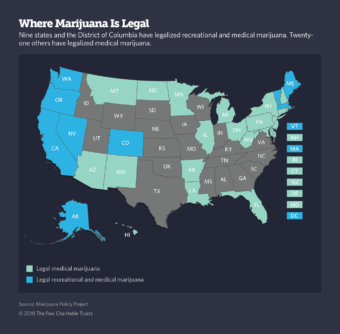
Source: Marijuana Policy Project. (Graphic by Pew Charitable Trusts)

Marijuana legalization at the state level has created a moneymaking opportunity not only for licensed growers and sellers but also for a wide range of ancillary businesses, from publicly traded garden product companies to local print shops.

Now a new Small Business Administration policy could force some entrepreneurs to choose between serving cannabis clients and getting a federally subsidized loan.

In an April policy notice, the federal agency said it won’t approve loans to businesses that derive any portion of their revenue from sales to marijuana clients, because the drug is illegal under federal law.

The policy could hurt local nature centers, architects, designers, attorneys and other businesses that occasionally work with licensed weed industry, legal experts say.

Supporters of cannabis legalization are speaking out against the lending policy.

“This rule would be impossible to implement and wreak havoc across multiple sectors of the economy,” said Oregon Rep. Earl Blumenauer, a Democrat, in a recent letter to the SBA. “For example, would just one order from a cannabis business for soil preclude a locally-owned garden center from receiving federal government loan support in the future?”

Nine states and Washington, D.C., allow marijuana to be sold for recreational and medical use and 21 others allow it to be sold for medical use.

Nationwide, sales of the plant and its products hit an estimated $8.6 billion in 2017 and supported over 121,000 jobs, according to a report from the Arcview Group and BDS Analytics, cannabis industry research firms. That’s almost double the sales Arcview estimated for 2014.

Even more jobs have been created at non-marijuana businesses. In states where marijuana is legal, it’s easy to find marketing agencies that create campaigns for cannabis brands, greenhouse manufacturers that sell products just for marijuana growers and commercial printers that offer new services for marijuana clients.

The SBA has backed over 300,000 loans nationwide since fiscal 2013, and some loan recipients are currently serving cannabis clients, according to a cursory Stateline review of federal loan data and company websites. The agency’s new policy could make them ineligible for future loan assistance.

Take the Green Sunshine Company, a Portland, Oregon-based business that makes lighting systems for growing plants and has used social media to promote its success with cannabis growers. A company representative said the lighting technology is made for anyone who wants to grow indoor plants, and that he may not know what customers intend to grow.

The Green Sunshine representative didn’t want to disclose his name – a reticence shared by several other SBA loan recipients whose websites boast of pot-related clients, but who declined to comment on the new policy.

The SBA isn’t answering questions, either. “Please be aware that the Small Business Administration is not making any comments at this time,” Cecelia Taylor, an agency spokeswoman, said in an emailed statement.

It may be too soon to assess the impact of the policy, said Barbara Vohryzek, president and CEO of the National Association of Development Companies, a trade association for lenders that provide SBA-backed loans.

She said she’s not sure why the agency made the new policy but it may be because the licensed marijuana industry has grown too big to ignore. “It’s becoming an issue that they’re having to address,” she said.

The latest federal crackdown

The SBA’s move to restrict loans to companies that touch marijuana money is the latest example of a federal agency obeying federal law and hurting pot entrepreneurs in the process, said Michael Correia, director of government relations for the National Cannabis Industry Association.

“It doesn’t shock me or surprise me in any way,” he said. Government agencies are risk averse, and would rather say no to the cannabis industry than get into trouble with the Justice Department, he said. Federal law classifies marijuana as a Schedule I controlled substance, on par with heroin and ecstasy. U.S. Attorney General Jeff Sessions is also a prominent opponent of legalizing the plant.

The SBA doesn’t make loans directly. Instead, it guarantees loans, allowing banks to lend money to businesses on better terms. Businesses are eligible for the loans based on the size of their revenues and number of employees, among other factors. Under longstanding federal law, businesses can’t get government-backed loans if they engage in illegal activity.

The agency issued updated guidance last October that said borrowers are ineligible for federally-subsidized loans if they lease space to businesses that violate federal law, including marijuana dispensaries. In April, the agency issued clarification on the marijuana issue – among others – in response to feedback from lenders.

“Because federal law prohibits the distribution and sale of marijuana, financial transactions involving a marijuana-related business would generally involve funds derived from illegal activity. Therefore, businesses that derive revenue from marijuana-related activities or that support the end-use of marijuana may be ineligible for SBA financial assistance,” the notice said.

Ineligible businesses include both those that directly touch cannabis plants, such as growers, processors, distributors and retailers, and businesses that derive any gross revenue from sales to growers, sellers and the like, the notice said.

It cited businesses that sell bongs, grow lights and hydroponic equipment as examples of potentially ineligible borrowers, and said some hemp businesses also may be ineligible for loans.

The new SBA policy could hurt non-white entrepreneurs who have been pushed to the fringes of the cannabis boom, said Kayvan Khalatbari, who chairs the board of the Minority Cannabis Business Association, a business group that advocates for equal access to the industry.

“We’ve see a lot of people of color move to ancillary businesses in this space,” he said, in part because they tend not to have the capital to start a licensed dispensary or grow operation. Khalatbari said it’s “really unfortunate” that such businesspeople will lose the opportunity to get a low-cost loan.

A challenge to enforce

SBA staff may not be commenting publicly, but they’re privately telling banks to increase their due diligence to make sure potential borrowers have no ties to the marijuana trade.

Mark Abell, senior vice president and SBA division director at NBH Bank, said SBA officials have told him that banks should carefully review borrowers’ websites to make sure they’re not marketing to the pot industry. If banks see any red flags, they should submit the prospective borrower’s file to the federal agency for legal review.

He said his bank also has started requiring all prospective borrowers to certify, to the best of their knowledge, that they have no connections to the marijuana industry. No loan applications have been denied yet, he said.

“When you’re in a market like Colorado, cannabis is pretty pervasive,” Abell said, and it’s hard to figure out if non-marijuana businesses are profiting from cannabis. “A business that sells online may not know if it’s selling to the cannabis industry,” he said. NBH Bank has branches in five states, including Colorado, where Abell is based.

Steve Schain, an attorney at the Denver-based Hoban Law Group who focuses on banking and cannabis law, says he doesn’t think the new lending policy will work. “I think it’s almost impossible to implement,” he said, because it’s impossible to police every business transaction.

The policy may create unreasonable due diligence requirements for companies, too, said Andrew Freedman, Colorado’s former “pot czar” and now a consultant working on marijuana legalization. “Making sure that you’re not doing it is much harder than a regulatory system for doing it,” he said.

Freedman gave the hypothetical example of a small electrical services business that occasionally works with indoor marijuana growers. Does the owner now need to train his electricians to identify marijuana businesses? “That’s the part where I’m like, ‘This could be real trouble,’” Freedman said.

Abell said it makes sense that companies that exist for the sole purpose of serving the marijuana industry—such as some businesses that sell grow lights—shouldn’t be getting federal loan aid.  “I think we should all agree that that isn’t a business that should get SBA financing,” he said. But businesses that just happen to serve cannabis clients operating legally in the state – such as garden supply centers – are a different matter, he said.

The SBA may rethink its policy in the future, Abell said. “I’m optimistic that ultimately, we’ll get to a more reasonable place.”

Homer’s first pot shop set to open Thursday

Uncle Herb’s (Photo by Aaron Bolton/KBBI)

Homer’s first marijuana retail shop is set to open Thursday. Uncle Herb’s was approved by the state Marijuana Control Board back in September, and the shop will open its doors just in time for the busy summer season.

Store manager Aaron Stiassny will run the shop in Homer for his father Loyd. Stiassny currently manages the family’s shop in Anchorage under the same name.

The display cases in Homer were empty Wednesday evening, but Stiassny said the shop will be stocked and ready to go.

“I mean we’re just really excited to be the first cannabis shop in Homer. I know there’s a lot of residents eagerly awaiting the first cannabis shop,” Stiassny said as he stood behind the counter. “It’s a great opportunity to bring this business down here. This is going to provide good sales tax revenue for the community. We really want to be good citizens.”

Stiassny said the shop will offer about 15 to 20 marijuana strains to start. He adds that Uncle Herb’s will purchase a large portion of its marijuana products from cultivators on the Kenai Peninsula, but it will also feature strains grown by cultivators in and near Homer.

Stiassny explains that the shop will also offer strains high in CBD content, which are said to provide pain relief, in the future.

“Flower and pre-rolls will be the two main staples for our opening, and we have deliveries of concentrates and cartages and edibles,” he explained. “I don’t know if they are going to make the opening on Thursday, but we will definitely be stocked up sometime next week.”

Uncle Herb’s has hired eight part-time employees so far. Stiassny said that could change depending on business during the summer, and he said the shop’s hours will be 10 a.m. to 10 p.m.

“Those may change over the course of the summer depending on traffic. Opening day, we’re going to delay that, 2 [p.m.] to 10 [p.m.], just to give us some time to set up in the morning and get ready for the excitement,” he said.

Stiassny hopes to capitalize on Homer’s busy tourism season, but he said the shop will stay open year round.

Uncle Herb’s joins the roughly 30 marijuana cultivation, manufacturing and retail businesses in the Kenai Peninsula Borough.  It’s the first retail shop to open on the southern Kenai Peninsula.
Urged by Alaska veterans, Sullivan supports cannabis research at VA

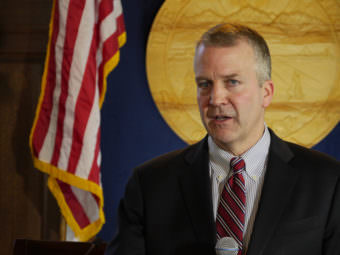
U.S Sen. Dan Sullivan talks with reporters during a press availability Feb. 24, 2017, following his annual address to the Alaska Legislature. (Photo by Skip Gray/360 North)

Alaska Sen. Dan Sullivan is co-sponsoring a bill that would direct the Department of Veterans Affairs to research medicinal cannabis.

The bill calls on the VA to look into the “efficacy and safety” of cannabis in the treatment of veterans diagnosed with “chronic pain, post-traumatic stress disorder” and other conditions.

Twenty-nine states have legalized the medicinal use of cannabis, but it still remains illegal under federal law. That’s why it has been unclear if the VA is allowed to research cannabis, and the bill would specifically authorize the department to do so.

Sullivan said the legislation has his support because he’s heard veterans say in conversations and in public testimony that the VA should look at the benefits of cannabis.

“Some have tried to find the benefits of dealing with pain through self-medicating marijuana, and doctors, particularly at the VA need to understand this and how it can affect their diagnoses, and I have heard from veterans that this has been helpful,” Sullivan said.

Sullivan cited the over-prescription of opioids and the rising number of overdose deaths in the past year as reasons veterans are looking for other treatment methods.

Medicinal cannabis has been legal in Alaska for more than two decades, and Alaska voters legalized its recreational use in 2015 through a ballot initiative.

Sullivan has said he did not support the initiative, but said he accepted the mandate of state voters when it passed.

Sullivan said he thinks views of cannabis are softening, in general, in Washington, D.C., after strong nationwide support for its medical use and the handful of states that have legalized its recreational use.

“I think there’s kind of a combination of people seeing the medical benefits, but also 10th Amendment elements of this, where the states have come out in statewide referendums like in Alaska, where they’ve come out in support, and even members of Congress who weren’t supportive or aren’t supportive of those kinds of referendums are saying, ‘Hey, look, the people are speaking … states have the right to do this,’” Sullivan said.

Sullivan, a Republican, is the lone co-sponsor of the VA cannabis research bill by Sen. Jon Tester, a Democrat from Montana.

Alaska Congressman Don Young, a Republican, is one of 55 co-sponsors on an identical bill in the U.S. House.

Alaska marijuana business license applications piling up

FAIRBANKS, Alaska — The number of applications for marijuana business licenses is outgrowing the Alcohol and Marijuana Control Office’s approval system.

The Fairbanks Daily News-Miner reports a May 8 Marijuana Control Office spreadsheet says there are 467 applications being processed with another 46 businesses set for inspection.

Brandon Emmett of the Alaska Marijuana Control Board, which oversees the office, says there is discussion of making Marijuana Control Board meetings longer to deal with the backlog of applications and also to manage the need to revise state regulations.

Emmett also says raising application fees could help cover the cost of hiring more staff.

Emmett says the Alaska Marijuana Industry Association and the Marijuana Control Board requested more state funding from the Legislature for the Alcohol and Marijuana Control Office, but the request was denied.

Fairbanks ordinance to limit marijuana retail shops to 25

Most of the standing-room-only crowd that turned out for Monday’s City Council meeting identified themselves by wearing red shirts, for those supported stricter marijuana regulation, and green shirts, for those favoring looser regs. (Photo by Tim Ellis/KUAC)

After a heated debate, the Fairbanks City Council approved an ordinance Monday that added regulations to the marijuana industry.

The amended ordinance maintains the city’s ban on on-site consumption of cannabis, but it would allow more than twice as many retail shops as the original introduced by Mayor Jim Matherly three months ago.

Council chambers were packed with partisans for and against the marijuana-regulating ordinance.

Councilmembers debated a flurry of amendments to the ordinance, starting with a provision limiting the number of retail shops in the city to 12, the number of shops that were either currently operating or about to open.

“Nine were open, three were in the queue — that’s where I originally started with the 12 to get it on the table for discussion,” Matherly said.

Jerry Cleworth and June Rogers introduced the substitute ordinance setting set the limit at 15, based on the principle that marijuana ought to be regulated like alcohol, as legalized-marijuana supporters have long advocated.

“Right now, inside the city, we have 15 operating package stores, which is the equivalent to a retail establishment for cannabis,” Cleworth said.

Valerie Therrien moved to amend the substitute ordinance to eliminate the limit and to delete a provision that would require the city to reduce that number to 11 over time.

“We don’t need to put a number on the number of establishments that we need to have in our community,” Therrien said. “I believe that zoning is going to take care of that.”

The council members approved that proposal 5-1, with Cleworth dissenting.

Therrien then moved to increase the retail-store limit to 25. She said that would be fair for the six shops now in business, as well as the three that are close to opening and 16 others that’ve submitted applications and are under review by the state Alcohol and Marijuana Control Office.

“I don’t think it was fair to the marijuana industry to limit the number of licenses after people had already initiated and spent their money,” Therrien said, “And now say to them, ‘Oh, we’re going to cut it down to 15.’”

The council narrowly approved setting the limit at 25, after a lengthy debate, with Cleworth, Rogers and Jonathan Bagwill voting no and Joy Huntington, David Pruhs and Therrien voting yes. Matherly cast the fourth and tie-breaking affirmative vote.

Pruhs and Therrien also prevailed in a vote to eliminate a proposal to establish a new method of measuring the minimum buffer of 750 feet between a marijuana retail shop and residential areas, schools and rehab facilities.

Their amendment re-established the use of the borough’s simpler system of measuring property line to property line.

They did not succeed in convincing the council to go along with a provision to authorize establishments to allow consumption of marijuana on-site.

Pruhs told marijuana advocates at the meeting that’s unlikely to happen anytime soon.

“No one on this council has a taste for on-site consumption,” Pruhs said. “It’s not legal in the state of Alaska. It’s not legal in Fairbanks.”

But the council approved the amended ordinance 6-0. Afterward, Matherly suggested to all in attendance that they may not have heard the last word on the issue.

“This is not the last you’ll see of this ordinance, I’m sure, and the discussion surrounding it,” Matherly said. “Just so everyone knows.”

But for now, the city’s marijuana industry has for the first time a complete set of rules under which to operate.

Site notifications
Update notification options
Subscribe to notifications