JUNEAU — Marijuana tax revenue in Alaska fell for the second straight month in December, though a state tax auditor says the slide may be short lived.
The state says it collected about $784,000 in marijuana tax revenue in December.
That compares with about $869,000 in November and about $920,000 in October, which is the most that has been collected in a single month since the collection of marijuana taxes from state-licensed businesses began in October 2016.
The tax is imposed when marijuana is sold or transferred from a marijuana cultivation facility to a retail pot shop or marijuana product manufacturing facility.
Tax auditor Dustin Heintzelman said preliminary reports indicate tax revenue for January will be about $1 million. He declined to speculate on why revenue tumbled in November and December.
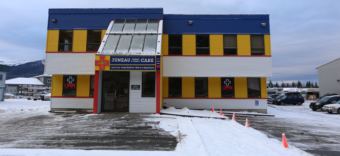
The doctor that owns Juneau Urgent and Family Care on Old Dairy Road, seen here on Jan. 26, 2018, plans to add a marijuana retail, manufacturer and cultivation operation in the same building. (Photo by Annie Bartholomew/KTOO)
A Juneau doctor is going into the marijuana business.
The owner of Juneau Urgent and Family Care has received local and state permits to grow, process and sell pot out of the same building as his clinic on Old Dairy Road.
Dr. Norvin Perez applied to the state board that licenses marijuana businesses late last year.
“I’m trying to think how to put this,” board member Mark Springer asked the doctor who was on the phone. “Have you ever suggested cannabis or cannabis products that some of your patients might want to consider?”
Yes, the doctor replied. But less than 10 times. There was concern on the board that the doctor’s medical clinic and pot business would be intertwined.
Not so, he said. The two might share the same address but they’d have separate entrances and keep different hours.
Still, some say confusion will be inevitable.
“You’re advertising this as a medical facility, this is urgent care, all of that’s advertised up front,” said Loren Jones, who sits on both the Alaska Marijuana Control Board and the Juneau Assembly. “Then you have this marijuana business in the back in which it will probably be minimally advertised, minimal signs, but people will still connect that medical practice to the marijuana.”
Despite his reservations, Jones voted to approve the doctor’s marijuana permits.
There wasn’t any legal reason not to.
“We have setbacks from churches, schools, correctional facilities, daycare if you want,” Jones said. “We don’t have any rules about setbacks away from medical facilities or doctors’ offices.”
Perez declined to be interviewed, as did his business manager, who said it would be premature to talk ahead of the business opening.
This won’t be the first Alaska doctor going into the marijuana business. But the arrangement is unique.
But retailers cannot make medical claims about their product.
Medical marijuana can be grown and supplied to patients, as long as no money changes hands.
“There is no medical market from a standpoint of anybody that can grow it and dispense it and then sell it to a patient — that market does not exist,” said Dr. Matthew Peterson, a practicing physician in Wasilla, who also owns a marijuana business.
Doctors are protected under the First Amendment to recommend pot to their patients. But medical ethics make it tricky if they’re also licensed to sell it.
“The advice that I was given is because I’m in the industry and I’m also a medical professional, that it would be a conflict of interest for me to put myself in a position where I am recommending medical marijuana,” Peterson said. “If I have a patient that’s wanting to do this I would not be the one that is making that recommendation.”
Then there’s the federal angle. The possession and sale of marijuana remains illegal under federal law.
“Our DEA registration is the license that allows us to prescribe controlled substances,” Peterson said. “As a physician if you cannot prescribe controlled substances, then it kind of limits your medical practice. I don’t put myself in that conflict of interest.”
What does Alaska’s mainstream medical establishment think about physicians profiting off pot?
It’s hard to say: both the head of the Alaska State Medical Association and the state’s chief medical officer declined to comment.
The state’s marijuana industry is pleased that more doctors are entering the business.
“I think it’s great. Of course he’s going to need to maintain a strong wall between the two businesses, which I’m sure he will,” said Lacy Wilcox, a board member of the Alaska Marijuana Industry Association.
She also has a marijuana business in Juneau and said she’s glad more doctors are endorsing pot.
“We’re not of course permitted to talk about therapeutic benefits in Alaska,” she said. “But there’s a benefit and if he sees it and he sees it enough to enter into the business arena, then I think it’s a great evolution for our industry.”
It’s likely Perez’s combined clinic-and-pot shop will be scrutinized when it opens later this spring.
The Marijuana Control Office’s field agents have already cited businesses that claim cannabis is medicine.
Correction: An earlier version of this story misidentified an Alaska Marijuana Control Board member and misnamed a business. Board member Mark Springer posed the quoted question about cannabis suggestions, not Peter Mlynarik. And the clinic business is named Juneau Urgent and Family Care, not Juneau Urgent Care & Family Medical Clinic.
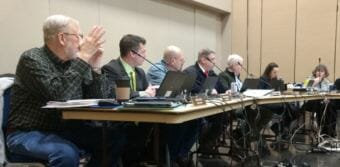
The selection of Mark Springer of Bethel as chair came during the Alaska Marijuana Control Board’s Jan. 24 meeting in Juneau’s Centennial Hall. (Photo by Jacob Resneck/KTOO)
The board that regulates Alaska’s legal marijuana industry has a more industry-friendly chair. State marijuana regulators also reacted to the Trump administration’s more hard-line approach to pot.
Mark Springer was elected Wednesday by fellow board members on the Marijuana Control Board.
Board member Brandon Emmett, an active proponent of legal marijuana, praised Springer’s tenure to date.
“You’ve been a member of this board since its inception and I feel that you’ve brought a measured approach to all the decisions you’ve made on the board,” Emmett said. “I think you make a fine chair.”
A Bethel city councilman, Springer replaces Soldotna Police Chief Peter Mlynarik, who some pot business owners had accused of being a “prohibitionist” hostile to the industry.
Alaska Marijuana Industry Association executive director Cary Carrigan said by contrast Springer has proven even-handed.
“I consider him extremely objective and consider him really well-read and thoughtful about what he makes decisions on,” Carrigan said after the vote. “And I’ve seen him pull back on things that which I thought could have been pushed forward but at the same time I think it’s because of that thoughtful approach that I think he’s going to be a really big addition and I really approve of him as being the chair.”
Mlynarik resigned this month after U.S. Attorney General Jeff Sessions released a memo calling marijuana “a dangerous drug.”
Sessions’ also rescinded Obama administration-era legal guidance to federal prosecutors advising them to defer to state laws.
Mlynarik explained his resignation saying the Trump administration’s posture undercut the legitimacy of state-regulated marijuana.
“In terms of the day-to-day operation of Alaska’s licensed marijuana businesses, the Sessions memo by itself doesn’t change things,” said Assistant Attorney General Harriet Milks, who advises the marijuana control board.
She told the board that the most troubling aspect of Washington’s hostile approach is the roadblocks that remain for banks to do business with the industry.
“There’s some concern – it’s just concern – that financial institutions will be ever more reluctant to work with cannabis businesses,” Milks told the board. “That will leave the multi-billion dollar cannabis industry highly vulnerable, or more vulnerable, to criminal activity — not to mention creating problems for states’ efforts to track and collect taxes.”
Most banks already refuse to accept the proceeds of legal marijuana for fear of running afoul of federal laws.
Mlynarik’s resignation also left an opening for a public safety designee on the board, which has since been filled by Gov. Walker who’s appointed North Slope Borough Police Chief Travis Welch.
Welch’s appointment and the reappointment of two other sitting members will be subject to confirmation by the Alaska Legislature.
Correction: An earlier version of this story misstated when Peter Mlynarik resigned. He resigned this month, not last month.
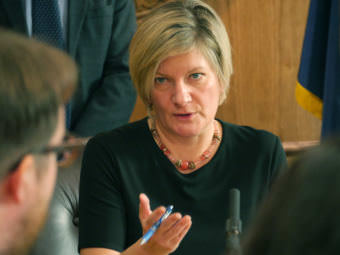
Alaska Attorney General Jahna Lindemuth discusses a lawsuit the state is filing against Purdue Pharma in the state Capitol on Oct. 31, 2017. Purdue makes the prescription pain pill OxyContin. (Photo by Skip Gray/360 North)
Alaska’s attorney general has joined a bipartisan group calling on lawmakers to change federal banking rules over handling legal marijuana sales.
Alaska Attorney General Jahna Lindemuth and 18 other attorneys general sent a letter to congressional leaders asking for legislation that would establish a “safe harbor” for the billions of dollars being generated from recreational and medical cannabis sales each year.
They ask that a financial institution be established in a state with legal marijuana in order to monitor compliance, simplify taxation and provide law enforcement a better vantage point to track industry finances.
The letter also says the move could help bolster the banking sector by infusing huge sums of cash that are currently barred from deposit and circulation because of federal drug laws.
The signatories are from across the country but slant toward generally Democratic-leaning states.
Earlier this month, U.S. Attorney General Jeff Sessions issued a policy switch to the Justice Department, scrapping the 2013 Cole Memo that deferred to states on enforcing marijuana laws.
The 19 attorneys general say in their letter that change is hastening the need for national legislation clarifying how cannabis should be regulated and policed in states that have voted for legalization.
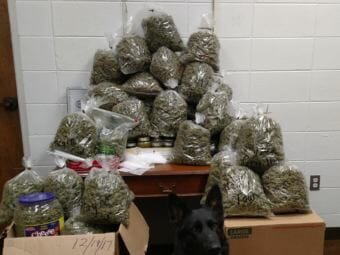
Sheriff’s deputies in York County, Neb., stopped a pickup truck on Tuesday when they noticed it driving over the center line and the driver failing to signal.
During the traffic stop, deputies noticed a strong smell of raw marijuana, the sheriff’s department says.
Patrick Jiron, 80, and Barbara Jiron, 83, said they were from northern California and were en route to Boston and Vermont.
Deputies asked the driver, Patrick Jiron, about the odor, and he admitted to having contraband in the truck and consented to a search of the vehicle.
With the help of the county’s canine unit, deputies searched the Toyota Tacoma. When they looked under the pickup topper, deputies found 60 pounds of marijuana, as well as multiple containers of concentrated THC.
“They said the marijuana was for Christmas presents,” Lt. Paul Vrbka told the York News-Times. The department estimated the street value of the pot at over $3oo,000.
The Jirons now face felony charges of possession of marijuana with the intent to deliver and no drug tax stamp. (Nebraska law requires marijuana dealers to purchase drug tax stamp from its Department of Revenue as evidence that the state’s drug tax has been paid.)
For the friends and family in New England who expected a bag of weed in their stocking this year, it looks like it won’t be a green Christmas, after all.
Copyright 2017 NPR. To see more, visit http://www.npr.org/.
One of Alaska’s biggest makers of edible cannabis products has been stripped of its license in an unprecedented move by state regulators.
Frozen Budz in Fairbanks was one of the first legal cannabis businesses to open in the state. After having its manufacturer’s license revoked Friday, Frozen Budz now holds another important distinction.
“The marijuana board, they’ve had some disciplinary actions for various types of violations, but they’ve never considered a license revocation before and they have never revoked a license,” said Erika McConnell, director of the state Alcohol and Marijuana Control Office.
Along with a $500,000 fine, the Marijuana Control Board ordered the seizure of all of Frozen Budz products around the state.
Frozen Budz is known for supplying popular edible products to retail shops, items with names like Cannabanana Bread, Toker Chai Tea and Dankchip Cookies.
The company has a separate retail license for a shop in Fairbanks, which is not affected by the board’s revocation decision.
State officials had issued a suspension earlier this month at Frozen Budz manufacturing facility for a range of alleged violations, including selling thousands of untested edibles, some of which contained mold and others that state investigators found to contain two or three times the legal limit of THC, the psychoactive component in cannabis.
McConnell said Frozen Budz also is alleged to have allowed on-site consumption at its premises and delivered products directly to consumers, both of which are illegal.
And McConnell said there was another problem: Frozen Budz failed to keep track of the origin of marijuana used in making thousands of edibles.
In an effort to prevent black market pot from making it into the legal market, regulations require precise tracking of marijuana products from seed to sale, but that’s not what was happening for thousands of edibles at Frozen Budz, McConnell said.
“It was like those edibles appeared out of thin air,” McConnell said. “Now it’s possible that that’s just a mistake in the tracking system, but if you were doing a good job with your inventory management, you would’ve found this mistake and then you would’ve been able to go back and correct it.”
In an interview this week with the Associated Press about the initial license suspension, a Frozen Budz owner blamed the discrepancies on computer software problems.
Frozen Budz did not respond to a request after the license revocation Friday for further comment.
Close
Update notification options
Subscribe to notifications
Subscribe
Get notifications about news related to the topics you care about. You can unsubscribe anytime.