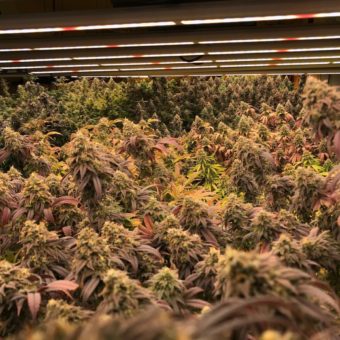
Marijuana plants grow at Rainforest Farms’ facility in Juneau in this 2016 photo. (Photo courtesy Rainforest Farms)
Whether the Trump administration will enforce the federal ban on marijuana in Alaska remains ambiguous.
U.S. Sen. Lisa Murkowski asked Deputy Attorney General Rod Rosenstein about cannabis policy at a hearing Tuesday. Rosenstein at times took a hard line.
“We follow the law and the science. And from a legal and scientific perspective, marijuana is an illegal drug,” he said “It’s properly scheduled under schedule 1.”
Murkowski asked about the Cole Memo — a 2013 document that says the feds will not take enforcement action in states, like Alaska, that have opted to legalize and regulate cannabis.
Rosenstein said he intends to discuss it with the new U.S. attorneys, once they take office.
Schapelle Corby’s trial was covered feverishly by the Australian media and broadcast on multiple television networks. Her guilty verdict and twenty-year sentence caused outrage and calls for boycotts of Bali, a popular tourist destination for Australians. Firdia Lisnawati/AP
It’s not entirely clear why Schapelle Corby’s case so captivated a nation.
The Australian woman was 27 in 2004 when she was caught with 9 pounds of marijuana in her bag upon landing in Bali for a two-week vacation. She was convicted in 2005, and sentenced to 20 years in prison. That sentence was ultimately reduced, and in 2014 she was released on parole. Now, she is set to return home to Australia this week.
Before her arrest, Corby was an ordinary young woman, working in her family’s fish and chip shop in the suburbs of Australia’s Gold Coast.
And yet, as TheSydney Morning Herald reports, hundreds of thousands of Australians watched in 2005 as Corby tearfully awaited her verdict. The Associated Press compared the “media bonanza” of her trial to that surrounding O.J. Simpson’s. Corby has inspired an HBO documentary, “Free Schapelle” T-shirts, and a call for a boycott of tourism to Bali. Her case inspired diplomatic dramas between Indonesia and Australia, and even a new slang term — to be “schapelled,” or “screwed over, brutally.”
Corby has always maintained her innocence, which might explain in part why her case has captured so much attention. A photogenic young woman, her face was splashed across tabloid covers and television screens. Fiona Connolly, editor-in-chief of Woman’s Day magazine, recently told The Sydney Morning Herald, “I was the first person to put Schapelle on a magazine cover. My publisher said, ‘Are you joking me?’ But that issue sold its socks off. She’s a profitable cover star.”
An unauthorized version of Michael Buble’s song Home played on Australian radio stations during her trial, mixing in quotes from Corby. Far from being upset about the remix, Buble told TheSun Herald he was glad his song was being used to cover the case.
“This song was written for people who are going through hard times such as this. I hope she can find her way home,” Buble told the paper in 2005.
Some have speculated that Corby’s case became sensationalized in part because she was so “ordinary.” As Australia consular affairs expert Alex Oliver told The Sydney Morning Herald, “It could have been me or my child.” Many Australians travel to Bali (1.14 million in 2016, according to Traveller.com) and perhaps Corby was simply easy to project anxieties on. Australian travelers now often wrap their suitcases in cling film to prevent tampering with luggage, according the Herald.
But support for Corby sometimes took on ugly, nationalist tones.
In an academic paper in The International Journal of the Humanities, media studies professor Anthony Lambert argued that Corby became a symbol of national identity for Australia. She represented whiteness, female vulnerability, and perhaps the suggestion of “Western ways of being under threat” as she faced trial in a foreign country, in a foreign language. A terror attack in Bali just two years earlier had killed 88 Australians. Lambert argues this history was fresh in the minds of those who tuned in to watch as Corby sobbed, at the mercy of a foreign system.
At times, the coverage became overtly racist. Lambert recalls Sydney radio talk show host Malcolm T. Elliot comparing the Indonesian judges to monkeys, saying, “They are straight out of the trees.”
As for the woman at the center of all of this, she remains mysterious. Though Corby co-wrote a memoir, published in 2006, she has mostly shied away from the media attention. Her family has asked for privacy as she prepares to return home, but one can only guess it will be difficult to find. As the editor of Woman’s Day told the Herald this week, “I’d be sitting next to her on the plane if I could.”
Copyright 2017 NPR. To see more, visit http://www.npr.org/.
Wild Chinook salmon, probably the most prized seafood item on the West Coast, could all but vanish from California within a hundred years, according to a report released Tuesday.
The authors with the University of California-Davis and the conservation group California Trout name climate change, dams and agriculture as the major threats to the prized and iconic fish, which is still the core of the state’s robust fishing industry.
Chinook salmon is just one species at risk of disappearing.
All told, California is home to 31 genetically distinct kinds of salmon and trout — 23 of which are at risk of going extinct sometime in the next century, according to the report.
The report, titled State of the Salmonids II: Fish in Hot Water, comes as an update to a 2008 assessment that made similar conclusions – except that nine years ago, the outlook wasn’t nearly so bad. At the time, the authors – among them UC Davis fisheries biologist Peter Moyle, who works at the university’s Center for Watershed Sciences and also contributed to the new report – concluded that five genetically distinct types of California salmon might vanish in the next five decades.
Now, the 50-year outlook is three times as bad, with 14 species and subspecies deemed likely to disappear if current trends continue. Though some factors affecting fish, like degraded river habitat and excessive diversions for irrigation, can be reversed, the report says climate change, already underway, could devastate California’s salmon and trout populations.
“As we began drafting the 2017 report, we realized that the new information and increasingly obvious impacts of climate change required us to rethink the metrics used in the 2008 report to evaluate status [of each species],” says Moyle, who wrote the new report with UC Davis colleague Robert Lusardi and California Trout’s conservation program coordinator Patrick J. Samuel.
Salmon and trout depend on clean – and, especially – cold water. But as the Earth warms, there will be less snow and cold water in the mountains where rivers, like the once salmon-rich Sacramento and the Klamath, begin.
Many waterways will become too warm for the fish to tolerate, or even dry up completely, in the summer months, the authors predict.
Agriculture can have similar impacts on watersheds, and in their 106-page report, the authors repeatedly cite production of food, marijuana, wine and other crops as a major threat to California’s salmon and trout.
Farming and grazing can foul waterways with eroded sediments and chemicals.
Irrigating crops also means pumping large amounts of water out of rivers, which can disrupt salmon migration patterns or strand them in warm, shallow water.
On California’s North Coast, in a region known as the “emerald triangle” for its marijuana production, Coho salmon – once thick in nearly every small coastal creek as far south as Santa Cruz – are critically threatened, according to the report.
The authors estimate that, as recently as 75 years ago, 100,000 to 300,000 Coho spawned each year in northern California’s and southern Oregon’s coastal streams.
Today, less than 5,000 still swim upstream to lay and fertilize their eggs.
Northern California marijuana growers — whose crop was legalized late last year – are known to suck dry creeks where Coho salmon spawn, especially in the summer, when virtually no rain falls in most of the state and growers become especially reliant on irrigation.
The juveniles of Chinook salmon, by contrast, spend just a few months in freshwater before migrating to the sea, which makes them somewhat less vulnerable to inland habitat loss. Still, Chinook salmon – the only salmon species that is commercially fished and marketed in California – are not doing well, either. The report says six of California’s eight genetically distinct Chinook populations are likely to disappear.
While hundreds of thousands of Chinook still spawn in California in a productive year, these prized fish are mostly the products of hatcheries that fertilize salmon eggs in tanks and release babies into the wild at several months of age.
According to the authors, this life-support system, though good for fishermen in the short term, is bad for wild, self-sustaining runs of salmon and steelhead.
That’s because the hatchery fish often spawn with wild fish, weakening gene lines and blurring the genetic distinctions between different populations.
California’s salmon are not necessarily all goners.
The authors suggest restoring riverside floodplains and coastal marshes, where young fish find abundant food.
They also recommend focusing conservation efforts on streams that arise from mountain springs. Such spring-fed creeks will likely remain cold even as the planet warms, and they might be the only places for salmon to spawn in the future.
Removing dams also could allow salmon access to cold-water tributaries, the authors say.
During a media teleconference call Tuesday, California Trout’s executive director Curtis Knight said native salmon might still be a part of California’s culture, economy and diet in the future.
“We do still have time, and we are optimistic that with some effort, we can have a future that involves these fish,” he said.
Copyright 2017 NPR. To see more, visit http://www.npr.org/.
The sign outside Pot Luck Events, located at 420 W. 3rd Ave. in downtown Anchorage. (Photo by Zachariah Hughes/Alaska Public Media)
Alaska’s first marijuana club, Pot Luck Events, has closed its doors after a years-long legal skirmish with state officials.
The club’s legality faced disputes from the beginning.
The final straw was a cease-and-desist order from state regulators, and the passing of the club’s founder, just days apart.
The closure comes while the state is still considering rules about where it’s legal to consume cannabis beyond private property.
On a recent weekday afternoon, inside a sprawling, dim room with high ceilings in a downtown building, a few guys are hauling away furniture.
Couches, comfy chairs, stools: pieces of the club are being cleared out.
“It’s still very surreal,” said Martin Christensen, who’s been volunteering at Pot Luck since it opened in early 2015, just months after Alaskans voted in favor of legalizing commercial cannabis.
Now, Christensen is dismantling a space he helped create.
“To come in and start pulling pictures off the wall … it’s like moving out of your ex’s house: there’s so many memories attached to everything, you want to fight over the popcorn bowl,” Christensen said with a slight chuckle.
The venue transformed over the past two years.
Initially, a small group of friends imagined it as a special events space that would be cannabis friendly, and paid for through membership dues. In between events, members were allowed to come in, socialize and consume cannabis.
As Alaska’s marijuana industry has taken shape, Pot Luck became more of a commercial hub.
Companies promoted product and connected with other businesses. There were even job fairs.
Lee Haywood calls himself a “cannabis emissary,” and has worked closely with Potluck’s owners guiding the enterprise toward a more community-oriented approach.
“It was a place to normalize what cannabis was in Alaska,” Haywood said.
when the door was opened to recreational pot, he thinks having places to socialize is an instrumental piece of bringing the new industry forward into maturity.
The club built a devoted community in Anchorage, and its total membership was somewhere between 8,000 and 9,000 people, according to Haywood.
It’s relationship with city and state officials was complicated, but not entirely negative.
Multiple law-makers have visited the business, with some commenting publicly in the past that it wasn’t what they were expecting.
Haywood, whose background is in the military and law enforcement, came into cannabis through the medical route while employed by the state.
He see’s work to be done putting officials into dialogue with cannabis users and the fledgling industry and tried to do that by putting Pot Luck’s operations out in the open.
“We want you to come in an study us, we want you to come in and show us how we can improve, how we can work together with the state,” Haywood said of his attitude.
But that’s ultimately not what happened.
The beginning of the end for Pot Luck was in mid-April, not long before a large “4-20” celebration was planned.
In Haywood’s account, licensed cannabis companies that were partnered with Pot Luck for the event started reporting that state investigators had gotten in touch to say they viewed participation in the event as legally dubious.
For growers or retailers that could bring serious problems.
Pot Luck got in touch with Alaska’s Alcohol and Marijuana Control Office, and what followed soon after was a very firm letter on April 19, saying the club was illegal and needed to cease operating.
“It was overwhelming at that point,” Haywood said. The celebration was the business’s biggest day of the year.
“The day before the event we get a letter, we read over it and are like ‘OK, what do we do now?’ I got sound-check today!’” Haywood said. He, Christensen and a small group of others were unsure of what to do.
Compounding this, the club’s founder and owner, Theresa Collins, was toward the end of a battle with cancer.
“We found out that the doctor had mentioned that Theresa probably wasn’t going to make it through the night,” Hawyood said.
With all of this going on, Pot Luck changed its plan. They turned the April 20 event into a celebration of life for Collins.
“She stayed with us through the 20th and she passed the morning of the 21st,” Haywood said.
The club struggled to make money, and according to Haywood, Collins was the sole remaining owner by the end.
Haywood does not have the resources for a prolonged challenge to the state in court and is not interested in a fight over the competing legal claims.
The Alcohol and Marijuana Control Office’s argument against Pot Luck’s legality has two major claims:
The first is a decision by the state’s attorney general in 2016 ruling that pot clubs violate a ban on public consumption. Membership or entry fees do not make them tantamount to the same standard that protects private property.
The second issue is that when voters opted for Ballot Measure 2 there were only four kinds of commercial permits they approved. Marijuana social clubs and special events venues were not on that menu.
“It did not create a license type for a social consumption location (like) a club,” AMCO director Erika McConnell said. “There is no mechanism for the Marijuana Control Board to issue a license for a business model such as Pot Luck Events.”
McConnell’s letter in April ends with a mention that AMCO had worked with the Anchorage Police Department on an enforcement plan.
McConnell declined to elaborate, saying she does not comment on enforcement.
The unfortunate timing in the sequence of events was coincidental.
McConnell said the state’s timeline responding to Pot Luck was dictated by resources.
Her letter also includes a note of hope that the business will redirect it’s efforts toward “lawful operations.”
That is Haywood’s goal, too.
“If it was going to end and we have to restructure what this looks like, now is the time to do that,” Haywood said. “This is not a surrender for us, this is a retreat for a moment, to regroup and work with our lawmakers, work with the city, work with the state, and see if we can develop an on-site consumption plan that works.”
The state’s Marijuana Control Board is taking up three proposals dealing with on-site consumption at meetings in July.
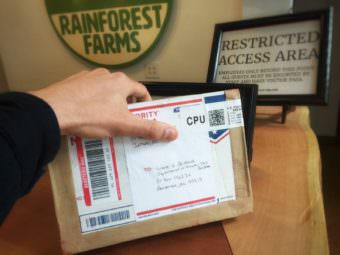
Rainforest Farms co-owner James Barrett said this parcel containing the pot business’ cash tax payment was rejected by the U.S. Postal Service on April 21, 2017. (Photo courtesy James Barrett)
Alaska tax officials have set up a system to tax licensed marijuana businesses.
Due to Alaska’s geography actually getting the revenue to the state isn’t always easy.
Usually sending a payment is straightforward — mail a check, pay online. But take James Barrett. He and his brother own Rainforest Farms, a marijuana shop in downtown Juneau.
“We’re able to do banking but we can’t put any of our cash sales into that bank account,” Barrett said.
None of the banks in Juneau will accept pot money, so his business can’t write checks.
There’s still cash.
That’s why Alaska’s revenue department set up a cash drop-off point in downtown Anchorage.
Yet for businesses off the road system — like Juneau — driving to Anchorage isn’t an option. So the state set up a special post office box to mail cash to.
Rainforest Farms co-owner James Barrett says marijuana businesses should be treated like any other legal enterprise. (Photo by Jacob Resneck/KTOO)
Alaska taxes marijuana bud at $50 an ounce and Rainforest Farms tax bill is often in the thousands of dollars.
In mid-April, Barrett dropped a brick of cash into the mail — with insurance of course.
“About an hour or so after I shipped my payment out,” he recalled, “I got a phone call from the post office and they said, ‘Come pick this up. We’re not gonna send it.'”
Tacked to the rejected parcel was a print-out reminding him of federal law.
“Proceeds from marijuana sales are illegal to send through the mail, and that does include tax payments even though it’s legal in the state of Alaska,” said Jeremy Leder of the U.S. Postal Inspection Service in Seattle. “From my agency’s perspective we have not seized any of these tax payments and we really have no plans to. It’s just if you’re going to use the United States mail, you’ll have to abide by federal regulations and marijuana businesses in Alaska sort of have to know that.”
Rainforest Farms claims this note from the U.S. Postal Service was the only explanation offered for rejecting the parcel. (Photo courtesy James Barrett)
The feds throwing up roadblocks for state taxpayers isn’t just exasperating for marijuana businesses.
“It’s such a weird in-between world world we’re in,” State Tax Director Ken Alper said. “I mean, this is a licensed business these guys have spent hundreds of thousands of dollars and gone through a pretty intense regulatory process. But yet they are operating and they’re prevented from doing just the normal things that a business is supposed to be able to do like use a bank or pay their taxes.”
In the end Barrett bought a plane ticket to Anchorage to pay his taxes in person.
He admits there may be alternatives — he could set up a shell company, hire a courier or invent some other work around.
But his point is he shouldn’t have to.
“We want to do business like regular businesses do,” Barrett said. “In America, we have a common currency for a reason just so that all these businesses can work together.”
Guidance from the Department of Justice or an act of Congress is needed before the postal service can change its policy, Leder said.
“I think it can be kind of attributed to, you know, the states are moving a lot faster than the federal government when it comes to marijuana laws,” he said by phone. “Until that changes the postal service and the inspection services will have to abide by those laws.”
Alaska’s geography means there really isn’t any way in or out of roadless communities without triggering some sort of federal jurisdiction — even though it’s not leaving the state.
That needs to be addressed, Alaska’s tax chief says.
Alaska’s tax division chief Ken Alper says the federal government should recognize the cash as legitimate tax revenue. (Photo by Jacob Resneck/KTOO)
“The issue comes down to … we don’t want a new rule,” Alper said. “We want to interpret what’s being shipped is something other than the proceeds of a drug transaction. In our view, it is tax money.”
Clarity in Washington has been in short supply.
On one hand, Congress passed a $1 trillion spending bill last week that extends a rule barring the federal government from using funds to block state marijuana laws.
But in his signing statement, President Donald Trump said he reserves the right to ignore it.
U.S. Rep. Don Young, R-Alaska, is among 43 U.S. House members asking that Congress prevent the Justice Department from pursuing federal drug cases against people who are complying with their state’s medical marijuana laws.
U.S. Rep. Don Young, R-Alaska (Photo by Wesley Early, Alaska Public Media)
Young and his colleagues have written the leaders of the subcommittee that writes the Justice Department’s budget. They want the appropriations bill to say that none of the money Congress allocates to the department can be used to prosecute people for using, selling or growing medical marijuana if their conduct is legal under state law.
Congress has included similar language in appropriations bills since 2014. But it might be more controversial this year.
The new U.S. attorney general, Jeff Sessions, has long argued that marijuana is a dangerous drug that should not be tolerated.
Close
Update notification options
Subscribe to notifications
Subscribe
Get notifications about news related to the topics you care about. You can unsubscribe anytime.