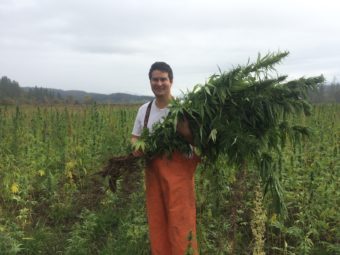
Jack Bennett of Homer harvests hemp in Oregon. (Photo by Maggie Hegarty and Nicholette Sutton)
Alaska became the third state to legalize recreational marijuana in 2015, but it’s not exactly ahead of the curve on hemp, which comes from the same plant.
Now, with growing pressure to diversify Alaska’s economy, lawmakers are talking about legalizing hemp for commercial purposes — something at least 30 other states have already done.
For the past year, home builder Jack Bennett of Homer, Alaska, has been working on a model home that he sees as a potential solution to affordable housing and energy in rural parts of the state.
He’s using building materials made from hemp.
“We acquired a facility for the year, imported the hemp insulation material and started to run experiments to build a brick for cold climate Alaska,” he said.
There’s just one problem: it’s illegal to grow hemp in Alaska, so Bennett imports his product from the Netherlands.
He’d like to source the product locally.
The 2014 federal Farm Bill allows states to grow and harvest hemp through pilot programs.
Sen. Shelley Hughes is sponsoring legislation that would establish such a program in Alaska.
“I think this is one more opportunity for farmers and Alaskans … and that it’s due time,” she said at the bill’s first hearing on Feb. 8.
But moving forward with the program is not as simple as waving a wand and making hemp legal. Lawmakers will have to decide on a regulatory framework that complies with federal regulations without stifling the industry before it even takes off.
Sen. Bill Wielechowski criticized the legislation at a Feb. 13 hearing.
“It’s uh, requiring that individual to register. It’s requiring that they list their global positioning coordinates where they’re going to be producing the hemp. They’ve gotta register every year. They’ve got to pay fees for applications and the fees have to cover the regulatory costs,” he said. “So, this is big government. I mean, this is extremely onerous.”
Don Hart, a farmer from the Mat-Su Valley, also is concerned about over-regulating the new industry.
“In order to benefit the farmers in the state of Alaska, it would be better to be able to remove it entirely from AS 17.38,” he said. “It allows anyone who does not want to see hemp growing in Alaska to be able to raise the issue by initiative or to propose their borough, administrative or municipality to be able to exclude it.”
The statute that Hart referred to, AS 17.38, lumps marijuana and hemp together under the same definition, allowing for local control over where the plant can be grown.
Alaska cultivated hemp until its ban in 1937 under the federal Marijuana Tax Act.
Bennett said the plant did well in Alaska, where it’s not always easy to grow things.
He’s committed to helping the industry grow.
“Alaska is, uh, it’s said to be in a fiscal crisis, but it’s a positive, it’s our opportunity. It’s our generation that gets to fix it. And hemp might not be the solution, but it’s a solution,” Bennett said. “Give them the freedom to farm, and let’s find out.”
The legislation will go to the Senate Judiciary Committee next, pending referral from Senate Resources.
Evan Levinton, left, looks over security forms with his business partner and mother, Jane Stinson, right, and their security contractor, Thomas Craig, while they were remodeling their store last May. (Photo by Zachariah Hughes/Alaska Public Media)
Over the last few weeks, many Alaskans have been trying something new: walking into a store to buy pot.

For more than a year, Alaska Public Media has been profiling one family cannabis business as they try to break into the new industry.
Now, they’re finally open for business, but not without some lingering concerns.
On a recent weekday evening, a two-person band played in the corner as dozens of people chatted, inspected glass pipes and bought small bags of cannabis. It was the soft opening for Enlighten Alaska, the latest in a handful of cannabis retailers to start in Anchorage and across the state.
Standing behind a glass display case was Victoria Davis, an employee with tattoos and long hair fading from blond to blue.
“I am a bud-tender here,” Davis explained. Bud-tenders are sales-people.
Davis’s job is talking with customers and answering questions, whether that’s a price check for a certain strain of pot or fielding inquiries about biochemistry.
I’m there to shop: to see what it’s like to make a purchase in Alaska’s newest industry. When Davis gets customers like me who aren’t particularly familiar with cannabis, she starts with a few basic questions about what kind of experience he or she wants from the drug.
“I ask them what they want to feel,” Davis said. “It just really depends on what you’re looking to receive out of the benefits of cannabis.”
Davis called this approach “consuming with intention.”
She got her start bud-tending at a medical dispensary in Michigan and now is one of the seven part-time employees working at Enlighten.
The shop has a one-page menu of cannabis products that I stare at, not sure which one is right for me.
Davis shows me glass jars filled with assorted marijuana buds: Blue Dream, Afgooey, Lost Coast.
She noted their potency, along with their effects on mood, energy and awareness.
A gram of these strains costs $22 — which, depending on quality and quantity, can be almost double what you might spend outside a legal business. But built into the prices here are costs for testing, taxes to the state, security cameras, heating the store and the professional guidance of an employee like Davis, who holds a jar of White Lemon buds up to my nose.
“I think that one smells pretty fresh,” Davis observed. “Almost like a Christmas tree, but not quite.”
There are other products, too. Edibles with names like “CannaCrisps” ($15 for two servings) and “Dank Chip Cookies” ($25 for four). Concentrated oils run a bit higher.
Under Davis’s advice, I decide on a strain called Vanilla Kush, which is on the lower end potency-wise, but I’m told it’s a good fit for relaxing in front of a movie before bed.
“Would you like a receipt?” Davis asked as she rang me up on an iPad.
I have to pay in cash, because marijuana businesses in Alaska and the Lower 48 don’t comply federal banking laws.
Davis tucked the small bag with a pinch of pot inside a white plastic envelope guarded by an elaborate child-proof zipper.
Overall it’s an extremely regulated purchase: my ID was checked twice; there was testing data all over the packaging as well as displays; and I got a lot of advice from an employee about the good I ultimately bought.
Getting the business to this point has not been easy.
“I’d say the risk that we took was investing our retirement funds and everything that we have,” Leah Levinton said.
She’s one of Enlighten’s three owners, along with her brother and mother.
She estimated that getting to this day, took $330,000 to $340,000. Almost double what they planned for.
“There’s no option but to be a successful business,” Levinton said with a chuckle.
Beyond the financial hardship, the family struggled a different points in time to prepare their permit application to the state, navigate local zoning rules and remodeling their shop to meet all the requirements.
Levinton also had to keep her involvement in the cannabis industry under wraps for months while she finished up at her previous job, basically putting in a second shift after work most days.
“It’s called ‘coming out green,’” Levinton said of transitioning toward being public about her involvement with cannabis. “This is a dream come true. This is something I never thought I’d be doing in my life.”
Both she and her mother, Jane Stinson, know there are major challenges ahead.
The overhead costs for cannabis retail shops are high. There still isn’t enough cannabis being legally grown in Alaska to re-stock stores quickly when they sell out.
“We would buy a lot of product if it were available, because I know the market is there,” Stinson said.
Enlighten is benefiting from starting a few weeks behind other Anchorage stores. They’re open for just six hours, three days a week, essentially rationing the product so that it is consistently available.
And they’ve gotten a glimpse from other retailers about what kinds of products are selling the best.
“They’re buying a lot of edibles and high THC flower,” Stinson said.
She attributed this in part to peoples’ assumptions that they want the strongest, highest potency types of cannabis and a general lack of familiarity with lighter strains.
When the shop runs out of product they won’t be able to get more until the end of February at the earliest.
Stinson expects the business will begin breaking even in May, once enough cultivators have opened to keep stores consistently stocked and open.
Still, Stinson doesn’t hesitate to explain that the difficulties have been worth it to get to this day.
“We’re so excited. So excited,” Stinson added for emphasis. “So many people have been congratulating us. And have been waiting for it!”
Stinson’s biggest concern now is that a Justice Department under nominee Sen. Jeff Sessions, R-Ala., could change federal policies toward cannabis, throwing the state markets into turmoil.
The state’s Marijuana Control Board was set to regulate the consumption of marijuana at licensed retailers. If it had been approved, Alaska would have been the first state in the nation to allow on-site consumption.
But that’s now moot.
A 3-2 majority voted Thursday to shelve the regulations after the control board’s staff said public notices contained errors and a decision would have to be postponed for at least another 30 days.
Control Board member Mark Springer of Bethel said he worried how the feds would react to marijuana consumption in public. Pot remains illegal under federal law.
“We don’t want to draw a whole lot of attention to what is going on in this state with marijuana,” Springer told fellow board members. “We don’t want a million people getting off a cruise ship in Juneau saying, ‘Oh yeah, it’s great. We’re going to go over a half-dozen stores and smoke marijuana,’ because it will draw a big spotlight on us.”
The control board has received dozens of public comments — many of them negative — ahead of its third meeting where it considered the rules.
Both Nicholas Miller of Anchorage and Brandon Emmett of Fairbanks — who are on the board as representatives of the industry — voted to keep the initiative alive.
After the vote, business owners from Alaska’s fledgling legal marijuana industry said they were dismayed by the decision.
“They’re putting everybody in violation that’s gonna be here consuming and it’s sad,” said Tara Bass, owner of The Remedy Shoppe in Skagway, the state’s first licensed retail marijuana store. She said renovations had already been made in anticipation of the new rules.
“We prepared it to be an outdoor consumption area so it would be plenty ventilated and it’s just interesting that they’re not giving people a place to go.”
The Alaska Marijuana Industry Association had lobbied for a legal way for customers to consume on the premises. Executive Director Cary Carrigan said retail outlets will need to regroup and rethink their strategy before bringing the issue back to the board.
“What I’m gonna do is push the membership to put forward solutions,” Carrigan said in an interview. “To not just say, ‘I want on-site consumption!’ How do you want it? And how are you going to accomplish that? And how do you make it so it’s not a health concern, so it’s not a public issue, so it’s not something that’s blowing smoke in everybody’s face, so to speak.”
Voters in Alaska approved legalizing marijuana for recreational use for those 21 and over in 2014. But it’s fallen to the five-member Marijuana Control Board to write the regulations of how to manage lawful consumption in the state.
Anchorage lawyer Jana Weltzin talks in her midtown office. Weltzin specializes in marijuana law, at a time when the emerging legal niche is at the center of commercial cannabis in the state. (Photo by Zahariah Hughes/Alaska Public Media)
Entrenched in a new industry facing an uncertain future in the Last Frontier, an Anchorage lawyer specializing in marijuana law is a bit of a pioneer, staking a claim that could be either a bonanza or a bust.
It’s a tricky time for commercial cannabis in Alaska.
Stores around the state are beginning to open, but without enough product available to keep shelves stocked for more than a few hours.
The state’s largest market, Anchorage, is seeing delays for businesses because of complicated zoning regulations. And there are concerns that a Justice Department under U.S. Sen. Jeff Sessions, R-Ala., may reverse tolerant federal guidelines that have let state’s develop marijuana industries.
At the center of all this is an emerging legal niche: pot lawyers.
On the wall of her midtown office, Jana Weltzin showed off two framed abstract pictures made by her high school best friend.
“It’s actually wax,” Weltzin said of one titled “Breath in and Out.” “I’m not supposed to touch, but I touch it.”
Weltzin grew up in Fairbanks, but went to college out of state. She graduated from Arizona State University’s law school in 2012, and started practicing in Phoenix. After Alaskans voted in favor of a recreational cannabis industry in 2014, she saw an opportunity.
“Marijuana law is something that’s is so exciting and interesting to me because we’re never going to see something like this happen again in my life time,” Weltzin said. “We’re never going to see an industry come up that’s never existed before.”
Weltzin is only 30 years old, young for a lawyer who has already had a large role shaping the regulations for a brand new business sector. If she’d been born 15 years earlier, she’d probably be counseling tech start-ups in Silicon Valley. Instead, her cannabis clients stretch from Aniak along the Kuskokwim to Kasilof on the Railbelt, with a few in the Lower 48, as well.
According to Weltzin, most of her clients are mom-and-pop operations, in no small part because that’s who’s willing to take the risk in commercial pot’s murky legal landscape.
“The cannabis industry, throughout the states that have legalized, has been largely born from small entrepreneurial startups,” Weltzin said. “The risk keeps out the big boys.”
Weltzin herself took a risk. Without specifying how much money she’s now making, she said the business is profitable, and that she’s doing better than when she collected a six-figure salary as an assistant attorney at a large corporate firm.
Before moving back to Alaska, Weltzin worked at the Rose Law Group in Arizona. There she got experience in the state’s medicinal marijuana industry, an area of the law which happens to involve a lot of rules over building and development.
“Just like (Anchorage), there’s a whole land-use component to the cannabis market there, where you have to get special use permits, there’s requirements for buffers, there’s multiple city hearings and public hearings,” Weltzin explained. “Same kind of process we’re going through here.”
Weltzin’s been a vocal presence at the state level in guiding legislation through Juneau, as well as giving input on the emerging regulations from the Marijuana Control Board as they’ve been drafted and adopted.
She’s also willingly been sucked into much more local battles in Anchorage over Assembly ordinances and zoning codes.
The mayor’s office is seeking to appoint her to a vacant seat on the city’s platting board, one of the most important yet dull local bodies governing land use.
“I just want to be more engaged in the public process, and able to be more of a boulder on the inside and not so much of a pebble on the outside,” Weltzin said of her interest in the platting seat.
The former chair of the Marijuana Control Board, Bruce Schulte, wrote in an email that Weltzin was the “most credible legal counsel in the state” when it came to setting up new pot businesses. He added that the pool is still quite small in Alaska, with other pot attorneys more focused on criminal defense areas of the law.
Like many of her Anchorage clients, Weltzin is frustrated that the city’s building code is proving to be such a stumbling block for new businesses — even if it’s a snag she financially benefits from. Still, Weltzin’s impressed by the speed with which the legal industry has come into existence, and the unique victories that have been won in Alaska for measures like on-site consumption.
“This is fun,” Weltzin said. “I mean, this is way fun. This is like probably the most exciting, fun, fulfilling two years that I’ve had, period.”
For now, Weltzin’s attention is firmly fixed on cannabis laws, which she sees as a “pillar of economic development” that needs to be well implemented from the start.
Two businesses in the Yukon Kuskokwim Delta are applying for the region’s first marijuana store licenses: The Green Tree , 260 C Osage Ave., Bethel; and Kuskokwim Enterprises, 3 Slough View Drive, Aniak.
Both businesses are in the first week of a three-week required public notice period.
The notice informs the public of the businesses’ intent to apply and allows the public to submit comments or objections to their local government, the applicant, and to the Alcohol and Marijuana Control Office.
The Marijuana Control Board has 90 days to grant or deny a license once the applications are submitted.
How the stores would get licensed marijuana or marijuana products, like edibles, if they do get a store license are still-to-be-resolved areas of local law.
There are no licensed facilities for growing, testing or manufacturing marijuana in the region, and without a road connecting stores to their products, businesses will rely on airplanes for transporting their merchandise.
The catch is that airplanes are under federal jurisdiction, where marijuana is illegal, flying over a state where it’s not.
“Well, all of marijuana is ‘operate at your own risk’ to some extent,” said Cynthia Franklin, director of the Alaska Alcohol and Marijuana Control Office.
She calls the state’s marijuana industry “risky business.”
“We don’t have any idea how the federal government is going to react to the reality of Alaska, which is that if you want to have a (marijuana establishment) in an area of the state that’s fairly inaccessible, you might be violating federal transportation rules,” Franklin said. “But keep in mind, everything that we’re doing is federally illegal,”
The U.S. Department of Justice has issued a memorandum saying that, in states that have created robust marijuana regulations, if you are a licensed establishment operating in full compliance with these regulations then you won’t be a priority to prosecute.
But it offers no guarantees.
“If you look at the end,” Franklin said, “it sort of disavows everything and says, ‘we can still do whatever we want.’”
And the memorandum, as mushy as it is, could disappear under Jeff Sessions, President-elect Donald Trump’s pick for U.S. Attorney General.
The marijuana business in Alaska is still young and in rural Western Alaska, untested.
With a new administration taking over the Justice Department, how the state and federal regulations will co-exist is still to be seen.
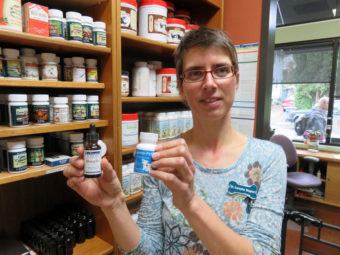
Dr. Cornelia Wagner shows several hemp-based supplements for pets stocked by the Hawthorne Veterinary Clinic. (Tom Banse/ Northwest News Network)
After the results of the November election, more than half of U.S. states have now authorized medical marijuana. And eight of those states also allow recreational marijuana.
So if pot helps some humans feel better, then how about people’s best friends?
Northwest veterinarians are being asked about treating pets with cannabis and that puts these vets in a difficult spot legally.
Cornelia Wagner runs the Hawthorne Veterinary Clinic in Portland.
She said pet owners turn to hemp or medical marijuana for many of the same things humans take it for these days including cancer symptoms, pain, inflammation, seizures, nausea, anxiety, chronic skin allergies and loss of appetite.
“Five years ago when I started here hemp never came up, or cannabis hardly ever came up,” Wagner said. “Now we talk about it a lot.”
‘We have to be careful about it’
Dr. Wagner tells dog owners that their animals are much more sensitive than humans to the effects of marijuana. It doesn’t take much to cause a bad trip. Her clinic only stocks a few over-the-counter supplements derived from hemp, the variety of the cannabis plant that is not mind-altering.
“They are so low in THC (tetrahydrocannabinol) that you can basically neglect it,” Wagner said. “We don’t have to worry about this ‘high’ effect. The marijuana plant was specifically bred to have relatively high amounts of THC, which is the psychoactive ingredient — what gets people high.”
Hemp for pets is largely unrestricted right now. Marijuana is different.
“Legally, we have to be careful about it,” Wagner said. “Even though recreational marijuana use is legal in Oregon now, as veterinarians we are not allowed to prescribe it. So we have to be careful about giving recommendations.”
She said cases of canine or feline cancer patients “where all other treatments have failed” are among the rare circumstances in which she might give advice on treatment with low doses of medical marijuana if a client asks.
Cautionary tales and consent forms
In those cases, the Portland vet clinic requires pet owners to sign a consent form stating that they understand the veterinarian cannot prescribe this controlled substance and that the pet owners have to obtain the substance themselves. When signing the consent form, the pet owners also agree to immediately stop the use of the marijuana treatment and consult the vet if negative side effects arise such as disorientation, drooling or inability to move.
In response to rising numbers of questions, the Oregon Veterinary Medical Examining Board this August mass-emailed what little guidance it could muster.
“Veterinarians may discuss veterinary use of cannabis with clients, and are advised to inform clients about published data on toxicity in animals, as well as lack of scientific data on benefits. Please be aware that a client’s written consent is needed for any unorthodox treatment,” the memo stated.
The Washington State Department of Health staffs the state’s Veterinary Board of Governors. The Department’s home page for veterinarians simply states, “The law doesn’t allow veterinarians to authorize medical marijuana for animals or humans, and doesn’t authorize the use of medical marijuana for pets.”
The Oregon and Washington State Veterinary Medical Associations have posted their own cautionary fact sheets online. Lisa Parshley, a WSVMA board member and owner of the Olympia Veterinary Cancer Center, said she is hesitant about cannabis products not just for legal reasons, but for the many scientific unknowns.
“I just feel like everybody is trying to jump the gun and get into the use of this without doing due process in the research labs, in the clinics, to try to get a really good product out there that is safe and actually works,” she said.
Parshley said researchers need to verify health claims, delineate risks and establish the proper dosing and delivery methods.
The U.S. Food and Drug Administration makes similar points on its website where it cautions against usage of marijuana products for pets. The FDA says the safety and effectiveness of these products has not been established and needs further study.
Entrepreneurs fight back
The murky legal terrain got murkier this month when the Drug Enforcement Administration announced it considers all extracts from the cannabis plant to be controlled substances, including from hemp. The Hemp Industries Association said Monday that it is considering legal action to fight what it called an “incorrect” categorization.
Entrepreneurs in pot-friendly western states aren’t waiting for the smoke to clear to meet consumer demand. Startups are selling a range of cannabis products for pets from capsules, oils, butters and tinctures to infused chew toys and dog treats.
The FDA singled out two Western Washington companies last year. They received warning letters for allegedly selling unapproved new animal drugs. But both Seattle-based Canna-Pet and Sultan, Washington-based Canna Companion continue to sell their lines of hemp-based capsules and concentrates.
An FDA spokesman wrote via email that the agency has open cases on both companies, but would not provide further details on the enforcement action.
Canna Companion co-founder Dr. Sarah Brandon said she learned a lot as a result of the FDA warning letter. “We changed our verbiage” in the company’s marketing materials, informed the FDA and have been left alone since, she reported.
“Cannabis fills a niche that is badly needed in the community,” Brandon continued. She said Canna Companion was striving for “legitimacy,” but anticipated that uncertainty about the future federal regulation of marijuana and related products would continue in the near term.
“We are comfortable with the gray zone,” Brandon said.
Canna-Pet did not respond to an interview request. In federal court filings last month pertaining to a trademark dispute, Canna-Pet reported it has sold more than 50,000 units of its products since 2013, “totaling more than one million individual capsules.” The court filings also characterize the products as “dietary supplements for pets” and reject any contention that they are controlled substances.
Oregon entrepreneurs venturing into this field include GEMM Farms of Portland, maker of hemp-derived CBD dog treats and FlowerChild CBD (formerly Inyanga Farms) in southwest Oregon, which sells a CBD oil for pets made from “medicinal hemp.”
CBD is the acronym for cannabidiol, a compound extracted from cannabis thought to have a range of beneficial health properties.
The infused products for pet owners are not cheap. Medical marijuana dispensaries sell eyedropper-sized bottles of CBD oils for around $40, while 30-capsule containers of hemp-derived CBD supplements sell online starting from $30 on up.
‘I wished I had known enough to start sooner’
Michelle Batten of Portland owns Willy, a small, caramel-colored 16-year-old Lhasa Shih Tzu. She said Willy has a variety of age-related problems including arthritis and anxiety from vision loss. Conventional painkillers made him sluggish.
“So I started on the cannabinoid capsules,” Batten said, which in her case are derived from hemp.
“I was very open to it and so pleased with what I saw,” Batten said. “He’s so much more content. He sleeps better. He’s not in pain and he doesn’t have the anxiety.”
But does Willy seem “high?”
“No, not at all,” Batten said. “Just more calm.”
Another Portland dog owner, Diane Benjamin, uses an eyedropper to put small amounts of hemp oil on the food of her 11-year-old greyhound-Rhodesian ridgeback named Pronto. She said the formulation provides relief from back trouble and arthritis.
The dog doesn’t appear to notice the culinary addition, but Benjamin said her acquaintances take notice.
“When I meet other dog owners and we start talking — especially if they have old dogs — and I mention that he’s on cannabinoid oil, they kind of raise their eyebrows like ‘Really?’ and maybe laugh a little bit,” Benjamin said.
She explains that she chooses the product for the medicinal properties.
“If it works and doesn’t have side effects, why not?” Benjamin said.
Terri Krick of rural Lewis County, Washington, contacted recreational marijuana shops for help getting a medicinal marijuana oil after her nine-year-old pit bull was diagnosed with lymphoma cancer this spring.
The dog started chemotherapy under the care of a vet, but Krick said in an interview that she searched online for what else she could do, which is how she landed on a marijuana-derived oil containing THC and CBD.
“I was going to do everything I could to give life to this dog,” Krick said. The initial dosage she administered was too high in THC though.
“His behavior changed. He was startled easily, almost on edge. Then I knew to cut back a little,” Krick recalled. Using a strain with lower THC and higher CBD levels, the pit bull, Master P, started eating better and displayed more energy. But the cannabis supplements did not beat the cancer as Krick had hoped they might based on online searches that turned up promising results in initial experiments with CBD for human cancer treatments. Master P passed away in October.
“I wished I had known enough to start sooner,” was her takeaway. “I was so scared to use it.”
Separate from purposeful dosing of dogs and cats with cannabis-infused medicines, dogs are being brought to vets after ingesting marijuana left in the open by humans. Curious, hungry dogs have wolfed down their owners’ stashes, pot edibles or even joints dropped in parks.
Parshley said accidental exposure causes disorientation, incontinence, nausea and pets that are over-reactive to sound and lights. In serious cases, the animal may require hospitalization. The marijuana itself is rarely fatal, although in combination for example with a large amount of dark chocolate brownies, a dog may perish.
Close
Update notification options
Subscribe to notifications
Subscribe
Get notifications about news related to the topics you care about. You can unsubscribe anytime.