Marijuana

Why doesn’t Anchorage have a pot shop yet? Dumpsters and parking lots

In the last few weeks, as commercial marijuana inches closer to a reality across Alaska, a lot of people are asking: why doesn’t Anchorage have a pot shop yet?

After store openings in Fairbanks, Juneau and Valdez, Anchorage is still weeks away from having an open retailer.

Jane Stinson is one of the owners of Enlighten Alaska, a business trying to open on a busy corner in the Spenard neighborhood. She showed off a brightly painted space with shelving and half-finished construction projects.

“This room is where we’ll be selling most of our marijuana products, in fact all of them,” Stinson said.

The store was on track to open any week now. But over the Thanksgiving holiday it was robbed.

“Everything that had a plug was gone, which was mostly construction equipment,” Stinson said.

The thieves even stole a broom. Stinson said the theft set them back about five days and $5,000, pushing them even further past their opening deadline. A main reason for the delay in opening is the difficulty it had getting the older building it rents up to par with the city’s elaborate building codes.

“We have to come up to compliance, and it’s costing a lot of money to make sure that we have enough parking, snow removal, gates around our dumpsters and those kinds of things,” Stinson said.

Anchorage revised it’s building code in 2013, implementing the so-called “new Title 21.” It requires that when a property like this goes through what’s known as a “change of use,” becoming, for example, a legal weed store, it has to be physically improved in the process. That means ironing out many of the old design features that are out-of-date and no longer acceptable in the building code.

To demonstrate, Stinson showed off the tiny parking-lot out her back door.

“The problem is is that we have parking for maybe two cars here,” Stinson said, and explained she’s working on a parking arrangement with neighboring businesses to accommodate the issue.

Right now, getting these kind of building features up to modern standards is the biggest reasons why Anchorage retail shops are weeks behind their counterparts elsewhere in the state.

Dick Traini is a long-serving member of the Anchorage Assembly, who explained these additional prerequisites are “just the cost of doing business” after a recent meeting on marijuana business licenses at the Planning and Zoning Department.

“People in the industry, no matter what you do, are going to say you’re trying to be obstructionist,” Traini said.

Since the state-wide passage of Ballot Measure 2 in 2014, Traini has led the charge adding local regulatory steps for would-be pot businesses. Measure that do not exist elsewhere — or if they do, not as robustly.

“Because we’re the largest urban area in Alaska. The dynamics that come with an urban area requires us to be a little more precise than say Fairbanks, or Valdez or any other place.”

The key mechanism for giving Anchorage officials more control over the marijuana industry is enforcing the Title 21 building code through a land-use permit, which some say is just as complicated and dense as the state license application.

Traini insists the Assembly is not trying to block marijuana businesses, but in keeping with the will of voters is treating pot like alcohol.

For Traini, that means not replicating what he sees as the mistakes of the alcohol industry — a perennial source of problems for the Assembly. It comes up in the form of bar break violence, crime, and a perceived imbalance of influence stemming from the state having more control over alcohol licensing than local governments.

“If we have a problem, we’re the ones that have to deal with it,” Traini said. “The state’s not gonna send their code-enforcement officers to deal with a bad licensee or a problem. They’re gonna say ‘we really can’t deal with that.’ It needs to be done here locally. It needs to be a code enforcement issue that’s handled by the citizens of this town.”

Traini cites the recent example of a business that was set to officially open, until it was claimed the owner was giving away small amounts of marijuana on the premise. The state took no punitive action after reviewing the evidence, but the Assembly opted to delay the business’s final inspections.

The issue is exacerbated by what properties are actually available to new cannabis businesses.

Erika McConnell is the city’s marijuana coordinator, and during an interview at her office explained that since so many marijuana businesses are moving into older properties there is more work that has to be done to bring them up to code.

“They can’t get finances from banks, can’t get investments from out of state from larger companies, (so) they presumably don’t have very much capital available to them,” McConnell said. “So they have to look for these properties that are older, or vacant or less well-kept-up.”

McConnell also pointed out that states like Colorado and Washington that have implemented commercial cannabis already had a medical marijuana industry up and running. There were buildings, businesses, capital, and regulations that could be adapted for the recreational industry. Alaska didn’t have that. Here, the legal pot industry is starting from scratch.

Of the handful of retail shops closest to opening in the municipality, two of them, Alaska Fireweed and Dankorage, say they’ll be ready later this month — with the caveat, though, that there might not be enough product to keep on the shelves for more than a few hours. Because even with just a few stores open in Alaska, demand, so far, is outpacing supply.

Murkowski to feds: Let marijuana users buy guns

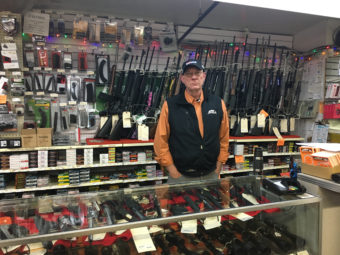
John Weedman, general manager of Western Auto Marine in Juneau, said the federal form asking potential gun buyers if they use marijuana is outdated. November 28, 2016. Photo by Andrew Kitchenman/KTOO.
John Weedman, general manager of Western Auto Marine in Juneau, said the federal form asking potential gun buyers if they use marijuana is outdated. (Photo by Andrew Kitchenman/KTOO)

When Americans buy guns, they’re asked whether they use marijuana. If they say yes, they can’t buy the gun. U.S. Sen. Lisa Murkowski wants to change that, and some Alaskan gun sellers, marijuana industry advocates and local officials applaud the move.

Juneau Assembly member Jesse Kiehl owns several rifles and pistols. And he also supported the ballot question legalizing marijuana in Alaska. Kiehl was pleased when the Wall Street Journal reported that Murkowski wants the federal government to stop asking whether gun buyers use marijuana.

“Where you have a conflict between a federal law that maybe doesn’t make a lot of a sense and privacy right that the Alaska Constitution respects and that now Alaska law respects, you have a weird situation with wiggle room,” Kiehl said. “And that’s not good public policy. It’s not good public safety.”

Murkowski asked U.S. Attorney General Loretta Lynch whether Lynch could change the policy requiring gun buyers to answer the question on the federal firearms transaction record, or if a new law is needed. The form asks prospective gun buyers if they’re “unlawful users of, or addicted to, marijuana” or other controlled substances. Murkowski noted an Alaska ballot question two years ago set rules for legally growing and selling marijuana. Legal marijuana sales started in Valdez in October and have been rolling out in other parts of Alaska. It remains illegal under federal law.

Sen. Lisa Murkowski (KRBD file photo)
Sen. Lisa Murkowski opposed the ballot question legalizing marijuana sales, but doesn’t want the federal government to keep people who’ve used marijuana from buying guns. (KRBD file photo)

The Department of Justice said in its response that the department was enforcing federal drug and gun control laws. In an email, Murkowski said she’s disappointed with the reply, because it reflects a bias against firearm owners.

Some gun sellers don’t like the question, including John Weedman. He’s the general manager of Western Auto Marine, a Juneau store that sells guns. He said that with the change in state law, the federal question is outdated.

Weedman said he hasn’t heard concerns from customers.

“If an applicant puts down on the form that they’re not a user of marijuana, we have no way to verify one way or another on that, OK? And we have no obligation to do that,” Weedman said. “We have a reasonable suspicion — they come in smelling like pot, then yeah — that’s a different story.”

Bruce Schulte is the former chairman of the state Marijuana Control Board and spokesman for the Coalition for Responsible Cannabis Legislation. He said in the short term, he’d like to see the federal government stop asking the question about pot use. In the long term, he said new federal laws are needed.

“The question alone – it hearkens back to an attitude that’s just not in sync with current social norms,” Schulte said.

Schulte noted that the federal government doesn’t ask about alcohol use on the firearm transaction form, though he said it’s more dangerous. He also said some injured military veterans may choose to use marijuana rather than prescription opioids, whose use, combined with guns, could also be more dangerous.

It’s a point reinforced by Kiehl, the Juneau Assembly member.

“I’ve filled out this form quite a few times myself,” Kiehl said. “And it does not ask if you ever take the gun out of where it’s stored when you’ve been drinking. It does not ask if you take a perfectly legal prescription medication that makes you dopey as a side effect. Those are serious safety issues.”

What happens with federal enforcement of marijuana laws – and how they interact with legalization in Alaska and other states – will depend on the next attorney general. President-elect Donald Trump’s choice is Alabama Sen. Jeff Sessions. Sessions opposes legal marijuana, but it’s not clear how he’ll handle state legalization.

Ketchikan Borough writes marijuana disclaimer

The Alaska Marijuana Control Board approved the first commercial license Thursday. (Photo by U.S. Fish and Wildlife Service)
The Alaska Marijuana Control Board approved the first commercial license Thursday. (Courtesy of U.S. Fish and Wildlife Service)

In a split vote Monday, the Ketchikan Gateway Borough Assembly agreed to add language to all votes related to routine state marijuana license application reviews.

That language is meant to protect the borough in case the federal government decides to start cracking down on states that have legalized pot. The language states that the borough doesn’t endorse or condone activities prohibited by federal law.

During Assembly discussion of the issue, Assembly Member Judith McQuerry argued that the added language doesn’t accomplish anything because it’s the state that issues the licenses – not the borough.

She says it’s a statement that some Assembly members want to add because they personally don’t approve of marijuana and that it’s nothing more than window dressing.

Assembly Member Stephen Bradford then suggested adding more language, stating that the federal law making marijuana illegal violates the 10th Amendment of the U.S. Constitution.

Bradford says the 10th Amendment is very simple and clear.

“It merely states that the powers not delegated to the United States by the Constitution, nor prohibited by it to the states, are reserved to the states, respectively, or to the people,” he said.

Bradford says he generally agrees with McQuerry on the issue of the added language, but thinks if the borough is going to make a statement; it should include a statement about the 10th Amendment.

McQuerry voted for Bradford’s amendment, but said, “I think that’s adding lace to the window dressing.”

The amendment passed unanimously. The main motion then passed in a 5-2 vote, with McQuerry and Bradford voting no.

Marijuana sells out at Rainforest Farms’ opening day

rainforest farms opening day line
The line at Rainforest Farms for its opening day of legal marijuana sales stretches down Second Street and around the corner in downtown Juneau, Nov. 25, 2016. (Photo courtesy Mary Uyanik)

Friday was the opening day for marijuana retailer Rainforest Farms, and they had to close early because they sold out.
Facebook users shared photos showing lines to the store running down Second Street and around the block for the first legal marijuana sales in Juneau. The business planned to open at “high noon” and close at 6 p.m., but closed early after running out of product.

On Facebook, the business says it will harvest another crop this week and re-open in a few weeks. Rainforest Farms is the first business in town to make it to retail.

At least 10 other ventures in town have sought state licenses in Juneau for one or more aspects of the marijuana business – separate licenses are required for growing, processing, retailing and testing.

Skagway business owner denied request for retail marijuana store

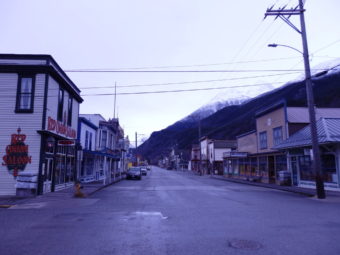
Downtown Skagway. (Courtesy of KHNS)

This month, the Skagway Planning and Zoning Commission denied a local business owner’s request for a marijuana retail store. The conditional use permit was denied not based on local zoning code, but on state law.

Skagway is a small community squeezed into a steep and narrow valley. That means many of the town’s businesses are condensed into an even smaller area. By state law, marijuana businesses cannot be within 500 ft. of a school ground, a recreation or youth center, a building where religious services are regularly conducted, or a correctional facility.

“There’s a very small area in Skagway where these shops can be permitted by state code,” said Deach. “It’s a pretty small window.”

That’s Planning and Zoning Chair Matt Deach at the Nov. 10 meeting. The commission was reviewing an application for a conditional use permit to operate a retail marijuana business. The application was submitted by Kristine Harder. She’s the owner of Buckshot and Bobbypins, which recently moved to 750 Broadway.

Her plan was to sell cannabis products in addition to the wide variety of items she already stocks.

“It was never my intention to just turn into a 100 percent cannabis retail store,” said Harder.

She says based on a map Skagway’s previous permitting official provided that showed where pot shops are allowed and her review of state and municipal code she should be in the clear to do that. And, she says she wouldn’t have moved locations if she believed it would be an issue.

Harder’s store is located in Skagway’s Business Historic zone. By municipal zoning code, pot shops are not prohibited there, but you need to obtain a conditional use permit. There are four criteria for that, but that wasn’t really the issue for the commission.

In May, they granted a conditional use permit to Skagway business owner Tara Bass for her marijuana retail shop in the Business General zone. And Deach says there is no bad attitude toward pot shops.

“We’ve always looked at them the same as any other retail business as permitted by the state,” said Deach. “There’s no animus coming from our particular corner of the local government towards it.”

What it really came down to was the state buffer zone regulations. Deach argued that Harder’s business is too close to daycares, a church, library, and Mollie Walsh Park.

There was some confusion around the wording used in the law. Harder contends “recreation or youth center” would discount daycares, especially since the wording changed from the original “child care facility.” Going by the state definition of that phrase, Deach disagreed.

“I would absolutely classify them as a place for youth, as well as Mollie Walsh Park,” said Deach.

Harder questioned whether it’s even in the local government’s jurisdiction to make judgment on the state law. Deach said yes.

“We cannot be less permissive then state code as a city entity,” said Deach. “We always have to uphold state code, whatever the strictest code is, state, federal, we have to uphold the strictest version we cannot be less restrictive.”

“Well I wouldn’t have applied if I hadn’t dotted my i’s and crossed my t’s and I’ve got everything marked in the law here,” said Harder.

TRACK: According to Cynthia Franklin, Director of the State’s Alcohol and Marijuana Control Office, local governments have the right to protest an application based on state regulations. But whether the Planning and Zoning Commission has that power is a question she deferred to the borough attorney.

Deach said they did consult the attorney.

“His response to whether or not P&Z should take state law into account was I think it is more important to look at whether the location satisfies all applicable laws,” said Deach. “If it does not satisfy state law then that seems to me a proper consideration from planning and zoning.”

He said they could turn the judgment over to the state.

“We can easily pass the buck onto the state,” said Harder. “I prefer to keep stuff in house as much as possible.”

Ultimately, the commission voted unanimously to deny the conditional use permit. Harder said this is an example of the difficulty business owners face in small communities like Skagway.

“There are a lot of other smaller coastal communities who feel that the statutes are currently not fair and equitable for people living in coastal communities with less land mass in Southeast Alaska,” said Harder.

And, she says it all comes down to the over-regulation of cannabis, compared to alcohol, when bars are allowed in that same area, but not her business.

Harder can appeal the decision to the borough assembly. She has not said whether she will follow that recourse.

Will Legal Marijuana Lead To More People Smoking Tobacco?


Is marijuana a gateway drug to smoking cigarettes? PhotoAlto/Katarina Sundelin/Getty Images
Is marijuana a gateway drug to smoking cigarettes?
PhotoAlto/Katarina Sundelin/Getty Images

California’s decision to legalize marijuana was touted as a victory for those who had argued that the state needed a system to decriminalize, regulate and tax it.

But the new law, approved by voters on Nov. 8, also could be a boon to the tobacco industry at a time when cigarette smoking is down and cigarette companies are looking for ways to expand their market, according to researchers in Los Angeles County and around the state.

They warn that unless the state proceeds carefully, the legalization of marijuana for recreational use could roll back some of the gains California has made in reducing the use of tobacco.

“There is a concern that there could be a potential renormalization of smoking,” says Michael Ong, an associate professor at UCLA’s David Geffen School of Medicine.

Ong says it will depend on how the initiative is implemented, whether officials follow through on the regulation, and how involved public health officials are with it. “It will be important to make sure that we don’t have a setback in terms of what we have done for clean air in California … and what we have done to reduce tobacco’s harms,” he says.

Ethan Nadelmann, executive director of the Drug Policy Alliance, which supports marijuana legalization, defended the measure, saying there is no evidence that legalization leads to increased cannabis consumption — or tobacco smoking.

California’s adult smoking rate is the second-lowest in the country, at 11.6 percent, according to the California Department of Public Health. The smoking rate dropped by more than 50 percent between 1988 and 2014, cutting health care costs and reducing tobacco-related diseases, according to the department.

The headway against smoking over the past few decades is due to a combination of factors, including tobacco taxes, laws restricting where people can smoke, and broad-based media campaigns and programs to help people quit. Despite the decline in smoking, the use of e-cigarettes has increased dramatically over the past few years, with nearly 10 percent of adults ages 18 through 24 now using them, according to the department.

Another ballot initiative passed by voters last week could push the smoking rate even lower. Prop. 56 will add $2 per pack to the tax on cigarettes and increases taxes on electronic cigarettes that contain nicotine and other tobacco products. The money will help pay for health care and increase funding for tobacco control and prevention.

The marijuana initiative, Prop. 64, allows adults ages 21 and over to grow, buy and possess small amounts of marijuana for personal use. It also regulates recreational marijuana businesses and imposes taxes that will help pay for drug education and prevention programs.

Bonnie Halpern-Felsher, a pediatrics professor at the Stanford University School of Medicine, says she is concerned that there may not be enough education and prevention written into the proposition, especially targeted at youth.

Marijuana is already the most widely used illegal drug among adolescents. Many young people consider marijuana and blunts, which are marijuana rolled with a tobacco leaf wrapper, to be more socially acceptable and less risky than cigarettes, according to a recent study co-authored by Halpern-Felsher. The study also found that youths who saw messages about the benefits of marijuana were more likely to use it.

Blunts are particularly worrisome because they contain nicotine as well as marijuana, Halpern-Felsher says. Many young people may not understand the risk of blunts or marijuana, she notes, and once they start thinking that smoking one product is acceptable, they may believe it’s OK to smoke other things as well. “That’s my concern,” she says. “I do think people are going to generalize.”

From the tobacco industry’s point of view, marijuana could serve as a “smoke inhalation trainer,” and thus become a gateway to tobacco use, says Robert K. Jackler, a professor at the Stanford School of Medicine who researches tobacco advertising. He says tobacco and marijuana are marketed in similar ways — as products to help people relax and ease their stress. “There is tremendous overlap potential,” he says.

Tobacco companies could easily try to exploit that similarity to enter the marijuana market, Jackler says. They already have enormous influence on state laws and regulations, and could try to set up small dispensaries and make marijuana another one of their products.

“The tobacco industry is always looking for replacement products because, at least in America, smoking is down,” he says. “This will give them a new entry into the market. They are best equipped to exploit this market opportunity.”

In fact, the tobacco industry considered getting into the marijuana market in the 1960s and 70s and could easily do so, says Stanton Glantz, a professor at University of California, San Francisco School of Medicine. Glantz believes that even as the newly approved tobacco tax reduces California’s smoking rate further, legalized marijuana will help sustain the tobacco market. He says he expected to see mass marketing and branding of marijuana over time.

Along with some therapeutic benefits of marijuana, there are also health risks, Glantz says. “The likely costs that are going to be incurred by all the marijuana-induced diseases don’t come close to being covered by the taxes that are written into Prop. 64,” he warns.

The initiative should have included higher taxes, graphic warning labels, provisions to keep demand low and a broad-based education campaign like there is on tobacco, Glantz argues. “The ideal situation is where it’s legal so nobody is thrown in jail, but nobody wants to buy it.”

Legalization supporters said they don’t believe the tobacco industry will get involved in the marijuana market until and unless federal prohibition ends. Marijuana is still illegal under federal law.

Nadelmann, of the pro-marijuana Drug Policy Alliance, says it is misguided to conflate the two products. Young people can distinguish between the effects of cigarettes and marijuana, he says.

“Teenagers are actually smarter than most of the adult propaganda,” Nadelmann says. “They know smoking cigarettes is really stupid and that smoking marijuana is not such a major issue.”

This story was produced by Kaiser Health News, which publishes California Healthline, an editorially independent service of the California Health Care Foundation.

Copyright 2016 Kaiser Health News. To see more, visit Kaiser Health News.
Site notifications
Update notification options
Subscribe to notifications