Marijuana

Long line for first legal cannabis sales in Ketchikan

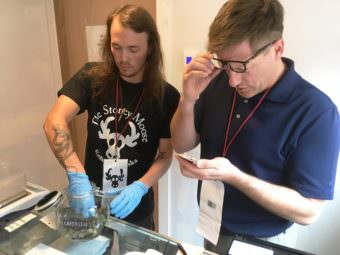
Travis Carter gets some cannabis buds out to measure for a customer while Mark Woodward checks an ID on the opening day for Ketchikan’s Stoney Moose. (Photo by Leila Kheiry/KRBD)

Ketchikan’s first marijuana retail store opened its doors to customers at about 4:30 p.m. Monday, which was a few days later than originally planned.

The 50-plus people in line were happy to buy legal cannabis for the first time in Alaska’s First City.

The stated opening time for the Stoney Moose on Stedman Street was 4 p.m., and the first couple of people in line were there by 3.

Nicholas Thayer was first, and said he’s eager to support the legal market.

“It will teach the idea that you don’t have to wait three hours in a parking lot somewhere,” he said. “It doesn’t have to be sketchy anymore.”

By about 3:30, a few more people had joined the line.

Among them was Jeremiah Hayward. Legalization was a move in the right direction, he said, so people don’t have to hang out in dark alleys and buy from dealers.

“It can be taxed, and put toward schools and what not,” he said.

Gail Jackson was about fifth in line, and said coming to the store opening meant she’d probably be late for work. She’s happy to see marijuana finally become legal.

“They used to say it’s a gateway drug. Alcohol is so much more a gateway drug,” she said.

As 4 o’clock drew closer, more and more people arrived and lined up. A jovial party-style atmosphere developed with lots of jokes and speculation about what kinds of marijuana the Stoney Moose would offer.

Co-owner Mark Woodward came out, and said they were still setting up to make sure they followed all the state requirements.

He gave an update to the now approximately 55 people in line.

“We’ll make sure everyone is taken care of today,” he said. “We have pre-rolls, we have eight other different types. They’re really good. Chem Dog – you can get Chem Dog, not a lot, but from Sitka – it’s fantastic. So be patient! We’ll open the door in just a couple minutes.”

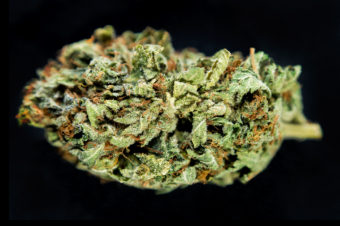
Chem Dog? Apparently, it’s a well-known variety with high THC – that’s the active chemical in pot, that makes you high.

Tim White, second in line, gave a history.

“Chem dog was found at a Grateful Dead concert. A bud was given to an old boy on the concert, and he took it back to the East Coast, where he found five seeds,” he said. “Later on, some more buds were sent to him, they had three seeds. He grew those seeds. That’s where Chem Dog came from.”

There was more general discussion about marijuana varieties, and then, at about 4:30 p.m., Stoney Moose co-owner Eric Reimer opened the door to start letting people in.

“Oh, yeah! How’s everyone doing?” he said. “Sorry about the wait. It’s kind of complicated getting stuff going in there, but I think we’re ready.”

It’s a tiny shop, so they only let in a few people at a time. The first customer – Nicholas Thayer – was ready and eager after his 90-minute vigil.

“Which one has the higher THC?” he asked. “I’ll take a pre-roll of Cookies and Cream, and a gram of Chem Dog.”

They carefully measured out a gram of Chem Dog, and packaged it up in a secure pouch, then packaged the pre-rolled joint in another pouch. Thayer paid for his purchase, and there it was: The first legal sale in Ketchikan.

Woodward was all smiles behind the cash register.

“Eric and I were here last night late, and we were like, ‘Can you believe this is happening?’ When the product got here this weekend, I knew, now it’s changed,” he said. “Now my mind can actually see that this will happen.”

Juneau warehouse pot grow gets the green light

Juneau now has six licensed marijuana cultivation operations. (iStockphoto)

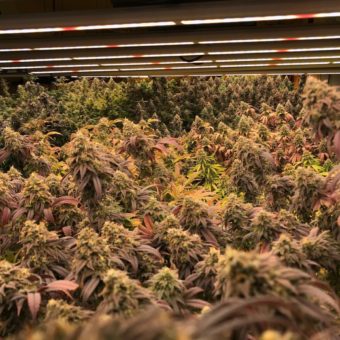
The Juneau Planning Commission unanimously gave the green light to a 6,000-square-foot warehouse marijuana grow operation at its Tuesday meeting.
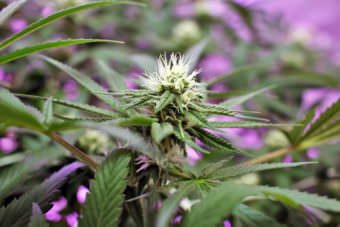
The decision marks the sixth licensed marijuana cultivation facility in the capital city.

It would be the second location for Green Elephant LLC, which plans a retail and growing operation at a Mill Street site south of downtown. The state has already licensed the Mill Street operation.

Co-owners Richard Dudas and Jennifer Canfield have also applied for an onsite consumption permit — but the state’s Marijuana Control Board remains undecided whether those would be allowed. Canfield is a former KTOO employee.

Juneau planning commission to consider warehouse pot grow

This undated photo shows a marijuana plant growing in an indoor, hydroponic garden in Washington, D.C. (Creative Commons photo by Adam Vartian)

An application for another marijuana grow facility is scheduled to come before the Juneau Planning Commission on Tuesday evening. If approved, it would add to the growing number of licensed cultivators in the capital city.
Green Elephant LLC proposes its second marijuana grow operation in a 6,000-square-foot vacant warehouse on Airport Boulevard. The product would be sold at the owners’ licensed retailer planned to open south of downtown.

Co-owners Richard Dudas and Jennifer Canfield already have a state-issued cultivation license to grow marijuana on Mill Street, where they have applied to open a shop. Canfield is a former employee of KTOO.

Juneau Assemblyman Loren Jones, who also sits on the state Marijuana Control Board, said local cultivation is essential for licensed retailers. That’s because federal law has always made shipping pot hard. And with the Trump administration’s tough talk against marijuana, he says, it’s even more so.

“Transporting marijuana is difficult and I think the new (U.S.) Attorney General has made it more difficult in that I think that TSA and the (U.S.) Postal Service and those places will be a little more cautious about shipping large quantities,” Jones said.

Regulatory hurdles remain. If the planning commission approves the growing operation on Airport Boulevard, there still remain permits for its retail operation. Green Elephant has also applied for cafe-style onsite consumption — but that issue still needs to be resolved by the state’s Marijuana Control Board.

Murkowski joins several Democrats in challenging proposed pot enforcements

U.S. Sen. Lisa Murkowski, R-Alaska, wants to slow the repeal of the Affordable Care Act. (Photo by Liz Ruskin/APRN)

A group of U.S. senators – including one Alaskan – is asking the Justice Department to keep existing guidance on marijuana laws.

The request came in a letter signed by Sen. Lisa Murkowski, Elizabeth Warren, D-Ma., and nine other senators. They asked U.S. Attorney General Jeff Sessions to continue upholding the Cole Memo — a 2013 document stating that federal officials will not take enforcement action in states that have opted to legalize and regulate cannabis.

States like Alaska, Colorado and Washington have looked to the Cole Memo for guidance in implementing recreational cannabis industries in recent years.

The senators’ letter said “sensible drug policies” can ensure that “state infrastructure, including tax revenue, small businesses and jobs can be protected.”

Their letter comes just a week after White House Press Secretary Sean Spicer told reporters the public could expect to see “greater enforcement” of federal marijuana laws.

That’s at odds with statements made on the campaign trail by then-candidate Donald Trump, who said the issue should be determined by states.

Murkowski was the only Republican to sign.

Alaska Sen. Dan Sullivan did not join the letter, but his spokesman said Sullivan thinks the federal government should defer to state law and the will of the voters on marijuana enforcement.

Spicer says feds likely to boost enforcement of anti-marijuana laws

marijuana in hand
Marijuana. (Creative Commons photo by Katheirne Hitt)

White House Press Secretary Sean Spicer said Thursday he expects the Department of Justice will step up enforcement of federal marijuana laws.

Spicer didn’t elaborate on what that might entail, and there are no details yet about how this will affect states that have set up recreational marijuana industries.

If enforcement is increased, it could collide with Alaska’s voter-approved legalization and damage Alaska’s new marijuana industry.

Spicer, at a White House press briefing, said President Donald Trump understands that terminal patients and people in pain take comfort from marijuana.

Spicer pointed out that Congress has previously used annual spending bills to restrict federal policing of medical marijuana.

“There’s a big difference between (medical marijuana) and recreational marijuana,” Spicer said. “I think that when you see something like the opioid addiction crisis blossoming in so many states around this country, the last thing we should be doing is encouraging people. There is still a federal law that we need to abide by.”

Spicer said reporters need to inquire at the Justice Department, but he said people can expect “greater enforcement” against marijuana, although he emphasized that the enforcement would be against non-medical purposes.

The opioid crisis is invoked by both sides of the marijuana debate.

Advocates of legal cannabis say it can help treat addiction to drugs like heroin.

U.S. Attorney General Jeff Sessions, at a Senate hearing last year, argued against lax cannabis rules.

“Marijuana is not the kind of thing that ought to be legalized,” then-Sen. Sessions said at a hearing in April. “It ought not to be minimized …. It’s in fact, a very real danger.”

U.S. Rep. Don Young, R-Alaska, in conjunction with three other House members who make up the newly formed “cannabis caucus,” issued a statement today saying they hope Spicer’s comments don’t reflect the president’s views.

The congressmen said they’re ready to “educate” the Trump administration on the need for more sensible marijuana policies.

States like Alaska, Washington, Oregon and Colorado that have voted to legalize adult marijuana use have been looking to an Obama Administration policy, the 2013 Cole Memo, for legal guidance on cannabis.

The memo said enforcing federal rules on the drug will not be a priority for the Justice Department in states that have set up their own strict rules regulating legal marijuana.

Alcohol and Marijuana Control Office hires new director

Rainforest Farms first marijuana crop
Marijuana plants grow at Rainforest Farms’ facility in Juneau, Nov. 7, 2016. Co-owner James Barrett says these plants will provide the first legal marijuana for sale in Juneau. (Photo courtesy Rainforest Farms)

The state announced Tuesday, Feb. 21, a new head for the office in charge of regulating alcohol and marijuana.

Erika McConnell has worked in Anchorage’s municipal planning department for more than a decade.

More recently, she wrote the city’s regulations for commercial cannabis businesses.

McConnell’s new job as director of the Alcohol and Marijuana Control Office falls under the Department of Commerce, Community and Economic Development.

Commissioner Chris Hladick said her expertise on local regulation makes McConnell an asset for state administration.

“She’s well positioned to take on management and regulatory duties of this position,” Hladick said. “She was the marijuana coordinator a while for the city, and I think that speeds up her on-boarding process as she learns the state’s regulatory structure.”

The AMCO director has a lot of influence shaping the state government’s role in Alaska’s new cannabis industry.

McConnell will have a say in controversial issues like on-site consumption and the legality of certain concentrated oils.

Though many of the rules regulating marijuana businesses are already written, the implementation of those rules has raised numerous issues that McConnell will have to weigh in on.

That includes decisions on controversial measures that are still in limbo, like whether or not to allow on-site consumption and legal disputes over certain concentrated oils.

Shortly after news of the appointment, opinions from industry members were mixed.

Bruce Schulte, the former chair of the marijuana control board, has reservations over whether McConnell’s background will align with industry needs.

“It is a fact that Anchorage has been one of the most difficult communities–really the most difficult community for any of these businesses to get established,” Schulte said. “Erika’s been very key in that process, so I hope that we don’t see any more complication extend state-wide like what we’ve seen in Anchorage.”

Schulte frequently disagreed about policy decisions made by the previous head of AMCO, Cynthia Franklin, before he was dismissed from his position by Gov. Bill Walker.

Schulte said he hopes that McConnell will bring a “broader perspective” to the office, which he’s criticized for being too top-down in the rule-making process.

“I would hope that we’d see a friendlier interaction with the cannabis industry, and an AMCO office that’s there to help them succeed rather than throw yet more obstacles in their way,” Schulte said.

Others found the appointment more encouraging.

Attorney Jana Weltzin represents several cannabis businesses in Alaska, and said, in her dealings, she’s found McConnell to be tough but fair. Weltzin added, “she’s going to be hard on both sides — which is how it should be.”

McConnell takes over as AMCO director March 30.

Site notifications
Update notification options
Subscribe to notifications