Marijuana

Opioid use lower in states that eased marijuana laws

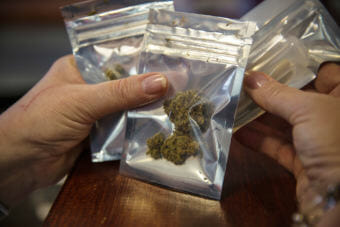
Medical marijuana is dispensed in Takoma Park, D.C. in 2014. (Photo by Evelyn Hockstein/The Washington Post/Getty Images)

Medical marijuana appears to have put a dent in the opioid abuse epidemic, according to two studies published Monday.

The research suggests that some people turn to marijuana as a way to treat their pain, and by so doing, avoid more dangerous addictive drugs. The findings are the latest to lend support to the idea that some people are willing to substitute marijuana for opioids and other prescription drugs.

Many people end up abusing opioid drugs such as oxycodone and heroin after starting off with a legitimate prescription for pain. The authors argue that people who avoid that first prescription are less likely to end up as part of the opioid epidemic.

“We do know that cannabis much less risky than opiates, as far as likelihood of dependency,” says W. David Bradford, a professor of public policy at the University of Georgia. “And certainly there’s no mortality risk” from the drug itself.

The National Academy of Sciences, Engineering and Medicine says there’s good evidence that cannabis is effective at treating pain for some conditions. So Bradford and three colleagues — including his scientist daughter — decided to see whether people who can get easy access to medical marijuana are less likely to get prescription opioids. The answer, they report in JAMA Internal Medicine, is yes.

“There are substantial reductions in opiate use” in states that have initiated dispensaries for medical marijuana, he says.

The researchers studied data from Medicare, which mostly covers people over the age of 65. (It was a convenient set of data and available to them at no cost). They found a 14 percent reduction in opioid prescriptions in states that allow easy access to medical marijuana.

They estimate that these dispensary programs reduced the number of opioid prescriptions by 3.7 million daily doses. States that allowed homegrown marijuana for medical use saw an estimated 1.8 million fewer pills dispensed per day. To put that in perspective, from 2010 to 2015 Medicare recipients received an average of 23 million daily doses of opioids, the researchers say.

Because opioid use nationwide was rising during the study period, their estimate of reduced uses reflects a slowing of the increase, rather than an actual decline in opioid use in these states, Bradford says.

The analysis found a correlation and can’t prove that marijuana use led to a reduction in the growth of opioid use. There might be other factors at work.

Even so, the findings suggests that expanding access to medical marijuana could help ease the opioid epidemic.

Hefei Wen at the University of Kentucky College of Public Health was lead author on another study in the same journal that reached similar conclusions. Wen, with Jason Hockenberry at Emory University, used Medicaid data. Medicaid is primarily a health insurance program for low-income people.

The authors write that laws that permit both medical marijuana and recreational marijuana for adults “have the potential to reduce opioid prescribing for Medicaid enrollees, a segment of population with disproportionately high risk for chronic pain, opioid use disorder and opioid overdose. Nevertheless, marijuana liberalization alone cannot solve the opioid epidemic.”

Bradford agrees that medical marijuana laws could have a role to play. “But it is not without risks,” he says. “Like any drug in our FDA-approved pharmacopeia, it can be misused. There’s no question about it. So I hope nobody reading our study will say ‘Oh, great, the answer to the opiate problem is just put cannabis in everybody’s medicine chest and we are good to go.’ We are certainly not saying that.”

One concern is marijuana use might encourage people to experiment with more dangerous drugs. Dr. Mark Olfson, a professor of psychiatry and epidemiology at Columbia University, authored a study that found marijuana users were six times more likely than nonusers to abuse opioids.

“A young person starting marijuana is maybe putting him — or herself at increased risk,” Olfson says. “On the other hand there may be a role — and there likely is a role — for medical marijuana in reducing the use of prescribed opioids for the management of pain.”

This is a question of balancing risks and benefits. And that’s difficult to do with the current studies based on broad populations — and in this case, populations that are not representative of the at-risk population as a whole.

Olfson says what they really need is studies that follow individuals, to see whether marijuana use really does supplant opioids. It’s hard to do study in this area because the federal government regards marijuana as a very dangerous drug and puts tight controls on research.

“That does make this a difficult area to study, and that’s unfortunate because we have a large problem with the opioid epidemic,” Olfson says “And at the same time, with an aging population, we have lots of people who have pain conditions and who will benefit from appropriate management.”

You can contact Richard Harris at rharris@npr.org.

Copyright 2018 NPR. To see more, visit http://www.npr.org/.

Early science says there are risks from secondhand marijuana smoke

Scientists are finding that, just as with secondhand smoke from tobacco, inhaling secondhand smoke from marijuana can make it harder for arteries to expand to allow a healthy flow of blood. (Photo by Maren Caruso/Getty Images)

The inspiration arrived in a haze at a Paul McCartney concert a few years ago in San Francisco.

“People in front of me started lighting up and then other people started lighting up,” says Matthew Springer, a biologist and professor in the division of cardiology at the University of California, San Francisco. “And for a few naive split seconds I was thinking to myself, ‘Hey, they can’t smoke in AT&T Park! I’m sure that’s not allowed.’ And then I realized that it was all marijuana.”

Recreational pot was not legal yet in the state, but that stopped no one. “Paul McCartney actually stopped between numbers and sniffed the air and said, ‘There’s something in the air — must be San Francisco!’ ” Springer recalls.

As the visible cloud of pot smoke took shape, so did Springer’s idea to study the effects of secondhand marijuana smoke.

He started thinking: San Franciscans would never tolerate those levels of cigarette smoke in a public place anymore. So why were they OK with smoke from burning pot? Did people just assume that cannabis smoke isn’t harmful the way tobacco smoke is?

Springer was already researching the health effects of secondhand tobacco smoke on rats at his lab at UCSF. He decided to run the same tests using joints.

“By the time I left the concert, I was resolved to at least try to make this happen,” he says.

He knew it would be difficult. Marijuana is still an illegal drug under federal law, and Springer’s research uses federal funds; so he has to purchase specially approved government cannabis for study. He also can’t test it on humans; hence, the rats.

In the lab, Springer puts a cigarette or a joint in a plexiglass box. Then he lights it, and lets the chamber fill with smoke, where an anesthetized rat is exposed to the smoke.

So far, Springer and his colleagues have published research demonstrating that secondhand smoke makes it harder for the rats’ arteries to expand and allow a healthy flow of blood.

With tobacco products, this effect lasts about 30 minutes, and then the arteries recover their normal function. But if it happens over and over — as when a person is smoking cigarette after cigarette, for example — the arterial walls can become permanently damaged, and that damage can cause blood clots, heart attack or stroke.

Springer demonstrated that, at least in rats, the same physiological effect occurs after inhaling secondhand smoke from marijuana. And, the arteries take 90 minutes to recover compared to the 30 minutes with cigarette smoke.

Springer’s discovery about the effect on blood vessels describes just one harmful impact for nonsmokers who are exposed to marijuana. Statewide sampling surveys of cannabis products sold in marijuana dispensaries have shown that cannabis products may contain dangerous bacteria or mold, or residues from pesticides and solvents.

California law requires testing for these contaminants, and those regulations are being initiated in three phases over the course of 2018. Because much of the marijuana being sold now was harvested in 2017, consumers will have to wait until early 2019 before they can purchase products that have been fully tested according to state standards.

“People think cannabis is fine because it’s ‘natural,’ ” Springer says. “I hear this a lot. I don’t know what it means.” He concedes that tightly regulated marijuana, which has been fully tested, doesn’t have as many chemical additives as cigarettes.

But even if the cannabis tests clean, Springer says, smoke itself is bad for the lungs, heart and blood vessels. Other researchers are exploring the possible relationship between marijuana smoke and long-term cancer risk.

Certainly, living with a smoker is worse for your health than just going to a smoky concert hall. But, Springer says, the less you inhale any kind of smoke, the better.

“People should think of this not as an anti-THC conclusion,” he says, referencing the active ingredient in marijuana, “but an anti-smoke conclusion.”

So is the solution simply to avoid smoke from combustion? In other words, is it safer to eat cannabis-infused products, or use “smokeless” e-cigarettes or vaping devices?

Springer still urges caution on that score because vaping, for example, can have its own health effects. Vaping devices don’t produce smoke from combustion, but they do release a cloud of aerosolized chemicals. Springer is studying the health effects of those chemicals, too.

All this research takes time. Meanwhile, Springer worries that people might come to the wrong conclusion — that the absence of research means the secondhand smoke is OK.

“We in the public health community have been telling them for decades to avoid inhaling secondhand smoke from tobacco,” Springer says. “We have not been telling them to avoid inhaling secondhand smoke from marijuana, and that’s not because it’s not bad for you — it’s because we just haven’t known. The experiments haven’t been done.”

Antismoking campaigners say we can’t afford to wait until the research is complete. Recreational pot is already a reality.

Cynthia Hallett is the president of Americans for Nonsmokers’ Rights, based in Berkeley, Calif. The organization was established in 1976, before there was a lot known about the health effects of secondhand smoke from tobacco.

Now that cannabis is becoming more common across the country — more than 20 cities or states have legalized it in some form — her organization is taking on the issue of secondhand marijuana smoke, too.

Hallett says some of the arguments being made in support of cannabis remind her of the arguments made on behalf of tobacco decades ago.

“I’m seeing a parallel between this argument that, ‘Gee, we just don’t have a lot of science and so, therefore, let’s wait and see,’ ” Hallett says. “The tobacco companies used to say the same thing about tobacco cigarettes.”

In California, smoking cannabis is prohibited anywhere tobacco smoking is prohibited — including schools, airplanes and most workplaces. Hallett is worried that the legalization of pot could be used to erode those rules.

It starts with the premise of decriminalization, she says, and then, over time, there’s “a chipping away at strong policies.”

Some cannabis advocates want to see pot regulated like alcohol — cities would issue permits for specialized smoking lounges, similar to wine bars.

But Hallett points out that smoke drifts, and it affects workers in a way that alcohol doesn’t.

“The difference is, if I were to spill my beer on you in a bar, it wouldn’t affect your long-term health,” she says. “If I choose to smoke, it can affect the health of the person near me.”

Pot is more like tobacco in that respect, and Hallett believes it should be regulated that way.

She says this era of California culture brings to mind a similar period in the 1970s and ’80s, when Americans started demanding more regulations for secondhand smoke, and a new etiquette around smoking took form.

When it comes to marijuana, Hallett says, “it is still polite for you to say: ‘Would you mind not smoking around me?’ ”

At Magnolia, a cannabis dispensary in Oakland, Calif., pot smokers talk about what responsibilities — if any — they should have when it comes to nearby nonsmokers.

“This is the first time that I have heard secondhand smoke in reference to cannabis,” admits Lee Crow, a patient-services clerk at Magnolia. “I’ve tried to be courteous — just common courtesy, like with anything.”

The dispensary’s director of clinical services, Barbara Blaser, admits she thinks a lot about secondhand smoke from cigarettes, but not pot.

“Both of my parents died of lung cancer!” she says. “I will stop a stranger and say, ‘You shouldn’t be smoking. My dad died of that!’ ”

California’s Proposition 64, approved by state voters in 2016, requires that some of the state tax revenue from the sale of marijuana to be distributed to cannabis researchers. In addition, the state’s Occupational Safety and Health Standards Board is examining workplace hazards that are specific to the cannabis industry.

This story is part of NPR’s reporting partnership, local member stations and Kaiser Health News.

Copyright 2018 KALW. To see more, visit KALW.

Alaska senator backs bill to allow pot business banking

FAIRBANKS — Alaska Republican U.S. Sen. Lisa Murkowski and a bipartisan group of senators are pushing legislation that would allow legal marijuana businesses to use banks to store profits.

The Fairbanks Daily News-Miner reported Thursday that Murkowski and Democrat Sen. Jeff Merkley of Oregon have introduced a measure within the Secure and Fair Enforcement Banking Act, a larger bill regarding federal banking restrictions that Merkley sponsored last year.

The measure would keep federal officials from being able to punish banks simply “because the depository institution provides or has provided financial services to a cannabis-related legitimate business.”

Many banks refuse to do business with marijuana growers, processors and sellers because marijuana is still a controlled substance under federal law.

Nominee to marijuana regulatory board withdraws

JUNEAU — The man nominated by Gov. Bill Walker to fill the public safety seat on Alaska’s marijuana regulatory board has withdrawn from consideration after losing his law enforcement job.
Travis Welch’s withdrawal from consideration was announced Monday.

Bob Griffiths, executive director of the Alaska Police Standards Council, says he was notified Thursday by the North Slope Borough that Welch had been dismissed as borough police chief.

He says the cause cited was a change in direction of leadership of the agency.

Messages left with Welch and the borough weren’t immediately returned.

Welch was chosen to replace Peter Mlynarik, who quit after the U.S. Department of Justice shifted its policy on marijuana enforcement. Mlynarik said the department’s decision removed the underpinning on which Alaska’s industry is based.

Juneau police end policy of flagging flying weed

Marijuana grown at a Juneau warehouse leased by THC Alaska on March 6, 2018. Up to half of the yield is earmarked for export to other parts of Alaska. (Photo by Jacob Resneck/KTOO)

A change in policy by Juneau police means licensed marijuana producers should now be able to fly their product out of Juneau on commercial airlines.

Until recently commercial cannabis was allowed to fly into Juneau International Airport, but not out.

In an industrial area of the Mendenhall Valley a red nondescript metal building houses THC Alaska.

Marijuana and its concentrates are produced here for Juneau’s retailers.

But they also have customers in other parts of Alaska, and Juneau’s geography means flying or crossing water to get it there, which involves federal legal jurisdiction.

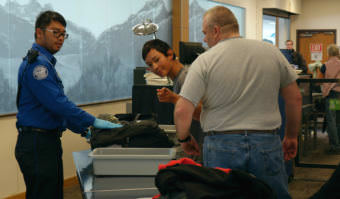
Transportation Security Officer Renier Cava preps passengers' carry-on belongings for X-ray screening at Juneau International Airport on Wednesday, Oct. 11, 2017.
Transportation Security Officer Renier Cava preps passengers’ carry-on belongings for X-ray screening at Juneau International Airport on Wednesday, Oct. 11, 2017. (Photo by Lorie Dankers/TSA)

Juneau’s pot producers have been turned away from boarding commercial flights.

It’s not clear exactly what the hang up was. There were different explanations, most coming back to the tension between state and federal marijuana laws.

But that’s all supposed to change. All four of Juneau’s licensed cultivators got a letter in the mail on Valentine’s Day on Juneau Police Department letterhead.

“To whom it may concern,” the letter signed by Juneau Police Chief Ed Mercer begins, “this letter is to advise of a procedural change the Juneau Police Department (JPD) will be making when dealing with legally licensed marijuana being transported via the Juneau International Airport.”

The letter CC’s the U.S. Attorney’s Office and the Transportation Security Administration.

Juneau authorities said it’s an evolving industry.

“We’re trying to do the best that we can from a due diligence point of view to make sure that we comply with what we’re supposed to comply with and make sure that people have the proper documentation,” Juneau Police Deputy Chief David Campbell said Tuesday. “But at the same time not hinder businesses, either. We’re just trying to find that balance.”

THC Alaska co-owner Ben Wilcox is taking the police at their word. He’s packed a carry-on – plus a personal item – for a Wednesday morning flight.

“These two bags I can easily get 15 pounds of trim or about 900 units of concentrates,” he said.

Since commercial pot was legalized in 2015, product has flown into Juneau’s airport.

Those in the industry report that product is routinely flown out of other airports in Alaska.

THC Alaska facilities manager Lacy Wilcox also sits on the board of the Alaska Marijuana Industry Association and said the “Juneau exception” was puzzling for everyone in the industry.

“It was hard for us to understand why Juneau was so different and all airports were freely coming and going and Juneau wasn’t,” she said. “We knew that it was a city-run airport vs. a state-run airport. But beyond that we really couldn’t understand why the requirements would be different from one to the other when we’re talking about in-state commerce.”

There has been a lot going on behind the scenes.

Meetings between the marijuana industry and Juneau police and city officials have been ongoing and sometimes, according to Lacy Wilcox, a little awkward.

“It’s always uncomfortable to go into the police department and say, ‘I’m a legal drug-seller and you’ve always looked at me one way and I’m hoping that you’ll look at me a different way starting today and how can we help you do that?'” she recalled. “It took a lot of people some guts to go and have that conversation.”

Ben Wilcox has his round-trip ticket in hand and an alarm set for an early wake-up.

“We’re going to give it a shot and turn hopefully three or four day trips into one-day trips,” he said with a laugh.

That’s assuming the weather cooperates.

Seattle moves to dismiss marijuana misdemeanors

Seattle’s mayor and city attorney announced plans to ask the courts to vacate all misdemeanor marijuana possession convictions that were prosecuted before it was legalized in Washington state in 2012 — a move that could affect the records of hundreds of people.

For years, pot convictions have had painful implications on the everyday lives of Washington’s most vulnerable populations, Mayor Jenny Durkan said in a press conference Thursday.

“It could be a barrier to housing, to getting credit, to getting good jobs and an education,” she said.

Once the misdemeanor charges are vacated or dismissed, she added, those seeking employment, applying to school, or trying to rent an apartment, “can check they do not have a conviction after this is done.”

Durkan and City Attorney Pete Holmes estimate more than 500 criminal convictions will be erased from court records. Most represent cases prosecuted between 1997 through 2009, which accounts for the period when pot misdemeanor cases were prosecuted in Seattle’s municipal court. Prior to 1997 they were tried in county court, over which city officials have no jurisdiction.

The final decision to undo the convictions is up to the courts, according to Holmes. “However,” he said, “this is an instance where the prosecutor is bringing the motion to vacate and dismiss and those instances there is very little discretion on the part of the judge.”

Individuals won’t have to ask for their conviction to be vacated. The courts will consider each conviction automatically.

Durkan began her career as a prosecutor working in Seattle’s Municipal Court system and says she saw firsthand the effects of the war on drugs. And this, she says, “is really a necessary step to right the wrongs” of what she called a failed war which disproportionately affected poor communities of color across the country.

Citing statistics from the Drug Policy Alliance, Durkan’s office said marijuana possession arrests in Washington rose sharply from about 4,000 in 1986 to about 11,000 in 2010, totaling 240,000 arrests. In Washington state, African Americans were arrested at 2.9 times the rate of whites during the first decade of this century. Latinos and Native Americans were arrested at 1.6 times the rate of whites.

This is not the first time the city is throwing out marijuana cases. Shortly after his election in 2010, Holmes dismissed all marijuana-possession cases and said his office would no longer prosecute such offenses, The Seattle Times reported.

Voters in Washington state approved legalization two years later.

Last week, prosecutors in San Francisco threw out thousands of marijuana-related convictions of residents dating back to 1975.

As NPR reported, District Attorney George Gascón said his office will dismiss and seal 3,038 misdemeanor convictions dating back before the state’s legalization of marijuana went into effect, with no action necessary from those who were convicted.

Prosecutors will also review nearly 5,000 felony convictions and consider reducing them to misdemeanors.

The National Conference of State Legislatures counts nine states and Washington, D.C., as having legalized the recreational use of marijuana — and 29 states and D.C. have laws allowing “comprehensive” legal medical marijuana programs. Additionally, at least nine states also have laws “addressing expungement” of some types of marijuana convictions, the group says.

Durkan said she hoped Seattle’s plan will serve as a template for other cities seeking to correct the biases of outdated and punitive drug laws.

Copyright 2018 NPR. To see more, visit http://www.npr.org/.
Site notifications
Update notification options
Subscribe to notifications