Marijuana

Marijuana cultivation to lead Alaskan job growth over next decade

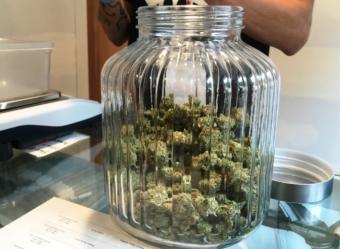
A jar of marijuana buds is seen at the Stoney Moose in Ketchikan. (KRBD photo by Leila Kheiry)

The fastest job growth in Alaska over the next 10 years will be in agriculture. But if you’re thinking about cows or potatoes, think again.

The Alaska Department of Labor projects that marijuana cultivation will lead all industries in job growth statewide between now and 2030.

The biggest declines in jobs are projected to come from broadcast and print media.

The data is published in the October issue of Trends, the monthly report of the Alaska Department of Labor and Workforce Development.

Cannabis cultivation emerged as Alaska’s leading high-growth industry for jobs because — unlike every other sector — it did not suffer a setback during the pandemic in 2020.

Job growth in marijuana cultivation and production actually increased by 8.2% that year, far ahead of the only other sector to remain in positive territory. Millwright jobs saw growth of about 2%.

Statistically speaking, marijuana is lumped into the “farming, fishing, and forestry” category, but state economists say that job growth in this category is driven by marijuana. Its dominant occupations are farmworkers and laborers, which represent about 40% of marijuana employment. This is also where almost 80% of the sector’s growth is expected to come from in the next 10 years.

Typically, health care is a strong sector for job growth, and the numbers suggest a post-pandemic rebound may be on its way: 14 of the top 25 fastest-growth jobs are in health care, with jobs ranging from surgical techs and registered nurses, to dietitians and recreational therapists. All those jobs fall below veterinarian, however, which is expected to see 16% more growth in the next decade.

The list of occupations expected to decline in Alaska reads a little like a 1990s career aptitude test: Fallers and logging equipment operators are on the decline, as are insurance sales agents, printing press operators and mechanical drafters.

Leading the pack in job declines, however, are broadcast announcers, news analysts, reporters, journalists, and broadcast technicians — which are all expected to see losses around 35% by 2030.

Alaska is a relatively small state in a large broadcasting world, however, and that tends to inflate the statistics somewhat. The actual number of broadcast and journalism jobs the state will lose is 36, with a third of that loss occurring during the pandemic. The data don’t capture how many people in the arts, design, entertainment, sports and media category transitioned to freelance work or became self-employed, which is common in this sector.

Factoring pandemic job losses into the overall picture for the next 10 years is important to consider. Other jobs in the bottom 25 include bartenders and ushers, lobby attendants, and ticket takers. The discussion in Trends points to an apparent contradiction: “If we were to look only at 2020-2030, these occupations would appear to be among the fastest growing — but they hemorrhaged jobs during the pandemic, making the recovery look like massive growth. From pre-pandemic levels, the decade decline is around 5%.”

Amid sluggish recovery, economist predicts more Alaska jobs in weed and mining

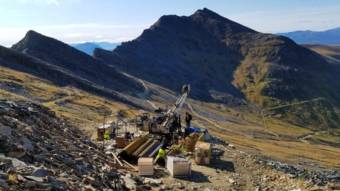
A drill rig in a remote-looking mountain range
Drilling at Trilogy Metals Inc.’s copper-rich Arctic Deposit in Alaska’s Ambler Mining District. (Trilogy Metals)

Alaska is slowly regaining the thousands of jobs lost during the pandemic, but it may take a few more years for the state to return to 2019 levels of employment. An October report from the state labor department said Alaska ranked 47th in the U.S. for job recovery from 2019 through the first half of 2022.

Paul Martz is an economist with the state of Alaska. He looked at 10-year industry projections for the state in the October Trends newsletter. He says the oil and gas industry was already losing jobs in the years leading up to the pandemic.

Listen:

The following transcript has been lightly edited for clarity.

Paul Martz: So oil and gas had been down from the recession, from the oil price collapse, starting in like fourth quarter of 2015. And we haven’t seen much growth from then leading into the pandemic. Obviously, there was another reduction in oil prices and further losses to employment. So we do have some positive outlooks for the industry in the short term. But we’re not confident in any sort of long term, cascading set of projects that will buoy the employment back up to where it was prior to the previous recession.

Michael Fanelli: I know that there’s heightened demand for mining certain critical minerals used in renewable technologies. But it looks like your projections are only based on the potential expansion of existing projects. Is that just because the approval process of new operations takes so long?

Paul Martz: Yeah, we mentioned that in the article. Yes, so the time it takes to get a mine up and running, developed, and operating is significant – probably well beyond the timeframe that we have for these projections, which end in 2030. So most of the growth we [project] for mining in Alaska is expansion of existing mines. There’s a few specific examples that we list, but almost all of the operating mines in the state are undergoing or have recently undergone exploration and expansion projects into the surrounding areas.

Michael Fanelli: So one other thing that caught my eye was that you expect the marijuana industry to continue growing rapidly over the next decade. I mean, at least here in Anchorage, it seems like there’s a dispensary on every other street corner. Is there really that much room for growth there?

Paul Martz: Yeah, so the industry has seen robust growth, even through 2021 — the pandemic only really slowed it down slightly. But yeah, I mean, it is a question that we’re wrestling with. If there’s a saturation point for this industry in the market, we don’t see any evidence of it now. And it’s a very new industry, you know, it hasn’t been around nearly as long as the other ones. So getting a handle on the trends and how it moves is a little bit more difficult.

So while we do have it projected to grow at a high percentage, in terms of a high percentage growth that we have projected, the actual number of jobs isn’t really all that much. It’s a small industry in terms of employment. So the percentage looks impressive, but when you look at the actual number of jobs, it’s not really all that many in regards to the overall economy.

Michael Fanelli: And then I was disappointed to see that you expect media jobs to continue declining, with the fastest shrinking occupation to be broadcast announcers. Is that just representative of the shrinking journalism industry overall you think?

Paul Martz: Yeah, so the occupations are based on the industry employment and, and when you have occupations that are concentrated in one industry and that industry is declining, then it cascades into those occupations. There is some uncertainty there because of changes in the industry itself. I’m sure you’re aware of this, but the extent to which people are becoming freelance, we can’t really track that, because then those people become self-employed, and they’re outside the scope of our employment data.

And there’s some technological advancements that have been occurring in the industry as well. If you look back 20 or 30 years, the amount of effort that goes into creating a print paper that gets mailed out is a lot more labor intensive than doing online publications. So that’s sort of where we’re at for that industry and in the occupations that fall within it.

On 4/20, Alaska House passes bill on marijuana records, underage possession

A jar of marijuana buds is seen at the Stoney Moose in Ketchikan. (KRBD photo by Leila Kheiry)

The Alaska House of Representatives passed a bill Wednesday to change how the state looks at two aspects of simple marijuana possession.

First, House Bill 246 would make past records of marijuana possession unavailable to the general public in searches of court cases.

And second, going forward, it would change the charge of marijuana possession for 18, 19 and 20 year olds from a misdemeanor crime to a violation, more like a speeding ticket.

Alaska legalized recreational use of marijuana for those 21 and older in 2015.

The House held a final debate Wednesday — April 20 — before voting on the bill.

“I find it poignant that today, being 4/20, and we’re discussing marijuana,” said Rep. Ken McCarty, R-Eagle River, referring to marijuana slang.

The bill’s supporters say past convictions for something that is now legal shouldn’t be a barrier to opportunities like employment or housing.
Rep. Jonathan Kreiss-Tomkins, D-Sitka, co-sponsored the bill.

“To some extent, we’re sort of in an equivalent situation. It’s like 1935, prohibition on alcohol ended seven years ago,” Kreiss-Tomkins said. “And to what extent as a society are we really deeply concerned about whether people were drinking in the 1920s?”

Those who might be concerned are potential employers, said Nikiski Republican Rep. Ben Carpenter, one of the bill’s several opponents.

“I think it’s important for the public to be able to tell whether it’s a speeding violation, or whether it’s a marijuana conviction, that somebody was or was not following the law in the past. That matters to an employer,” Carpenter said.

Kreiss-Tomkins said the bill would only affect the most public-facing court records, not more in-depth background checks some employers conduct.

After about an hour of debate, the House passed the bill by a vote of 30 to 8. It now goes to the state Senate.

USDA approves Alaska’s industrial hemp plan

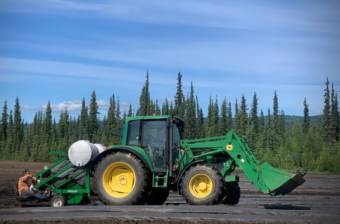
A green tractor in a field with spruce forest in the background
Mado CBD partners Paul Quist and Daniel Ponickly planting hemp seedlings last year at the company’s farm off Cripple Creek. (Photo courtesy of Mado CBD)

Earlier this month, the U.S. Department of Agriculture approved Alaska’s plan to promote and regulate the production of industrial hemp. The head of the Alaska Division of Agriculture says that means Alaska farmers will be able to diversify by growing a different crop that can be made into products that are increasingly in demand here and worldwide.

Hemp is a type of cannabis that only contains a tiny amount of the psychoactive ingredient THC. It’s a versatile plant used for biomass and the manufacture of materials like rope and fabric, as well as for a variety of CBD-based products for things like pain relief, health and beauty.

“This is already a more than 2-billion-dollar-a-year industry,” state agriculture division director David Schade said. “And that’s (expected) to grow exponentially around the world.”

Schade says hemp holds a lot of economic promise for Alaska. And he says the state has what it takes to grow the stuff.

“We have clean water, clean soil, clear air,” he said. “So we can, in the right regions, grow great plants.”

Schade says that’s been proven by nine growers located from Fairbanks to Homer who’ve cultivated hemp on a total of 70 acres outdoors and some 14,000 square feet of indoor space. The cultivation took place as part of a hemp pilot project that was established through a provision of the federal 2014 Farm Bill.

He expects the harvest will grow now that the USDA has approved the state’s plan to promote the industry, as authorized by the 2018 Farm Bill.

“That really opens up the market to Alaska,” he said. “And of course, you get an Alaska Grown label, in the Pacific Rim, that’s going to help sell your product.”

Zoe Quist, a partner in the Fairbanks-based hemp venture Mado CBD, agrees.

“What differentiates our product from a lot of competitors nationally and internationally is that it’s all natural,” she said.

Quist helps run the state’s most productive hemp-growing operation, which is on a family farm near Cripple Creek, just west of Fairbanks. The operation grew 5,000 plants on 6 acres last year, using organic growing methods and no pesticides.

Quist says the harvest will be used to make CBD products that will have greater appeal to health-conscious consumers.

“We are working with a few different companies in-state for different forms of processing,” she said.

Quist agrees that the Alaska CBD market is small, made somewhat larger by tourists and other visitors. But she and her family-member partners were all born and raised in Fairbanks, and they believe they’re doing more than just growing the raw ingredient of a product that’s increasingly in demand by people here and worldwide.

“We hire local people to work on the farm,” she said. “The money stays in the economy. And we just want to put our products in Alaskans’ hands and just keep it a home-grown operation.”

That’s the kind of sustainability Schade says the state is trying to promote through efforts like the industrial hemp program.

“We’re trying to do food security,” he said. “But food security also includes making sure that we have a strong, vibrant economy so that everybody can produce food.”

Alaska’s cannabis industry has the most retail shops per capita in the country

A jar of marijuana buds is seen at the Stoney Moose in Ketchikan. (Leila Kheiry/KRBD)

Alaska’s cannabis industry generates tens of millions of dollars in sales each year. After all, the state has the most retail cannabis shops per capita in the country.

So it might seem like there’s plenty of cannabis consumers’ cash to go around. But insiders say the industry is very competitive, and cannabis entrepreneurs have to be shrewd to keep their businesses alive.

recent story in the Anchorage Daily News looked into that competitiveness.

And ADN reporter Zachariah Hughes says some factors impacting Alaska’s cannabis industry are unique to the state.

The following transcript has been lightly edited for clarity.

Zachariah Hughes: One of them is just purely historical. And that’s that Alaska didn’t have a medical cannabis industry prior to legalization and the recreational industry standing up in 2016. So some other states, you know, notably California and some other West Coast states, did have a medical apparatus. And when legalization happened, decriminalization happened, the medical cannabis businesses sort of transitioned, or there was at least some infrastructure in place. We didn’t have that in Alaska. So the industry here was built from the ground up.

But some of the other nuances that we have, there’s no cap on licenses in Alaska. In other states, there are caps, and that makes the price of a permit a lot more valuable, since there’s a ceiling on how many people can get involved. I talked to one attorney who handles a number of cannabis clients who mentioned Arizona, where there’s a really firm cap in place and permits to cultivate and sell cannabis can go into the eight digit figures, which I was blown away by but is true.

The other thing that we have that not a lot of other states have is a very firm residency requirement in the form of you have to be a PFD recipient in order to be out of business license and be part of the cannabis business.

And so there’s not a lot of out-of-state money that can come in legally and prop up businesses. In other states, there’s a couple of very large multi-state business entities that have gotten involved in the cannabis sector and growing and selling. And we don’t have that.

Casey Grove: How are some of those things that are unique about Alaska affecting the industry now?

Zachariah Hughes: Well, according to a report in Politico, we have the highest number of cannabis retail shops per capita of any state that they looked at. They were looking mostly at Western states where the market really is kind of the biggest, but we have more pot shops per resident than anywhere else. There’s a number of cultivators, there’s a number of manufacturers, but we have you know, upwards of, it’s in the neighborhood of 140 or 150 retail shops.

I would almost call it like a Wildcat type industry patchwork here, you know, there’s a lot of independent small operators, and they’re working together, and they’re competing for market share. But there’s just a lot of small companies, very small companies, some of them are literally mom and pop or a family run businesses, and not too many of them are that big. There’s only a couple of businesses that have, you know, multiple sites for retail.

Casey Grove: And I guess there’s some thinking that to stay profitable in the future that some of those businesses need to get bigger, right? And to vertically integrate, I think is what you said in your story, huh?

Zachariah Hughes: Yeah. And that was a trend that I’d heard about from the beginning that, you know, there is this kind of race, when businesses started opening, to vertically integrate. That basically means you’re controlling all of the different steps involved from seed to sale. So you have a business that might have started out, you know, growing cannabis products, and then it gets into manufacturing, and then it gets into retailing, and plenty of them did this in different orders. But you’d basically be able to grow your product, refine it, manufacture it, and things like edibles or concentrates or flower products that you’d then sell at your retail location. And that was always seen as a way of giving businesses more flexibility.

The thing is, it’s quite expensive to vertically integrate. Cannabis businesses are pricey to operate anywhere in the country, and that’s certainly true in Alaska. And one of the byproducts of the costliness is that you need a lot of cash to open new businesses, because cannabis is still federally illicit or illegal or kind of this shady gray zone. Banks won’t lend to these people. So to start new businesses, you need to have your own cash. It’s a very cash-intensive business, particularly because there are so few financing options for people like you would get, you know, in other sectors.

The other thing is, it’s a very regulated business. And what I have heard from a lot of people is that a lot of businesses are not making it. They are operating on razor-thin margins, there’s intense competition among growers and retailers over price points. And I think we’re probably going to see more businesses go under, and that’s a long process. That’s a, you know, a year minimum to get a license to cultivate, manufacture or sell cannabis. It’s very costly. And we’ve seen dozens of businesses that in the five years since the industry got off the ground have already folded because it’s just not a very profitable business at this point, given how open the market is.

John Havelock, former Alaska attorney general, has died

John E. Havelock, 89, died Aug. 31, 2021. He spent his final days greeting friends and reflecting on his legacy. (Liz Ruskin/Alaska Public Media)

Former Alaska Attorney General John Havelock died Tuesday.

He was 89 and died at home of cancer, his wife, Mona, confirmed.

Havelock played a role in some of Alaska’s most important federal statutes, including the Alaska Native Claims Settlement Act and the trans-Alaska pipeline bill. He also drafted the language for Alaska’s constitutional amendment recognizing the right to privacy.

One afternoon last month, Havelock reflected on his life and legacy.

“I am a short-timer, you understand,” he said from a hospital bed set up in his Anchorage living room. “Well, I’m happy about it. I’ve had a good, strong life, full of accomplishments, and I don’t need anything else.”

Havelock came to Alaska the year statehood began — 1959 — with a newly-minted Harvard law degree to work in the AG’s office. He served as attorney general under Gov. Bill Egan from 1970 to 1973.

Havelock said he got a first draft of Alaska’s privacy amendment from Sen. Terry Miller, R-Fairbanks. He thought it was too wordy.

“So I went back to the office and I wrote it the way it is now and went out in the hall, handed it to him,” Havelock recalled. “And that became the Privacy Amendment.”

Section 22 of the Alaska Constitution is just 20 words: “The right of the people to privacy is recognized and shall not be infringed. The legislature shall implement this section.”

It is the backbone of Alaska Supreme Court opinions decriminalizing marijuana and upholding the right to abortion.

When it was written, in 1972, the concern was the government collection of personal data, but Havelock said applying it to abortion is appropriate.

“It is a broad idea. Privacy should apply to that situation,” he said. “A woman’s consultation with her doctor — Jiminy Crickets. There’s a limit to what you can do with that with a judicial proceeding.”

Havelock was a founding partner in the law firm Ely, Guess, Rudd & Havelock. He taught justice and political science at the University of Alaska. A room in the UAA Justice Center will be named for him.

Site notifications
Update notification options
Subscribe to notifications