Elizabeth Jenkins, Alaska's Energy Desk - Juneau
Juneau seawater heat pump more than a pipe dream?

Ted Stevens Research Institute
At NOAA’s Ted Stevens Marine Research Institute, the water in the lab is cycled to the basement where it becomes heat for the building. (Photo by Elizabeth Jenkins/KTOO)

Recently, the Alaska House passed a bill that could make it easier for one hydro project to get off the ground. If the Juneau Hydropower Inc. plant gets built, the company wants to bring sustainable heat to some residents from an abundant source.

It’s been done before but the company says not on this scale in North America.

In Drammen Norway, warmth is brought to its nearly 60,000 residents with water. At NOAA’s Ted Stevens Marine Research Institute in Juneau, the building is kept a toasty 70 degrees the same way, using a seawater heat pump system.

John Cooper is the facilities manager here, and he’s proud that the building has been kept warm this way since 2011. With the price of fuel today, he thinks it would cost around $180,000 a year to heat the building.

“With electricity, we’re using about $36,000 to heat this facility,” Cooper said.

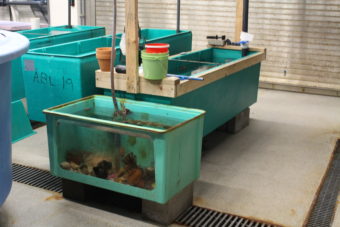
The seawater used in the building’s marine lab — the same water that holds starfish and sea cucumbers — gets cycled to the basement. And that’s where the magic happens.

Kind of like your refrigerator at home, the same technology is used here, but in reverse. The back of your fridge feels warm because that’s heat that’s been transferred away from the inside.

So if you stuck your hand in the Gastineau Channel and, to the touch it feels cold, actually, it’s fair to say there’s heat circulating in that water.

“There absolutely is heat circulating in that water. I’ve got two pipes right here. One of those is before the heat is extracted and one of them is after, and you can feel a difference. So we are physically removing heat from cold water,” Cooper said.

So imagine taking this idea and, like Norway and Iceland, duplicating it on a larger scale.

“Well the district heating has actually been a Juneau idea for the last 20 years, and we’re just taking it to another level,” said Duff Mitchell — the managing director of Juneau Hydropower. He claims the advancement of district heating is to heat what LED lights have been to lighting.

His plan is to build a hydro facility at Sweetheart Lake, south of Juneau, that will generate enough electricity for the project. Seawater would be pumped in from Gastineau Channel. It would have to be around 37 degrees to work efficiently. From there, the heat would be extracted and a closed loop water system would circulate the warmth through pipes around the city.

“We’re first and foremost looking at the downtown area,” Mitchell said.

He says places like the federal building, swimming pool and capital complex could be heated with the technology. High-density areas work best.

“So we would spider web out — downtown first. Then we’re looking at the future, if there’s another heat availability in the Gastineau Channel to do Douglas,” Mitchell said.

Keith Comstock, the company’s president, says 78 percent of people in Juneau use oil to heat their homes. Converting to district heating would be relatively simple.

“Because basically, they can leave their existing systems in place and right now, they basically burn oil which heats water, which is then distributed around,” Comstock said. “So instead of getting hot water from the boiler, they can get hot water from the district heat system.”

To be clear, the water itself won’t come from the district heat system; the heat will.

Inside the basement in Ted Stevens
Inside the basement at NOAA’s Ted Stevens Marine Research Institute, seawater is run through a compressor to extract the heat. (Photo by Elizabeth Jenkins/KTOO)

Comstock and Mitchell say their plans are sustainable and minimize the impact to fisheries. But you’re probably wondering who’s going to pay for it and how much is it going to cost? Comstock says so far private, local funders have invested. It’s $125 million for the hydro project, $25 million for the district heating, and that’s not all.

“Building a project like this is kind of like buying a house. If you have the ability to pay your mortgage, someone will loan you money, but you’re going to have to come up with a down payment,” Comstock said.

House Bill 143, which recently passed the House, could help. If the entire legislature passes it, Juneau Hydropower may be eligible for up to $120 million in low-interest loans from a state-backed corporation. And for the remaining expense, Mitchell says they want to negotiate with the U.S. Department of Energy for more loans — not grants.

“It should be the old fashioned American way. You come up with a good product. If you can borrow money and make a business model, you should pay it back,” Mitchell said. “And so especially with the times our state has and with others, I think it would be imprudent for anyone to be asking for money that would otherwise go to our schools and to other things.”

Back at the Ted Stevens lab, John Cooper is showing me the two boilers that once burned 200 gallons of fuel a day. They’re now backups. The room is used mostly for storage, and the space is pretty quiet.

“This is the sound of progress. And I have a 10,000 gallon fuel tank in the parking lot that stays full. It has some stale fuel in it,” Cooper said.

Although Cooper gets to enjoy the seawater heat pump system at work, Juneau Hydropower’s plans don’t extend to his home in valley. The company plans to break ground this summer. They would like to be delivering heat by 2018.

Mattel publicity stunt renames Juneau for April Fools’ Day

Students play Uno at City Hall with the cards being given out by Mattel as part of their April Fools' day event (Photo by David Purdy/KTOO)
Students play Uno at City Hall with the cards being given out by Mattel as part of their April Fools’ day event (Photo by David Purdy/KTOO)

The residents of Juneau got a surprise Friday when the city was renamed after an iconic Mattel game. About 25 kids got to go to city hall to witness the “historic” event and, of course, play with the namesake. So, what happens when a municipal government cooperates with a toy company’s publicity stunt?

You might have played it growing up or even as an adult: the card game with primary colors and big block font. Now, at least for Friday, we don’t live in Juneau, Alaska.

 “I live in UNO, Alaska. I live in UNO, Alaska. Me, too!” shout a chorus of children.

That’s right. UNO, Alaska. Like the classic card game. All the students seemed to be enjoying taking a break from class.

“We’re playing UNO. It’s a very epic game!” said 8 year-old Peyton Edmunds.

A postcard reading "Greetings from Uno Alaska" (Photo by David Purdy/KTOO)
A postcard reading “Greetings from Uno Alaska” (Photo by David Purdy/KTOO)

Tom Schwartz, a fourth and fifth-grade teacher at the Juneau Community Charter School, said on a typical day, this is the student’s math time.

“I told my kids we were coming on a math fieldtrip. And we were going to help them to do some accounting down here. So they were surprised to walk in and find out this is what we were actually doing,” Schwartz said.

The city’s Facebook page also reflected the name change, but that wasn’t the extent of it.

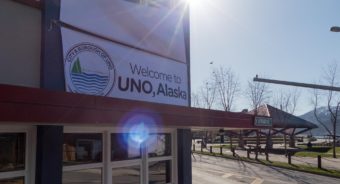
“Well, we’ve got the sign on city hall that says ‘Welcome to the city of UNO, Alaska.’ Our web page says UNO,” said Kim Kiefer, the city manager.

She got a phone call recently from Mattel — the same company that makes Barbie.

“It’s like, what? You’re from where? Why are you calling?” Kiefer said.

The reason: Mattel is adding new cards to UNO’s deck. The company even flew in Candice Jacobson, a company representative, to explain the “wild cards.”

“What that means is we’ve added three blank cards into the deck, and you can basically make it whatever you want, so it can be anything from ‘show me your hand’ to ‘jump in the lake,’” Jacobson said.

Mattel presented a $15,000 check to the Juneau Community Foundation as part of their April Fools' day event (Photo by David Purdy/KTOO)
Mattel presented a $15,000 check to the Juneau Community Foundation as part of their April Fools’ day event (Photo by David Purdy/KTOO)

She says Mattel initially thought of “wild” Alaska’s capital when it came to a way to promote the new edition. And, as a measure of goodwill, the company donated $15,000 to the Juneau Community Foundation Mayor Fisk Memorial Fund. Jacobson presented a giant check.

“This is an April Fool’s Day prank. But the check is not a joke,” Jacobson told the crowd.

The memorial fund was set up after the death of Mayor Fisk, and the money will go to at-risk youth in the community. Kiefer said Fisk’s son gave his blessing.

And although some might not be excited about their property taxes going to the city of UNO, Kiefer said, so far, the complaints have been minimal.

“We’ve had a couple people saying you’re wasting city money. And my response to that is Mattel has done all the heavy lifting,” Kiefer said. “All the cards, all the press releases, all the photographs. All that stuff — they’ve provided us.”

If it was up to Peyton Edmunds, the city of UNO would be here to stay.

“I think it’s a way better name. Just leave it like that forever. It’s a permanent name now,” Edmunds said.

The temporary sign on City Hall with a version of the city seal reading "City and Borough of Uno" (Photo by David Purdy/KTOO)
The temporary sign on City Hall with a version of the city seal reading “City and Borough of Uno” for Mattel’s April Fools’ day event (Photo by David Purdy/KTOO)

At ‘Hope, Not Heroin’ event Saturday, JPD to try softer approach

UntitledThe Juneau Police Department is hosting an event Saturday to help heroin users and those who have lost someone to the drug. Hope, Not Heroin will have food, music and 31 booths with information about addiction and recovery.

Lt. Kris Sell said it’s not common for police departments to organize an event like this.

“No, and we recognize that fact that we need to do something differently because our old tactics don’t work. The old tactics of just focusing on the supply don’t work, so we have to go after the demand,” she said.

Sell said seven people in Juneau died of heroin-related deaths in 2015. There’s been one death this year, and Sell said the police and fire department haven’t had a call since the beginning of March. Still, she said that number tends to increase in the summer.

To connect people with services, Sell said active opiate users are invited to attend the event.

“They are absolutely welcome, and we’re not going to be patting them down. That’s not what this is about. What we want is for them to get information and see what’s out there,” she said.

Hope, Not Heroin will also have several resources for the family and friends of those struggling with addiction. There will be a memorial wall to commemorate loved ones.

Sell said Capital City Fire/Rescue will be there to give information about Naloxone, which can save someone who’s overdosing. Recently, the legislature passed a bill that makes it easier for pharmacist to dispense Naloxone and gives protections to people administering it.

“They’re are probably going have questions like, ‘Do I tell the addict in my family I have this? Will that encourage brinkmanship in using too much of the drug? Trying to get higher and higher and thinking this is a safety net.’ Those are very real decisions that have to be made,” Sell said.

Hope, Not Heroin is on Saturday from 2 to 6 p.m. at the Juneau Arts and Culture Center. Capital City Fire/Rescue will discuss Naloxone at 2:30.

Ken Koelsch sworn in as Juneau mayor

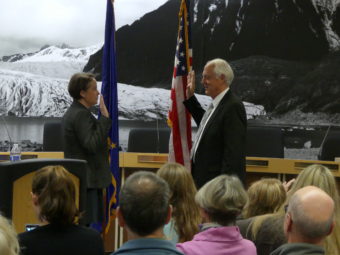
City Attorney Amy Mead swears in Juneau Mayor Ken Koelsch. (Photo by David Purdy)
City Attorney Amy Mead swears in Juneau’s new mayor Ken Koelsch. (Photo by David Purdy/KTOO)

The capital city’s new mayor Ken Koelsch was sworn in Monday in front of a packed crowd. Koelsch beat his opponent Karen Crane in a special election by over 1,300 votes, receiving the most support in the Mendenhall Valley precincts.

He will be replacing Mary Becker, who stepped in to fill the seat after Mayor Greg Fisk died of natural causes in November. Koelsch campaigned to “unify” the Juneau Assembly, which had some discord over whether or not to hold a special election — costing the city around $35,000.
For his first act as mayor, Koelsch said he wants to prepare for the fiscal hardships the state and municipalities could soon face.

“Starting to pull the mining community together, the tourism community together, the fishing community, the small business entrepreneurs together and make sure that we have them rock solid,” he said.

Koelsch’s opponent Karen Crane voted for the special election and left her assembly seat to run for mayor. During her campaign, she was blasted by some assemblymembers for using an old assembly photo on promotional materials. Those three assembly members — and former Mayor Merrill Sanford — showed support for Koelsch. Eventually, the Alaska Public Offices Commission or APOC launched an investigation but found no fault.

Despite the election drama, Koelsch said he felt like he ran a clean campaign.

“I think people have the right to object if they they think something is wrong. APOC ruled on it, and it is acknowledged, and we have moved on,” he said.

Koelsch, who previously served on the Juneau Assembly from 1997 until 2003, will head his first meeting as mayor on April 4.

Gold Medal has urban origins, village tradition


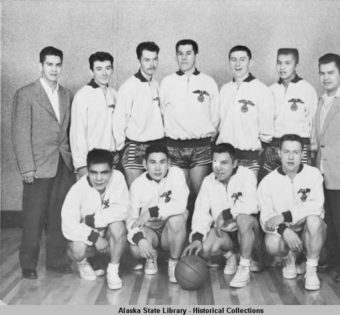
The Sitka Alaska Native Brotherhood team at the 1956 Gold Medal Tournament. (Photo courtesy of Alaska State Library Historical Collection)

Before statehood, before the Alaska Marine Highway System, there was the Gold Medal Basketball Tournament in Juneau. This year, the event is 70. It brings adult players from across Southeast to compete against neighboring villages and communities.

Elders sit along Juneau-Douglas High School’s gym wall. Their eyes are fixed on the players as they warm up before a game — Yakutat vs. Klukwan.

Charlie Williams, 75, is one of them. He lives in Juneau now but has been coming to Gold Medal since the 1940s. Naturally, he’s rooting for his home team.

“All the good looking people come from Klukwan ‘cause they drink that Chilkat water. 21 mile’s where you want to drink your water,” Williams said.

The tournament started back in 1947, a year after another basketball institution — the NBA. Shorts were shorter, the 3 point line didn’t exist, and traveling to Juneau meant making a special trip.

Williams says his parents laid it out like this: if he wanted to go to Gold Medal, he’d have to get better grades than his siblings.

“Well, there’s probably about eight of us kids then competing. Fortunately, I just studied a little harder. We had to do our chores. It wasn’t easy,” he said.

Chopping and carrying heavy wood is one of those chores he remembers being especially tough.

“We really didn’t have that much, and it was really great to come down to the old gym here on Fifth Street. It was quite an experience,” Williams said.

Gold Medal started as a fundraiser for the Boy Scouts. Although villages dominate the brackets now, some of the first teams to compete were Juneau, Petersburg, Ketchikan, and Skagway. Petersburg took home the win that first year.

Yakutat faces off against Klukwan in Tuesday's game. (Photo by Elizabeth Jenkins/KTOO)
Yakutat faces off against Klukwan in Tuesday’s Gold Medal game. (Photo by Elizabeth Jenkins/KTOO)

Gil Truitt, a former Gold Medal player, coach, referee and all-around wealth of information on the topic, said Kake was the first village team to enter the tournament in 1949.

Truitt couldn’t be at the tournament this year because it came down to attending Gold Medal or the state high school basketball tournament. But Gold Medal still holds a special place in his heart. He played in the early years with his high school team in Sitka in the late 1940s and early 50s.

“First with Mount Edgecumbe, then Sitka ANB, then Sitka Columbia Lumber,” Truitt said.

In those days, basketball was big in Sitka and had been for a while. One of Sitka’s first teams was started in 1914 by a branch of the Alaska Native Brotherhood. Truitt says pre-internet, pre-ESPN, he looked up to Herb Didrickson — a local player. So when Truitt was able to travel for the tournament with his high school team, he came over on a 14-hour long voyage to Juneau on a fishing vessel.

“It was cold, frightening, scary. You swore up and down you’d never do it again. I’m sure a lot of guys prayed,” Truitt said. “You had to love basketball to travel on those boats.”

That boat would also be the team’s sleeping quarters during the week. Truitt remembers the players would arrive wobbly-kneed from the trip over. And arriving in Juneau back in that day, Truitt says the players — Alaska Natives — didn’t always receive the warmest welcome.

But over the years, “the people were able to see that the Native team like Sitka and Metlakatla were so outstanding and colorful and wonderful to watch, that people forgot about the color,” Truitt said. “And I think basketball helped break down the prejudice that we witnessed.”

Kids run through court during a game break with homemade Hoonah flags. (Photo by Elizabeth Jenkins/KTOO
Kids run on the court with homemade Hoonah flags. (Photo by Elizabeth Jenkins/KTOO)

Now the teams travel to Gold Medal by ferry and air — from Hoonah, Kake, Craig, Haines, Wrangell, Hydaburg, Klukwan, Yakutat and Metlakatla. Some things about the tournament have changed. NCAA certified refs are brought in from down South to make sure there’s no local bias and woman-led teams are tearing up the courts.

This is Haines player Jaime Bentley’s first year at Gold Medal. She says, so far, the community excitement for the tournament has made an impression.

“I mean you see family, kids running around. The families are all enjoying this event together. It’s very unique to Southeast Alaska, and I love it,” Bentley said.

For Charlie Williams, sitting courtside, who’s gone to decades of games, it’s about the same thing.

“That’s why I come to the Gold Medal. Friends. Right here,” Williams said with a chuckle.

And of course, the basketball. Williams’ team Klukwan won its game that day.

Gold Medal kicks off in Juneau

Gold Medal attendants file into the gym before an evening game. (Photo by Elizabeth Jenkins/KTOO)
Players warm up in the gym before an evening Gold Medal game. (Photo by Elizabeth Jenkins/KTOO)

The Juneau Lions Club’s 70th annual Gold Medal Basketball Tournament kicked off at Juneau-Douglas High School this week. This year’s lineup includes teams from Hoonah, Kake, Craig, Haines, Wrangell, Hydaburg, Klukwan, Yakutat and Metlakatla.

Lions Club President Ted Burke has been coming to Gold Medal for 28 years. He said it’s difficult to determine what the attendance will be this year. But so far, the crowds have turned out.

“There are elders and children that run around with flags cheering on their team. It is the greatest. It is the noisiest. It is the most fun you’re ever going to have watching basketball,” Burke said.

The tournament is the Lions Club’s biggest fundraiser. Last year’s tournament brought in around $38,000. After overhead, the money is distributed to culture camps, eyesight assistance and $1,000 in scholarship funds for each competing team.

Students at Juneau-Douglas High School raise money for their activities, too, by staffing food booths.

“And every bit of profit they make goes back into their school program. So one of true, wonderful things about this in my eyes, the young boys and girls are learning to volunteer,” Burke said. “They’re helping themselves and their school as well and that’s vitally important.”

Burke estimates the students could collect up to $16,000 for their school. Gold Medal continues throughout the week with finals starting at 2:45 p.m. Saturday.

Site notifications
Update notification options
Subscribe to notifications