The Juneau Assembly approved new guidelines for a city pot license on Monday. Those seeking to cultivate commercial marijuana will have to apply for the $250 license, in addition to the state’s.
It’s part of the assembly’s attempt to streamline the conditional use permit process and establish new guidelines for marijuana businesses.
Commercial pot grows are zoned for industrial areas and some low-density neighborhoods, like parts of Thane, North Douglas and out the road. Lisa Cone, a North Douglas resident, testified that she wasn’t happy about the possibility of living next to a grow operation.
“We’re at the point where we have to sort of put up with what’s going on at North Douglas. Even though all the neighbors that we’ve spoken with are in disagreement about what’s going on,” Cone said. “But I feel strongly that individuals who are growing out there need to live on their properties.”
The new guidelines say a person must live on site if they are cultivating commercial marijuana in a neighborhood. That could be the owner or a tenant. Grow houses must be set back 25 feet from the property line.
Two people testified that the shifting regulations could discourage new business. They said some of the regs were based on antiquated fears. But Assemblymember Kate Troll said that wasn’t the case.
“We want to proceed with this. I feel that we aren’t driven by ‘Reefer Madness’ in assuming that everyone’s a bad hippy for those previous days,” Troll said.
The assembly approved the city marijuana licensing ordinance and changes 7-2, with Assemblymembers Mary Becker and Jerry Nankervis voting no.
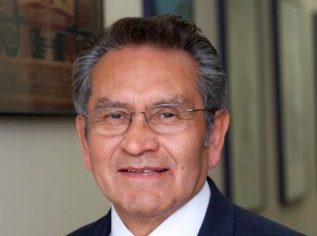
Ed Thomas received an honorary doctorate of laws Sunday. (Photo courtesy of Sealaska)
Tribal leader Ed Thomas received an Honorary Doctorate of Laws from the University of Alaska Southeast on Sunday. Thomas is a director at Sealaska and former president of Central Council of Tlingit and Haida Indian Tribes of Alaska.
He accepted the honorary degree at UAS’s graduation and gave the commencement address.
Alaska’s capital is one of the most expensive places to live in the nation. With no roads in or out, the city has been dealing with a “stuck” housing market. A report commissioned by the City and Borough of Juneau says 1,000 affordable rental units are needed to keep up with the demand. Juneau’s housing market is especially tough for people living on low incomes.
But one Juneau family is taking matters into their own hands and challenging the convention of what makes a house a home.
Carrie Joy doesn’t have a typical street address. But she has really helpful neighbors. When we can’t find her boat, a stranger springs into action — knocking on doors.
Yachts, sailboats and fishing vessels bob on the water at Aurora Harbor. And nearby, there’s a row of small houseboats. What they lack in space, some make up for in character. They’re fiberglass or made of wood, painted the colors of the rainbow.
Walking down the dock, we see it: the little gray boat with yellow trim. Carrie’s 9-year-old son William invites us through the small door.
We step down into the living room. It’s actually more of a multipurpose space.
Carrie Joy and her son William’s bed against the wall. (Photo by David Purdy/KTOO)
“This is my bed, my desk, my dining table. This is where William and I do school. This is where I write when I write,” Joy said.
Carrie home schools both children, so it’s also a floating classroom. And it’s the space where William sleeps. His bed touches the foot of Carrie’s. Her 14-year-old son sleeps in the back — with a little more separation — but there’s no bedroom door.
The entire home is just 200 square feet.
“Privacy is a huge sacrifice. We have to be very intentional about giving each other privacy. I mean, you can look around and see there’s nowhere to hide here,” Joy said.
Without walls, personal boundaries replace physical ones. She says everything from getting dressed in the morning to taking a shower can be an obstacle — especially with her youngest, who loves to give running commentary.
“Our life is a musical and typically he sings it,” she says with a laugh, as her son sings a tune.
As a single mom, she decided to buy the houseboat three years ago.
“When I came to look at it, I knew it would be hard,” Joy said. “But it has a shower, it has a flush toilet, and there’s room to put bunks in. And I just loved it. It was so sweet.”
The cost: around $28,000. Carrie used to be a teacher. She was also a state employee. But now she makes money freelance writing and cleaning houses.
“I make ends meet because first of all, I don’t have any debt. And second of all, I keep my expenses extremely low.”
That means making the most of about $1,600 a month. To put that in perspective, that’s less than a third of Juneau’s average yearly income.
She receives food stamps. She’s also eligible for federal cash assistance, but she hasn’t taken it yet. That would mean having to first cash out her retirement with the state, which she wasn’t ready to do until recently. So at the end of the month, is this enough?
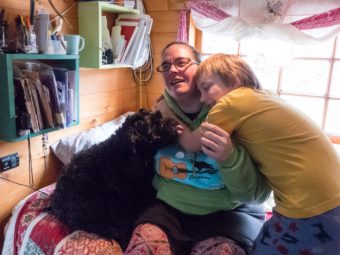
Carrie Joy, her son William and their dog Sadie. (Photo by David Purdy/KTOO)
“Well, I’m still breathing and my children are still breathing and their bellies aren’t hungry. I guess it depends on what you consider a need?” Joy said. “Could we use some different things? Absolutely. Would it be nice to have a door that shuts that doesn’t go to the outside? Yes, that would super rock. But is it necessary? Not at this point.”
Carrie says what is necessary for her family is time. Teaching in the public school system left her feeling burned out. As a parent, she didn’t think one-size-fits-all learning was beneficial for her children, which was why she decided to homeschool.
“Honestly, for me, it was probably a pretty selfish decision because I like reading cool books, I like doing art projects, I liked doing music. … And I couldn’t keep up in school, and teaching my own kids, we can discover those things together,” she said.
Carrie’s family has lived on the water longer than she thought they would. The plan was to save up for a regular house. And she thinks that could still happen, but probably not until after her sons are grown.
Right now, they’re in the process of renovating the boat. And Carrie will eventually have her own room again. She says from the outside, she might look poor.
“But I’m so time-rich and most of the folks who are struggling to make their ends meet are time poor and money poor,” Joy said. “Had I not chosen to live on a boat here in Juneau … There’s no way I could do it and be sane and happy, and anybody who knows me might wonder about the sane part, but nobody will tell you we’re not happy.”
And she’s dating somebody who she says can relate. He lives on a boat, too.
(Photo by David Purdy/KTOO)
Funding for Chasing the Dream is provided by the JPB Foundation and the Ford Foundation. It’s part of an ongoing series about poverty and opportunity in America.
An artist rendering of the art installation. (Image courtesy Juneau Docks and Harbors)
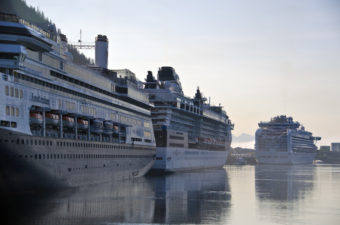
The first cruise ship of the season arrives in Juneau on Saturday. And next week, large ships will be able to use a new, floating dock.
They’re called Panamax ships because they’re the biggest thing that can fit through the Panama Canal.
The nearly $54 million project is paid for by marine passenger fees. In the past, some Panamax ships have had to anchor offshore and tender passengers over in small boats. Carl Uchytil , the port director for Juneau Docks and Harbors, said this deters tourists from leaving the ship.
“And so we really want that ability for the vessels to tie up at our float, walk ashore, go on excursions, go to shops and frequent the restaurants,” Uchytil said.
Now more passengers will be able to walk down a ramp to the wharf. Uchytil said he’s seen an uptick in Panamax ships with the popularity of Alaska’s cruise industry.
Phase 2 of the project is slated to be completed next May.
“Then in Southeast Alaska you’ll have the three major cruise ship ports: Skagway, Juneau and Ketchikan, all capable of accommodating four Panamax-sized cruise ships,” Uchytil said.
The status quo has been three in Juneau.
A $500,000 light-up art installation is also in the plans. It features several abstract columns along the waterfront. It was designed by a Los Angeles artist, inspired by whale flukes and the span of eagle wings.
Uchytil expects the art to go in sometime in the late summer of 2017.
The Alaska state capitol building in Juneau. (Public Domain photo)
Alaska’s larger cities could see a drop in state funding as Community Revenue Sharing is scaled down. Anchorage takes the biggest hit. Juneau could lose over a million dollars in the next few years. Meanwhile, some rural communities could receive more. But as legislators squabble about how to fill the state’s budget void, the uncertainty has some municipalities wondering if they’ll be fine, or have to close entirely.
Back in 1999, Alaska’s policy makers believed the state had enough oil wealth to share with local governments. And for about 17 years there was.
Under its Community Revenue Sharing program, the state paid some municipalities millions of dollars. It was prorated based on population. Some cities used it to pay for the necessities, like emergency services and plowing roads in the winter. In smaller places, it sometimes helped fund an entire city’s’ operations.
Now, legislators have given it a new name: Community Assistance. And with it, some changes.
“The difference is the formula is different and it’s half of what it was before,” said Kathie Wasserman, the executive director of the Alaska Municipal League.
The legislature passed SB 210 this month, and it’s waiting on the governor’s approval. It establishes a formula to manage the dwindling funds. Small communities will receive the same amount — if not more. Big cities receive less. The total pot of money to be doled out yearly would be no more $30 million.
“Senate Bill 196 which says, ‘OK, here’s where we get the $30 million and put it into the revenue sharing, that has not passed,” Wasserman said. “So we have a funding amount and a formula, but we don’t have the money.”
Left as is, the Community Assistance fund would stop paying out by the year 2020. That’s according to the Community Revenue Sharing office.
Wasserman says that would be a huge blow to cities in rural Alaska — where it can be up to 85 percent of the operating budget.
“You know, what do you do? Should you put the key to the city hall in an envelope now? And have it ready to mail to somebody? It’s just difficult to run anything well when you can’t plan,” Wasserman said.
In the immediate future, larger cities must deal with less. In fiscal year 2018, Anchorage could see an $11 million reduction in Community Assistance. In Juneau, it would be about a $1 million reduction.
Bob Bartholomew, Juneau’s finance director, said the capital city relies on numerous funding sources from the state.
“And so, we know it’s coming and we’re just trying to, number one, get advanced notice and, two, try to understand, over the next couple of years — it’d be nice to know what is the size of the overall reduction?” Bartholomew said.
Historically, Juneau has used the funds to help pay for police patrols and emergency services. It uses it to pay out local grants. Permanent supportive housing for the city’s at-risk homeless is being built with a portion of the money. Bartholomew thinks Juneau’s diverse economy will help the city pull through.
But if the funding doesn’t come back, Kathie Wasserman says that could be the end of some small city offices.
“It will certainly change the look of Alaska, and I don’t know if the legislature has really thought that out,” Wasserman said.
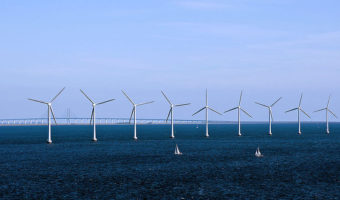
In Denmark, electricity is generated through wind turbines for district heating. But in Juneau, a hydropower project is in the works. (Creative Commons photo by CGP Grey)
A proposed district heating project in Juneau has captured the attention of the Danish government. On Friday, a Danish representative gave a presentation to the legislature about how that works in Denmark. Juneau Hydropower invited the speakers.
The Juneau company wants to build a dam on Sweetheart Lake. The electricity collected will power a downtown seawater heat pump system, circulating warmth through pipes around the city.
HB 143 could free up loans to fund a similar project in Juneau. The bill has already passed the House. It’s now in the Senate Finance Committee. Jakob Bjerregaard was visiting from the Danish Embassy in Washington, D.C. He said more than 60 percent of his country gets heat through district heating.
You can listen to his conversation with me here:
Close
Update notification options
Subscribe to notifications
Subscribe
Get notifications about news related to the topics you care about. You can unsubscribe anytime.