Elizabeth Jenkins, Alaska's Energy Desk - Juneau
Hunting baby seals for science near Yakutat’s glacial fjords

Capture_mode: Researchers move slowly through the ice in Disenchantment Bay hoping to get close enough to net a seal so as to measure and weigh it, collect samples, and attach a satellite tag to monitor behavior. Photo collected under the authority of MMPA permit No. 19309. Photo credit: Jamie Womble (NPS)
Researchers move slowly through the ice in Disenchantment Bay hoping to get close
enough to net a seal. (Photo by Jamie Womble/National Park Service)

Summer is an important time for seal pup development. So the federal government is asking vessels — like cruise ships — to stay farther away from harbor seals in glacial fjords. Biologists are tracking the population in Disenchantment Bay near Yakutat to see how the new guidelines are working. 

Tagging 45 precocious baby seals is no easy task. That’s the number John Jansen, a federal biologist, has in mind. His crew is preparing to float through the water near the face of Hubbard Glacier.

The plan: Catch the pups as they drift by on hunks of glacial ice.

“Our first attempt is going to be using a small dip net and trying to approach them in a stealthy way,” Jansen said.

Of course, mama seals can make this difficult. It’s easier if they scoop up a pup before she notices they’re around. Once Jansen and his crew catch a seal, they’ll glue a satellite transmitter to its fur, either on its back or head.

“Because that’s the only part that typically comes out of the water when they’re at sea. Those have been equated with party hats,” he said with a laugh.

Back in his Seattle office, Jansen will be able to see the pup — just a small dot — on his computer screen. It sounds like a seal version of Big Brother, but the National Oceanic and Atmospheric Administration wants to know how much time pups spend hauling out on the ice. It’s an important time for seals to rest. And for baby seals, it’s a chance to fatten up.

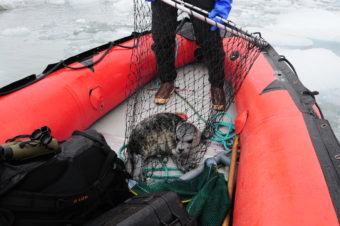
A netted pup: a harbor seal pup just captured in Disenchantment Bay, Alaska. The pup will provide hair, skin, and whisker samples just before having a satellite tag glued to the hair on its back. Pups were reunited with their moms in 20-30 minutes. Photo collected under the authority of MMPA permit No. 19309. Photo credit: John Jansen (NOAA)
A netted pup: a harbor seal pup just captured in Disenchantment Bay near Yakutat. (Photo by John Jansen/NOAA)

“There is a really critical function of hauling out, and if that period of hauling out is disturbed by humans, it has a consequence,” Jansen said.

As many as four cruise ships can be in Disenchantment Bay a day. It’s popular spot to see massive hunks of the Hubbard Glacier fall into the water. Seals are rest on icebergs nearby.

But the ships sometimes scare seals into the water.

“In Yakutat, we harvest seals so the seal population has to stay healthy,” said Victoria Demmert, the president of the Yakutat tribe.

She said local hunters became concerned in the late ’90s when they noticed fewer seals in Disenchantment Bay. And they wondered if an increase in tourism was affecting the population. So NOAA started monitoring the seals. Over the years, the federal agency has observed large vessels are causing the seals to spend less time on the ice.

Demmert said that’s a growing concern for the tribe.

“We understand they want to show off the area for their passengers but we need them to be considerate,” Demmert said.

The old marine viewing guidelines advised vessels to stay 100 yards away from seals. They were created before the boom of tourism. Aleria Jensen, a NOAA stranding coordinator, said that’s no longer adequate in glacial fjords. So the agency came up with new guidelines and public comment was taken.

NOAA had two options: Make it voluntary or require it through regulation.

“The agency decided to go with a voluntary approach. So there are some measures that are meant to apply to glacial fjords across Alaska,” Jensen said.

Vessels are now being asked to stay 500 yards away from seals. Jensen said NOAA realizes the tour industry offers the state a significant economic boost.

“And the goal here is to protect seals without compromising opportunities for high quality glacial viewing and wildlife viewing experiences but finding the balance,” Jensen said.

Satellite technology: A closeup view of a satellite tag attached to a harbor seal pup. The tag will transmit information about haulout and diving behavior of pups during the period they are dependent on mom for nutrition, and during their first year of independence. Photo collected under the authority of MMPA permit No. 19309. Photo credit: Jamie Womble (NPS)
A closeup view of a satellite tag attached to a harbor seal pup. (Photo by Jamie Womble/National Park Service)

Soon, NOAA and the National Park Service will be closer to figuring out what that balance is. They’ll use this summer’s research to determine exactly how the vessels impact the growing seals. For example, how much time are they really spending on the ice?

Back in Disenchantment Bay, John Jansen and his team are giving a seal pup a haircut. Actually, they’re taking hair and whisker samples to bring back to the lab. Then they glue on the tracking device.

“We just want to make sure that the rise and presence of humans is not putting those populations at risk,” Jansen said. “We want to make sure they’re there for everyone to enjoy in the long term.”

After awhile, the seal mom swims around to check on her baby.

“That’s frickin’ awesome!” Jansen said.

When the biologists are finished, they’ll dip the pup back into the water — with new haircut and new hardware.

Study participant: A study animal resting on ice in a group near Hubbard Glacier in Disenchantment Bay some days after having a satellite tag attached (see tag on pup’s back). Photo collected under the authority of MMPA permit No. 19309. Photo credit: John Jansen (NOAA)
A study animal resting on ice in a group near Hubbard Glacier in Disenchantment Bay. (Photo by John Jansen/NOAA)

Correction: An earlier version of this story overstated how many cruise ships are in Disenchantment Bay at once. This summer, as many as four cruise ships are scheduled to pass through the bay in a single day, but not at the same time. 

388 scientists ask Obama to stop offshore lease sale

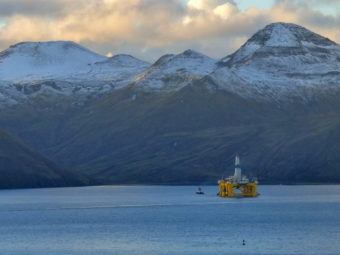
Shell Polar Pioneer
Shell’s Polar Pioneer leaving Dutch Harbor on Oct. 12, heading for Washington state. (Photo by John Ryan/KUCB)

Nearly 400 scientists sent a letter to President Barack Obama Wednesday asking for an end to offshore lease sales in the Arctic. The U.S. Department of the Interior is considering leasing areas in the Beaufort and Chukchi Sea for offshore drilling.

More than 30 scientists from Alaska signed the letter. Eugénie Euskirchen, an associate research professor at the University of Fairbanks, says most of her colleagues are opposed to the lease sale.

Euskirchen studies the effects of climate change in the Arctic and worries that if drilling occurs a crisis could follow.

“First of all, it upsets an ecosystem that’s already very fragile,” Euskirchen said. “And second of all, if there’s a disaster or spill or any sort of problem, the oil companies do not seem like they’re very well ready to handle any such problem.”

There hasn’t been a lease sale in Alaska since 2008. Last year, the Department of the Interior canceled the current lease cycle after Shell decided to halt exploratory drilling, citing disappointing results and lack of industry interest.

Josh Kindred, of the Alaska Oil and Gas Association, says even though oil prices are low now, that may change. He thinks getting rid of the lease sale altogether could bar the U.S. from drilling in the Arctic forever.

“You know, at the end of the day, we don’t know where we’re going to be as a nation from an energy standpoint five years from now,” Kindred said. “And so foreclosing this opportunity prematurely — particularly when we’re still afforded that opportunity four or five years from now to simply have BOEM pull those lease sales — seems like poor policy.”

BOEM is the Bureau of Ocean Energy Management. The bureau’s public comment period for the 2017 to 2020 plans ends Thursday.

Juneau charges ahead with electric vehicles

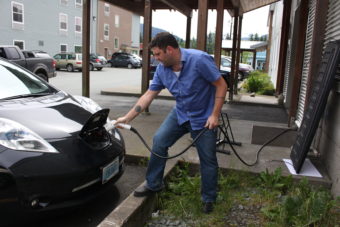
Travis McCain plugs in his 2013 Nissan Leaf. (Photo by Elizabeth Jenkins/KTOO)

With its limited road system, Southeast doesn’t seem like a paradise for car lovers. But it might be the perfect spot for Travis McCain.

He’s the enthusiastic owner of a 2013 black sedan. With the push of a button, he starts the quiet car and describes some of his favorite features:

“Heated seats, heated steering wheel, heated rear seats.”

McCain hasn’t been to the gas pump in months — ever since he bought the all electric Nissan Leaf. When he bought the car back in February, he tried to shop locally.

“I went to all the dealerships in town and said, What can you do that’s similar to the Nissan Leaf?’ And nobody quite had the answer,” McCain said.

So he bought one from Washington and had it barged up. He says he wanted the car to help cut fuel costs — the electricity for the vehicle is only about 2 cents a mile. The positive environmental impact was the icing on cake. In Southeast, there’s one thing he doesn’t have to worry about, and it’s something that does worry drivers in the Lower 48.

“Range anxiety. That’s associated with the car, which I never really had,” McCain said. “It’s Juneau, if I get stuck somewhere, oh, well. I’ll call a friend.”

But even that scenario is unlikely because along Juneau’s nearly 60 miles a road, there are a lot of plugs.

Alec Mesdag, a director at the Alaska Electric Light & Power Company, runs down a list of ten public charging stations.

In 2014, he worked with the city’s economic development council to help identify the locations for the charging stations, which were grant funded.

Mesdag says at first some criticized the charging stations as a handout. The electricity is free, and the city doesn’t give away gasoline.  

“While that analogy is out there, the biggest difference is the expense is so different,” Mesdag said. “It would literally cost the city more to administer the collection of funds than to give the electricity away.”

Mesdag says Alaska’s capital currently ranks with places like Austin, Texas and Portland, Oregon when it comes to plugs per capita, but he thinks Juneau has the advantage.

“In all honesty, we’re better suited for the vehicles than a lot of those other communities,” Mesdag said.

What some see as an oddity — the city’s remoteness — is actually a superpower for electric vehicles. There’s just not that far to drive. Still, it can be a pain to ship cars here or have them repaired. Groups in Juneau and Sitka are trying to organize regular visits from technicians. Soon, there might be enough electric cars to warrant the trip.

Mesdag says there’s a new Nissan Leaf arriving just about every week. There are about 50 fully electric vehicles, or EVs, now.

“We’ll be close to 100 EVs in Juneau by the end of the year,” Mesdag said.

This couldn’t work everywhere in the state. Fully electric vehicles can have issues in colder climates. Furthermore, it requires cheap — or relatively cheap — electricity, which means it doesn’t make sense in regions that rely on expensive diesel. But in Southeast communities with lower-cost hydropower like Juneau, Sitka and Petersburg, electric vehicles pencil out.

Mesdag thinks they could start to become the new norm.  

“A year ago, I would have been less sure this was going to happen, but now people seem to be developing a pretty strong comfort-level with the vehicles,” Mesdag said. “Word of mouth is a big sales tool. And we have a lot of people who own these vehicles now, and they’re pretty happy with their experience.”

Travis McCain says he doesn't feel like he's given anything up driving a fully electric car. (Photo by Elizabeth Jenkins/KTOO)
Travis McCain says he doesn’t feel like he’s given anything up driving a fully electric car. (Photo by Elizabeth Jenkins/KTOO)

Back on the road in his Nissan Leaf, Travis McCain is going down the list of five people he’s converted to the church of EV, including his sister and fiancé.

He still keeps a truck around to haul his boat, but the Leaf has become his primary vehicle. It’s changed the way he looks at other cars.

“On a nice day even like today, I’ve noticed that I might typically drive with the windows down,” McCain said. “And then as I pull up to an intersection, I put my windows up so I don’t have to smell other’s car exhaust. Getting finicky!”

McCain is in the process of buying another Leaf. It’ll be a delivery car for his business.

Thousands of dollars granted for Southeast energy audits

Village of Angoon
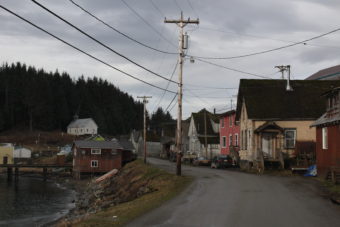
Some remote Southeast communities, such as Angoon, run off of a diesel generator. Power cost equalization helps lower the bill for residents but for local businesses, the energy costs can be extremely high. (Photo by Elizabeth Jenkins/KTOO)

In remote Southeast communities, electricity costs for local businesses can be very high. Businesses don’t qualify for power cost equalization — a state program that subsidizes energy costs for private residents. But a small federal grant could help businesses identify some simple ways to save.

When you hear the word “audit,” good things may not come to mind. You might think about the IRS peeking into your personal accounts, finding you owe more on your taxes.

“Sometimes I call it an assessment so we don’t get that negative connotation with it,” says Shaine Kilcoyne, a director of the Renewable Energy Alaska Project.

She said this audit is something businesses might want to sign up for.

“The level of energy audit we’re doing is really trying to get an understanding of how the building is using energy,” Kilcoyne said.

Up to 26 Southeast businesses can request the energy audit, and the grant covers most of the costs. Kilcoyne says to think of it as more of a workshop. After businesses turn over two years of electricity and heating info, an energy auditor stops by and makes suggestions.

“Some of the easier ones are efficient lighting. LEDs have become a lot more affordable. Weatherization — we see a lot of cracks in doors and windows,” Kilcoyne said.

And those suggestions can save big bucks, especially in communities that run primarily on diesel. In Hoonah last year, the energy auditor recommended LED lights in the harbor and gym.

“They had these old lights that would buzz and take a while to turn on, and they were having we’re having a problem keeping the gym open,” Kilcoyne said.

After the switch, the city saved $17,000.

Kilcoyne says this year they’re considering offering the energy audits to commercial fishing vessels, too. Later on, the final reports could help businesses qualify for loans to finance more expensive improvements.

Even though that’s money spent, Kilcoyne thinks it’s also money saved.

“That could go back to staying open longer or hiring more people or expanding their business,” she said.

The Renewable Energy Alaska Project is administering the $95,000. It was awarded to Southeast Conference — an economic development organization based in Juneau.

What these drones have detected could mean hazards for the Bering Sea

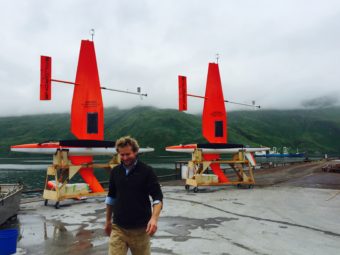
Saildrones Inc. CEO Richard Jenkins turns his back (unwisely?) on two of his creations in Unalaska. Photo: John Ryan/KUCB.
Saildrones Inc. CEO Richard Jenkins turns in Unalaska. (Photo by John Ryan/KUCB.)

Orange drones were launched in Dutch Harbor last summer to measure sea ice retreat. Now Saildrones are back in the Bering Sea with a new mission and new features.

One of them is to record North Pacific right whale calls to help track its migratory patterns. There are only 30 North Pacific right whales in U.S. waters. The other new feature will help determine how many fur seals and pollock live in parts of the Bering Sea.

The pollock fishery there is the largest in the U.S.

“Is it going to be a winner or a loser over the next decade in terms of the effects of warming, ocean acidification and loss of sea ice?” asks Douglas DeMaster, a science director at the National Oceanic and Atmospheric Administration Alaska Fisheries division.

DeMaster says scientists are concerned about the fur seals, which feed on pollock, and the diminishing stocks of pollock.

“It’s something the fishery needs to plan for and adapt to. And the only way to do that is with good information,” DeMaster said.

https://vimeo.com/167481038

In addition to testing the temperature, oxygen and salinity of the water, the Saildrone will also be using echo sounder technology. DeMaster calls it “a sophisticated fish finder.”

“It’s basically a ping, a sound impulse that’s sent through the water column and it’s reflected off of fish,” he said.

NOAA has used it on research vessels before but never on the Saildrone. Scientists will be able to sit from the comfort of their office or even in a coffee shop, as some of the data is collected in real time. In September, they’ll pluck the Saildrones out of the water when the season changes. They run off battery and solar power. It’ll take six months to a year before scientists can draw solid conclusions from the data.
Christopher Sabine, the director of NOAA’s pacific marine environmental lab, says pollock stocks have dropped before. The temperature of the Bering Sea warmed up in the early 2000s.

“Then it got cold again and the fish stocks came back,” Sabine said. “We’re now swinging back into a warm period again and we’re looking at potentially three years for this to manifest itself in the fisheries side of things.”

Since the Saildrone were launched two weeks ago, some startling information has already come back. Sabine says temps in the lower Bering Sea are about five degrees warmer than normal.

“Weeks or months” before NOAA knows what killed whale

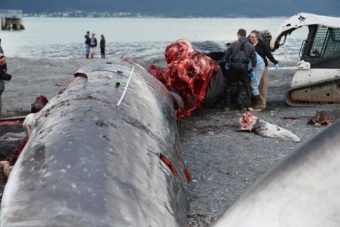
Carol Fairfield, Bureau of Ocean & Energy Management, takes samples during a necropsy of a fin whale in Resurrection Bay, Seward, Alaska. Jennifer Gibbins/Alaska SeaLife Center
Carol Fairfield of the Bureau of Ocean & Energy Management takes samples during a necropsy of the fin whale. (Photo courtesy of 
Jennifer Gibbins/Alaska SeaLife Center)

It could take weeks or months before scientists know what killed a fin whale stuck on the bow of a Holland America cruiseship. The whale carcass was found Sunday when the cruiseship docked in Seward.

Julie Speegle, spokesperson for the National Oceanic and Atmospheric Administration, says the endangered juvenile fin whale was about 50 feet long. It was moved to a nearby beach where a two-day necropsy took place.

Speegle said the lead pathologist took a number of tissue samples to determine the cause of death.

“Some of the samples she took were intended to be tested for exposure to harmful algal blooms, which means if those tests (come) back positive it could be related to the unusual mortality event of large whales,” Speegle said.

Last year, nine fin whales were found dead in Southcentral Alaska waters. Speegle said NOAA doesn’t know what caused the whale deaths, but algal blooms — caused by warming ocean temperatures — are the leading theory.

“The harmful algal blooms have a toxin in them that get into the phytoplankton, which the whales eat, which then introduces the toxin to the whale.”

Essentially, poisoning the whale.

Russ Andrews, Carol Fairfield and Laura Morse participated in the necropsy. The whale's body will be buried on the beach. Later, the bones could be dug up and re-articulated for display. (Photo courtesy of Jennifer Gibbins from the Alaska SeaLife Center)
Russ Andrews, Carol Fairfield and Laura Morse participated in the necropsy. The whale’s body will be buried on the beach. Later, the bones could be dug up and re-articulated for display. (Photo courtesy of Jennifer Gibbins/Alaska SeaLife Center)

Speegle says the fin whale discovered Sunday could have died from natural causes. A predatory killer whale could have harmed it, or it could have died from illness.

There’s also the possibility the cruise ship struck it at sea. Speegle says Holland America reported that they didn’t notice anything when they entered Resurrection Bay.

Holland America could not be reached for comment.

Site notifications
Update notification options
Subscribe to notifications