A foreign-owned tanker is expected to transport North Slope crude to Asia in the coming weeks. BP has shipped its oil overseas before, but it’s been decades since it was on a tanker built and managed outside the U.S.
State petroleum economist Joyce Lofgren said news about the oil tanker — named Tianlong Spirit — has caused some confusion. She’s received emails from people wondering what all of the fuss is about. They thought Alaska was already able to export crude.
“I don’t think it was the idea of exporting that was the big issue. It was the issue of the foreign flag,” Lofgren said.
Alaska was already exempt from laws that kept other American oil producers from selling overseas. But last year, Congress dropped those restrictions. Now, those companies can sell to foreign refineries, and Alaska producers can transport crude on foreign tankers.
That’s what BP is doing. Tianlong Spirit will haul North Slope crude to Asia and a Bahamas flag is flying from the tanker.
Lofgren said before, if BP wanted to transport crude overseas, it had to use an American-made vessel, staffed with U.S. labor.
“So it’s more expensive, say, than a foreign flagged tanker from the Bahamas,” she said.
BP confirmed its crude is being transported on Tianlong Spirit, headed for an Asian refinery. The company said its own tanker is in dry dock, which is the “primary motivation” for using the foreign flagged vessel.
Lofgren said typically, North Slope crude heads to the West Coast.
“There were some special things happening about that time, and one of them was the maintenance on the North Slope,” Lofgren said. “So there were maintenance issues and some refining issues that made a little more crude available.”
In the past five years, Lofgren said North Slope producers have been selling off their West Coast oil refineries, but she doesn’t think more Alaska crude will make its way overseas.
“You know, I don’t imagine we’re going to see, just my personal feeling, a lot of this because, first of all, Alaska production is so significantly less than it used to be,” Lofgren said.
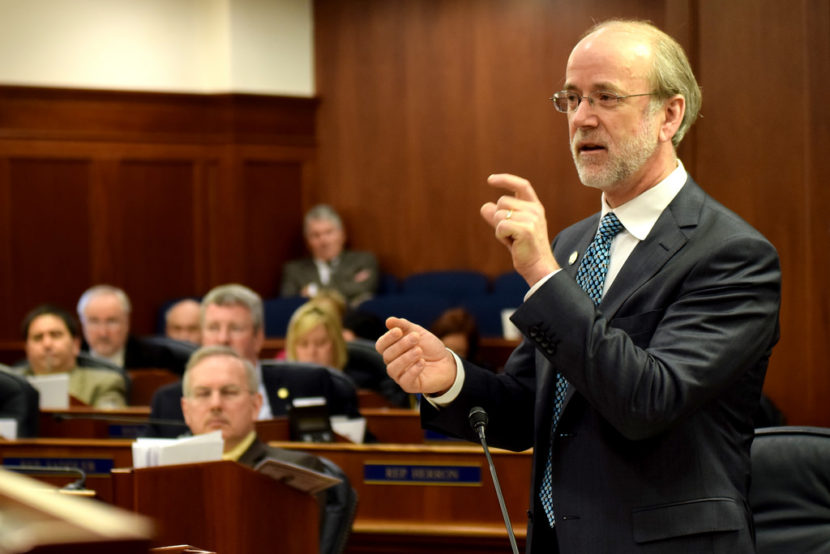
Sen. Hollis French addresses a joint session of the Alaska Legislature, April 17, 2014. (Photo by Skip Gray/Gavel Alaska)
Gov. Bill Walker has appointed Hollis French to the Alaska Oil and Gas Conservation Commission, or AOGCC. French, a Democrat from Anchorage, served in the Alaska Senate for 12 years. Now he’ll oversee regulation of the state’s oil and gas industry.
The third seat on the AOGCC is designated to a member of the public who is familiar with oil and gas. French says some of his legislative colleagues may be unaware of his background.
“I started my oil and gas career washing pots and pans on an oil rig in Cook Inlet, and the company that ran that platform, Shell, decided to train me to be an operator,” French said.
That’s the person who runs the turbines, pumps and compressors after the oil comes out of the ground. French also worked on the North Slope. In all, he says he spent 18 years working in the industry.
Previously, Gov. Walker appointed Michael Gallagher to the commission. But Gallagher wasn’t confirmed by the legislature. And come January, French will also need enough legislative support to keep his seat.
But French says he’s not worried about his appointment seeming political.
“Really, I have gratitude towards the industry,” French said. “I used my oil industry days off to get an undergraduate degree. I used my oil industry earnings to go away to law school, and so I think that they’ll see we have a lot in common.”
French starts his new job as an AOGCC commissioner on Monday.
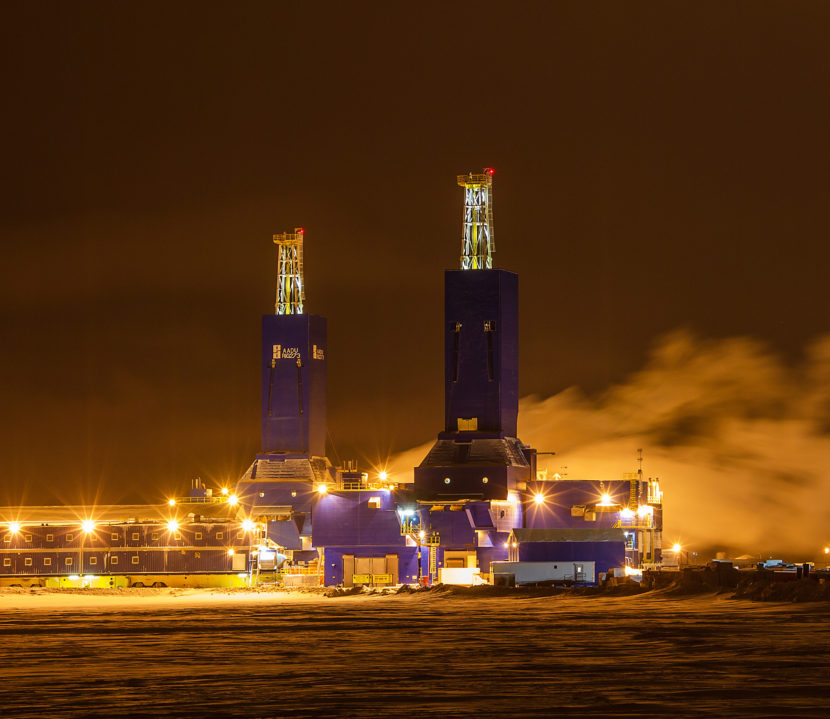
North Slope drill rigs, Dec. 5, 2012. (Creative Commons photo by Kevan Dee)
At a Senate Resource Committee meeting on Tuesday, lawmakers pressed state officials about why the administration is trying to obtain gas marketing information from North Slope oil and gas producers. Gov. Bill Walker has yet to sign off on the oil companies’ 2016 development plan for Prudhoe Bay.
Corri Feige, the director of Alaska’s Division of Oil and Gas, acknowledged it was a new policy. But says it’s within their rights to request the information.
“We are asking for information concerning marketing plans and activities that will result in the commencement of a major gas sale,” Feige said. “And to have those just be adequately explained with anything that is specific and measurable. Are there any timelines that they could share with us at this point in time?”
Feige says the division has a responsibility to make sure there’s “diligence” in the development of the gas. But for some Republican lawmakers, the discussion raised more questions than it answered.
Rep. Craig Johnson, a Republican from Anchorage, thinks the request is a conflict of interest, as the state looks at developing natural gas.
“Until we make a decision how we’re going to take our gas. Are we going to let them market it for us? All we’re doing is asking for a marketing plan from our competitors,” Johnson said. “If I were Wal-Mart and I walked into Kmart and said, ‘Hey, I need to know your marketing plan for the next six years,’ they would throw you out the door.”
BP, ConocoPhillips and ExxonMobil lease the land on the North Slope from the state. The producers have until November to turn in the marketing information. No industry representatives testified at the hearing.
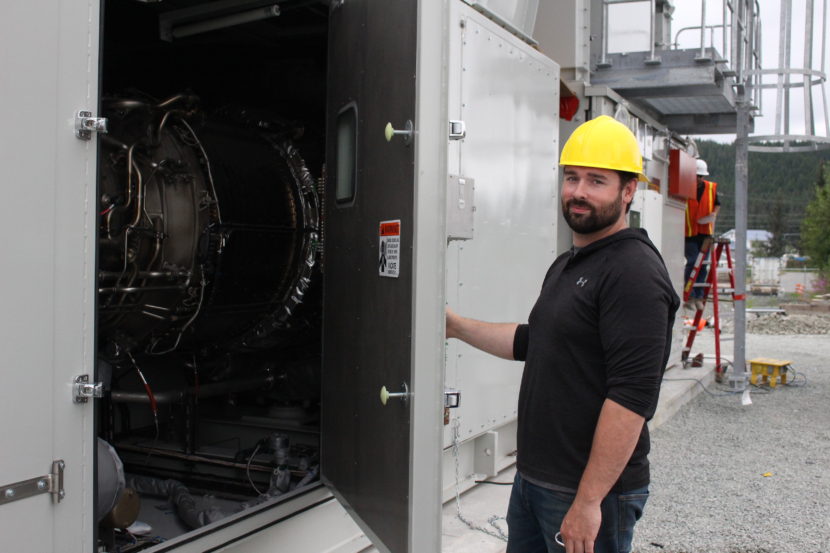
Bryan Farrell, an engineer at AEL&P, holds open the hatch to the diesel turbine. (Photo by Elizabeth Jenkins/KTOO)
Juneau’s privately owned electric utility, AEL&P, has already broken ground to build an industrial diesel plant to meet growing demand. And for the city’s residents that means the price for electricity is likely to go up. Before the development goes any further, some community members are asking the state’s regulatory commission to take a closer look.
Bryan Farrell, an engineer for Juneau’s electric utility, asks me to put on a blue hard hat before showing me around his work site.
Construction on the $22 million project began in January. And already, there are two 50,000-gallon tanks installed that will feed a diesel turbine.
“A diesel turbine is exactly what is sounds like. It is a combustion turbine that compresses air, injects diesel fuel as a fuel source and ignites that to turn another turbine which then turns a generator,” Farrell said.
Right now, on a normal day, the city runs entirely off hydro. But when something goes wrong, like an avalanche takes down a power line, that service can be disrupted. That actually happened in the spring of 2008. And Farrell says when that occurs, the diesel is the backup.
“We have diesel strategically placed throughout the system, and this spot is going to add greatly to that strategy,” Farrell said.
The location for the diesel plant is in a Juneau area called the Mendenhall Valley, and the electric company says growing demand is the reason. In other words, more people powering their homes and businesses in that area.
Farrell says if another catastrophe happened:
“I do not have enough diesel generation in the valley to pick up all the valley in that situation,” he said. “What that would turn into is rotating blackouts for different areas in the valley.”
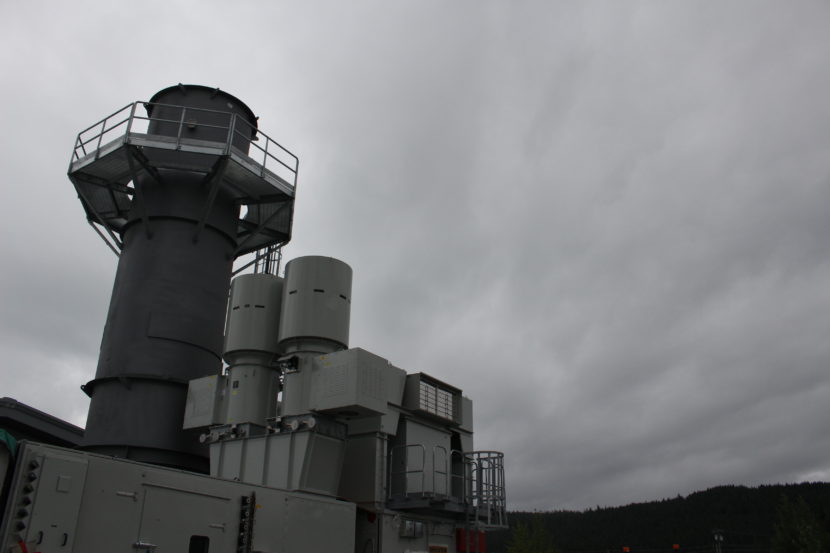
The exhaust stack for the new diesel turbine. (Photo by Elizabeth Jenkins/KTOO)
But Danielle Redmond, a Juneau climate change activist, thinks there has to be a better way.
“Why would we bring in a new fossil fuel monopoly when we have local, clean abundant energy in the form of responsible hydropower?” Redmond asks.
She sent a letter to the Regulatory Commission of Alaska asking for community input. To pay for the new diesel plant, the electric company will have to increase rates, and that’s when the regulatory commission gets involved.
On top of that, Redmond thinks the diesel plant doesn’t reflect the city’s overall values.
“For me, its more of an issue that if we continue to build infrastructure, we’re not going to make investment in clean renewable alternatives,” Redmond said.
Recently, the city drafted an energy plan outlining goals for moving away from burning fossil fuels, like diesel. But Tim McLeod, AEL&P’s president, says investing in renewable energy for an emergency situation doesn’t make sense.
“First off, diesel generation for backup is a fraction of the cost to our customers as building a new hydro would be,” McLeod said.
In 2010, after the company completed the Lake Dorothy hydro project, McLeod says Juneau’s electric rates went up nearly 20 percent. He thinks backup hydro doesn’t pencil out and would wind up costing customers more. As to how much the diesel plant will raise rates, he thinks it will be “much less” than that.
“But I don’t know what the numbers are,” McLeod said.
AEL&P has yet to file paperwork with the regulatory commission about the rate increase.
For Danielle Redmond, the problem isn’t about being stuck with the bill.
“It may well be the case that Juneau ratepayers would be willing to pay a little bit more for additional hydropower capacity in favor of keeping new fossil fuel projects out of town.”
Redmond says she certainly would. But she might not have much choice in the matter. AEL&P expects to have its new diesel generation plant operational by this winter.
Steve Henrikson has worked at the state museum since 1988. (Photo by Elizabeth Jenkins/KTOO)
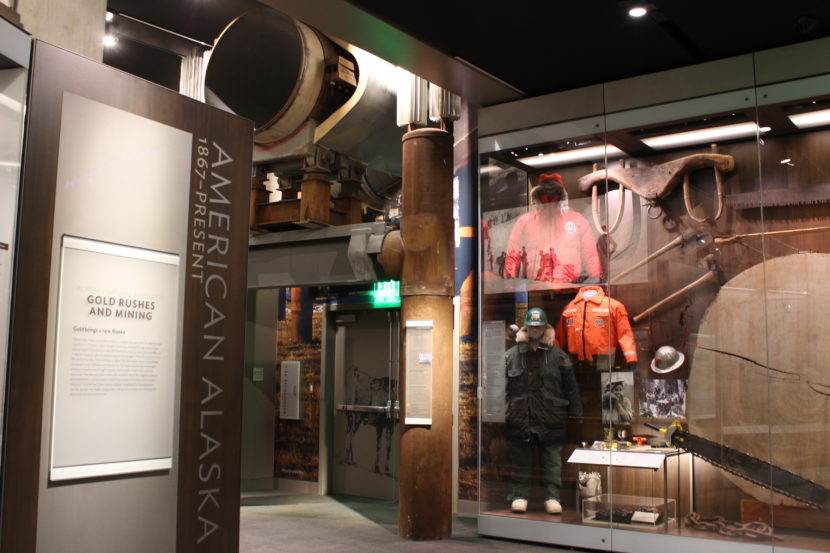
The State Library, Archives and Museum opened recently in Juneau with a new display that includes a piece of the trans-Alaska pipeline as part of an exhibit on the oil industry. But the drama of the state’s current fiscal crisis puts that history in a new light.
Steve Henrikson tells stories with things. Sometimes those objects go way back, like woven baskets from 6,000 years ago. But part of Henrikson’s job as a museum curator is also collecting items from this century, and that can take some guesswork.
“Trying to figure out, what in 100 years from now will be significant to people then that speaks to our time in history,” Henrikson said.
And when it comes to significant events that happened recently — or relatively recently — Henrikson says there was something missing in the museum’s permanent collection: the development of the trans-Alaska pipeline.
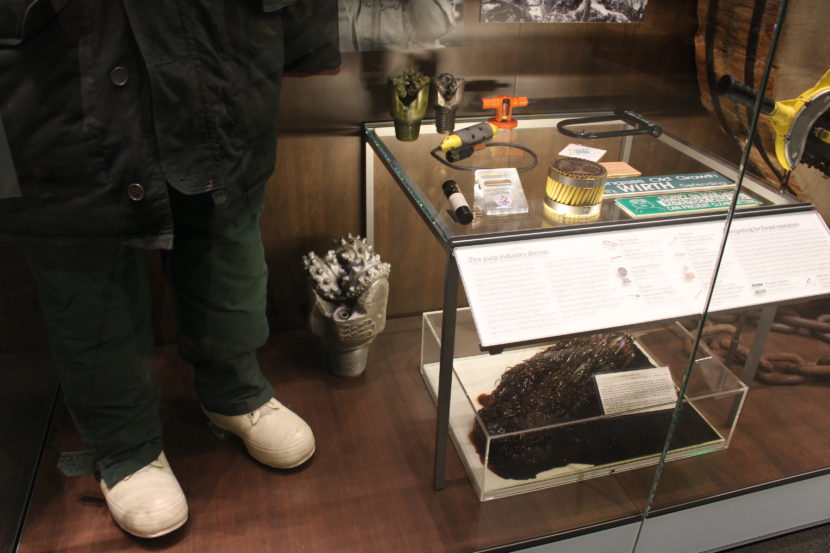
So, the museum went to work to curate pieces for its new building from that point in history. Now behind glass, there’s a drill bit, an engineering uniform worn on the North Slope and much more.
Under the dim museum lights, the section of pipeline looks like a rusty football goal post with a circular tube balanced on top. Bob Banghart — the museum’s deputy director — says other collectors have a piece of it. But he doesn’t think anyone has a part that’s standing 18 feet off the floor.
Three years ago, Banghart says the museum approached Alyeska Pipeline Service Co. which runs the pipeline.
“At first, they were kind of, ‘Well, hmm.’ And we explained our intent,” Banghart said.
Banghart says they wanted to show a continuous theme with the whole museum collection: “the human mind’s creative adaptability.”
The defunct piece of the pipeline weighs about 3,000 lbs. (Photo by Elizabeth Jenkins/KTOO)
If you look back in history, the development of the pipeline helped solve a huge problem. How do you transport valuable crude from the North Slope down to the Lower 48? Do you try to float it on an icebreaking tanker through the Northwest Passage? That’s something the oil industry actually tried and it worked once, but that was deemed impractical.
The pipeline — on the other hand — made transporting the oil much easier. Banghart says you can see that same ingenuity in other items, like the spear point.
“So, we felt that the corollary between the pipeline and spear point was established that we wanted a piece of the pipeline,” Banghart said.
But there’s another recurring theme in Alaska’s history that keeps coming up inside the museum.
“The state’s economy came to rely largely on oil revenue, but oil is not a sustainable resource and is running out,” Steve Henrikson reads off a plaque in the museum called Timber, Oil and the Quest for Sustainability. He says you can see a boom and bust cycle in other time periods — in displays about the fur trade, the gold rush and logging in the Tongass National Forest.
“If people went to exhibits like this and paid more attention to human history, I think we could avoid some of those problems,” Henrikson said. “But we’re all human beings and humans sometimes don’t make the best decisions.”
For the museum itself, the current fiscal crisis has meant scaling back. Henrikson is doing double duty — working his job as a curator and filling in at the front desk. The museum hasn’t been able to bring on seasonal workers, due to the state’s hiring freeze.
But Henrikson says he doesn’t mind. He likes the opportunity to mingle with visitors and talk with them about what they’ve learned — even though some of the history behind the exhibits isn’t always a happy one.
“We’re not trying to tell a feel good story here. We’re trying to put the facts out there and people can decide for themselves what it might mean,” he said.
As for what’s going to happen in Alaska’s future, Henrikson says he’ll be watching and collecting.
Inside a display case, clothing worn during the construction of the trans-Alaska pipeline, a drill bit and a snare used to absorb oil from the Exxon Valdez oil spill. (Photo by Elizabeth Jenkins/KTOO)
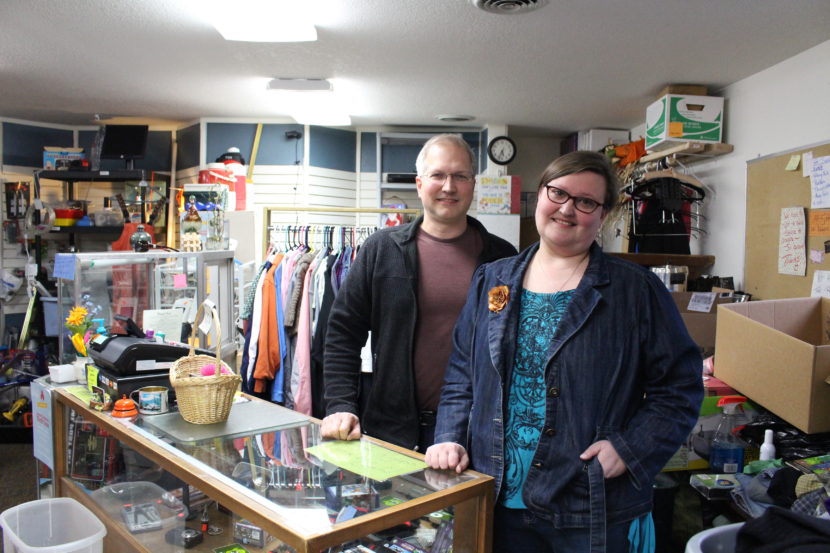
Rebecca and Mark Dundore want to give their employees pay raises and increased hours, but they say it’s caused anxiety for some of their staff. (Photo by Elizabeth Jenkins/KTOO)
A pay increase should be a happy event in a person’s life, but for some it can evoke fear. That’s because more money earned could mean less money overall when public assistance programs get cut off.
Rebecca and her husband Mark Dundore own Juneau Treasures Thrift Store. A place that’s filled to the brim with eclectic used items. Their shop is doing well. So well they’re opening a second location that will sell mostly secondhand furniture. But in the course of running their business, they’ve run into some issues with staffing.
They have three employees right now, who make between $10 and $12 an hour. That’s more than Alaska’s minimum wage.
But when they’ve offered pay increases or more hours, they didn’t get the response they expected. One employee was worried she would lose her public assistance.
“We wanted her to work almost full time, and she couldn’t do it because she has six children, and they’re on food stamps,” Rebecca said. “We wouldn’t be able to give enough to get her off the food stamps support entirely, and she wasn’t able to take anymore ‘cause she was afraid she would lose the food stamps.”
Rebecca says it was an awkward situation. They’ve even had employees volunteer to work for free, so as not to make too much money and wind up going over.
“That’s a really serious concern for a lot of people around here,” Rebecca said.
Per capita, Alaska has the most households on public assistance in the nation. That’s according to statistics from the U.S. Census Bureau.
Anna Schetky and her husband live in one of those households. Anna works for Rebecca at Juneau Treasures. She decided to transition to the part-time job after learning of her pregnancy. Before she worked in a stressful environment with at-risk kids, and she hoped the move would be good for her and the baby.
But it meant losing the family’s insurance. So she signed up for Denali KidCare, a Medicaid program.
“Due to the major drop in income, we also were trying to get on WIC,” Schetky said.
That’s food and nutrition assistance for women, infants and children.
“All of those things were kind of looming over us. And we had to sit down and start crunching some numbers,” Schetky said.
She says with that first WIC voucher, she was able to stock up on perishable items, milk and some veggies. It helped supplement what they got at the food bank.
When she first started at Juneau Treasures, she was making about $10 an hour.
“All of a sudden they’re like, ‘Hey, you’re doing a great job, we want to offer you more hours and more pay,’ and I just kind of looked at them and I was like, ‘I don’t know if I can do this,’” Schetky said. “I had to sit down again and start crunching pennies basically, to see if we could still keep these benefits to see if we could make enough money to survive.”
She says the WIC office advised she would be on the cusp of making too much. To be eligible, she couldn’t make more than about $3,800. Her gross household income would be about $4,000 a month. So she decided to drop WIC.
“For right now we’ve had to find our little groove and not really swerve one way or the other because we want our baby to be covered,” Schetky said.
She is still covered by Denali KidCare. The income limit for that is $400 higher.
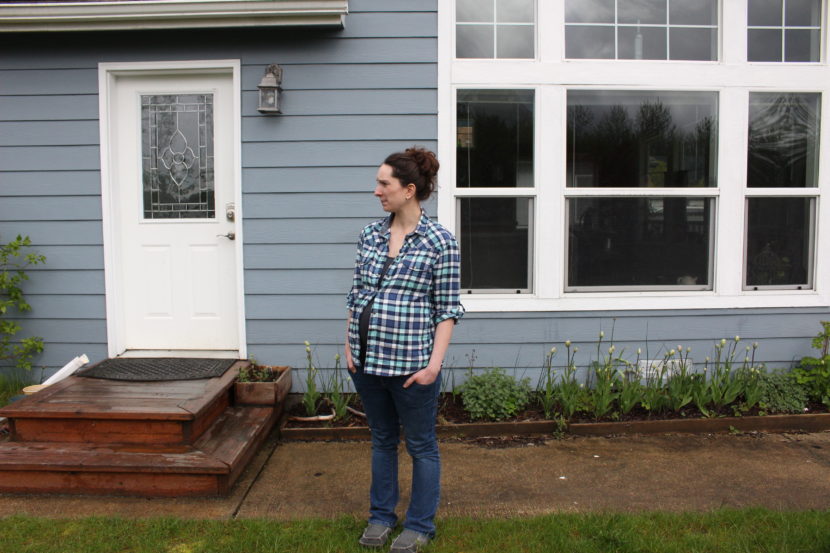
Anna Schetky at her home in Juneau. (Photo by Elizbeth Jenkins/KTOO)
A WIC representative thought Schetky might still qualify. Being eligible for one might automatically qualify her for the other. But for the past few months, she’s bee paying for the expense out-of-pocket. She wants to grow a garden to help offset some of the cost.
Rebecca and her husband Mark Dundore say they make enough to keep the doors open at Juneau Treasures but not enough to pay more than $12 an hour.
“I think to bridge that gap, we’d have to pay almost $15 or $16 an hour. It’s a small business, with all the other taxes and fees and stuff, we just can’t do that right now,” Mark said.
One of the solutions they’ve come up with is having a bunch of part-time employees, but they realize there’s no easy fix. The problem isn’t as simple as having employees who don’t want to work.
“I would say that’s probably the exception.” Rebecca said. “Everybody we’ve encountered anyway has just worked really hard and been energetic and we’ve really appreciated that.”
For now, they might have to show that appreciation in a weird way: by offering their employees less.
Funding for Chasing the Dream is provided by the JPB Foundation and the Ford Foundation. It’s part of an ongoing series about poverty and opportunity in America.
Close
Update notification options
Subscribe to notifications
Subscribe
Get notifications about news related to the topics you care about. You can unsubscribe anytime.