Elizabeth Jenkins, Alaska's Energy Desk - Juneau

What do Juneau and the Golden State have in common? Electric vehicles

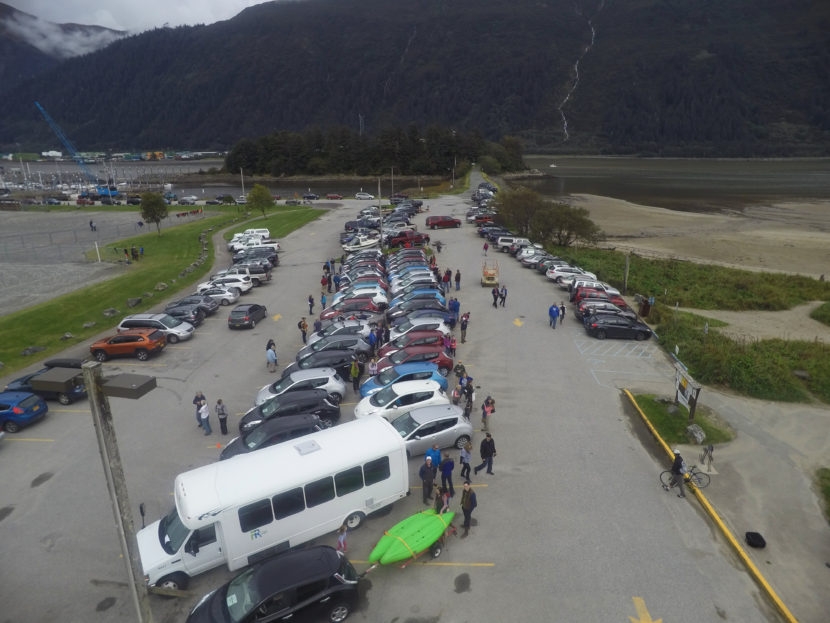
A drone shot of Juneau's electric vehicle get together. (Photo by Gabe Strong.)
A drone shot of Juneau’s electric vehicle get together. (Photo by Gabe Strong)

If the capital city were a state, then it ranks with places like California when it comes to the number of electric vehicles per capita on the road.

And Juneau’s EVs owners love to show off.

This past weekend, the quiet cars rolled into a local park so the public could take a glimpse.

In total, there are about 80 fully electric vehicles on the roads of Juneau — running off hydropower rather than gasoline. More than 40 of those were parked at Savikko Park in Douglas on Saturday at an electric vehicle get-together.

Clusters of people ogled an espresso-colored car. They talked to the sharply dressed owner, instead of walking their dogs on the nearby trail.

This isn’t just any electric vehicle.

It’s a new Tesla with a price tag of over $109,000.

Myron Klein says, typically, his car doesn’t get this type of attention. 

“Not too much. I usually don’t drive it to places with lots of people,” Klein said.

Klein hasn’t had the car very long, so he’s still getting comfortable with busy parking lots.

It’s one of two confirmed Tesla’s in town, and there’s a rumor of a third.

The upscale EV has a longer range than, say, the Nissan Leaf. But with 10 public charging stations, plugging in isn’t a huge problem. There’s a limited road system, after all.

What can be a burdensome, though, for those wanting to join this growing club is getting the cars to Juneau and maintenance.

There’s no Tesla or Nissan dealer in town.

Still, that didn’t stop Kyle Cuzzort from purchasing his blue Nissan Leaf.

He says he did tons lots of research before buying it.

“I do like to do numbers. That’s what I do,” Cuzzort said. “I did the math once and figured how much weight I would lose if I walked the stairs everyday. Two pounds a year.”

Cuzzort took a deep dive into electric vehicle forums and learned the car’s battery could work well in a mild Southeast climate.

He’s owned the car for about three years now.

And compared to what he used to drive, he says powering the Leaf costs much less than what he used to spend on gas. It pencils out to about $25 bucks month.

“What we save in gas, we could take a vacation every year,” he said.

When Cuzzort bought his Leaf around 2013, there were only about seven in town.

Now that number has ballooned far beyond that and the Juneau branch of the Electric Vehicle Association is looking to boost the numbers even more.

This fall, a Nissan tech is traveling to Juneau to service its cars with recall issues. And the association is looking at organizing a “group buy” of Nissan Leafs. It could help offset some of the costs of barging the vehicles here.

Although, Cuzzort clearly loves his car. I can see he’s eyeing the Tesla.

“I would want one,” he said.

He explains if you drive a decent amount of miles, owning a Tesla could be cheaper than owning a minivan — or at least that’s what he’s heard on his forum. A less expensive Tesla model is expected to launch later next year.
As tiny homes take root, where do you park them in Alaska?

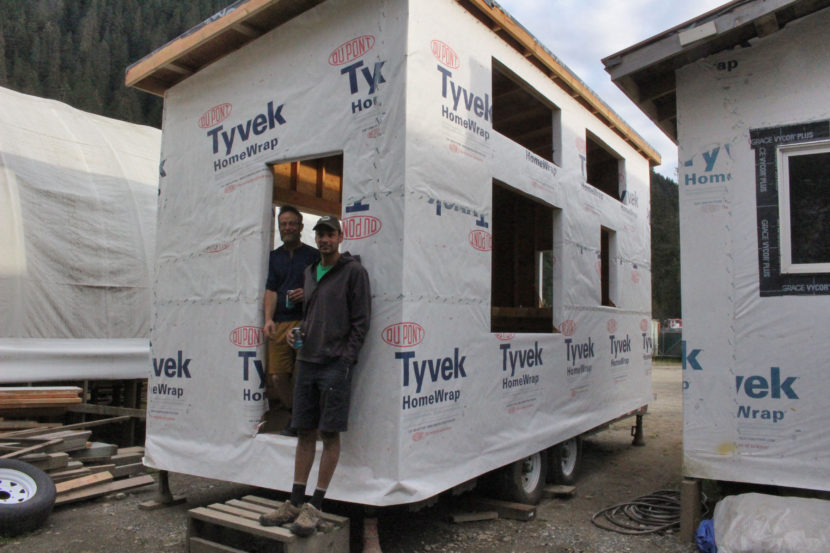
Jason Donig (right) and Jeff Martinson (left) stand in front of the tiny they're building. (Photo by Elizabeth Jenkins/KTOO)
Jason Donig (right) and Jeff Martinson (left) in the yard at AK Reuse. Martinson is the builder of the small home. (Photo by Elizabeth Jenkins/KTOO)

There might be a small solution to the capital city’s housing problem but it’s not without its roadblocks.

A Juneau company is building its first tiny house on wheels to sell commercially and it intends to make more.

The diminutive dwelling is crafted with reclaimed materials and locally-sourced wood.

But the city’s zoning codes haven’t caught up with the tiny house craze.

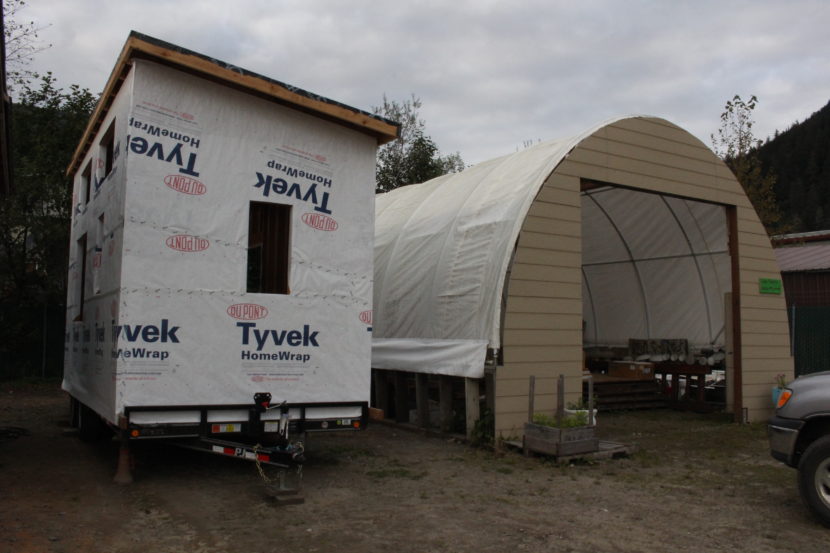
For 160 square feet, this rolling home feels pretty spacious. Step inside and you’re greeted with high ceilings and large windows. At this point, it’s still a shell which can make identifying the bathroom tricky.

“Right now, I’m in the bathroom?” I ask.

“Nope, you’re still in the kitchen,” Jason Donig explains.

Donig is the owner of AK Reuse, the company constructing the small home.

It’s in an industrial part of town.

For a guy really passionate about recycled materials, it’s the perfect spot to draw inspiration.

There are crates of mismatched drawer pulls, old doors, a vintage gym floor.

“We got a bidet. I don’t know how cool that is,” he says with a laugh.

The bidet isn’t going in the tiny house, but Donig says other pieces from the yard are. People drop off the items at AK Reuse, and he sells them to customers looking for unique or inexpensive home materials.

As a carpenter, Donig says he was frustrated by what others throw away.

This business, I feel good when I come here because it’s not taking things apart and putting it in the dump,” Donig said. “I feel good because we’re reusing what we can. And same with the tiny home.”

Donig says he decided to build small because he saw his friends struggling to save up for a mortgage.

This tiny home is on the high-end — it could cost more than $70,000. But he thinks it could be done for less.

If you’ve watched TV lately, then you’re probably familiar with the idea of families willingly downsizing to 200 square feet.

Donig says he hasn’t seen any of these.

“Me either. ‘Cause I’m afraid,” said Beth Mckibben — a planning manager at the City and Borough of Juneau.

McKibben says she’s afraid because she knows the tiny house zoning issue hasn’t been resolved. Yet, the interest in building small is growing.

Some communities in Alaska are skeptical that this is the solution cities should be looking for when it comes to a tight housing market. Wasilla’s city council recently banned tiny houses for a temporary period, due to concerns about landlords building multiple units on a single lot and what it could do to a neighborhood’s character.

In Juneau, the real issue is what do you do with a house that rolls? You can build a 120-square foot-home on a permanent structure. But can you park one if it’s on wheels in your friend’s backyard?

“Depends on where the house might be so it’s a big fat maybe,” she said.

Maybe because it’s not zoned for every location. Tiny houses on wheels can go in mobile home parks — no problem. But it requires a trip to the planning commission before rolling one onto someone’s private lot.

Jason Donig tiny house (Photo by Elizabeth Jenkins/KTOO)
AK Reuse is using locally-sourced wood from Icy Straights Lumber & Milling for this tiny house. (Photo by Elizabeth Jenkins/KTOO)

So far, Mckibben says no one has appeared before them to get the ultimate OK. But she thinks it’s only a matter of time before more small homes start popping up.

Well, for me, that’s a concern right now. If people are going to buy them, they need to know they can place them somewhere,” she said. “They shouldn’t be making an investment not knowing what they can do with that.”

In Sitka, at least one tiny house on wheels is headed before the planning commission. It would be parked in a residential neighborhood. But nothing’s been decided yet.

Mckibben expects the zoning conversation to happen in Juneau later this year.

Back at the building site, Donig is working on what will become the sleeping loft in the tiny house. He’s talked to people who work at the city about what’s coming down the line. And he thinks they’ll be able to work something out that could keep more tiny houses in production.

Still, if he could change one thing — besides the zoning rules — it would be the namesake of the movement.

“The word tiny home makes me think of something really tiny. I don’t want to live in something called a tiny home, but I want to live in something called a modest home,” Donig said.

He expects this “modest home” to be completed by spring, and he wants to build more after that. Just don’t call him that tiny house guy.

Editor’s Note: The photo caption has been expanded to explain Jeff Martinson’s role in the tiny house build. 

Most humpback whales removed from Endangered Species List

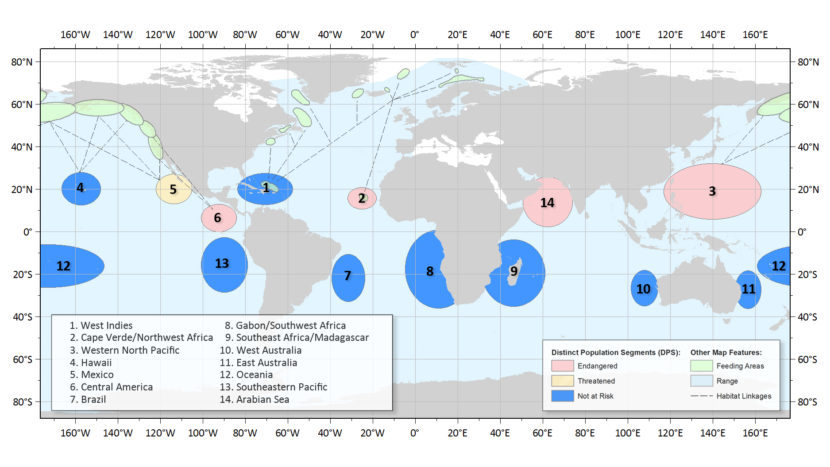
Map of different populations of humpback provided by the National Oceanic and Atmospheric Administration.
Map of different populations of humpbacks provided by the National Oceanic and Atmospheric Administration.

The National Oceanic and Atmospheric Administration announced Tuesday that most humpback whales will come off the endangered species list, but it’s a mixed bag for humpbacks that visit Alaska.

Some sub-groups of humpbacks around the world will remain on the list.

Three different humpback populations swim to Alaska and now they all fall into different categories. The Hawaii population is de-listed. The Mexico population is still labeled as threatened under the Endangered Species Act. The Western North Pacific humpback — which feeds in the Bering Sea and Aleutian chain — is still listed as endangered.

Marta Nammack, a NOAA Endangered Species Act coordinator, says with the variety of humpbacks:

“Our Alaska region is going to have to use a proportional approach to decide what populations is being affected by different things that happen like vessel strikes or fishing gear entanglements,” Nammack said.

Nammack says fishing gear entanglement is a serious threat to the Western North Pacific humpbacks and that’s expected to increase.

The Mexico population of humpbacks labeled as threatened feed in Southeast Alaska waters. NOAA said there wasn’t enough data to indicate a population increase.

Angela Somma, chief of NOAA’s endangered species division, says the agency looked at the impact of climate change on humpbacks and whether that could affect the overall population down the line.

“There certainly are issues to be concerned about, but we found no basis to conclude that potential impacts of climate change contribute significantly to extinction risks to these population now or even in the foreseeable future,” Somma said.

Commercial whaling in the 1800s and early 1900s significantly reduced the humpback population. It was listed under the Endangered Species Conservation Act in 1970 and later the Endangered Species Act in 1973.

Gone glacier: fashion magazine depicts Mendenhall melt too soon

John Neary Mendenhall Glacier
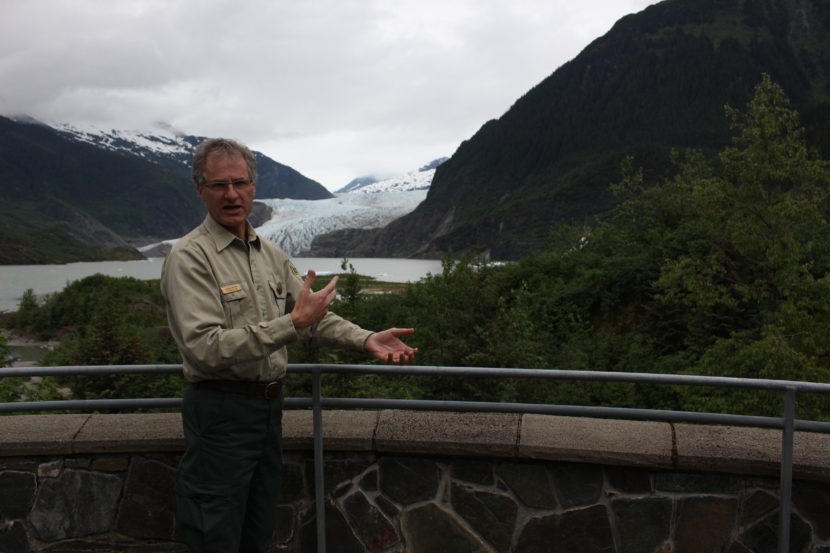
John Neary, the director of the Mendenhall Glacier Visitor Center, in front of the actual glacier. (Photo by Elizabeth Jenkins/KTOO)

The magazine Marie Claire sent a team of journalists and fashionistas to the Mendenhall Glacier in the summer. The story that appeared in its September issue is called On Thin Ice: Can the Fashion Industry Help Save the Planet? But as first reported in the Juneau Empire, the magazine got a couple of key things wrong.

“It felt like I was in Frozen, that’s the only way I can describe it!” said Nina Garcia in a video on Marie Claire’s website. She was describing what it’s like to enter the ice caves at the Mendenhall glacier.

Garcia is the creative director of the magazine. You’ve probably spotted it when you wait in line at the supermarket. This month’s cover featured Sarah Jessica Parker.

And inside, there was an article about the effects of climate change on glacier ice and how the fashion industry can help by reducing wasteful packaging. But some of the photos’ captions are pretty off. Or, as Nina Garcia would say as a judge on Project Runway:

“I think you made a real big effort. However …”

However, one of the pictures looked like it’d been put through an Instagram filter. It was supposed to depict the Mendenhall glacier in 1970.

“And we know, that at that time, nugget falls was falling — well, in the 70s — it was falling onto the glacier,” said John Neary, the director at the Mendenhall Glacier Visitor Center.

He thinks the photo was actually taken some time in the 1990s.

Then there was another photograph in the magazine spread — captioned “The Mendenhall Glacier today.”

“The other photo was more strange. It was — from what I can tell — a picture from the top of Thunder Mountain looking at that Thunder Mountain Basin with the airport behind it and then North Douglas,” he said.

You can see a rolling mountain with grass and only a little bit of snow. No glacier anywhere in sight.

When the article came out, Neary says he was in Denali National Park on vacation and initially he was disappointed. But he recognizes everyone makes mistakes.

“And I don’t fault them for it because it’s a long ways away from where they are,” Neary said.  “And they did a really good job of fact checking. I got follows ups about this fact and that fact but they just missed this one.”

No doubt, the Mendenhall Glacier is shrinking. In the past 30 years, Neary’s noticed extreme change. And scientists say the glacier won’t be visible from the visitor center by the end of this century.

Neary says even though Marie Claire got the photos very wrong, he found the overall message of the story interesting.

It’s from a different take than I would write an article on but at the same time people are coming from really different places than I am, too,” Neary said. “And if they’re coming from the New York fashion scene, then maybe that article really appeals to their sensibilities.”

As the Marie Claire article concluded, you shouldn’t have to choose between fashion and the glacier

One People Canoe Society to paddle for Standing Rock Tribe to protest controversial pipeline

Doug Chilton and DeAndre King in front of the canoe they're transporting to North Dakota. (Photo courtesy of Central Council of Tlingit and Haida Indian Tribes of Alaska)
Doug Chilton and DeAndre King in front of the canoe they’ll take to North Dakota. (Photo courtesy of Central Council of Tlingit and Haida Indian Tribes of Alaska)

Members of the One People Canoe Society will travel this week from Alaska to North Dakota to paddle in protest over a controversial pipeline.

The Standing Rock Sioux Tribe has asked paddlers from around the country to show support with a float down the Missouri River.

Doug Chilton and DeAndre King left Wednesday night on the ferry from Juneau, said Richard Peterson, president of Central Council of Tlingit and Haida Indian Tribes of Alaska.  

“It was kind of a last minute deal because a lot of folks with the One People Canoe Society are actually canoeing here to Kasaan tomorrow,” Peterson said. “So they got together what they could. They got their raven canoe together and they just needed some financial support.”

There’s a ceremony in the village of Kasaan for the restoration of the Chief Son-I-Hat Whale House Naay I’waans on Saturday, but Chilton and King decided to go to North Dakota after the chairman of the Standing Rock Tribe put out a call asking for help, Peterson said.

They’ll be displaying a Central Council flag, and he thinks it’s an important time to show support, Peterson said.

He sees similarities with British Columbia mining and Southeast waterways.

“You know, we’re fighting here on transboundary issues, and we don’t know what turn that’s going to take and we may need people to stand with us as well,” Peterson said.

If the pipeline is built, then a half-million barrels of crude could flow daily from North Dakota to Illinois.

For it to get there, it would have to cross under the Missouri River — Standing Rock Reservation’s water source.

Peterson thinks it could take two days for Chilton and King to reach North Dakota.

Forest Service gives go ahead for Kuiu Island timber sale

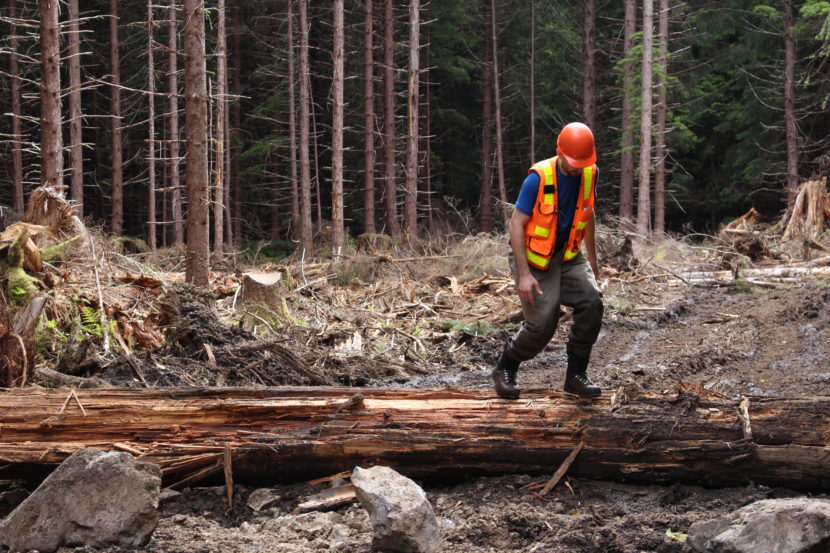
In 2014, the U.S. Forest Service repaired streams on Kuiu Island damaged by logging in the 1970s. Now, 23 million board feet could be harvested on the north part of the island. (Photo by Elizabeth Jenkins/KTOO)
Kuiu Island in 2014. At the time, the U.S. Forest Service was repairing streams on the island damaged by logging from the 1970s. Now, 23 million board feet could be harvested on the north part of the island. (Photo by Elizabeth Jenkins/KTOO)

An old growth timber sale recently announced in a Ketchikan newspaper has one conservation group scratching its head.

That’s because this type of harvest — near valuable salmon streams — won’t be allowed in the future.

The U.S. forest service is working on a new timber plan in the Tongass National Forest, which is expected to be finalized by winter.  

In the meantime, forest managers are moving ahead with timber sales under the old rules.

Recently, in the Ketchikan Daily News an ad appeared along with advertisements of cars for sale and apartments for rent. The forest service was looking for a buyer for 866 acres of old growth trees on north Kuiu Island.

“You know, no one would know about it unless you’re reading the back pages of the Ketchikan paper,” Austin Williams said.

He learned about it from a Trout Unlimited member in Ketchikan. Williams is the director of law and policy for the organization.

What troubles Williams about the timber sale is where it’s slated to happen.

“Right in the middle of some of the most valuable and important fish and wildlife habitat in the region,” he said.

It’s one of a group of watersheds, known as the Tongass 77, that environmental groups want protected.

Logging can cause erosion,  creating problems for spawning salmon, Williams said.

Just a few years ago, the Forest Service repaired streams on Kuiu damaged by timber harvests from the 1970s, back when there were no regulated buffers along salmon streams.

That’s changed and this particular sale went through an environmental assessment and a public comment period before becoming final eight years ago.

“There’s been no opportunity for public involvement since the decision came out in 2008,” Williams said. “And you know, a lot has changed since then.”

One major change: soon sales like this won’t be possible.

The Forest Service is about to come out with an amended timber plan for the Tongass. Old growth logging in these watershed areas won’t be allowed.

Jason Anderson, a deputy forest supervisor, said sales that have already been approved — like the one on Kuiu — can move forward.

“We would not have necessarily crafted this sale under the new plan,” Anderson said. “But we’re also operating in that change-over period.”

Anderson said the Kuiu sale is happening now because the “market conditions” are right.

He’s not sure how many outstanding timber sales exist like this.

He thinks — compared with the overall size of the Kuiu sale —  the trees in the watershed area represent a relatively “small percentage.”

“While I can recognize the concerns that are out there. I think on the whole, the transition spells out how a lot of this will occur in terms of bringing forward more young growth over time,” Anderson said. “Being very deliberate about what old growth is offered. And again, considering and protecting those watersheds that have the highest fisheries value in the region.”

The Forest Service approved the Kuiu timber for export, which means the trees aren’t likely to go to local mills.

That’s OK with Owen Graham, the executive director of the Alaska Forest Association, a timber industry group.

The Kuiu sale is made up of a lot hemlock, a low value timber, he said.

“Those chips used to go to the pulp mills and now they have to be barged 800 miles south,” Graham said. “The economics of trying to harvest timber and manufacture on a remote island like Kuiu is pretty difficult.”

There are no pulp mills left in Southeast Alaska. The Forest Service’s red tape doesn’t make it any more cost effective for domestic buyers, Graham said.

Still, he thinks the Kuiu Island timber sale is significant for the logging jobs it does keep in the region.

The public should have another say before old growth trees are cut down in a watershed, Williams said.

“You know, one of the things about Southeast Alaska is that largely our fisheries are intact and our watersheds and streams are healthy,” Williams said. “But if we don’t take care of it, we risk losing those.”

The objection period on the amended Tongass plan ends this week.

The Forest Service is accepting bids for the Kuiu island timber sale until September 13.  

Editor’s Note: We’ve updated the story to clarify the definition of the Tongass 77. 

Site notifications
Update notification options
Subscribe to notifications