Elizabeth Jenkins, Alaska's Energy Desk - Juneau
Squirmy sustainability: One man’s mission to fix a common problem

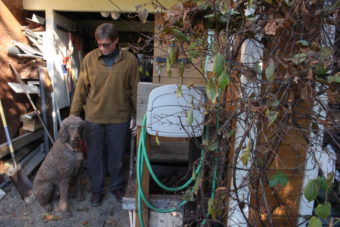
Bob Deering at his home with his dog Gamby and compost bins. (Photo by Elizabeth Jenkins/KTOO)
Bob Deering at his home with his dog and compost bins. (Photo by Elizabeth Jenkins/KTOO)

There’s nothing like taking a walk on Alaska’s pristine wilderness. Unless you step in something — unexpected along the way.

For parkgoers, what dogs leave behind on the trail can be a sensitive topic. But one Juneau man has an unconventional solution he thinks could ease tensions and reduce waste, all at once.

Bob Deering has the Midas touch when it comes to compost. He’s all about turning unpleasant trash into gardening gold.

“My friends are really receptive to the idea. Some of them think I’m a wackjob,” he said with a laugh.

In Deering’s backyard are two wooden bins — full of cardboard, dirt and hundreds of small pink and purple worms. Deering is what you could call a worm composting aficionado. These tiny creatures are known as red wigglers and they’re used to break down organic matter, like food scraps.

But Deering thinks they might also be a solution for an age-old municipal problem.

“Dog poop on trails, it’s such a contentious subject,” Deering said. “We walk our dog on a trail around here and it really bothers us to see, to be stepping around big piles of dog poop on the trails.”

Also contentious: the plastic blue bags responsible dog-owners use to scoop that poop, which can end up in the landfill.

So Deering had a wild idea. He’s been composting with worms for years. If the red wigglers can break down coffee grinds and vegetable scraps, why not more pungent waste?

It was just kind of an experiment. I just threw the dog poop in there and it went away and the lightbulb came on for me,” Deering said.

He said what came out of the worms was nutritious fertilizer for his trees and shrubs.

And he thought, what if something like this existed at trailheads? Dog owners could easily pick up the poop with scoops or biodegradable bags. And the trailhead sites could also become a place to drop off cardboard. Apparently, worms love snacking on cardboard.

“Now we’re taking care of two different waste products. That’s kind of the holy grail when you’re trying to look for sustainability,” he said.

Bob Deering has orders his red wigglers through the mail. (Photo by Elizabeth Jenkins/KTOO)
Bob Deering orders his red wigglers through the mail. (Photo by Elizabeth Jenkins/KTOO)

Michele Elfers, a program manager at the City and Borough of Juneau’s solid waste department, said she’s familiar with different ways to compost.

However, “I haven’t heard about this specific technology,” she said.

Elfers said conserving space in the landfill is a huge priority. It has a 20 year life expectancy and the city isn’t sure what it will do when that space fills up. For now, it’s focusing on what it can do to keep garbage out of it. That includes adding more recycling drops offs and considering alternative methods, like composting.

And although Elfers hasn’t heard of Bob Deering’s big idea, she said the city has worked with individuals to think outside the box. She points to the influx of electric vehicle charging stations in Juneau.

“So it happens a lot, actually,” Elfers said.

She said there will be public meetings this winter to brainstorm more.

Ann Dombkowski calls her bin the "worm yacht." (Photo by Elizabeth Jenkins/KTOO)
Ann Dombkowski calls her bin the “worm yacht.” (Photo by Elizabeth Jenkins/KTOO)

In the meantime, Deering is leading his own charge. He’s become the community’s pied piper of composting with worms. And he’s convinced about 40 of his friends to try it.

Ann Dombkowski is one of Deering’s composting converts. She doesn’t own a dog and admits, initially, the concept of composting with worms seemed “creepy.” But after trying it, she warmed to the idea.

Deering gifted her a worm bin on a very special day.

“It’s a wedding present. So these are our babies. We’re too old to have children together so we have a zillion worms,” Dombkowski said.

If Bob Deering has his way, Juneau may have zillions more worms — and happier hikers.

New Southeast atlas identifies valuable habitat and threats

Sockeye salmon. (Photo by Katrina Mueller/USFWS)
(Photo by Katrina Mueller/USFWS)

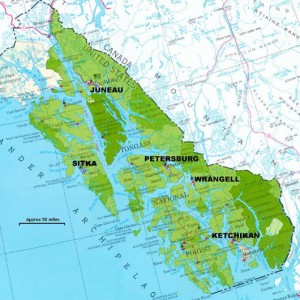
Audubon Alaska recently released an atlas showing where the most valuable salmon streams and bird habitat are located in Southeast. It also identifies the biggest threats to those areas.

Spread across 200 pages, the ecological atlas of the region includes a lot more than maps. Melanie Smith, the director of conservation science for Audubon Alaska, said the organization wanted to create something both policymakers and regular people could use.

It follows in the footsteps of other atlases Audubon has released about the Arctic and Western Alaska. Smith said this latest Southeast edition is another comprehensive overview that helps provide context.

“What do we know about how this place works?” Smith said. “And why it matters and what types of considerations we should be thinking about when we’re thinking about a sustainable future in the Tongass?”

The atlas features bear viewing hotspots and birding locations. But also, what Audubon Alaska believes are human-caused dangers to these environments, like old growth clear cut logging.

Smith said what surprised her the most while putting the atlas together is how quickly the climate is changing.

“I’m sorry to say that Southeast Alaska is supposed to become a little bit of a wetter place,” she said.

The region has enjoyed a recent sunny streak. But Smith said — in the future — more rain could be in the forecast due to warming. Climate projections suggest a 2-degree temperature rise by the year 2050.

“Which also has implications for how productive salmon populations may be so there’s a chain of possible effects.”

Smith said less snow pack and more downpours could affect salmon laying eggs in nearby streams. But for now, the atlas shows where the fishing is ripe in Southeast. And she hopes to encourage readers to keep it that way.

You can learn more about the regional atlas on Thursday in Juneau. Audubon Alaska will be presenting at the University of Alaska Southeast student recreation center at 7 p.m.

One last chance to protest at the end of an era for the Tongass

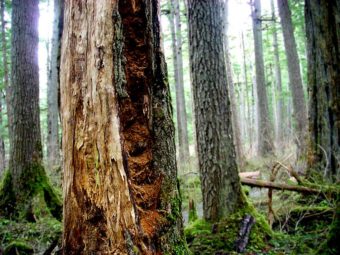
Part of the Tongass National Forest in April 2008. (Creative Commons photo by Xa’at)

The federal government is getting close to finalizing a plan that could shape the future of timber in the Tongass National Forest. Various stakeholders have given input through the years. But if the objection letters are any indication, several agencies and groups are still not content — for different reasons.

Buck Lindekugel has been spending a lot of his time with maps. They’re color coded to show which areas of the Tongass are suitable for timber harvests. And which areas are prioritized for conservation.

“But most of my time has been looking at these heavy books,” he said.

Forest Service books that outline how much timber is harvested from the Tongass.

The agency is expected to finalize a plan for the national forest this winter. Lindekugel is the grassroots attorney for the Southeast Alaska Conservation Council or SEACC. And although the planning phase is almost over, the organization still has issues with what’s left of the table. Namely, so many old growth trees.

Lindekugel says it’s not exactly clear where those trees can be cut down.

“And we think that lack of clarity is going to create confusion … Are they going to be logged or not logged? There’s ambivalence here in the maps,” Lindekugel said.

SEACC isn’t the only organization that thinks the plan needs more work. The forest service received more than two dozen objection letters. Most of the criticism is from timber industry groups that say the plan transitions away from logging more valuable old growth trees too soon.

And to address those concerns, the forest service is trying something new. It’s inviting its biggest critics to come together for one last series of hearings. One of those critics is the state of Alaska.

“Some would describe this as a battle almost among certain groups,” said Chris Maisch, a state forester.

Alaska’s Department of Natural Resources is another agency that doesn’t agree with how the Tongass plan has come together. He says the sixteen year transition period doesn’t give the industry enough time to adapt.

Milling young growth trees requires different equipment.

“And no one is going to make that kind of investment if they’re not certain they have a log supply they can depend on. And unfortunately right now, that’s not the case,” Maisch said.

Recently, a controversial timber sale on Kuiu Island didn’t receive a single bid. All of the wood was approved for export, meaning the logs wouldn’t likely go to Southeast mills.

Buck Lindekugel from SEACC says that makes the point that the timber industry has already transitioned. 20 years ago, it employed about 5,000 people.

“It used to be a main driver. There’s no question that for decades it was. But that industry couldn’t compete in today’s market,” Lindekugel said.

He thinks that’s due in part to Alaska’s remoteness. Tourism, not timber, is the region’s main economic driver.

But Chris Maisch, the state forester, says even though there’s less than 400 jobs left in the industry, he still sees the potential.

“Well, it is worth saving because I think everyone in the state is keenly aware of the financial state the state finds itself, and we need to do everything we can to diversify the state’s economy,” Maisch said.

The forest service is holding its Tongass objection meeting this week in Ketchikan and next in Juneau. Both Maisch and SEACC say they’re not sure what — if anything — will change.

Why Alaska utilities can build now, ask for rate increases later

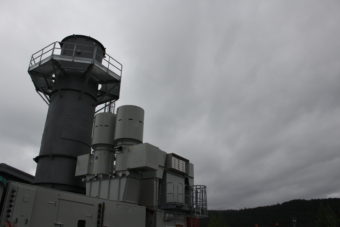
The exhaust stack for diesel turbine. (Photo by Elizabeth Jenkins/KTOO)
The exhaust stack for the diesel turbine. (Photo by Elizabeth Jenkins/KTOO)

Alaska’s privately owned electric utilities can’t increase their rates overnight. They first have to go through a process with the state’s regulatory commission to demonstrate a need. That’s what Juneau’s utility — AEL&P — is at the beginning stages of doing.

But customers get little say about projects already on the books.
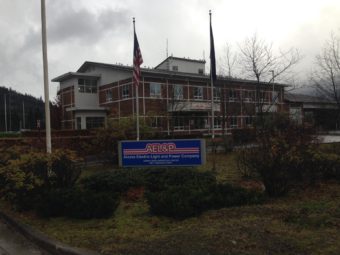
Last week, Alaska Electric Light & Power announced Juneau residents could expect to pay 8 percent more on their electric bills by the end of 2017 — pending approval from the Regulatory Commission of Alaska, or RCA.

The community’s last rate permanent increase was six years ago after a new hydro project was built.

“A lot happens in that amount of time,” said Debbie Driscoll, AEL&P’s vice president.

Like investments of over $50 million, according Driscoll. Since 2010, she says the company spent money on improvements to its transmission lines, substation upgrades and — most visibly — a new $22 million backup diesel plant.

“Which is less than half of the $50 million that we’ve invested over the last six years. In addition to those capital investments, we also just have increased costs,” she said.

Driscoll says that comes from normal inflation. And it was necessary to build the diesel plant to avoid rolling blackouts, in case of an emergency, like an avalanche.

The utility is proposing increasing Juneau rates in phases. First, this November by nearly 4 percent and again next year, by about another 4 percent. Essentially, the way it works for the state’s privately-held utilities is build now, ask for rate increases later.

“You have to pay for everything upfront. All the infrastructure. And the regulatory commission allows you to recover that over time,” she said.

Driscoll doesn’t think the utility typically earns everything back.

Still, compared to most other states, the order this happens in is unusual. And in Alaska, it can look like putting the cart before the horse. Or, in this case, the diesel plant and capital improvements before a final say on a rate increase.

“That’s a specific construct the legislature has created,” said Bob Pickett — a commissioner at Alaska’s regulatory authority.

He says in lots of other places, electric utilities have to submit a plan before spending money on projects. That plan can include things like current and projected load growth, how much power will be used over time, community input and ways to reduce the overall costs.

But here, the conversation happens afterward. At least, publicly. And it always has.

“Pretty much. Yeah,” he said.

There is a process of checks and balances. Privately owned utilities, like AEL&P, have to go through hearings with the state’s regulatory commission to establish a need for steeper electric rates.

“It’s like a trial. Yes, that’s probably a way to think about it,” Pickett said.

He says it takes over a year to reach a final decision on a permanent rate increase.

As it currently stands, Debbie Driscoll, from AEL&P, says Juneau’s electric rates are below the national average. And if the regulatory authority approves the full 8 percent, she says the capital city would only be slightly above that. It’s an increase of nearly $7 a month for an average customer in the summer.

“And an increase of $8 a month of during the winter,” Driscoll said.

Comments are open on the rate increase until Oct. 20.

AEL&P announces how much electric rates could go up

Keeping the lights on in Juneau could be more expensive this fall. Alaska Electric Light & Power – the privately owned electric utility that powers the city – wants to increase its rates. The company announced Friday that, overall, customers can expect to pay 8 percent more on their electric bill by the end of 2017.

According to a press release, rates will increase gradually.

In November, rates could go up by nearly 4 percent, pending approval from the Regulatory Commission of Alaska or RCA. It’s an increase to pay for a backup diesel generation plant in the Mendenhall Valley and improvements to the electric utility’s systems. AEL&P has invested over $50 million for additions and upgrades. The diesel plant makes up about $22 million of that. 

In December of 2017, rates will go up another 4.24 percent. Again, pending RCA approval.

It would be the first rate increase since 2010. That increase followed the utility’s Lake Dorothy hydro project coming online.

Editor’s Note: This story has been updated to explain AEL&P’s investment for upgrades and improvements. 

A hydro license brings district heating one step closer in Juneau

After years of waiting, Juneau Hydropower Inc. was recently awarded a federal license for Sweetheart Lake Dam. It gives the company the go-ahead to start serious planning for a new multimillion dollar hydro facility. It could power a gold mine and supply heat to the downtown core of the capital city with an innovative system.

Duff Mitchell calls getting the Federal Energy Regulatory Commission or FERC license a milestone. He’s the managing director of Juneau Hydropower. After waiting six years, he learned his company was receiving the license in early September.

“I hate to use it but it’d be like a liquor store. You bought all the liquor, you bought the store but you can’t sell it until you get permission. This is the permission,” Mitchell said.

In the U.S., water — like Sweetheart Lake — is considered a public resource. That’s why Juneau Hydropower had to apply for the regulatory license. That public resource could be used to generate electricity from a privately owned dam.

There are still a few more hoops to jump through, but Mitchell thinks they could start some preliminary work at the site as early as this winter.

Once the dam is built, the company plans to power the Kensington Mine, which runs entirely off of diesel. Meanwhile, Mitchell says they’ll also began construction next summer on a seawater heat pump in Juneau.

“And so we’re going to be trying to lay pipe in Juneau this summer, too,” Mitchell said.

The technology works similar to your fridge at home. Except, in this case, it’s warmth that’s transferred away from the water.

It’ll be powered by Sweetheart Lake dam and bring heat to buildings through pipes in the downtown core — displacing heating fuel.

But not everyone has been supportive of the dam project. Back in 2014, the privately-owned utility that services Juneau — AEL&P — sent a critical letter to FERC explaining there wasn’t a need for new hydro.

Tim McLeod — AEL&P’s president says that was before the dam proposal included the district heating idea.

“We did not forecast a load that would justify the project when we submitted that letter,” McLeod said.

Now that district heating is part of the equation, McLeod says he’s isn’t sure. He doesn’t know how much juice it would take to pencil out.

“I don’t have any knowledge of that. That haven’t talked to AEL&P about the heating district,” McLeod said.

But Juneau Hydropower might have to. McLeod says he expects the company will want to use AEL&P’s existing transmission lines. And Duff Mitchell agrees. He says he’ll work with the utility to make it happen.

For district heating to make sense, Mitchell says large Juneau buildings will have to come online, like the capitol complex, state office building and Juneau-Douglas High School. And eventually, people’s homes.

“It’s going to require a subscription. In other words, a lot of the neighborhoods are going to want to do it. It can’t be just one house,” Mitchell said.

He believes there’s interest from the large downtown buildings.

“Yes, the bottom line is that this reduces greenhouse gases. A lot of people are interested because this is the wave of the future.”

He says the Danish government thinks so, too. Denmark has a long history with district heating. And Mitchell says the country’s representatives have their eye on Juneau.

“So they’re working with us however and whenever they can, and they see Juneau as a flagship where they can also sell more Danish pipe and stuff in the future,” Mitchell said.

Mitchell thinks Denmark could help pay for some of the project cost with Danish bonds. And he believes that’s a real possibility, along with financing from the Department of Energy and private investors. A bill that passed the Alaska legislature this year also frees up low-interest loans from a state backed corporation.

Site notifications
Update notification options
Subscribe to notifications