Elizabeth Jenkins, Alaska's Energy Desk - Juneau
Does salvaged sound better? Guitar maker opts for more sustainable spruce

Worker routs the top of an acoustic guitar. Photo credit: RA Beattie/Musicians for Forests
A worker routs the top of an acoustic guitar. (Photo by RA Beattie/Musicians for Forests)

A little piece of Alaska has helped create some of the music industry’s biggest hits. Sitka spruce is a prized “tonewood” used to make guitars and violins. But one guitar company is pushing back and asking the feds and music insiders to reconsider clear cut logging in the Tongass National Forest.

Tom Bedell thinks when most musicians pick up an acoustic guitar, they don’t realize they’re strumming on wood — likely harvested from old growth clear cut logging.

“If they knew that, they’d be outraged,” he said. “But they don’t. They don’t think to ask.”

He says 80 percent of the world’s guitars are built, in part, with Sitka spruce, harvested from the forests of the Pacific Northwest and Southeast Alaska. Guitar makers say a good piece of tonewood should ring like a wine glass, and Sitka spruce does the trick.

“You name it. Crosby, Stills and Nash, Bob Dylan. Anyone who plays an acoustic guitar, odds are, they played a Sitka top,” Bedell said.

That’s the part of the guitar that Sitka spruce is used for: the guitar’s top.

Bedell started his own guitar company in the basement of his parents’ garage as a teenager.

“In 1966 I opened my first retail store and that same year I opened a second one,” Bedell said. “So when I was a junior/senior in high school I was doing about a half a million dollars in business.”

Bedell says, back then, the idea was to make an affordable guitar, but he also realized the wood likely came from old growth clear cut logging.

After becoming a teenage guitar tycoon, Bedell sold the company and went into a different career for almost 30 years, before starting Bedell Guitars back up again in 2009 in Bend, Oregon. This time, he says, with the intent to make a different kind of product.

“I said, ‘OK, we’re going to stop using any clear cut of any kind in any of our instruments.’ … Because it’s not just about the tree,” Bedell said. “We get emotional about how that tree was treated. It’s the neighborhood it lives in.”

In Southeast Alaska, Bedell says that neighborhood is close to valuable salmon streams and important habitat, so he now relies on a supply of salvaged Sitka spruce from dead or down trees.

Brent Cole is the owner of Alaska Specialty Woods on Prince of Wales Island — Bedell’s supplier. His company deals mainly in salvaged trees, which they mill themselves.

The U.S. Forest Service is gearing up to transition away from old growth logging in the Tongass. But it won’t end the practice entirely. Meanwhile, some timber industry groups have said less old growth could mean fewer jobs in the region.

“Some of my timber constituents wonder why I built this factory with old growth on its way out like that. Where am I going to get my resource?” Cole said. “I guess if I stay as a small boutique of supplying custom builders, I guess that’s one way.”

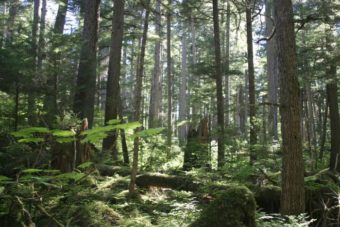
Tongass National Forest
Tongass National Forest (Creative Commons photo by Henry Hartley)

Cole says there are two barriers to convincing the bigger guitar manufacturers to build with reclaimed materials: it can be more expensive than clear cut and the wood isn’t always pretty.

But when Charles Barber wanted to buy a guitar, he knew he didn’t want a cookie cutter instrument. Initially, he was looking at a rock ‘n roll design with inlaid snakes.

“I sent [an image] to my wife and she said, ‘please do not get a guitar that is that tricked out. Get something that is more traditional.’ And I said, ‘don’t worry,'” Barber said with a laugh.

Barber is a director at World Resources Institute: A global research organization that focuses on forests, climate and energy.

He’s having a high-end guitar built by Bedell to the tune of about $6,000. And while there are no inlaid snakes, you could call it sustainably tricked out. It’s being built with salvaged wood and details that include fossilized mammoth ivory, some of which has been unearthed by climate change.

Barber says he wanted this guitar to tell a story.

“People listen to music, they play music, they have more of a personal relationship with something like a guitar than they do the 2X4s that go into making your deck extension,” Barber said.

Tom Bedell agrees. He’s asking for lawmakers to end clear cut old growth logging in the Tongass, and he’s asking guitar makers to make the same pledge.

He says he wants to show the world that salvaged sounds better.

“I’m doing this because to me there’s something really special about the music that’s part of our lives and the forests that enable the wood,” Bedell said.

He says it might be a while before more musicians start asking for guitars made out of reclaimed Sitka spruce; it would be music to his ears.

Plugging in could be cheaper for Juneau’s electric vehicle owners in 2017

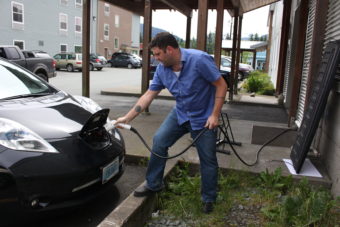
Travis McCain plugs in his 2013 Nissan Leaf. (Photo by Elizabeth Jenkins/KTOO)
Travis McCain plugs in his 2013 Nissan Leaf. (Photo by Elizabeth Jenkins/Alaska’s Energy Desk)

The price to plug in could become a little cheaper for electric vehicle owners in Juneau. That’s because the city’s privately-owned electric utility is trying to expand a program, aimed at shifting when those drivers juice their cars.
For electric utilities, the twilight hours are a relatively quiet time.

“The biggest thing that happens is people go to sleep so they’re not consuming energy at the same rate as they are when they’re awake,” said Alec Mesdag, a director at Alaska Electric Light & Power (AEL&P).

He says when you power down most of your household gadgets at night, it leaves open an energy window. Essentially, there’s just not as much of a drain from the grid. So, it’s a perfect time to plug in the city’s growing number of electric vehicles.

About six years ago, the utility came up with a pilot project for 10 electric vehicle owners to incentivize this. Drivers charging their cars after 10 p.m. would receive a cheaper rate.

“It took a while to get started,” Mesdag said. “Then, once we saw those ten customers fill in, it wasn’t very long before I had twice as many people contact me about getting into the program but it was already full.”

In 2013, it’s estimated there were about nine fully electric vehicles on Juneau’s roads. That number has now ballooned to about 80, and it’s expected to increase even more — with the cars becoming more affordable.

Last week, the utility filed a request with Regulatory Commission of Alaska or RCA to expand the pilot project.

“We want to shift when people charge their vehicles,” Mesdag said. “So that we don’t create a situation where we have too many people.”

Mesdag says forming those habits now, reduces the risk the utility will have to build costly infrastructure later — as electric vehicles start to become the new norm.

He expects the average owner who signs up could save about $10 a month in the summer to charge their vehicle.

“And then in the wintertime, it will be about $12 to $13,” Mesdag said.

If approved by the RCA, the utility will began offering the new rate structure to electric vehicle owners in early 2017.

Budget cuts leave some Alaskans chilly this winter

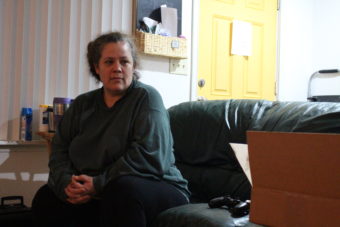
Diane Buck at her home in Juneau. (Photo by Elizabeth Jenkins/KTOO)
Diane Buck at her home in Juneau. (Photo by Elizabeth Jenkins/Alaska’s Energy Desk)

It could be harder for thousands of Alaskans to stay warm this winter. That’s because a state heating assistance program — created when oil prices were up — has gone away. In the past, the program offered relief for families and individuals who earned too much to qualify for federal heating assistance. Now, some of those households are starting to feel the effects.

There’s a white, rectangular box on Diane Buck’s wall that’s giving her a lot of anxiety. It controls the heat in her the three-bedroom home that she shares with her boyfriend, his daughter and his daughter’s three children.

Right now, the thermostat’s circular knob is turned to about 60 degrees.

“I call it the safe zone. The safe money zone. To get the house at least 69, 70, it will go up to here. The money zone is what I call it,” Buck said.

And she says that’s where her family would feel the most comfortable, temperature-wise, at 69 or 70 degrees. But as Buck suggests, turning the thermostat up to the “money zone” has consequences.

Even coming over here to look at it, she says, fills her with a sense of dread.

“It scares me. I really don’t like messing with it. That’s how afraid I am right now,” Buck said. “Because if it gets any higher than $600 a month, I’m screwed. I’m going to get a disconnect notice because I can’t pay it.”

She says last winter it wasn’t uncommon for her electric bill to climb to $600 a month — her entire disability check. And her boyfriend’s income mostly covers the rent. A relative was helping out with some of the expenses last year, but he moved out.

So, for the first time, Buck says her family needed the extra help. And she hoped they could rely on a state heating assistance program to stay warm. They were counting on it.

“I called them and they said, ‘No, we have a new application because of the budget cuts.’ And that’s when I’m thinking no we’re still qualified because who in their right mind is going to do a drastic cut when there’s family in need?” she said.

The Alaska Heating Assistance Program was created in 2008 when oil prices were high and the cost of heating fuel was, too. The application process was the same as its federal cousin, the Low Income Home Energy Heating Assistance Program.

But the state version served people above the federal income threshold. In other words, it helped families like Buck’s who were on the bubble.

“I printed out the application. I had it all filled out,” Buck said.

Fred Byrd is receiving less heating assistance this year. (Photo by Elizabeth Jenkins/KTOO
Fred Byrd is receiving less heating assistance this year. (Photo by Elizabeth Jenkins/Alaska’s Energy Desk)

When the price of North Slope crude was soaring, those funds even carried over into the federal program. There was more heating assistance, overall. But the state program didn’t make it through cuts to this year’s budget.

“I could probably heat this house with two candles if I had to,” said Fred Byrd.

He was also on the Alaska Heating Assistance Program. He’s a former state worker on social security disability. And he still qualifies for some federal heating assistance. But he says it’s about $500 dollars less than what he received before.

He thinks he’ll be able to make it through the winter. In his words, his financial situation isn’t in “dire straits.” He understands why the program was cut, but he wishes he would have known before this November.

“It’s a delicate subject. You get your hopes up. I might get subsidized for this and that will help,” Byrd said. “And then they turn around and slap you in the face. ‘Oh, no. I’m going to give you nothing.'”

The state sent out a letter this summer warning past recipients about the cuts.

And besides the declining oil revenue, the state says another reason it’s doing away with the program is there just wasn’t enough need. But Diane Buck doesn’t agree. She says her family could have really used the help.

“It’s sad. We actually have to wrap up in blankets. What can I do?” she said tearing up. “I can’t even provide enough electricity because if I did, it would be over $600.”

For now, Buck says it’s about keeping the thermostat out of the “money zone.”

New guidelines for Hawk Inlet draw criticism

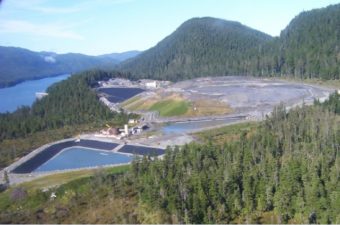
Dry stacked tailings facility at Greens Creek Mine. (Photo courtesy Hecla Mining Company)

Alaska’s Department of Environmental Conservation is working on new guidelines for Hawk Inlet — the location of Hecla’s Greens Creek Mine.

Last spring, an environmental advocacy group found elevated levels of mercury in a seal harvested near the inlet. That sent off alarm bells for a nearby village, which is dependent on subsistence foods.

There was barely an empty seat in the small, rectangular conference room in DEC offices. Staff repeatedly reminded the crowd this wasn’t a hearing. It was a chance for the agency to share a report it collected on Hawk Inlet.

Still, many in the crowd gave passionate testimony, including Albert Howard — Angoon’s mayor and tribal president.

“It’s in the back of our minds everyday now until we actually get answers to what’s happening,” Howard said. “And it’s even more so now because there wasn’t any salmon to speak of for us to fall back on.”

Howard sent a letter to the state earlier this year asking for help. But he doesn’t feel like his concerns were heard. And these new guidelines don’t do enough.

He says people in the village are still scared to harvest seal. And Green Creek mine hasn’t been held responsible for its past violations.

In 1989, the company spilled an unknown amount of ore into the inlet and went through the steps to clean it up. But Howard thinks “the problems still there.”

Village of Angoon
The village of Angoon is the home to about 400 people. (Photo by Elizabeth Jenkins/KTOO)

Before the Friends of Admiralty Island discovered high levels of mercury in the seal, Hawk Inlet was already listed as an impaired waterbody. That prompts the state to puts together a report to submit to the federal government.

The report on Hawk Inlet details recent and past monitoring tests — including information gathered by the Friends of Admiralty Island.

Gretchen Pikul, an environmental program specialist at DEC, says when the agency crunched all the numbers, it found the inlet to be healthy overall, with a couple of sites that should be monitored more closely.

“This plan doesn’t clean up water but actions do,” Pikul said.

One of the plan’s recommendations is to cast a wider net when it comes to monitoring the area. Another is to post warning signs near the inlet not to gather food near the mine’s loading dock. 

But these are suggestions, not requirements. The state can work with the Greens Creek mine to implement the changes when the company’s permit is up for review in about four years. But it can’t force the mine to change anything now. After this story was reported, a DEC representative clarified, “We can alter the permit at any time; it is at DEC’s discretion. Of course, we would prefer to change the permit within the permitting cycle, but we can change the permit at any time.” 

Meanwhile, the report didn’t identify how the seal could have had such high levels of mercury. Michelle Hale, the director of DEC, said the mercury could have come from somewhere else.

“It could be air deposition from China,” Hale said. “Because we know that happens in some places. We don’t know that source right now.”

But for Albert Howard, that answer wasn’t satisfying. He still has questions about the historic ore spill. And questions about how today’s monitoring is done.

“I don’t agree with them. Because there’s no checks and balances there,” Howard said. “There’s no, ‘well if you spill ore, this is what’s gonna happen.’ There’s nothing there. There’s no mechanism to prevent them from irreparable harm.”

The Department of Environmental Conservation is taking public comment on the report until Nov. 14.

Correction: It’s the Greens Creek mine’s loading dock area — not discharge area — where the agency is recommending people not collect food nearby. This story has been updated to reflect those changes.

Glacial fjords home to surprise coral — but maybe not for long

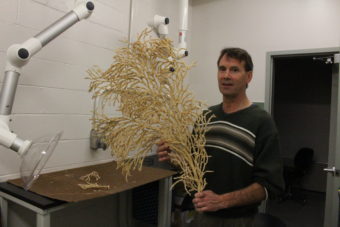
Bob Stone holds a 50 year old red tree coral. (Photo by Elizabeth Jenkins/KTOO)

You might not expect coral to thrive in Southeast Alaska. But it exists in the silty waters of glacial fjords. Now scientists are wondering if the coral, which serves as important fish habitat, could be in danger from an invisible threat — ocean acidification. 

Inside a lab at the National Oceanic and Atmospheric Administration’s Juneau headquarters, Bob Stone is showing me a red tree coral plucked from the bottom of Tracy Arm fjord. This one is dried, the color of ramen noodles.

“If you feel it, it feels like popcorn,” Stone said.

But in the wild, he says it’s an intense red, like the color of salmon roe.

Stone is a fisheries research biologist at NOAA. And — until fairly recently — he didn’t know that coral could exist here.
“Until 2003 nobody did. Or if they did, they weren’t telling.”

Around 2004, someone did tell. Stone was giving a seminar and a person from the audience came up to him. They said they had seen this type of coral in a glacial fjord in Southeast Alaska.

“And I said, ‘no you didn’t’ … and they showed me the specimen and it was indeed that.”

The next year, NOAA received the funding to go see for themselves. Stone had his doubts because red tree coral typically lives far below the ocean’s surface —  in places like the Gulf of Alaska and Bering Sea, at depths of more than 2,000 feet.

Glacial fjords, on the other hand, can be shallow. But its unique landscape replicates the environment of deeper water, so the coral can thrive. For Stone and the other scientists, that was a huge surprise.

“The first time I saw one, I was amazed. I didn’t know what I was looking at,” Stone said. “They’re almost more of an orange color but they’re just a huge reddish orange tree under water. To me, they’re one of the more beautiful animals I’ve ever seen.”

It also serves a very important function. Stone says scientists call the thickets of red tree coral “little forts” because they’re hideout for small species, like fish and crab.

Red tree corals are a focal point of the Deepwater Exploration of Glacier Bay National Park Expedition. These corals have been shown to be the foundation of diverse deepwater communities in Alaska. And can occur as shallow as 6 meters. Here several fish and urchins congregate around a large red tree coral. Image courtesy of NOAA- Alaska Fisheries Science Center and Deep- Sea Coral Research and Technology Program.
Image courtesy of NOAA Alaska Fisheries Science Center and Deep- Sea Coral Research and Technology Program.

But around the same time scientists were discovering just how versatile this coral could be, they were also becoming increasingly concerned about changes in the ocean.

“By the early 2000s, we had recognized the ocean was actually increasing in carbon dioxide level. That ocean acidification was happening,” said Tom Hurst.

He studies the effects of climate change on marine life at a NOAA lab in Oregon. And his primary focus is commercial fisheries in Alaska.

Hurst says, in part, the reason our oceans are becoming more acidic has to do with us.

“Primarily from the burning of fossil fuels,” Hurst said. “So, you’re taking all this carbon that was stored underground in the form of coal and oil. And as we burn it we’re releasing all that carbon into the atmosphere.”

And that becomes carbon dioxide which gets absorbed into the water. Now you’ve got a cocktail for ocean acidification. Still, Hurst says a big piece of the puzzle that’s missing for scientists is what that could mean for marine life.

“We don’t really yet have a good handle on which of those things are going to be affected, how much they’re going to be affected and how those changes are going to ripple through the food web,” Hurst said.

Already, in Washington state, ocean acidification has been linked to oysters not being able to fully develop their shells. As far as we know, that hasn’t happened in Alaska yet.

But scientists have named places like Southeast Alaska and the Aleutian Chain as potentially threatened spots. Hurst says what’s next is figuring out how — not if — ocean acidification will impact different forms of sea life.

Back at the NOAA lab in Juneau, Bob Stone is showing me a baby pollock suspended in a bottle. Typically, the coral helps shield the baby fish from predators.

“This one right here, I actually collected in the coral by hand,” Stone said.

Discovering the red tree coral in the glacial fjords has an added bonus. It makes it easier for scientists to retrieve since it’s in shallow water.  

Now Stone is conducting an experiment to see how much ocean acidification could hurt the coral down the line. It has an easily dissolvable skeleton. And scientists are wondering if the added chemicals in the water could make it harder for the coral to reproduce.

But ocean acidification may not be its only threat. The glacial fjords that are home to this surprise coral are also changing.

“Well, yeah. We now realize that, say for example, in Tracy Arm, that the two main glaciers that are there go up into the alpine, up into the valleys rather, that system will shut off,” Stone said.

When the glaciers disappear, the shallow water coral will, too.

As objection hearings wrap, countdown to new Tongass plan

The U.S. Forest Service wrapped up objection hearings Wednesday on a plan that could shape the future of timber in the Tongass National Forest.

It was the last chance for the public to register opposition to to the Tongass Land and Resource Management Plan amendments, which has been nearly three years in the making and will go into effect this winter. The meetings took place during a two week span in Ketchikan and Juneau.

About 27 groups and organizations testified in opposition — including the state of Alaska.

Timber industry reps say the forest service plan transitions too quickly from logging valuable old growth trees to smaller young growth timber. Meanwhile, some environmentalists believe there’s too much old growth left on the table.

Beth Pendleton, of the Forest Service, said the plan outlines a new direction for the Tongass but that doesn’t mean it’s set in stone. This is called adaptive management.

“So, as new information becomes available because we’re moving into a new management regime for example around young growth, that we take that information more real time and make adjustments in the management approach,” Pendleton said.

In all, less than 400 timber industry jobs remain in Southeast.

Pendleton has until Nov. 28 to respond to the objectors about what changes the forest service will incorporate — if any. The final plan is expected to be completed this December.

Site notifications
Update notification options
Subscribe to notifications