Elizabeth Jenkins, Alaska's Energy Desk - Juneau
Why is this Alaska glacier surging ahead of the others?

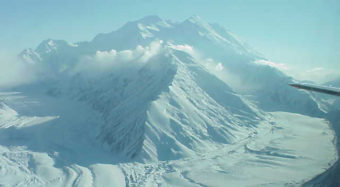
Two glaciers cascade off Denali.
Two glaciers cascade off Denali. (Public domain photo courtesy National Park Service)

Geologic changes typically move slow. But one glacier in Denali National Park and Preserve could be moving at a decidedly un-glacial pace. Scientists think it’s doing something only a small amount of glaciers do, an event called “surging.”

The Traleika glacier last surged around 60 years ago and experts think it’s on track to do it again.

“It’s just exciting to see the natural world rearing up and acting crazy. Doing big things,” said Michael Loso, a physical scientist at Wrangell-St. Elias National Park.

His work also takes him to Denali, where the glacier is showing signs of increased movement.

Photo courtesy of the National Parks Service
Ice flow speed is increasing on Traleika glacier, indicating a coming surge. (Photo courtesy of the National Park Service)

When a glacier’s ice flows downward at a relatively accelerated rate, that’s when it’s surging. It will start to flatten at the top with more ice moving towards the glacier’s lower end.

Loso says, at the moment, you might not notice anything is different about the Traleika glacier.

“But if it develops into a full blown surge, the kind of behavior that we know it exhibited back in the 1950s,” Loso said. “You would see a glacier that was completely transformed from what is had looked like, say, a year before.”

Not all glaciers surge. In fact, Loso estimates that only a small percent in the world do. It’s something that scientists only partly understand.

And while climate change is causing Denali’s glaciers to shrink, Loso says surging is different. It’s more that the glacier is changing shape.

Loose sediment and flowing water have something to do with it, and Loso knows that the behavior happens in cycles. In Traleika’s case, scientists think it’s about every 60 years. The upper part of the glacier thickens, enough to start to move quickly.

I ask if I planted a lawn chair down by the glacier and took a seat, would I actually be able to see it moving over time?

“If you sat with your lawn chair and brought a tent and just watched for a few days, you would see the difference,” Loso said. “You would see the changes. Absolutely.”

Loso says that camping out by the glacier is kind of fanciful idea given the rugged terrain. He says scientists will be keeping a close eye on the Traleika glacier to see if it has a domino effect.

The last surge caused the Muldrow glacier, which is connected Traleika, to surge, too.

Is hydropower renewable energy? One village in SE Alaska needs it to be

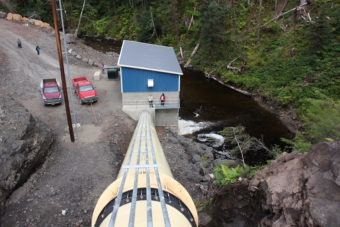
Water flows down the tube and spins a turbine that creates electricity. (Photo by Elizabeth Jenkins/KTOO)
Hoonah’s hydro project, Gartina Falls, was completed in 2015. (Photo by Elizabeth Jenkins/Alaska’s Energy Desk)

A multimillion dollar dam in Kake would make it easier to bring renewable energy to the village, which currently runs off diesel. But the definition of “renewable” isn’t the same in everyone’s book. Federal grants for hydro projects can be limited — compared with what’s available for wind and solar.
Jodi Mitchell puts up a different kind of inspiration in her Juneau office. There’s a yellow sticky note on her computer that warns about how much carbon dioxide diesel emits.

“I write that there to remind myself everyday of why we’re doing this,” Mitchell said.

Mitchell is the CEO of the Inside Passage Electric Cooperative, a nonprofit that supplies energy to small Southeast Alaska communities. She says sometimes the only way to power remote Alaska is by burning diesel. And as her yellow sticky note attests, she thinks there’s a better way.

“If I could build a hydro project in each of those communities, even if it wouldn’t cover the full load, at least they would have some energy security,” she said.

But Mitchell says building a hydro project from scratch can be expensive and the permitting can take a long time.

About three years ago, Mitchell says the utility was getting close to completing a hydro project in Hoonah and the village of Kake was next on the list. The utility sent a couple of engineers to scope it out.

“I was surprised. I was shocked when they sent me the pictures,” Mitchell said. “I was like, where are you? And they were like, we’re at Gunnuk Creek. There’s a dam here already, Jodi!”

What the engineers discovered was an estimated $12 million tank and dam intended for Kake’s drinking water. Mitchell says it was built around 2006, using mostly federal funds. But its electric pumps made it too pricey for the village to operate.

What makes this unused dam special is that it can be converted to generate electricity.

“As far as I know, it’s the lowest hanging fruit in the state and perhaps in the nation,” Mitchell said.

The U.S. Department of Energy sees untapped potential, nationwide, for retrofitting non-power generating dams, and Mitchell thinks this one could be done for about $6 million. It would supply more than half Kake’s electricity.

In the past, she says the utility would have relied on the Renewable Energy Fund, a state program, but because of Alaska’s mega budget deficit, that funding has gone away. Loans aren’t out of the question. Still, that’s an expense that could be passed on to ratepayers. Something that Mitchell says she doesn’t want to do.

So, what options are left?

The Gunnuk Creek dam in Kake. (Photo courtesy of the Alaska Energy Authority)

“Most of the grant funds that are available through the federal government do not include hydro,” Mitchell said. “And anyone who lives in Southeast Alaska thinks that’s completely bonkers.”

Jeff Leahey, the deputy executive director of the National Hydropower Association, says that’s partly true, but it’s more complicated.

“Do people recognize that hydropower is a renewable resource? Yes, they do believe that at the federal level,” Leahey said. “But sometimes they have not included that in the definition of renewable energy.”

Leahey thinks that’s why there aren’t more federal grants for hydro projects. There isn’t consistency across the different federal agencies.

U.S. Sen. Lisa Murkowski was working on a bill that would have made that definition more clear, potentially opening up more federal grants for hydro, but Congress ran out of time.

Leahey says solar and wind seem to get all of the attention.

“I think some of that comes back to the misconception that the real growth in renewables can only come from wind and solar technologies,” Leaheay said. “And the myth that hydro is all built out, that there were no new opportunities for growth.”

Back at the office at the Inside Passage Electric Cooperative, Jodi Mitchell reads me a rejection letter:

“Your project was not one of the highest ranked projects selected for funding at this time.”

It’s from the United States Department of Agriculture, one of a handful of federal grant opportunities that includes hydro.

“I mean, I do a lot of crying when I’m alone because I want it so bad,” Mitchell said. “I want it so bad to help my people.”

Mitchell still thinks Kake’s best bet for cheaper electricity is retrofitting its existing dam. She’ll try to reapply in the next grant cycle. But she’d like to see the floodgates opened on more federal funding.

Cuts to state jobs prompt union outcry

The ASEA sign on their office window (Photo by David Purdy/KTOO)

The largest state employees union isn’t happy with some of the cuts in Gov. Bill Walker’s budget. In a class action grievance filed Tuesday, the Alaska State Employees Association says the governor overlooked a crucial detail in its contract agreement that could wind up costing the state more.

Jim Duncan, the executive director of Alaska State Employees Association, says he’s received worried calls from union members, particularly from those who work for the department of transportation in construction design.

The governor’s budget outlines cutting 76 of those positions in 2018. And up to 300 total the year after.

“Our job as a union is to be sure that their rights are protected,” Duncan said. “And to be sure that if something should happen to them, as far as their job disappearing, that it’s been well thought out and we’ve done everything to protect it.”

What the governor is proposing, Duncan says, is not well thought out.

He says there’s no indication that eliminating the department of transportation jobs could save the state money; private contractors could increase the price to do business over time.

“And the bottom line should be it’s not just to move money from the public to the private sector. But it should be to reduce costs to bring about efficiencies,” Duncan said. “They haven’t evaluated that at all.”

In a statement from his office the governor reiterated that reducing the size of government is how he intends to tackle the more than $3 billion budget deficit.

But if those jobs are privatized, Duncan says, there’s no guarantee they would remain in Alaska.

And he thinks the cuts violate the union’s contract. He says the state is required to give the positions another look with a feasibility study that would compare the cost and obstacles of shifting the jobs into the private sector.

“The budget still has to go through many, many hearings,” Leslie Ridle said.

Ridle is the deputy commissioner at the state’s department of administration. She says the governor’s budget still has a ways to go before being finalized.

“So, it’s just the first step. We still  have time to do a feasibility study before any contracting out is actually done,” Ridle said.

But Jim Duncan says that’s not part of the deal.

“I’ll wait and see if they’re going to do a feasibility study, if they’re going to choose an independent third party, that’s exactly what we’re asking for,” Duncan said. “But still, it’s a contract violation to do it after the decision is made.”

The legislative session starts on Jan. 17. Duncan says the union plans to move forward its class action grievance.

Correction: An earlier version of this story misstated when the Alaska Legislature will convene. The legislative session starts Jan. 17, not Jan. 19. 

In Southeast Alaska, the holiday spirit is diesel-powered

Photo courtesy of Nancy Bean.
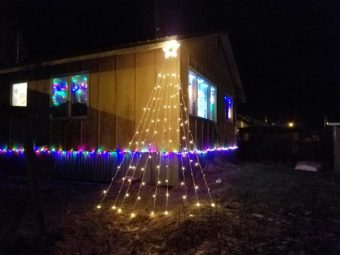
Nancy Bean’s home in Kake. Her holiday lights display is powered by diesel. (Photo courtesy of Nancy Bean.)

Diesel is running about $2.71 per gallon in Southeast Alaska, but in places that depend on diesel for electricity, there are still households that won’t let the cost dampen the holiday spirit.

For Nancy Bean, a Kake resident, it started off small — with a couple of light-up reindeer. But every year, she’s added something new.

“We have lights everywhere. Some houses have a little bit and some houses have a lot. I have more than a lot,” she said with a laugh.

Outside, Bean’s yard has a decorative train, two angels with trumpets, a waving Santa, strings and strings of multicolored lights and more.

“One thing we bought, and I don’t think we’ll do this again, is we bought a 10-foot Christmas tree. A blowup. And it is beautiful when the wind’s not blowing,” Bean said.

Kake is a small community of about 600 people. And Bean estimates there are nearly 20 homes decked out for the holidays.

What’s powering those festive displays is diesel, which can be expensive.

Bean qualifies for power cost equalization, a state funded program that helps lower electric rates in remote places. Still, she says on average, the lights add up to an extra $200 on her electric bill.

Frank Willis says, so far, it's cost him about $20 extra dollars on his electric bill to keep up the lights. (Photo courtesy of Frank Willis)
Frank Willis says, so far, it’s cost him about $20 extra dollars on his electric bill to keep the lights up. (Photo courtesy of Frank Willis)

North of Kake, in Angoon, Frank Willis says his is one of only three or four houses decorated for the holidays. And his display was hard fought.

“The first one we put up the dogs chewed through it,” Willis said.

Angoon is another village with less than 500 people. And, like Kake, it also runs off diesel.

“Putting up Christmas lights used to be a big thing around here. And it’s just kind of, like, going downhill the past few years,” Willis said. “[I’m] just hoping to get everyone back in the spirit.”

Nancy Bean says that’s what motivates her. When pressed, she’s modest about having a house that looks like a snow globe, one of the most decorated in Kake. She says both adults and children stop to admire the twinkling lights and the waving Santa.

There’s this one girl, she says:

“Her mother passed away, and she’s staying with her uncle. And he brings her up every single night, and he lets her run around in the yard. I can sit in my living room, and I can hear her laugh,” Bean said. “And that’s what it’s all about.”

I ask Bean if she’ll buy more holiday displays next year and she answers “yes” — without hesitation. She says it’s not just the decorations that light up, it’s the faces of the people, too.

Is the forest service supplying enough Tongass timber?

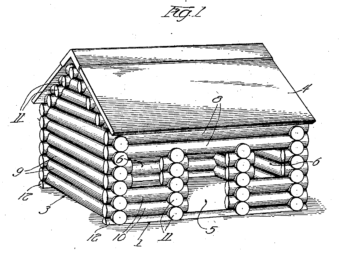
A Lincoln Log cabin.(Creative commons photo by (Creative commons photo by Lloyd Wright John)

A Lincoln Log cabin. (Creative commons sketch by Lloyd Wright John)

The U.S. Forest Service wears a lot of hats. The agency oversees federal lands, repairs salmon streams, and auctions off trees. In Alaska, timber sales are intended to stimulate the local economy, but industry groups say that through the years the forest service hasn’t made enough logs available to keep the industry alive. Now, with changes to federal regulations, even less old growth is slated for market.
It might surprise you but kids know a thing or two about timber — at least, they used to. Back before the glow of tablets captured the imagination of children, they played with Lincoln Logs. For those too young to remember, Lincoln Logs are the iconic toy that resemble … logs. You can stack them to build miniature houses or forts.

I brought a set to the federal building in Juneau to find out how a federal timber sale comes together.

Dave Harris, the director of forest management for the U.S. Forest Service, Alaska Region, looked amused by the stand-in timber.

“This will be interesting,” he said with a laugh.

I asked Harris if he played with the toy as a kid.

“Oh, gosh. Yes. And we won’t talk about how long ago that was,” Harris said.

But he would agree to use the Lincoln Logs to help demonstrate how a federal timber sale comes together in the Tongass National Forest. Although the Tongass is large, what the forest service has set aside for market is relatively small — somewhere between 6 to 8 percent.

First the agency has to figure out where a sale would be viable. Then, Harris says the timber sale goes through a lengthy process that includes environmental assessments and an objection period.

“There’s a lot of steps,” Harris said. “I don’t know how else to put it. It’s a heck of a lot of work.”

From start to finish, it should take about four years to complete a sale. It starts with advertising for 30 days, usually in Ketchikan’s newspaper. Then, the bidding can begin.

“You submitted a bid. And you are the high bidder on this contract,” Harris tells me during our Lincoln Log sale.

“How much did I pay for it?” I ask.

“How much did you bid for it? You bid at least the minimum price of what we appraised,” Harris explains.

And that’s an important point. I can’t bid below that. I can’t offer less than what the forest service thinks the timber sale is worth. But how the agency makes those calculations is hotly debated.

Eric Nichols, a partner at Alcan Forest Products, says the forest service looks at past timber sales to set the price today. So when there are market fluctuations, the industry can have very different ideas about price from what the forest service has set.

In 2014, the U.S. Forest Service repaired streams on Kuiu Island damaged by logging in the 1970s. Now, 23 million board feet could be harvested on the north part of the island. (Photo by Elizabeth Jenkins/KTOO)
In 2014, the U.S. Forest Service repaired streams on Kuiu Island damaged by logging in the 1970s.  (Photo by Elizabeth Jenkins/Alaska’s Energy Desk)

Nichols’ company specializes in the purchasing, managing and marketing of timber in Alaska, among other places.

It’s estimated that a few hundred timber jobs remain in the region. And Nichols thinks the industry’s decline is due, in part, to the forest service’s bad appraisals. Recently, a controversial timber sale on Kuiu Island received exactly zero bids — even after the forest service said the trees could be shipped overseas.

“I thought that the cost would exceed the value of the timber,” Nichols said. “You would have lost money if you bought that timber sale.”

With the exception of Big Thorne, the last sizable timber sale in the region, Nichols says, “the volume has been steadily decreasing to the point where the timber industry is in a death spiral at this point and time here.”

In January, the forest service will start to transition away from valuable old growth logging in the Tongass. That’s another barrier Nichols thinks could be bad for business as federal timber sales are scarce already.

“I don’t see how we’re going to make this transition unless we see some consistent supply coming from the forest service,” Nichols said.

Dave Harris, from the forest service, says he thinks that’s an accurate statement.

“I mean, we have seen our offers declined, our ability to get sales appraising positive. Ability to get past some of the challenges,” Harris said.

He says the agency is looking at coordinating with other landowners, like the State of Alaska or Mental Health Trust, to make more timber available — trying to bring more life-sized logs to market.

Yes, scientists say, Alaska wildfires linked to climate change

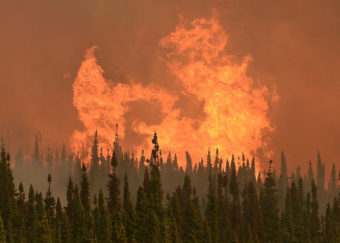
Flames from the Funny River Wildfire flare up on May 24, 2016 in Soldotna, Alaska. The wildfire started unusually early in the season and burned nearly 200,000 acres on the Kenai Peninsula. (Photo by Rashah McChesney/Peninsula Clarion)
Flames from the Funny River Wildfire flare up on May 24, 2014, in Soldotna. The wildfire started unusually early in the season and burned nearly 200,000 acres on the Kenai Peninsula. (Photo by Rashah McChesney/Peninsula Clarion)

2015 was a headline grabbing year for extreme weather events. Massive floods, extreme drought and low snowpack were seen around the globe. In Alaska, wildfires scorched over 5 million acres of land. Now the National Oceanic and Atmospheric Administration (NOAA) is taking a closer look and trying to figure out what caused them.

James Partain, a NOAA climatologist, says he can’t go anywhere without someone asking about climate change. His dentist, passengers on airline flights — he says they all want to know what’s triggering these unusual weather events around the state?

“Last night, I was at my restaurant in Eagle River having some supper and my waiter asked the same thing,” Partain said. “He sat down with me.”

Partain recently coauthored part of a report called Explaining Extreme Weather Events of 2015, which his colleagues at NOAA presented this week in San Francisco.

His contribution focuses on the large wildfires that blazed through Alaska two years ago. That year set a record for the second largest number of acres destroyed by wildfire since 1940.

“Wildfires are probably the most visible catastrophic footprint of climate change that you can get,” Partain said.

But he says, in the past, it’s been difficult for scientists to answer the bigger question:

“This press release and this paper that we’ve developed shows unequivocally that man made change is a cause of why 2015 was such a serious event,” he said.

Partain says lightning strikes caused most of the wildfires to ignite. About 44 percent were started by people (garbage fires, someone dropping a lit cigarette, etc.).

But he says the unusually dry conditions that caused the wildfires of 2015 to blaze out of control, that’s on us, too. And that’s the part which has been linked to the planet heating up, due to an increase of carbon emissions.

“As man made climate change continues to advance and increase, we expect to see more and more and more of these very strong fire seasons,” he said.

Still, Partain says currently we’re in a La Niña year — meaning things have cooled slightly for now. He expects next year’s wildfire season won’t be as severe as 2015, but it’s unknown for now.

He welcomes more questions.

Site notifications
Update notification options
Subscribe to notifications