Elizabeth Jenkins, Alaska's Energy Desk - Juneau

Alaska’s infrastructure report card probably not going on the fridge

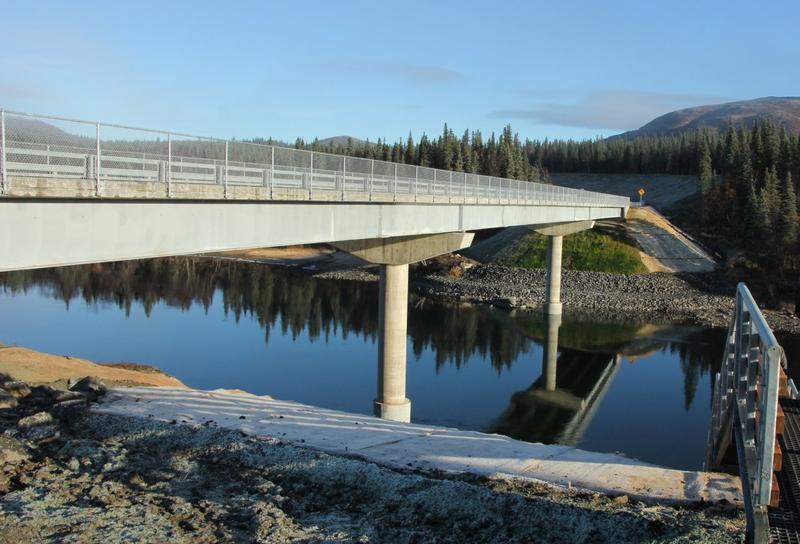
Aleknagik Wood River Bridge
Alaska scored a B- on its bridges, the state’s highest infrastructure grade from the American Society of Civil Engineers. (Photo by KDLG)

Is Alaska on the honor roll for its energy grid and water systems? According to the American Society of Civil Engineers the answer is “no.” The professional organization graded Alaska’s infrastructure for the first time, releasing the report card on Tuesday. And while the state didn’t ace anything, it could always be worse.

On average, the rest of the country is sitting at a D+ for things like bridges, roads and water systems. It makes Alaska’s GPA look pretty good. We scored an overall C-. But Greg Kinney, with the Alaska branch of the American Society of Civil Engineers, says we’re not off the hook yet.

“It’s a mediocre grade,” Kinney said. “Looking at it as a parent from a positive light, you say, ‘You can do better.'”

Falling into that mediocre group is Alaska’s energy grid. It scored a C- for reasons you might expect: Parts of rural Alaska still run on diesel.

But there are problems in urban areas, too. Kinney says electric utilities around the state need to do a better job of working together, especially in railbelt Alaska.

“There are bottlenecks currently, particularly in the transmission lines, which have not kept pace with the generation capacity,” Kinney said.

When that occurs, Kinney says you get steeper electric rates. It’s a problem the Regulatory Commission of Alaska identified last year. In January, three Anchorage-area power companies agreed to work together. Kinney says that’s the kind of collaboration his organization wants to see. It could boost the state’s energy grade beyond a lukewarm score.

But there are other areas dragging down Alaska’s overall GPA, like the marine highway system, ports and harbors and access to clean drinking water — all D’s.

Kinney says that grade represents the system being at risk for failure. According to the report card, more than 30 rural communities have no centralized water or wastewater systems. And Kinney thinks those that do could benefit from more routine maintenance.

A spokesperson for Alaska’s Department of Environmental Conservation agreed. The agency helps train people who monitor the water, but it said federal funding is needed to ensure those workers can stay in rural parts of the state.

But if Alaska has one thing going for it, Kinney says it’s that the state’s infrastructure was built from decades worth of oil money, so it’s relatively new.

“This is really what we’re trying to achieve here is how can we get newer infrastructure to actually stay new,” he said.

As the state grapples with a multi-billion dollar hole to fill because of oil, Kinney’s organization realizes that could be a challenge. He says they support measures like increasing the state’s motor fuel tax to help Alaska’s infrastructure make the grade.

What road lies ahead for Juneau’s electric cars?

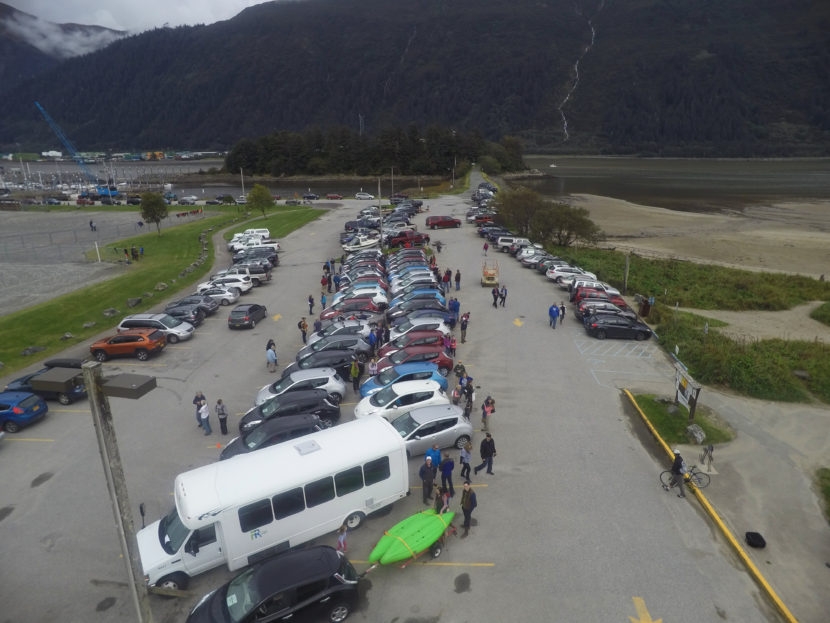
A drone shot of Juneau’s electric vehicle get together. (Photo by Gabe Strong)

Juneau’s privately-owned electric utility is trying to plan for a future that includes more electric cars. It’s estimated there are over 100 fully electric vehicles in the city, with one or two arriving by ferry or barge each week. Even Teslas — the Porsche of electric vehicles — have been spotted in the capital city. As this new reality sets in, the state’s regulatory commission is taking a closer look. It’ll be reviewing how the utility is responding to its ratepayers and the influx of electric cars.

Juneau’s car dealerships don’t sell fully electric vehicles (EVs). There’s no tax break for buying one here, like in Washington state. But Devon Kibby, the president of Juneau’s Electric Vehicle Association, says that hasn’t slowed the momentum.

“Even without these incentives, people are still buying electric vehicles,” Kibby said.

Juneau’s electric utility, Alaska Electric Light & Power (AEL&P), is trying to figure out a way to incentivize those drivers to charge at night. That’s when the least amount of electricity is being used, so the cars are less of a burden on the the grid.

In November, the utility filed a request with the state’s regulatory commission to offer a cheaper rate to electric vehicle owners who plug-in during those times — a program they could opt into.

“It’s not necessarily a bad deal. It by no means is a bad deal,” Kibby said. “We’re just wondering if there’s another way to allocate the benefits to better help EV adoption in Juneau.”

In January, The state’s regulatory commission approved AEL&P’s nighttime charging rate. But the agency is also investigating how the utility makes those decisions. Kibby says the electric vehicle association wants a seat at the table, too. They want to ensure that best framework is being created to support the growing number of electric cars.

Kibby thinks the utility should offer the same nighttime charging hours, like its previous experimental program, and provide affordable limited energy from public fast-charging stations during the day.

“One of the things that often comes up when we have an incentive rate programs is that all customers are treated fairly by the proposal,” said Alec Mesdag, a director at AEL&P.

The fast chargers can juice a Nissan Leaf in about 20 minutes, lessening the dreaded range-anxiety. With a typical charger — there are 10 of them in townthat can take about four hours.

The utility’s Washington-based parent company, Avista, has installed fast chargers for electric cars down South. But Mesdag says Washington has a very different regulatory environment than Alaska. Namely, the Washington legislature passed a bill making it OK for the utility to pass on that expense to ratepayers.

Even though there are several electric vehicles in Juneau, Mesdag says, that doesn’t mean there’s the same type of demands as other cities.

“What we don’t have in Juneau is a large number of people who would need to utilize that infrastructure,” Mesdag said. “The current owners of electric vehicle owners find it more convenient to charge at home because they typically have off street parking.”

Mesdag thinks there’s still a lot to learn as more electric vehicles cruise into town.

The Regulatory Commission of Alaska is trying to navigate the new environment, too. Its next meeting on the matter is Friday, Feb. 10.

Alaska’s budget, easier to swallow with ice cream and beer

Economist Gunnar Knapp and Cliff Groh, Chair of Alaska Common Ground, talk to a crowd about Alaska’s budget at McGivney’s, a sports bar and grill, on Thursday in Juneau. (Photo by Rashah McChesney/Alaska’s Energy Desk)

The Alaska legislature has a lot on its plate trying to fix the state’s multi-billion dollar budget deficit, and a couple of budget experts are adding to the menu. They’re inviting the public to weigh-in over ice cream and beer.

More than 20 people are crowded into Coppa — a local ice cream shop in Juneau — to learn about what’s happening with Alaska’s budget. People dig small plastic spoons into flavors like “fiscal crunch” and “sustainable blueberry budget.”

Carole Triem is here with a friend. And while the ice cream doesn’t make the fiscal situation taste any sweeter, she says her main reason for coming is to learn.

“I feel like I should know more about the budget than I do. Especially as a state employee because it affects my livelihood,” she said.

Jobs like Triem’s could be on the chopping block, as the Alaska legislature looks at ways to reduce state spending. There’s a more than $3 billion hole to fill this year, and with declining oil production and weak revenue, Cliff Groh says we can’t keep living like we have.

Cliff Groh, Chair of Alaska Common Ground, talks to a crowd about Alaska’s budget at Coppa, an ice cream and coffee shop, on Thursday in Juneau. (Photo by Rashah McChesney/Alaska’s Energy Desk)

Groh is the chair of Alaska Common Ground, a public policy nonprofit, and he served as a special assistant to the Commissioner of Revenue. He’s here presenting with Gunnar Knapp, an economist. You could say Groh’s role is to simplify the jargon of the budget crisis. That’s his mission.

“Alaska’s in deep kimchi and all the bland food options have left town,” Groh said. “The choices are spicy and not the easy meatloaf and mashed potatoes. People need to think clearly about the difficult choices we face.”

Groh says that means the options to fix Alaska’s budget are not that appealing: deep cuts to state infrastructure, creating a state income or sales tax, repealing the oil and gas tax credit program. We can’t just pick one.

“But those are the kinds of choices that Alaska faces now because the savings are running out very fast,” Groh said.

He says we’re eventually going to have to eat our kimchi.

Groh and Knapp give this same spiel to their audience for over an hour. After everyone leaves, they make their way over to McGivney’s where they’ll do it again.

In a back room at the downtown sports bar, Knapp and Groh pick up their informal budget conversation with an after-hours crowd.  They aren’t  shy about telling other people to get comfortable.

A budget conversation and free ice cream drew a crowd to Coppa, an ice cream and coffee shop, on Thursday, in Juneau. (Photo by Rashah McChesney/Alaska’s Energy Desk)

“By the way, those who just came in, get some beer, there’s beer, enjoy the beer,” Knapp tells a crowd of about 15 people.

Knapp kicks off his shoes and reclines on a bar stool while giving the crowd a broad overview of the budget. The state’s dependence on oil money has left lawmakers reeling — trying to figure out where to cut and how deep. So far, Knapp says, they’ve been relying on savings.

The crowd is a mix of lawmakers, legislative aids, community members and even a former Deputy Commissioner of the Department of Revenue. And while the conversation is relaxed, they’re grappling with some difficult concepts. A woman in the crowd asks if we’re all screwed. Should she stick it out or leave the state?

“I mean, I’m fundamentally an optimist about Alaska,” Knapp said. “And I think that we’ve got a lot of resources, there’s a lot of oil still in the state.”

It’s those same concepts that lawmakers struggle with by day at the state capital just a few blocks away. Groh says the competing philosophies of cutting further, capping spending, taxing Alaskans and dipping into the Permanent Fund, make it difficult for legislators to work together.

“And Alaska’s political situation surrounding the fiscal problems are sort of like what you might see in an old spaghetti western or Quentin Tarantino film,” Groh said.

A standoff.

He says Alaskans have been very good at announcing what they don’t want. Now they need to think about what they will accept. And sometimes a scoop of ice cream or a swig of beer can help that reality go down easier.

Editor’s Note: A previous version of the story stated Cliff Groh was a former commissioner at the Department of Revenue. He served as a special assistant to the Commissioner of Revenue. The story has been updated to reflect the changes. 

After months of controversy, Deer Mountain might not be logged after all

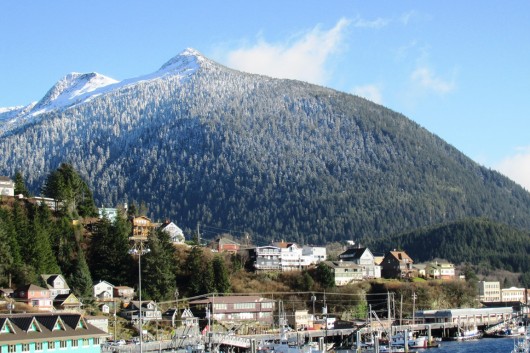
A springtime view of Deer Mountain. (File photo by Leila Kheiry/KRBD )
A springtime view of Deer Mountain. (Photo by Leila Kheiry/KRBD )

Last summer, the Alaska Mental Health Trust announced its intent to log Deer Mountain — a popular scenic spot in Ketchikan. The trust uses its lands to make money for state programs, like mental health services, housing and addiction treatment. Now with a federal land swap in the works, the trust says they’ll pass on Deer Mountain.

From Alaska’s Energy Desk, Elizabeth Jenkins spoke with Leila Kheiry from KRBD in Ketchikan, who’s been reporting the story:

Looking outside your radio station, can you see Deer Mountain?

Not really today because it’s covered in clouds. Normally, though, yes. We would have a great view of Deer Mountain from here at the station. And really, there aren’t that many places in the core part of Ketchikan were you can’t see it. It’s definitely the backdrop for the community. There’s a popular hiking trail that people use in the summer and winter. And it’s probably featured in vacation photos for hundreds of thousands of cruise ship visitors who come here in the summertime.

So, for someone who’s new to this story can you explain why Deer Mountain is valuable and who owns it?

Valuable in terms of money? Because of the timber on it, the trees. It has stands of old growth that could be cut down, milled and sold. Timber is a big deal in this area. And that’s why they want to be able to log it. And be they, I mean Alaska Mental Health Trust and they’re the one’s who own at least part of Deer Mountain.

Last summer, the Alaska Mental Health Trust said they would move forward with plans to cut down trees on Deer Mountain. But there was an “if.” That is, if they didn’t get approval from Congress to do a land exchange. What is a land exchange?

Well, in this case, the land exchange would be a federal land trade. So, the federal government owns some land on Prince of Wales Island and in the Shelter Cove area, which is on this island, and they would trade that federally owned land and take control of the controversial parcels on Deer Mountain and in Petersburg. And those parcels would then be under U.S. Forest Service control.

The trust gave a January deadline for a decision to be made. Were people in Ketchikan and Petersburg surprised? 

It was a complete surprise. The fact that they were going to make this decision was not well advertised ahead of time. Mental health officials have even admitted as much. And so, local residents in both communities were very unhappy. Groups formed in Ketchikan and Petersburg to oppose the decision. Local government officials spoke strongly against it — state representatives, there was as online petition.

And keep in mind, people in Ketchikan especially tend to be very pro-logging. Except for a couple of folks, even the most vocal timber supporters said, “not Deer Mountain.” And the concern wasn’t just about how it would look. There was concern in both communities about landslides because the parcels in question are right above residential neighborhoods.

Did the trust give any indication about why they wanted to log Deer Mountain or do the land swap now?

Yeah, Trust officials said the timber industry in Southeast Alaska is dying. And if they didn’t log the land they have now, if they waited even a year, there wouldn’t be anyone left in Southeast who could cut down the trees. And timber is the only way they see to make money off of the land.

Getting back to the Alaska Mental Health Trust’s January deadline, is Congress going to be able to approve the land exchange for Deer Mountain in time?

Well, partly because of the community backlash, the Mental Health Trust board in November reconsidered that January deadline. So, at this point, we do not have that hanging over our heads. If the deadline had been in place, we would have missed it, though, because Congress was not able to approve the land trade in time.

With a new Congress, the bill has to start fresh and so about a week ago, Senators Lisa Murkowski and Dan Sullivan and Rep. Don Young introduced companion bills to accelerate the exchange.

These bills have been filed to accelerate a land exchange for Deer Mountain. Do people in Ketchikan seem optimistic that it will actually happen?

Yes, especially with the new Trump administration and a Republican Congress. Those bills do still have to go through committees before they get to the floor for adoption. But Paul Slenkamp, he’s the senior resource manager for Mental Health Trust land office, he told the Ketchikan Gateway Borough Assembly, just a few days ago, that he’s extremely optimistic that the exchange will pass very quickly.

And they’re so confident that in the mental health board packet for its regular meeting coming up is an update: the trust land office will not be pursuing timber sales on its lands in Ketchikan and Petersburg.

The Alaska Mental Health Trust will meet this week in Anchorage to discuss the issue on Thursday, Jan. 25.

Disclaimer: KTOO’s building sits on land leased from the Alaska Mental Health Trust Authority. KTOO has also applied for and received occasional grants for special reporting projects from the authority.

Culturally valuable yellow cedar on the decline

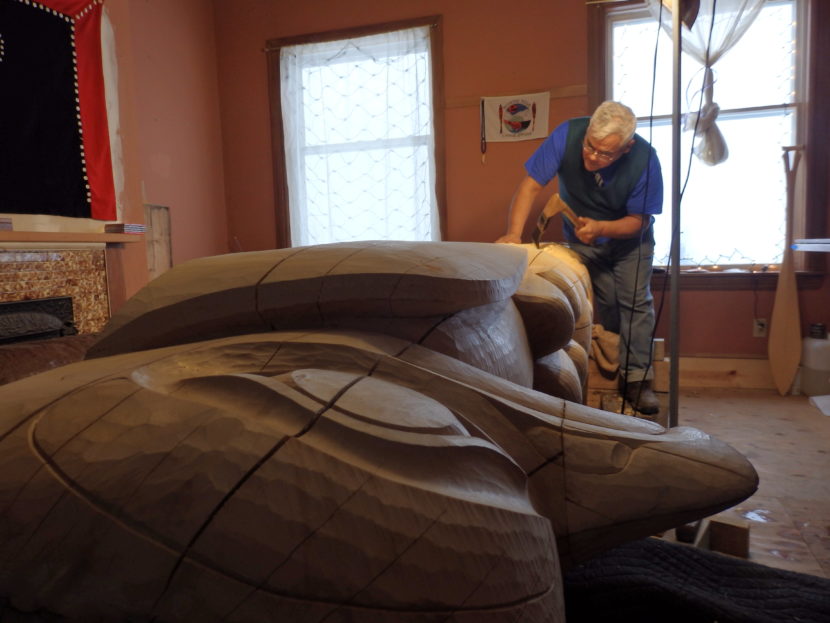
Wayne Price works on a 12 foot tall totem pole in his Haines studio. (Photo by Emily Files/KHNS)
Wayne Price works on a 12-foot-tall totem pole in his Haines studio. (Photo by Emily Files/KHNS)

Yellow cedar trees grow from the top of California, all the way to Alaska, and according to a recent study, the Southeast part of the state could be the hardest hit with yellow cedar’s decline, due to the planet heating up. The U.S. Fish and Wildlife Service has been petitioned to put yellow cedar on the endangered species list. The wood is commercially valuable. It’s culturally valuable, too.

Wayne Price is working on a 12-foot-tall totem pole in his studio in Haines. He uses a tool called an adz to shape an eagle and wolf design. He’s about six months into the project, which includes carving not one but two totems.

“All of it’s made out of yellow cedar,” Price said.

When it’s finished, it will make up a new sign for the local veterans housing complex.

Price has been carving for about 45 years. He says what makes yellow cedar a good material is that it’s resistant to rot. Traditionally, Alaska Native people used the bark from yellow cedar to weave blankets and clan hats. They used the trees to carve paddles and canoes.

Price says there’s a Tlingit creation story that highlights its importance:

“The killer whale was made out of red cedar and it floated too high. And it was made out of spruce it didn’t last very long,” Price said. “But when it was carved out of yellow cedar that it floated right and was given life and was the creation of the killer whales.”

Price buys most of his yellow cedar from a small mill in Hoonah. But in the past decade, while out on the water, he’s noticed more dead standing trees.

And he’s not alone.

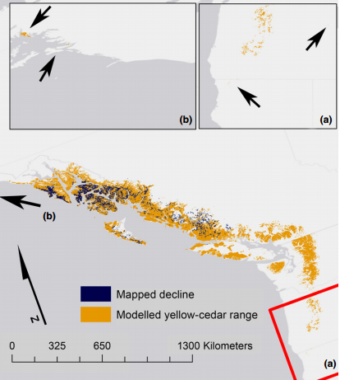
A map of yellow cedar decline. (courtesy of Brian Buma/UAS)
A map of yellow cedar decline. (courtesy of Brian Buma/University of Alaska Southeast)

“Essentially, yellow cedar is freezing to death,” said Brian Buma, an assistant professor of forest ecosystems at the University of Alaska Southeast.

Buma recently released a paper on how much yellow cedar could decline across its entire range. His team pinpointed actual yellow cedar trees from California to Prince William Sound. With current climate projections, Buma was able to capture a glimpse of what that future could look like for yellow cedar.

“It’s suggesting major changes. We don’t think that it’s going to go extinct in 50 or 60 years but it is going to look like a very different forest in large parts of Southeast,” Buma said.

He says, so far, we’ve lost about 7 percent of the range of yellow cedar. That number might sound small, but it’s actually about a million acres of trees. In the next half century or so, we could lose another 8 percent.

Buma says yellow cedar is particularly vulnerable in the spring. In a normal year, a blanket of snow is there to insulate the roots.

“Climate change is taking away that blanket. So when the temperature goes to 33 on average, say, during the winter, we don’t get snow, we get rain,” Buma said. “And if we do get a cold snap, the soil gets very, very cold and that kills yellow cedar roots, essentially.”

He says scientists started to notice the decline of yellow cedar back in the 1980s. Now it’s one of the best documented cases of a tree species affected by a warming planet.

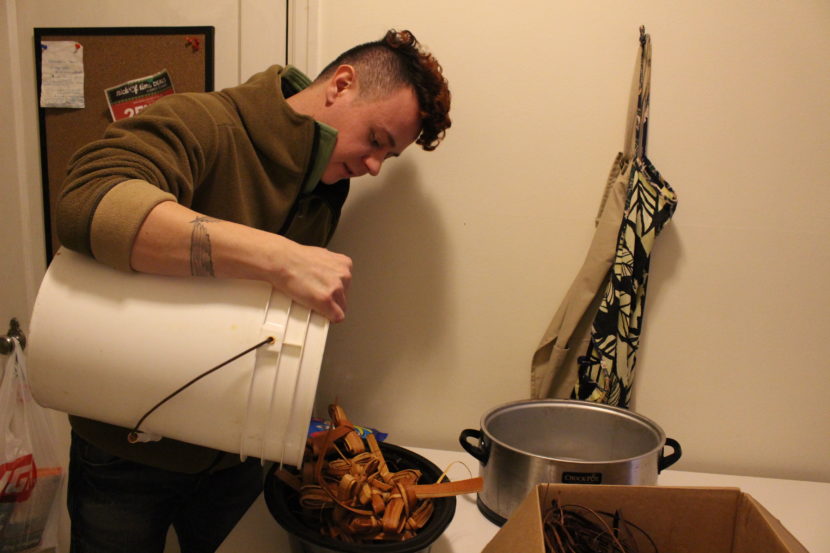
Ricky Tagaban prepares yellow cedar strips to later weave into warp. (Photo by Elizabeth Jenkins/Alaska's Energy Desk)
Ricky Tagaban prepares yellow cedar strips to weave into warp. (Photo by Elizabeth Jenkins/Alaska’s Energy Desk)

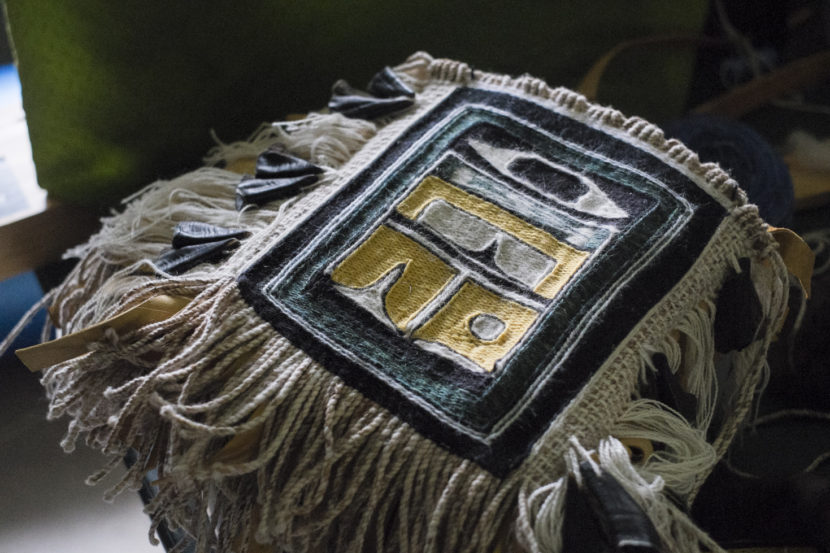
Ricky Tagaban has been weaving in the Chilkat tradition for about seven years. He’s soaking yellow cedar strips in warm water, preparing to spin them with merino wool into warp, a stiff thread he’ll use to weave commissioned items, or one of his commercial pieces: iPhone bags, pendants and long woven earrings.

“When I became a full-time weaver it was really crucial for me to learn how to make my own warp,” Tagaban said. “Because before I would have to save up a lot of money to buy enough just to start a project.”

Friends who weave baskets sometimes give him yellow cedar scraps. He’s also gone out a couple of times to collect it himself.

He says he is worried about the die-off of yellow cedar, but he doesn’t think that government officials should be in charge of its management.

“The point of colonization is outside groups coming in and controlling resources,” Tagaban said.

He says for thousands of years indigenous people collected yellow cedar sustainably.

“If you compare the way of life that came out of the 10,000 years of stewardship, with the changes that have happened just in the last 200 years. It’s insane the difference,” Tagaban said. “So the words like management, management is not stewardship.”

The U.S. Fish and Wildlife Service was petitioned to put yellow cedar on the endangered species list in 2014. But it still has a ways to go before a decision is made. A Fish and Wildlife spokesperson says there’s a backlog, due to federal funding issues.

Tagaban hopes to still be weaving in the next 50 years. And he hopes there’s enough yellow cedar for future generations to weave, too.

A Chilkat woven legging
A single Chilkat legging woven by Ricky Tagaban. (Photo by Annie Bartholomew/KTOO)

Alaska’s warming waters could slow coral growth, impacting fish

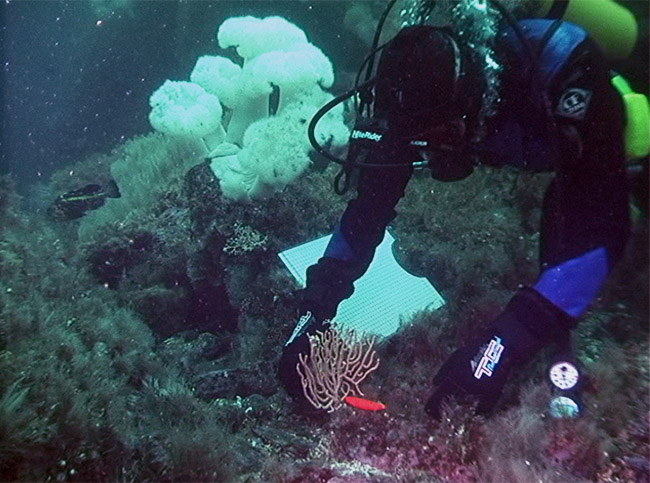
Bob Stone prepares to measure a tagged gorgonian coral colony Photo: Linc Freese, NOAA Fisheries
Bob Stone prepares to measure a tagged  coral colony. (Photo by Linc Freese/NOAA Fisheries)

The National Oceanic and Atmospheric Administration says warming ocean temperatures, due to climate change, could slow the growth of some Alaska coral. In a study released Thursday, scientists warned about the potential impact to fish, which take refuge in thickets of coral.

Bob Stone, a fisheries research biologist, dove in the waters of Southeast Alaska to photograph one group of sea fans, a type of coral. His team returned yearly for a period of five years, and they noticed it wasn’t growing as quickly as they anticipated.

“There is evidence from other studies around the world that show for some corals under warmer conditions, they do grow more slowly,” Stone said. “So it’s surprising to us but important because at least at the present moment our oceans are warming particularly in the Gulf of Alaska.”

Sea fans grow in the waters of British Columbia, spreading all the way to the Aleutian Chain. There are around 136 different types of coral in Alaska waters.

In the future, scientists think ocean acidification could threaten coral, too.

Site notifications
Update notification options
Subscribe to notifications