The bearded seal was released back into the wild at Nome’s west beach. (Photo by Gay Sheffield/University of Alaska Fairbanks Alaska Sea Grant)
Sea Grant knew the Trump administration wanted to eliminate its budget for next fiscal year. But those cuts could come much sooner. The organization says the White House is asking Congress to slash this year’s funding, too. That could mean the end for dozens of Alaska programs, focusing on fisheries and climate change.
Paula Cullenberg, the director of Alaska Sea Grant, says this latest news was unexpected. Sea Grant supports research at 33 universities nationwide, including the University of Alaska Fairbanks.
But, as early as this spring, some of those projects could be on the line.
“It’s anxiety-making to have this hanging over your head,” Cullenberg said.
Cullenberg says Sea Grant found out about the additional cuts from an agency that acts as its congressional liaison.
She says the White House is proposing cutting $30 million from Sea Grant programs for this year. That’s not to be confused with the Trump administration’s ask to eliminate the Sea Grant funding for next year.
“I think that’s highly unusual,” Cullenberg said. “I’ve never seen anything like that.”
Alaska Sea Grant receives matching funds from the university and the state, but Cullenberg says those federal dollars make up the program’s core funding. It’s those federal dollars that pay for projects that measure the economic vitality of the seafood industry and help communities adapt to climate climate.
“We’re supporting ten graduate students with research fellowships, three Alaska Sea Grant State Fellows, coastal issues …” Cullenberg said.
“There’s not too much in our program that wouldn’t be severely disabled if that came to pass,” Cullenberg said.
Congress is deciding at the end of this month what Sea Grant’s budget will be for the rest of 2017. Senators Lisa Murkowski and Dan Sullivan have shown support for Sea Grant.
They’ve asked for “adequate funding” for next fiscal year. Cullenberg says she’s remaining hopeful for this year, too.
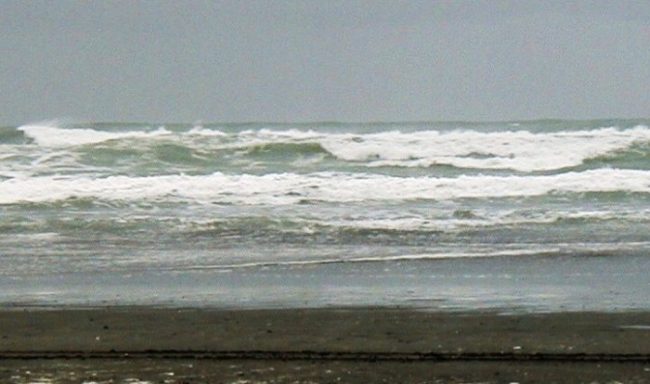
Waves crash onto Yakutat’s Cannon Beach. (Photo by Ed Schoenfeld/CoastAlaska.)
When you think about renewable energy in Alaska, what comes to mind? Probably wind, which contributes to about 3 percent of the state’s power generation. And maybe solar panels, which are starting to gain momentum. But there’s also the potential for what lies along 6,500 miles of coastline.
An Ask the Energy Desk reader wanted to know: why isn’t Alaska using more wave or tidal energy?
In Yakutat, Jeremy Kasper says he’s measured waves that were 20 feet high.
Those gnarly swells make the Southeast village a good spot to surf. But that’s not the reason Kasper has visited in the past. He’s part of a team at the University of Alaska Fairbanks, studying the feasibility of generating power from the movement of the water.
“I think this is a worthwhile technology because it basically fills in a niche,” Kasper said.
It’s a niche that can’t be filled by hydropowered dams.
Yakutat is home to about 600 people, and it’s powered using a diesel generator.
Kasper says the village’s geography and weather patterns make other types of renewable energy a challenge. He thinks solar could work in the summer when there’s increased demand for energy: the fish plant is in operation.
But when it comes to displacing Yakutat’s diesel fuel the rest of the year:
“Wave is probably their best option,” Kasper said.
A diesel plant in Yakutat. (Photo by Ed Schoenfeld/CoastAlaska)
In 2009, a study by the Electric Power Research Institute backed that up. It was funded by the U.S. Department of Energy. And it estimated that for under a million dollars, Yakutat could install one wave energy converter.
For reference, it would take about 15 of those to supply half of Yakutat’s energy needs. Kasper says the village has completed a number of the early studies needed for its federal permitting.
Still, there’s no planned timeline for an installation yet.
“So there’s a lot work being done in the state, but there’s not a lot of technologies that are ready to be put in the water,” Kasper said.
Part of the reason wave or tidal energy carries such a steep price tag is because the technology is so new. With wind or solar energy there’s an established chain of supply and demand, plus decades of upgrades and improvements.
“And the ability to mass manufacture,” said Chris Rose, the director at the nonprofit Renewable Energy Alaska Project.
The organization refers to the potential of wave and tidal energy on its website as a “goldmine.” Albeit, one that needs more time and investment.
“So right now, what you have you have with tidal energy and wave energy,” he said are “the developers who are still trying to go out and perfect their design before they go out and make 10,000 of them.”
Yakutat isn’t the only place in Alaska looking into this type of renewable energy.
In 2014, a company based in Maine successfully generated a small amount of power from the current of the Kvichak River, near the village of Igiugig. The same company has explored using Cook Inlet’s massive tides as an energy source. Although there’s still more work to be done to measure the impacts on marine life, like endangered beluga whales.
Jeremy Kasper says that impact on fish is also something Yakutat needs to cross off its list before seriously considering wave energy. But he doesn’t think the development of the technology is too far off.
“They could conceivably be in the water in a couple of years,” Kasper said. “Getting to that point though is figuring out how to pay for those installations.”
In the meantime, he’ll go back to Yakutat in May to do another study. And possibly, try to catch some waves.
To learn more about tidal power in Cook Inlet check out the video below.
A hockey team plays a game at the Big Dipper Ice Arena. The Alaska Center for Energy and Power, the University of Alaska Fairbanks and the Fairbanks North Star Borough are hoping an innovative energy system can help power the lights. (Photo by Tim Ellis/KUAC)
A system that could power remote Alaska is being tested in an unexpected place. Typically found in Scandinavian countries, a new cleaner energy technology is now coming to Fairbanks.
“Our PR campaign has been this isn’t wood burning. This is wood gasifying,” said Ben Loeffler, an energy management engineer at the Fairbanks North Star Borough.
He’s talking about an innovative system for generating both heat and power. It’s the first of its kind in Alaska, and it’s being installed at a location called the Big Dipper.
“It’s used for recreational skating, and it’s also where the Ice Dogs play their home games,” Loeffler said.
In December, the Alaska Energy Authority awarded a matching grant to help fund the new project in Fairbanks’ ice rink. It’s expected to cost upwards of $700,000 and the borough is picking up some of the cost.
Loeffler says this as a way to save money and an opportunity that could eventually create jobs.
It works like this: wood chips are heated up, driving a gas off the wood. The gas goes into an internal combustion engine driving a generator.
“And so it’s very similar to running a generator on natural gas,” Loeffler said.
An ice rink might seem like an unlikely place to try this out. And, there’s another reason you might not expect a wood gasification system in Fairbanks.
“We’ve run into a lot of healthy questions about emissions especially,” Loeffler said.
That’s another reason, Loeffler says, the borough was interested in the investment: The gasification process separates out the harmful particles, so the system runs fairly clean.
Loeffler says it won’t supply all of the Big Dipper’s energy needs, but it could displace about about a quarter of the electricity and about half of costs to keep the building warm.
In remote Alaska — in places that run on diesel — the savings could be a big.
“In rural communities, if this technology is viable and they can produce a suitable fuel to run it, the payback would be on the order of a couple years,” Loeffler said.
He says that pencils out to reduced energy costs of up to $200,000 a year.
Of course, this is a test project and it will take some time before they’ll know if this technology could apply to places in Alaska that need it the most.
Loeffler expects the system could be installed at the Big Dipper within the year. And the Ice Dogs can play their games under lights powered, in part, by wood.
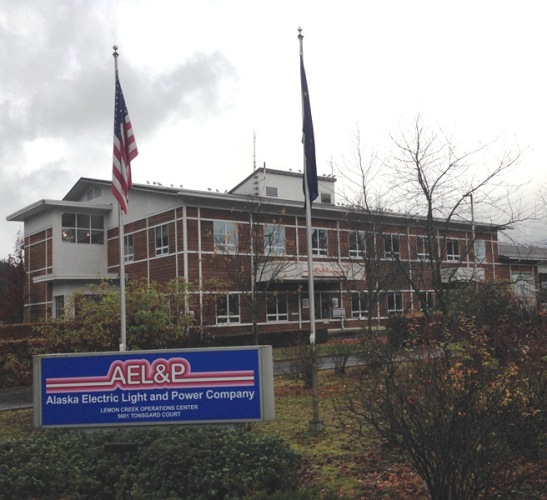
AEL&P headquarters in Lemon Creek. (Photo by Casey Kelly/KTOO)
The president of Juneau’s electric utility announced on Wednesday that he’s retiring after 34 years. Tim McLeod started his career at Alaska Electric Light & Power in 1983 as an engineer. In 2002, he was promoted to president.
He says one of his biggest achievements during his decades-long career was the construction of the Lake Dorothy hydro project. That project included selling surplus energy to Princess Cruise Lines and Hecla’s Greens Creek mine.
McLeod says the deal helped keep the price for its regular customers low.
“I guess it’s one of the things that I’ll always remember for sure, and I will always be proud that we were able to that,” McLeod said. “I mean, my grandsons will be someday enjoying the benefit of that whole arrangement.”
Connie Hulbert will take over McLeod’s role in July. She currently serves as the utility’s vice president.
Diesel car engines like this one in a 2012 Volkswagen Golf are among those that include software that circumvents EPA emissions standards for certain air pollutants.
The state of Alaska is receiving over $8 million in settlement money after a top car company cheated on its federal emissions tests. Volkswagen sold more than 500,000 diesel-powered cars nationwide between 2009 and 2016. And those cars were equipped with so-called “defeat devices,” or software that masked actual emissions when tested.
The governor’s office has appointed the Alaska Energy Authority (AEA) to help administer the state’s share of the settlement.
“This is just another way to leverage some of that improvement that’s needed in rural Alaska,” said Sean Skaling, an energy policy director at AEA.
Skaling says the types of projects that can be funded are defined in the settlement, including improving emissions for transit buses, ferries and boats. That could mean replacing diesel engines with fully electric or hybrid ones.
Additionally, the money can also be used to upgrade energy infrastructure in remote villages.
The agency is taking public comments to help prioritize the most effective projects. The final plan is expected to be completed in the fall.
Skaling says this $8 million is different from the Volkswagen buyback program and settlement money that’s being doled out nationwide.
Outside of what the state is receiving, the settlement includes nearly $54 million for federally recognized tribes.
“One role that AEA can play here is we can help bring together whole regions, tribes within regions, for example, to leverage other funding and to make the most of the funding that is available,” Skaling said.
The U.S. Department of Justice will be administering the tribal allocation. Skaling expects the deadline to submit a plan for that will be Sep. 1.
(Matt Kern harvests wild bull kelp. Photo courtesy of Matt Kern and Lia Heifetz.)
In February of last year, Governor Walker signed an administrative order to help jumpstart mariculture, or sea farming, in the state. One Juneau couple is whipping up a recipe to make local kelp an enticing business and snack. They’re part of a growing number of startups that see Alaska seaweed as a marketable food.
There’s an aquatic plant that’s become a big part of Matt Kern and Lia Heifetz’s relationship.
“It’s basically all we talk about it,” Heifetz said with a laugh. “Every day of the week. Every night of the week. Every weekend.”
Kern and Heifetz are dedicating so much of their time to seaweed because they’ve been laying the groundwork for a new business.
“Kelp Salsa,” Kern said. “It’s made from predominantly from bull kelp that we harvest from around Juneau.”
The Alaska Department of Fish and Game doesn’t have a formalized process for collecting wild kelp for commercial use — at least not yet. So, the couple forages under an experimental permit.
A lot of work and late nights goes into whipping up a batch of salsa.
Matt pops the lid off a small mason jar and opens a bag of corn chips.
“Today we have a green salsa verde,” Kern explains. “And another flavor called campfire that has roasted garlic and onions.”
Both jars of salsa contain lots of minced bull kelp. I scoop my chip into the campfire flavor. It’s tart from the seaweed and mildly spiced.
(Kelp salsa at Juneau’s public market. Photo courtesy of Matt Kern and Lia Heifetz.)
The couple recently received a $40,000 Path to Prosperity grant, which is for Southeast entrepreneurs to help grow their business. Last year, they made about 2,000 jars of salsa, mostly cooked up in their home kitchen and sold at the local public market. But they want to eventually expand distribution beyond Juneau.
Having access to enough foraged seaweed for that expansion could be difficult, but a California-based startup might be able to help. Blue Evolution is looking at the prospect of seaweed farming in Alaska. Right now, the company grows the plant in Mexico, dries it and turns it into pasta.
“They were really interested in doing domestic production,” said Tamsen Peeples. She’s employed by Blue Evolution and works on the science of seaweed farming at the University of Alaska Southeast, as a marine biologist.
She says coastal states like Maine are already kelp farming, but developing it in Alaska has its advantages.
“Alaska has bountiful amounts of coastline obviously, clean water,” Peeples said. “As an Alaskan, I think it’s a great opportunity for individuals who otherwise in the winter are laying low between commercial fishing and tourism.”
But one thing Alaska doesn’t have is easy access to kelp seed. The department of fish and game says you can only farm with plants native to the region, and that’s where Peeples’ research comes in.
She’s been working on propagating seed from local kelp spores.
“In order for this industry to grow, we’re going to have to get a number of other hatcheries to come online,” Peeples said.
A new House bill could make it easier for more nonprofit hatcheries to receive state loans. Even though those wouldn’t apply to a company like Blue Evolution, Peeples thinks it’s a good thing.
So far, she has successfully incubated varieties like sugar and ribbon kelp. And those plants are growing in the waters of Kodiak and Ketchikan. Blue Evolution will buy the seaweed back in the spring.
As their kelp salsa business grows, Matt Kern and Lia Heifetz say they’re also interested.
“We plan to be sourcing directly from farms in the future,” Heifetz said.
They say, for them, it’s not about building a seaweed snack empire.
“This wasn’t a huge day-to-day leap in our lives … to go from doing it on our home scale,” Kern said. “‘Because this is what we’d be doing with our time anyways.”
That means building their business sustainably, making thousands of jars of kelp salsa and sharing it with friends.
Close
Update notification options
Subscribe to notifications
Subscribe
Get notifications about news related to the topics you care about. You can unsubscribe anytime.