The bearded seal was released back into the wild at Nome’s west beach. (Photo by Gay Sheffield/University of Alaska Fairbanks Alaska Sea Grant)
The White House wanted to cut Sea Grant’s funding for the remainder of this fiscal year. If the request had been approved, several projects in Alaska would have ended as early as this summer.
Sea Grant helps coastal communities with fisheries and climate change research.
Despite President Donald Trump’s request, Congress released a bipartisan spending bill on Monday that will allow Sea Grant to continue for the time being.
Sunny Rice from Alaska Sea Grant in Petersburg says that’s good news.
“It’s going to allow us to keep doing the things at least through the end of September we had been planning on,” Rice said. “I feel like it’s a quarter of a sigh of relief because I think the big effort is going to be for the full budget.”
Since the president made the announcement in March, Alaska’s congressional delegation has shown support for Sea Grant, saying the program as a good return on investment.
Sea Grant helps fund research at the University of Alaska Fairbanks.
Congress is expected to approve a budget for next fiscal year by October.
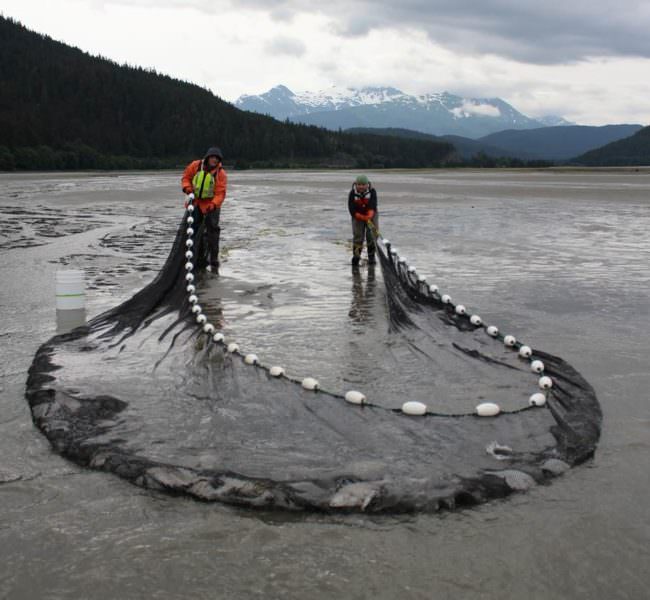
University of Alaska Fairbanks students and volunteers pull in a seine net. (Photo courtesy of University of Alaska Fairbanks)
Southeast Alaska is home to hundreds of glaciers and a lucrative fishing industry. As those glaciers retreat, the freshwater they send into the ocean could begin to dry up. Scientists are trying to figure out how that will impact the marine environment.
The gut lab at the University of Alaska Fisheries Department in Juneau has all the traces of its namesake: fish parts preserved in jars of yellow ethanol. But none of the smell.
Masters student Doug Duncan lifts open a cooler to show off this morning’s catch.
“We’ve got our one lone fish in here. And as you see, it’s a small one,” Duncan said.
It’s a baby chum salmon, no bigger than an anchovy. Typically, the scientists are trying to catch predator fish to bring back to the lab. And juvenile salmon are sometimes along for the ride, too, in the bellies of those larger fish. This little guy didn’t meet that fate.
But Anne Beaudreau, an ecologist at UAF, says figuring out how hatchery salmon end up becoming lunch is a little like playing detective.
“Sometimes I like to talk about stomach content analysis of fish like forensics because you’re piecing together all of these clues to try and figure out what it was when it was eaten,” Beaudreau said. “It’s totally like CSI Fish.”
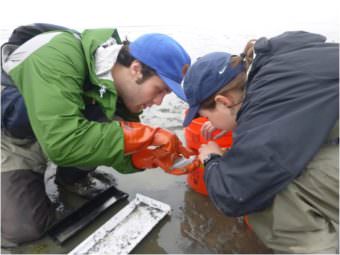
Master’s students Doug Duncan and Emily Whitney work at one of the sampling sites. (Photo courtesy of University of Alaska Fairbanks)
About five years ago, Beaudreau moved from Seattle to Juneau, and she was curious about what she saw.
“I was really struck by the fact that you can be out on the water in the marine environment and looking at a glacier that’s really not that far away,” Beaudreau said. “Thinking about with glaciers melting and receding rapidly throughout Southeast, Alaska, all of that water is going somewhere.”
Eventually, it ends up in glacial estuaries. Beaudreau set out to find what type of fish lived in those waters and what they were eating.
Freshwater glacial runoff mellows out the salinity of the ocean water, which is good for some kinds of fish. Plus, it can wash down debris, like leaves, that the fish like to eat.
Beaudreau says scientists compared what fish were eating in estuaries near glacial rivers to those in rain-fed creeks.
“As glacial systems transition to more rain-fed systems, it kind of gives us a window into what the future might look like,” Beaudreau said.
It also helps scientists establishing a baseline — something to contrast the future with, which right now is crucially important. Most of the world’s glaciers are losing ice because of climate change.
Beaudreau says scientists know that it’s happening. What they don’t know is how that melt will affect the marine environment. But one thing this study does prove is the interconnection between land or glacier and sea.
Still, Beaudreau says more research is needed to answer the big question: what does that mean for fish? And she says a lot is riding on the answer.
“Not even the million dollar question, the billion dollar question,” Beaudreau said. “I think that the work that we’re doing is a really important start.”
The research is on pause while Beaudreau looks for new funding for the project.
In the meantime, her team is working on the hatchery study, and she’s also holding on to tissue samples, in the hopes of someday continuing the one on glacial estuaries.
But right now, it’s not easy to find federal dollars for climate change research.
“A lot of people are concerned about the ability to keep this work funded,” Beaudreau said.
She says her team will keep investigating the stomachs of predator fish.
“Every little study that we do is just one piece of a bigger puzzle,” Beaudreau said.
A puzzle, she says, that will take a lot more scientific research to solve.
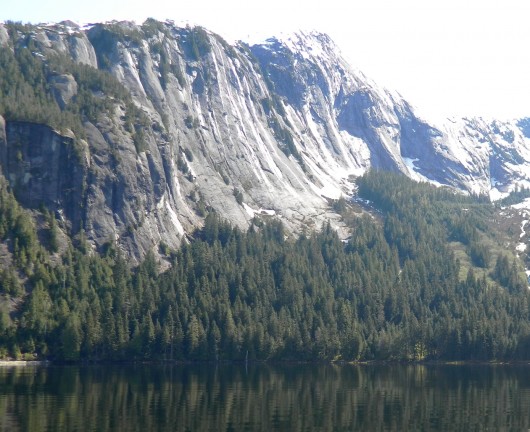
Misty Fiords National Monument is known for its dramatic granite cliffs. Pictured is a view from Rudyerd Bay. (File photo by Leila Kheiry/KRBD)
On Wednesday, President Donald Trump signed an executive order to consider scaling back some national monuments. The plans likely won’t affect Alaska, but the president still gave a shout out to the state in his speech.
Alaska has five national monuments, mostly designated by President Jimmy Carter under the Antiquities Act, which gives the president the authority to protect lands quickly.
Trump’s new directive asks the U.S. Secretary of the Interior to consider downsizing national monuments that are over 100,000 acres and created after 1996. That leaves Barack Obama’s land designations, like Bears Ears National Monument in Utah, up for review.
One monument in Alaska, at least in part, could also be part of that review. The World War II Valor in the Pacific Monument extends from Hawaii and California — all the way to the Aleutian Chain. But those islands in Alaska are additionally protected as a wildlife refuge.
Still, Trump mentioned Alaska in his speech on Wednesday. He praised the splendor and the beauty of the country’s natural resources and pointed to Sen. Lisa Murkowski, who chairs the energy and natural resources committee.
“I can tell you the group that’s in here right now, they’re really doing the job. Isn’t that right, Lisa?” Trump said. “We’re going to take care of Alaska, too. Don’t worry about it.”
Trump seemed to be referring to the executive order on reversing offshore drilling protections in the Arctic. He’s expected to sign that on Friday.
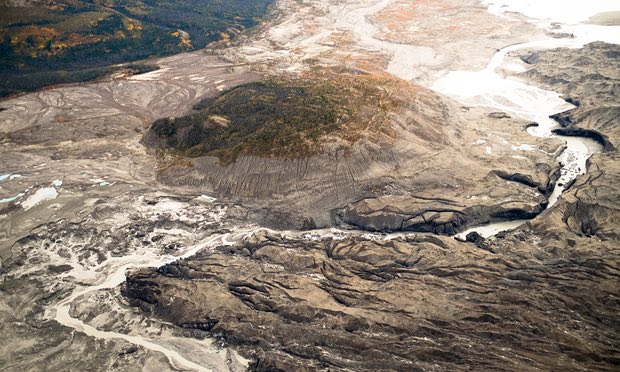
Scientists say they can pinpoint a day in May 2016 when the water levels in the Slims River dramatically dropped. (Photo by Dan Shugar/University of Washington Tacoma
Scientists are pointing to climate change as the reason a river that used to feed into the Yukon has nearly disappeared.
A report published in Nature Geoscience on Monday says it’s the first documented case of river piracy in modern times — linked to the planet heating up. River piracy is when one river steals the flow of another.
Scientists knew the Kaskawulsh Glacier in northern Canada was shrinking. But they didn’t expect it to cause a nearby lake to almost vanish. At least, not so quickly.
“Nobody’s documented this as basically occurring under our noses,” Shugar said.
Dan Shugar researches how landforms evolve at the University of Washington in Tacoma.
And last fall, he set out with his colleagues to study the Slims River. It’s fed by a series of ponds at the front of the Kaskawulsh Glacier.
When he arrived, Shugar says he expected the river’s current to be low.
“But as it turned out is was essentially no flow,” Shugar said. “So we couldn’t actually put our instruments in the water it was so shallow.”
Shugar didn’t spend the remainder of his time in Canada kicking back. His new mission became figuring out what happened to the Slims River.
The body of water used to flow into the Kluane Lake, and eventually into the Yukon River, which empties into the Bering Sea. But because of glacier melt, that water redirected.
“The Kaskawulsh River essentially stole all of that water that would have otherwise flowed into the Slims River,” Shugar said. “So it pirated that flow. It captured that flow.”
Now that water goes from the Kaskawulsh River to the Alsek River and all the way to the Gulf of Alaska.
Shugar says, due to the circumstances, this particular situation is unique. Still, the rapid pace at which it occurred serves as an important reminder.
“Climate change is happening and it’s happening here,” Shugar said. “So we need to be keeping in mind that we may get thrown a few curve balls moving forward.”
So while the Kaskawulsh River was the pirate, Shugar says human-caused climate change is ultimately to blame.
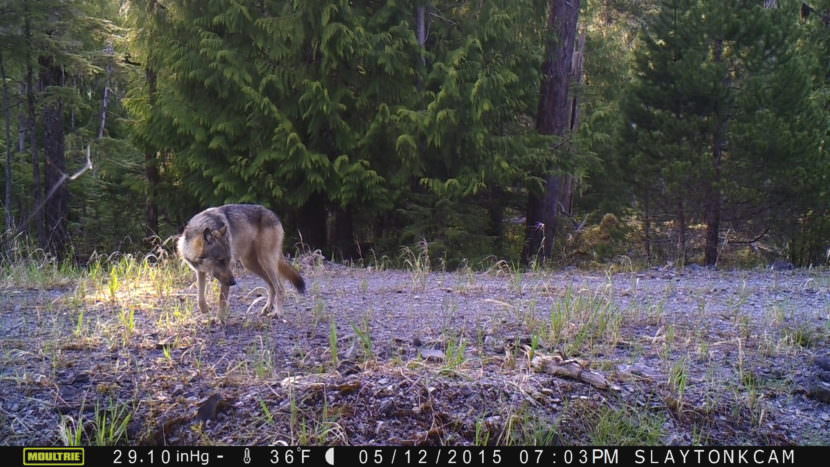
A wolf on Prince of Wales Island, as captured by a trail camera. (Photo courtesy of the Alaska Department of Fish & Game)
The Alexander Archipelago Wolf didn’t go on the endangered species list in 2016, after it was petitioned by six conservation groups. But the feds and the state are looking at ways to stabilize the wolf population on Prince of Wales Island.
In a joint-effort, new recommendations were released this month. But this holistic approach still leaves open a lot of questions.
Gretchen Roffler, a biologist with the Alaska Department of Fish & Game, isn’t taking any chances. We’re standing alone in a dim lit basement.
“A couple of months ago I ordered a new supply of lure and had it delivered to our office,” Roffler said. “It showed up just in a cardboard box. And everyone in the building could smell it.”
She’s agreed to show me the lure — or wolf bait — away from people.
“And you will see it has quite the potent cache,” she said.
Roffler pulls the lid off a white bucket. And removes a bottle from two plastic bags. It looks yellowish-brown, almost syrupy and the smell…
“It’s got an odor of skunk. It’s a little onion-y … The wolves find it irresistible,” Roffler said.
So irresistible they roll on baited barbed wire that collects their hair, like a comb. Roffler uses the hair to estimate the wolf population.
“Instead of marking them with a physical thing like a wolf collar, we mark them genetically,” Roffler said.
Back in 1994, the state thought there were over 260 wolves living on Prince of Wales. The animals were tracked using radio collars and fly over aerial surveys. Roffler now uses the hair snare method, and her team’s last count places the population at about 100 wolves.
The reason for decline? Well, that depends on who you ask.
Steve Brockmann, a federal employee with the U.S. Fish & Wildlife Service, says there’s evidence to suggest that at least in part, it has to do with over-harvesting.
“There’s a significant segment of the trapping community that’s interested in protecting a deer population for human hunters,” Brockmann said.
He’s part of a group that includes Alaska’s Department of Fish & Game and the U.S. Forest Service: agencies that say they’re interested in keeping the wolf population on Prince of Wales sustainable. After a year of meetings, the group came up with some guidelines that are built around a philosophy Brockmann calls “managing the ecosystem.”
“Wolves, humans, deer and timber,” Brockmann said.
He says timber that was harvested since the 1960s left changes to the landscape on Prince of Wales.
“A lot of places that were logged during that period have now grown back to dense stands of young growth that really do offer poor habitat for deer,” Brockmann said.
That can mean fewer deer on the island. So, the guidelines suggest opening up spots of young growth trees, creating a good place to grow food for the deer. And Brockmann says more deer on Prince of Wales could mean more wolves, too.
Keep in mind, people are allowed to hunt or trap a set number of wolves on Prince of Wales. Brockman says some do it for the pelts and some do it because they believe they’re competing with the wolves for deer. It becomes a problem when the taking of wolves is excessive.
“We found wolves dead,” Brockmann said. “It’s not that they didn’t come back, it’s that we found them dead in the woods with a bullet hole in ’em or with trap wounds or in a snare or something like that. Not reported.”
Of those that actually do get reported, Fish & Game was notified of around 28 wolf kills on Prince of Wales by the end of last season. The quota was set at 11.
Ryan Scott, the regional supervisor with the Alaska Department of Fish & Game, worked on the new guidelines with the other agencies. He says, yes, there are still some wolves that wind up dead, as he puts it from “unreported human caused mortality.”
“Certainly, there’s some level of that happening,” Scott said. “But it’s not occurring at the level it may have been in the past.”
In fact, Scott says the wolf population on Prince of Wales is increasing, from 89 wolves in 2014 to more than 100.
I ask if there’s still a reason to be concerned.
“I don’t think so. Yeah. They seem very healthy,” Scott said.
Even so, the new guidelines Scott helped create do call for coming up with a target number, but he says his agency doesn’t know what that number should be.
“I think that a lot of additional conversation is going to have to happen to figure that out,” Scott said.
When President Donald Trump’s blueprint budget came out in March, it included eliminating funding for the Sea Grant program for next year. But Alaska’s congressional delegation doesn’t want it to go away.
On Tuesday, Sen. Lisa Murkowski introduced a bipartisan Senate Resolution — showing support for Sea Grant. Murkowski co-authored the resolution with Oregon Senator Jeff Merkley.
The resolution acknowledges that Sea Grant plays a “vital” role in many communities nationwide.
Last week, Congressman Don Young signed a letter of support with members of the House. In a town hall meeting in Petersburg on Monday, Young said the program receives a good return on investment.
“The Sea Grant program is dear to my heart,” Young said. “I had the head guy in my office the other day. We’ll continue to fund that. It works.”
Sea Grant helps fund research at the University of Alaska Fairbanks. The program helps track the economic vitality of the seafood industry and measure the effects of climate change — making up dozens of projects across Alaska.
In the coming months, Congress will decide Sea Grant’s funding for next year. The White House has asked to cut Sea Grant’s funding for the remainder of this year, too. That budget needs to be approved by the end of April.
Close
Update notification options
Subscribe to notifications
Subscribe
Get notifications about news related to the topics you care about. You can unsubscribe anytime.