Flanked by U.S. Sen. Lisa Murkowski and Alaska Gov. Bill Walker, Interior Secretary Ryan Zinke speaks to reporters after signing an order to promote more drilling on Alaska’s North Slope. Photo taken May, 31 2017. (photo by Elizabeth Harball/Alaska’s Energy Desk)
Interior Secretary Ryan Zinke is reshuffling several senior government positions, and it could affect Arctic policies in Alaska. The Washington Post reports that dozens of career officials received reassignment letters last Thursday.
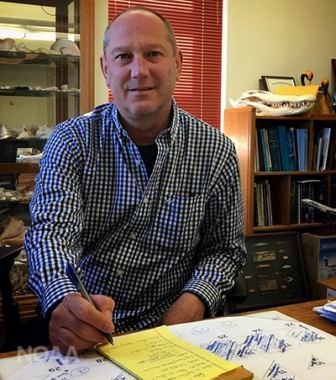
Alaska’s Energy Desk was able to confirm that Joel Clement, a climate policy adviser, received one of those letters. Clement helped advise former President Barack Obama on Arctic issues.
In 2011, Clement was appointed to an interagency task force to look at energy development in the Arctic and climate impacts. He authorized a report detailing the effects of warming in the region, such as sea ice loss and melting permafrost.
Now Clement has been reassigned to the Office of Natural Resources and Revenue, which collects oil and gas royalties, among other things.
In April, President Donald Trump signed an executive order to expand offshore oil and gas drilling in the Arctic.
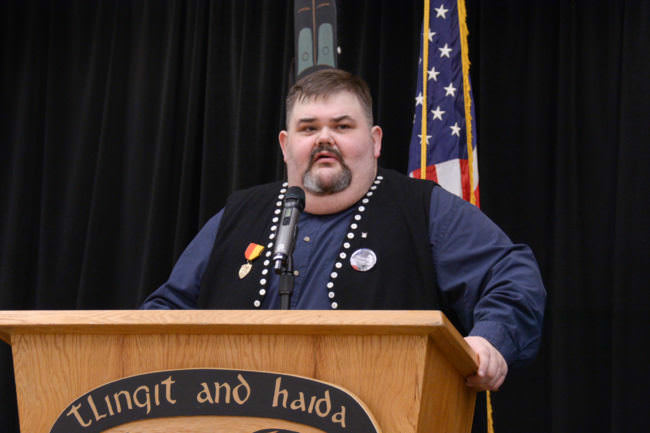
Central Council President Richard Peterson. (courtesy of the CCTHITA)
The largest tribal government in Alaska is sticking by the Paris climate change accord.
Central Council of the Tlingit and Haida Indian Tribes of Alaska says it will continue to support the agreement, which aims to reduce the world’s carbon emissions and slow climate change.
Central Council President Richard Peterson says that surprised him.
“You know, he’s a businessman, and I think that it’s proven that right now, alternative energies is good business,” Peterson said.
Central Council will try to do its part by working on renewable energy solutions, he said.
Peterson said Alaska already is experiencing the effects of a warming planet. Villages are crumbling into the ocean.
“For us, it comes down to the fact that as Alaska Natives, as the first people, we have a responsibility as caretakers,” Peterson said. “We’re responsible for these lands. And more importantly, we’re responsible for what we pass down to future generations.”
The Standing Rock Sioux Tribe in North Dakota also is supporting the Paris accord. In Washington, the Quinault Indian Nation and Swinomish Indian Tribal Community have made a similar pledge.
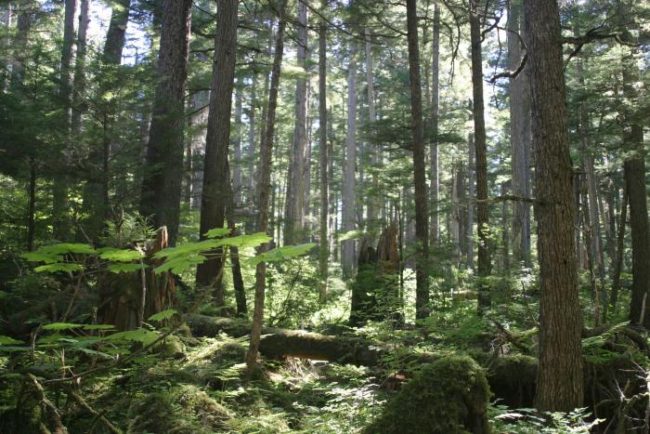
The U.S. Forest Service is also looking at harvesting young growth on Kosciusko Island in the Southeast region. (Photo by Henry Hartley/Wikimedia Commons)
After new federal plans were set in motion last year, old growth logging in Alaska’s national forests is on its way out. Still, the feds have to make some timber sales available in the Tongass. And so, the U.S. Forest Service is in the early stages of planning one of its first young growth sales since the switch, just outside of Ketchikan.
Mike Sallee is a small mill operator in Ketchikan, who deals mostly in dead and down trees, and he owns a homestead on nearby Gravina Island.
His neighbors on Gravina are big landowners, like the state, the feds, the Ketchikan Gateway Borough, and the university and mental health trusts — all of which can sell trees on their land for profit.
In the past, Sallee says some of the landowners haven’t left Gravina in good shape. He’s noticed a tangle of trees still on the ground after they’re done logging.
“Places that I had been hiking through and hunting for decades [were] basically turned into like a blowdown,” Sallee said.
Which is why Sallee says he’s not enthusiastic about a road being built by the state on the island, slated to be completed this year.
The road could make it easier for more timber sales to pencil out, including one being planned by the U.S. Forest Service. The agency has a new obligation: bringing more young growth trees from the Tongass to market.
Between the many landowners and the new road, there’s a kind of menu: an a la carte of trees.
“Access, access, access. Everybody wants to have access to their lands,” said Buck Lindekugel, a grassroots attorney for the Southeast Alaska Conservation Council (SEACC).
His organization petitioned the feds to transition away from old growth logging in the Tongass, so you’d think he’d consider harvesting the young trees to be a victory. But it’s not that simple.
“There’s some steep slopes in there so there’s real concern,” Lindekugel said. “It might not be the best thing to go back onto this land.”
Lindekugel says at the bottom of the slopes are salmon streams, and he worries the proposed logging could damage the area. He thinks the federal agency should learn from its past mistakes and stop clear cutting.
“We think the forest service needs to have a lighter touch on these areas,” Lindekugel said. “Pull out some marketable products but at the same time don’t unravel the habitat.”
Eric Nichols, a partner at Alcan Forest Products, says these trees have all been clear cut before.
“It needs to be clear cut again,” Nichols said. “And start it all over.”
Nichols is eyeing the young growth sale for his company, which specializes in buying timber. He admits times have been tough for the industry — a death spiral, as he puts it. It’s estimated there are only a few hundred timber jobs left in the region.
Part of the problem Nichols says is there hasn’t been a steady supply of trees. So while this young growth sale is relatively small, at least it’s something. And if the forest service wants a buyer, Nichols thinks there shouldn’t be any more limitations.
“So its either get it now with these other landowners or they’re not going to be able to get it in the future,” Nichols said.
He says the road being built and collaboration is key. Once harvested, a company like Nichols’ would likely send the young growth to be milled in Asia.
Buck Lindekugel from SEACC says he doesn’t see the timber industry or the argument over the national forest going away — even with the transition.
“But it’s not going to be like it is was in the past where timber was first in the Tongass,” Lindekugel said. “Those days are over.”
Instead, Lindekugel imagines small mill operators like Mike Sallee selling specialty products from salvaged logs and more trees left in the ground on places like Gravina Island.
The forest service is taking public comment on its young growth plans on Gravina Island. The agency is trying to figure out how to harvest the trees and if the sale is viable. The comment period ends June 9.
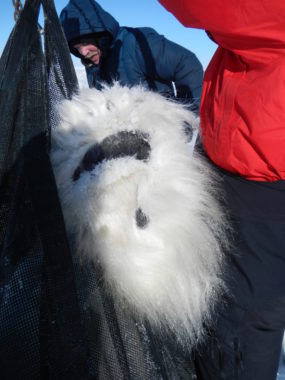
Scientists travel into the Arctic every year to study polar bears. It helps them estimate the population. But this year, they had to cut that research short. Melting sea ice is making the task a lot more difficult.
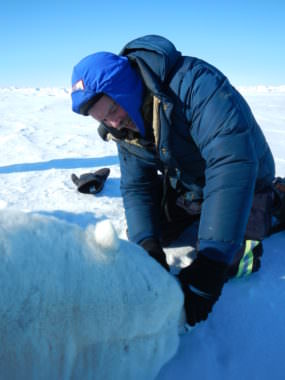
Dr. Riley Wilson, veterinarian with the Alaska Zoo and the Pet Stop, examines a large polar bear. Photo courtesy of U.S. Fish & Wildlife Service.
Michelle St. Martin flies as far as 100 miles off the coast of the Chukchi Sea, looking for polar bear tracks or blood splatters on the ice.
“Seals, ice seals are their number one prey item,” she said.
St. Martin is a wildlife biologist with the U.S. Fish and Wildlife Service. Along with her team, she sedates the polar bears before taking samples, weighing them and removing a small tooth from each bear: a way for the scientists to determine the age of the animal.
The work has been going on since 2008 when polar bears were listed as “threatened” under the Endangered Species Act. Since that time, St. Martin has traveled along Alaska’s northwest coast to check on the bears.
“So we went out this year and in the beginning it looked like any other year,” St. Martin said.
To get to the polar bears, her team flies from their base camp at the Red Dog Mine. But this year, she says as the weeks went by, the biologists noticed less and less sea ice. Typically, they’re out there for six weeks in the spring, but around the time week four rolled around:
“It was pretty crazy how much water just kind of showed up. Once there’s water on top of the ice it tends to melt quite a bit quicker because of the heat from the sun,” St. Martin said. “And so we actually were flying the ice edge at one point out of Red Dog and we came back the next day and flew the edge and it was a loss of 15 miles of ice just in one day.”
So with no ice platform to land on, St. Martin and her colleagues were forced to cut their field season short — by over a week. That’s a shorter hunting season for the polar bears, too.
A nearly 1,300 lb polar bear gets weighed. Photo courtesy of the U.S. Fish and Wildlife Service.
She says knowing how many of the animals live along the Chukchi Sea is important. Scientists think the bears are doing OK. But the latest population estimate is decades old, and bears in the neighboring Beaufort Sea are showing signs of some decline.
“The response of polar bears to sea ice loss differs throughout its range,” said Todd Atwood. He heads up the polar bear research in the Beaufort Sea for the United States Geological Survey.
Like St. Martin, Atwood’s field research also ended weeks earlier than normal. In general, he says the Beaufort’s ecosystem isn’t as abundant as the Chukchi, which can make it difficult for the polar bears to find something to eat; even more so in years with less sea ice.
“They’re kind of showing these adverse effects more quickly,” Atwood said.
His team is working on a follow-up to a population estimate in the Beaufort from about seven years ago, when the polar bear numbers were down. But Atwood says this research is becoming harder to do.
“We’ve just got to have to try and figure out ways to work around this,” Atwood said. “Because I don’t see it getting any better.”
He’s thought of a few workarounds, including shorter or earlier field seasons to search for polar bears before the ice melts.
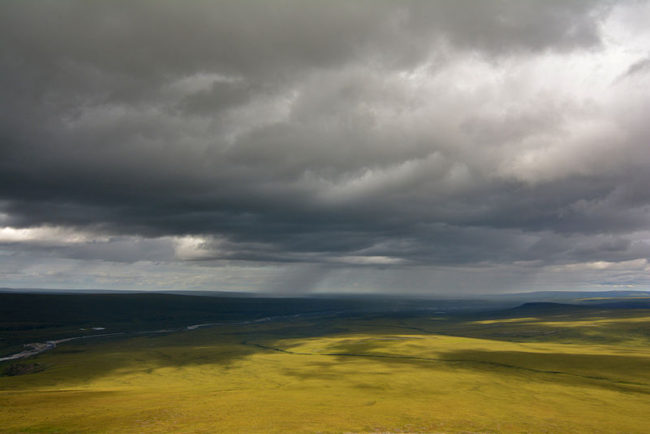
Much of the North Slope of Alaska is characterized by low, sweeping tundra hills, and a complete absence of trees. (Creative Commons photo by Paxson Woelber)
When you think of carbon emissions, you probably think of the exhaust that comes from your car. But it comes from the ground, too. As the temperature continues to rise in the Arctic, Alaska’s melting permafrost is releasing carbon dioxide into the Earth’s atmosphere. A new report published Monday says CO2 is escaping in the wintertime at increasing rates.
Róisín Commane is an atmospheric researcher at Harvard, and she’s flown a number of times over places like Bethel, Nome and Barrow in a plane that looks — as she describes it — like a FedEx truck with wings. The aircraft is small and boxy and outfitted with instruments that measure carbon dioxide.
Commane says you can’t really see the CO2 hovering in the air. But you can feel it.
“The plane will be bouncy. You make sure you have your coffee cup in your hand not left on top of anything because you never know when you could hit an air pocket,” she said.
Most of Commane’s time in the state has been spent flying over it. Still, it’s the tundra that she’s really interested in. The soils in the northern parts of Alaska and Canada are extremely rich in carbon.
“So this is ancient carbon,” Commane said. “The carbon that’s locked in the permafrost in the Arctic is thousands and millions of years old.”
She says it’s estimated that the frozen lands of the Arctic contain twice the amount of carbon dioxide currently in the Earth’s atmosphere. In the summer, some carbon dioxide escapes as the permafrost melts. But scientists have discovered it’s now happening in the winter, too.
“I think the main reason we’re worried about this is because as the temperatures are increasing and we’ve been seeing that happening for the last few years, the amount of CO2 that’s going to come out will go with that temperature,” Commane said.
She says it can be described as the climate equivalent to a dog chasing it’s own tail.
“Because it’s getting warmer, there’s more CO2 coming out which means it’s going to get warmer which means there’s more CO2 coming out,” Commane said. “And it will just run away with itself.”
As far back as the 1960s scientists thought this could someday be a problem in the Arctic. Eventually, they came up with climate models to help forecast the change.
“The problem is that most of the those models predicted that for 100 years into the future,” Commane said. “We’re now having to reassess, OK, this needs to be added to those models now. Because we’re seeing this much earlier than we thought we would see it.”
Some scientists think they can help fix the problem. Commane has heard of a Russian lab that wants to bring woolly mammoths back from extinction to stomp down the tundra, so it refreezes over. But she thinks that idea is far fetched.
She says for the Arctic, there appears to be no turning back.
“Yeah, I feel like there’s not much I can do which is almost frustrating,” Commane said. “It’s such a complex system, and we’ve pushed it past the point of us being able to do anything about it.”
The one thing she can do is collect more data on the Arctic. She says it’s important for scientists to continue to track the changes to come.
Close
Update notification options
Subscribe to notifications
Subscribe
Get notifications about news related to the topics you care about. You can unsubscribe anytime.