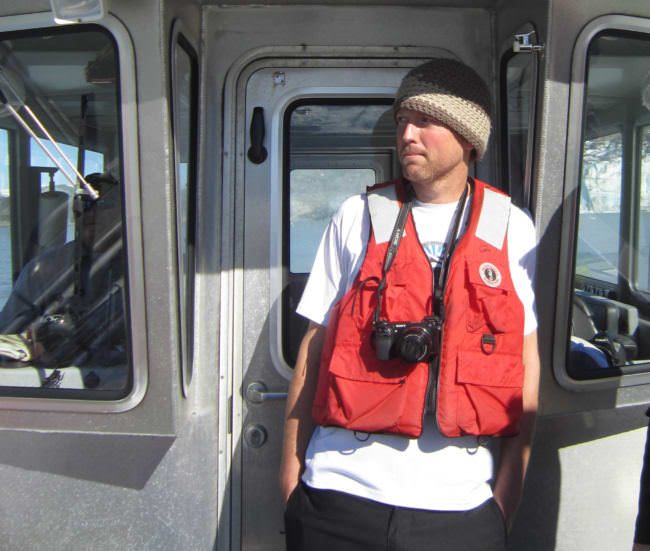
Seb Kurland sits right of DEC Commissioner, Larry Hartig. (Photo courtesy of the Alaska Center)
The Alaska Department of Environmental Conservation denied a climate change petition on Thursday submitted by a group of teens. The petition asked the state to reduce carbon emissions, monitor greenhouse gasses and come up with a long term climate change strategy.
In late August, the teens hand-delivered the petition to DEC commissioner Larry Hartig. In his rejection letter, Hartig said the request posed “significant consequences for employment and resource development” in the state.
Seb Kurland, a member of Alaska Youth for Environmental Action, the group that submitted the proposal, was initially disappointed by the decision. But the 17-year-old from Juneau isn’t giving up.
“I’m hopeful the governor and the Lt. governor will take action on this subject,” Kurland said. “And that their newly appointed members will do something about it.”
The governor’s office has made some strides to address climate change since the teens voiced their concern. The administration created a new position, appointing a climate change adviser.
Lt. Governor Byron Mallott says a climate plan is forthcoming.
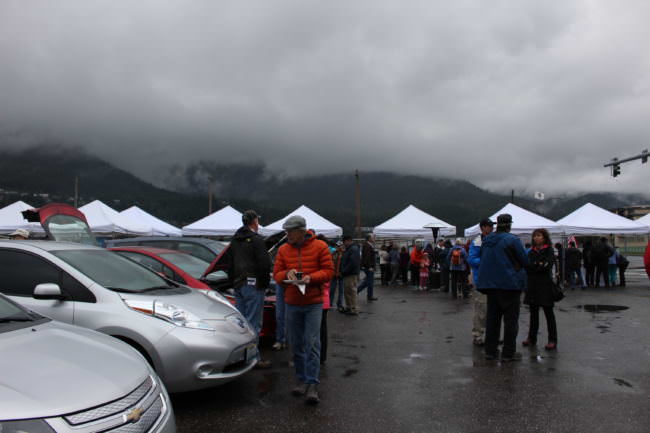
The Juneau electric vehicle fair was part of the National Drive Electric Week. (Photo by Elizabeth Jenkins/Alaska’s Energy Desk)
Alaska’s economy is powered by oil. So are the vast majority of cars and trucks worldwide. But globally, the market for electric vehicles is growing. So as more people move away from gasoline powered cars, the big players in the oil industry have started to pay attention — and that includes Alaska.
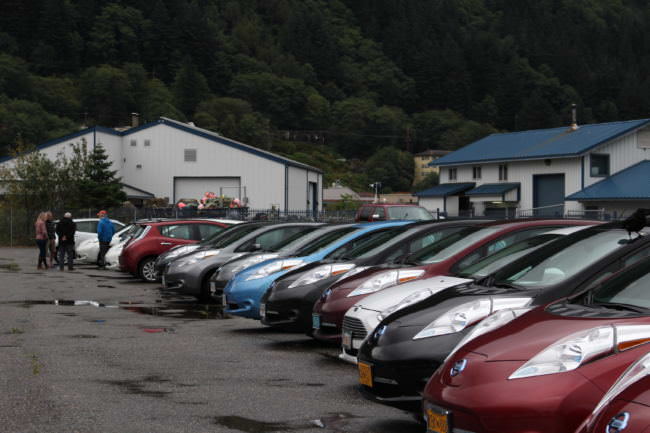
On a recent weekend, nearly 70 electric vehicles are lined up in a bare parking lot near downtown Juneau. It’s the city’s annual electric vehicle fair. The 1980’s song “Electric Avenue” is playing in the background.
John Cooper is here showing off his two EVs. And he’s proud to say he was one of Juneau’s early adopters.
He invites me inside his fully-electric sedan and pops the keys in the ignition.
Cooper says there are plenty of charging stations in Juneau. Range anxiety isn’t an issue. He says the convenience of owning an electric car was a big selling point.
“When you’re on the way to work, your car is [at] full [charge],” Cooper said. “And it’s an incredible feeling to get in the car — like, the whole time we’ve been talking — this car has been on and idling.”
It’s quiet because there’s no rumble of a gasoline-powered internal combustion engine.
Not too long ago, electric vehicles weren’t commercially available. But over the span of about five years, the number of EVs has reached into the millions worldwide.
That’s still only a tiny fraction of cars on the road. Even so, oil companies and Alaska state economist Neal Fried are paying attention.
“Does it keep me up at night? Not too often,” Fried said. “But it’s not just a thought experiment by any means.”
For the past 40 years, Alaska has paid its bills largely using oil revenue.
Recently, that’s presented the economy with some extreme challenges, and Fried says electric cars are potentially yet another threat. How big of a threat? That depends a lot on how quickly the shift happens.
“Look at iphones and how fast they were adopted. Could the same thing happen to us?” Fried said. “I don’t know.”
Then, there are companies like BP, which project much smaller numbers.
Sam Ori, the executive director at the Energy Policy Institute at the University of Chicago, agrees with Fried that electric vehicles are nothing to scoff at.
The global demand for oil is still increasing, but Ori says as consumers snap up more electric cars, the demand could start to flatten out.
“It’s not as if people are going to stop showing up to buy oil from Alaska,” Ori said. “But the price that they buy that oil is going to be less than it otherwise would have been, because of this change in the oil market. And electric vehicles are a piece of that — a small piece, but they’re going to become a bigger piece of it.”
Already, he says, electric vehicles and more fuel-efficient cars are affecting the global oil market.
That trend is likely to continue as countries consider measures to reduce carbon emissions. The Chinese government is thinking about banning gasoline-powered cars altogether.
Juneau’s ten public charging stations around town give EVs owners a variety of places to plug-in. (Photo by Elizabeth Jenkins/Alaska’s Energy Desk)
But Ori says the transition isn’t going to happen overnight.
“I think if people are thinking of it as like, ‘Well, are electric vehicles going to become so widespread in the next few years that they eliminate the demand for oil?'” Ori said. “That’s not happening soon.”
Still, Ori says globally it’s becoming cheaper to produce oil. Far-flung places where it’s expensive to drill, like Alaska, could start to look less and less appealing.
Back at Juneau’s electric vehicle fair, Monique Reeder is taking a break from the rain under a tailgate tent.
She’s here promoting her dealership, which carries electric vehicles. But Reeder herself?
“You know, I actually don’t own a car,” Reeder said with a laugh. “But I do take home demos.”
In any case, she doesn’t think the capital city’s enthusiasm to move away from gasoline cars has to be a reflection on the state’s economy.
She says Alaska will have to adapt.
“Because we don’t want what’s happening with the barrel prices, we don’t want that to affect our economy so much, where it’s really hurting our budget because we’re dependent,” Reeder said. “If we can diversify, it’s going to be a positive all around.”
As for her business, Reeder’s been selling electric cars for about a year, and she says they’ve been flying off the lot.
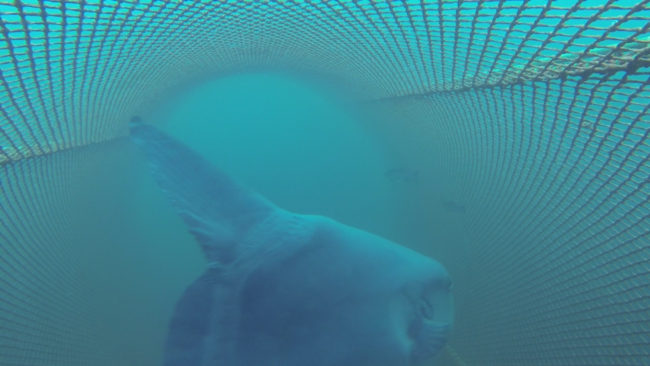
Ocean sunfish is captured in research trawl in July 2015. (Image courtesy of National Oceanic and Atmospheric Administration)
Scientists are trying to better understand how the world’s fish will adapt to climate change. One recent finding: as temperatures rise new species could move into Alaska waters.
Researchers from the University of Washington used 80 years of data to figure out how much warming fish could withstand. They discovered fish in the tropics are already living in water at the upper end of their threshold. Migrating to cooler waters could be their best option for survival.
As that occurs, Alaska waters could become a host to new kinds of marine life. Already, tropical species like ocean sunfish have been spotted in the state.
Scientists say they need more information to determine how local environments could be affected as new fish arrive and compete for food.
Hundreds of birds have been discovered along a stretch of the Bering Sea, on the Pribilof Islands and as far north as Deering.
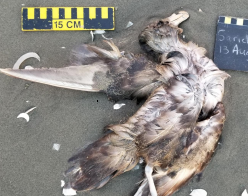
A Northern fulmar found dead along the coast this year. (Photo by Ken Stenek/Coastal Observation and Seabird Survey Team)
Julia Parrish, an associate dean at University of Washington, says seabirds have to work really hard just trying to find dinner.
“You’re spending a heck of a lot of your time flying around for food,” she said.
That means the birds have to consume enough fatty fish to sustain themselves. But Parrish says the thin bodies of the dead fulmars and shearwaters washing up on shore suggest the birds are struggling to find enough to eat.
So far, about 800 have been discovered along the coast of the Bering Sea. Parish says early lab results don’t point to disease. It looks like the birds are starving to death.
In 2016, scientists documented the largest seabird die-off in the state in the Gulf of Alaska.
“This is the next step in that progression,” she said.
Parrish says the mortality rate this year isn’t as high. Still, scientists are concerned about the frequency of the die-offs. Before 2014, it wasn’t uncommon to see seabird deaths every three or four years as the ocean ecology shifted.
“Now we’re seeing one to two a year. So that’s a big difference,” she said. “And it just points to more rapid and persistent shifts in the system.”
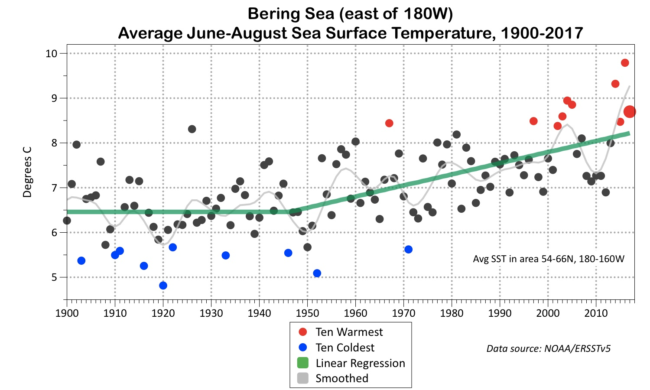
The Bering Sea has shown a trend of warming for about the past 50 years, according to the National Weather Service in Alaska. Last year was the warmest one on record.
Graph of Bering Sea warming by Rick Thoman/National Weathers Service in Alaska
Parrish says that could be affecting the seabirds’ regular feeding spots.
“So if there’s a shift in the system that takes away the prey that you’re used to and replaces it with prey you’re not used to, you may be going to the wrong grocery store,” Parrish said.
But Parrish says that doesn’t mean the seabirds can’t adapt if the warming trend continues. Humpback whales snack on commercial hatchery fish, which is an altered feeding behavior.
She says Alaska seabirds could eventually learn to visit new grocery stores, too.
“So if the system changes majorly and everyone goes to the place they think the food is going to be, and the food is not there? It’s somewhere,” she said. “It’s a bit of an arms race.”
Whether the seabirds can keep up with their changing environment remains to be seen. Scientists are watching closely, as seabird deaths can signal the health of the entire ocean.
Seb Kurland sits right of DEC Commissioner, Larry Hartig. (Photo courtesy of the Alaska Center)
The last serious effort to create a statewide climate change policy for Alaska happened under former Governor Sarah Palin. Now a group of teenagers is trying to push the issue.
They hand delivered a petition to the state’s Department of Environmental Conservation recently — asking for reduced carbon emissions and a strategy moving forward.
17-year-old Seb Kurland is home schooled in Juneau and grew up in the capital city. But Seb says the landscape around town looked different not that long ago.
The Mendenhall Glacier continues to shrink. Every year there seems to be less and less snow. And as Seb has gotten older, this teen’s concern about the changing environment has grown, too.
“You know, one of the hard things especially about being a teenager with these concerns is that you don’t feel like you can do anything about it,” Kurland said. “And I found Alaska Youth for Environmental Action.”
Alaska Youth for Environmental Action is part of the Alaska Center, an environmental nonprofit.
The program engages teens across the state to voice their opinions on issues like climate change.
In late August, Seb flew to Anchorage to deliver a petition to Larry Hartig, commissioner of the state Department of Environmental Conservation.
Seb was joined by 18 other teens asking the state to fulfill an obligation to protect Alaska’s natural resources.
“Basically what we’re saying with this petition is, ‘hey you’re not doing that!’” Kurland said.
The petition asks the state to reduce CO2 emissions, monitor what greenhouse gasses it does emit and come up with a climate change strategy for the long haul.
The carefully-crafted legal document didn’t just come out of nowhere. Back in 2011, a group of Alaska teens filed a lawsuit that made it all the way to the state Supreme Court. The Justices ruled that it was a matter for the executive or legislative branch.
“Now, kind our reply or our response is that’s the reason we were in court in the first place,” said Brad DeNoble, a lawyer from Eagle River. He helped craft both the lawsuit and the current petition.
He says the state may be obligated to do more to address climate change, under a common law with ancient roots called the public trust doctrine.
“Certain resources are essentially so important to society that they have to be protected,” DeNoble said. “They’re incapable of private ownership.”
DeNoble says the atmosphere in Alaska is the resource that needs to be protected from harmful emissions like CO2. It’s a concept, he says, that’s even embedded in the state constitution.
But Rep. Chris Birch, a Republican and freshman member of the House Resource Committee, doubts regulating industry further would do much good. Birch thinks climate change is cyclical — not just caused by people.
While he applauds the youth’s civic engagement, he says there’s more than one way to look out for Alaska’s future.
“You know, certainly the oil and gas industry in Alaska has led to tremendous benefits for each and every one of our citizens and residents,” Birch said. “And I think to compromise that or to try to put a lid on that or to burden that development is not reasonable.”
Seb Kurland, the teen from before, doesn’t see it that way. Kurland says climate change is jeopardizing the state’s other economic drivers, like tourism and fishing, and it’s something the Alaska legislature needs to address now.
“It can’t be delayed any further. Like, this is an issue that gets worse,” Kurland said.
The Department of Environmental Conservation has until Sep. 29 to respond to the petition. At which point, it can reject it or call a public hearing.
Brian Buma received funding support from the National Geographic Society. (Photo courtesy of Brian Buma/University of Alaska Southeast)
Glacier Bay National Park and Preserve is home to some of the oldest ecology records in the world. But until fairly recently, nobody knew where to find the metal nails that marked the research plots. They were left by scientists over 100 years ago and buried beneath a carpet of soil and shrubs.
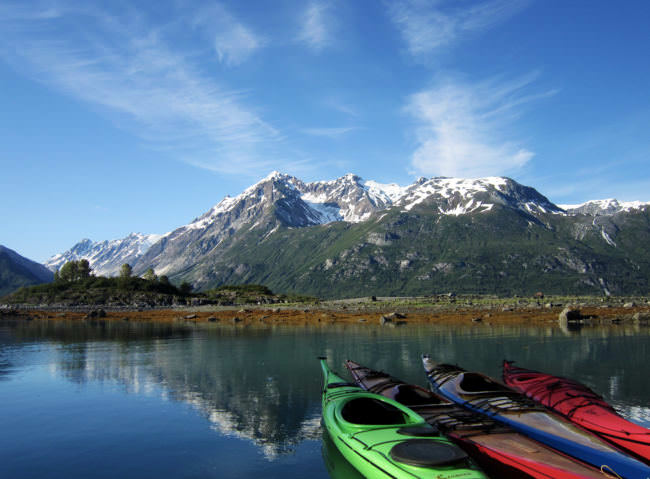
When William S. Cooper arrived in Glacier Bay in 1916, he did so in a large, comfortable research vessel. But Brian Buma’s transportation around the inlet was a little more modest. Buma led three scientists along the coastline this summer in kayaks.
Sometimes the group would have to wait in the water, as a sow and her cubs nibbled on wild strawberries on shore. Patience would become a reoccurring theme in Buma’s quest to find the lost plots.
He’s an ecology professor at the University of Alaska Southeast.
And there are two characters who have influenced his academic pursuits. One is William S. Cooper — the godfather of modern ecology. The other is referenced in Buma’s yellow notebook – the one he takes with him out into the field. On the inside it reads, ‘to the canyon of the crescent moon,’ a nod to Indiana Jones and the Last Crusade, where Indy searches for the Holy Grail.
In some ways, Buma would embark on his own journey looking for his version of buried treasure. He would combine the spirit of his two idols and set out to find Cooper’s lost plot points in Glacier Bay.
The research began over 100 years ago when Cooper traveled from his home in Minnesota to Alaska. Cooper wanted to see how the landscape was adapting to glacial melt, and that meant returning to the same spots overtime to see how the vegetation changed.
By the 1930s, Cooper had stopped coming to the area.
“So we have all these really interesting and really exciting studies that he did but then a big gap,” Buma said. “So I thought it might be just possible to retrace his steps.”
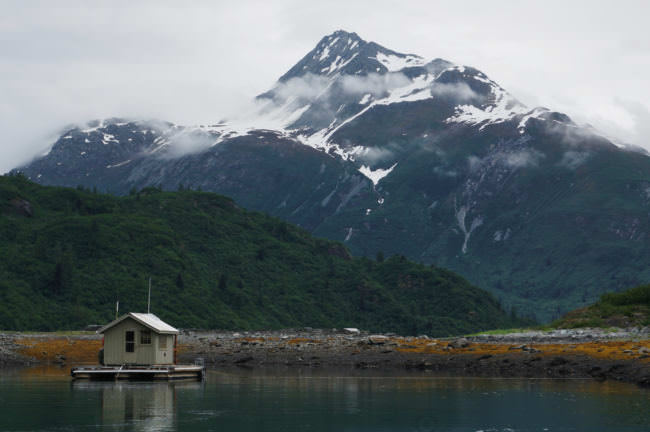
When the researchers weren’t in kayaks, they spent time in a small float house in Glacier Bay. (Photo courtesy of Brian Buma/University of Alaska Southeast)
To pinpoint the exact locations in Glacier Bay, Buma flew to the University of Minnesota last year to look through Cooper’s journals for clues. He found exhaustive notes, photographs and sketches about where the plots could be found. But finding Cooper’s exact locations would still prove to be a challenge.
“He did a lot of distance in paces, which is generally not a standard unit of measurement,” Buma said. “So frankly, on paper, it looks pretty easy and then when you get out there it turns out to be very, very difficult.”
Buma would have to navigate through a different landscape than in Cooper’s day.
In the early 1900s, there was lots of exposed rock in the area. Glaciers had recently retreated from the plots, but there was still more ice visible.
Today, the surroundings are largely a tangle of shrubs and trees.
“It’s like trying to push through a jungle gym. They just don’t give, and so you’re constantly contorting yourself to slope yourself sideways and get yourself diagonal,” Buma said. “And you’ve got a backpack and a metal detector and bear spray.”
Buma and his team have spent two weeks over the last two summers looking for Cooper’s plots. After bushwhacking for hours, sometimes days, they would get an inkling they were in the right location.
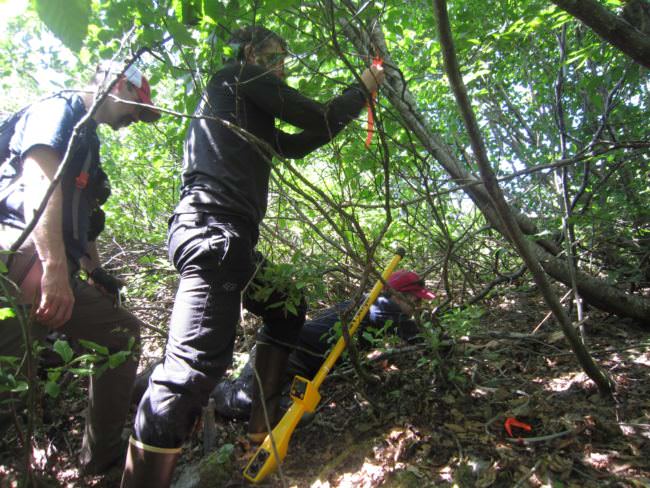
Maybe it came from Cooper’s old black and white photographs or the compass bearings retooled for today’s magnetic north. In any case, that’s when they would bring out the metal detector.
“You’re thinking wow, this is amazing!” Buma said. “No one’s been here for a very long time. This is the spot I read about as an undergrad.”
The team documented the GPS coordinates so the plots will be be easier to find in the future. (Photo courtesy of Brian Buma/University of Alaska Southeast)
It took Buma about a week in 2016 to locate all eight of Cooper’s plots in Glacier Bay.
After cataloging the species of plants in the area, his team did something not possible back in Cooper’s day. They took a nitrogen sample from the soil with the hopes that scientists can better understand how vegetation grows in a place that used to be covered in ice.
“All that information will make us better modelers of climate change in the future,” Buma said.
Buma says observations like Cooper’s are rare. Most climate change research didn’t start until decades later. So this kind of record can help tell us where the future is headed, as more of the world’s glaciers retreat.
It’s unclear if Cooper knew that warming would become a threat over 100 years ago. But Buma says he did know people could have an impact on the environment. Cooper even lobbied Congress to protect Glacier Bay as a national park.
“It makes him prescient in a sense,” Buma said. “Even in his very first paper saying, ‘the value of this study … will only increase with time. So I’m leaving directions so that it can continue after I’m gone.'”
Buma says Cooper was right. The value has increased, and he plans to return to Glacier Bay to help maintain this research for the rest of his life.
Photo courtesy of Brian Buma/University of Alaska Southeast
Close
Update notification options
Subscribe to notifications
Subscribe
Get notifications about news related to the topics you care about. You can unsubscribe anytime.