Elizabeth Jenkins, Alaska's Energy Desk - Juneau

One Arctic species is listed, one isn’t. Did politics play a role?

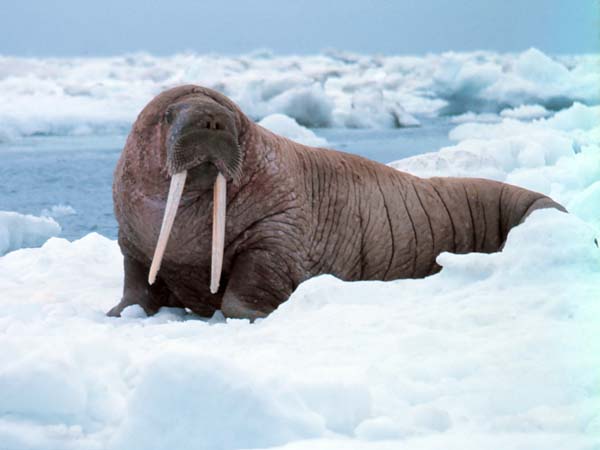
Pacific walrus. (Photo courtesy National Oceanic and Atmospheric Association)

Two of the Arctic’s most iconic animals face challenges with retreating sea ice. The Bush administration listed the polar bear under the Endangered Species Act in 2008.

But recently, the Pacific walrus was denied the same protections under President Trump. Critics have called it a political decision.

But the real story is likely a lot more complicated.

Nine years ago, a conservation group petitioned the federal government to put the Pacific walrus on the Endangered Species list. The U.S. Fish & Wildlife Service decided the listing was warranted.

But the decision got stuck in limbo because there was a huge backlog of other listings.

“Personally back in 2008, I was very happy that the decision could be delayed for a while,” said Rosa Meehan.

Meehan is retired now. But when the Pacific walrus was first up for review, she managed the marine mammal program at the U.S. Fish & Wildlife Service.

She says scientists knew polar bears living in the Arctic were threatened by changing conditions.

“Walrus, there was concern. But it was not as immediate,” she said.

Female walrus spend their summers in the Arctic Ocean, giving birth and feeding their pups. They rest on sea ice and then dive to the ocean floor to feast on clams.

But as sea ice has retreated earlier in the summer, more females and their young have been forced on shore. It’s become a regular occurrence to see thousands onshore in Alaska and Russia.

“Having that many animals hanging out on a land haulout- it’s was like, ‘Whoa, that’s kind of a lot,'” said Meehan. “You just don’t know what they would do. So there’s a question there.”

And Meehan says scientists were unsure how to answer that question back in 2008. There were concerns about stampedes, and they didn’t know how far walrus could swim for food.

With good sea ice, it’s as if walrus have a grocery store right in their neighborhood. When they’re hauled out on land, though, they have to swim a long way for food.

Chad Jay, a walrus biologist with the U.S. Geological Survey, has tracked walrus on epic journeys to visit their favorite feeding spot — a place called Hannah Shoal.

“They’re essentially then not able to haulout for 250 miles of travel,” he said.

Jay has worked on walrus studies for the past 20 years. During that time, he says there have been some major changes in the Arctic.

“Sea ice has been declining for the last couple decades,” Jay said. “And we’ve seen that firsthand in our field studies, and it’s been pretty dramatic.”

Faster-moving sea ice brought on my rapid global warming is added to the physiological stress of Alaska's polar bears, a new study says. Creative Commons photo by
Faster-moving sea ice brought on my rapid global warming is added to the physiological stress of Alaska’s polar bears. Creative Commons photo by Christopher Michel/Flickr)

So if polar bears and walrus both use sea ice to feed, retreating sea ice should be equally hard for both species, right?

Rosa Meehan says, ‘no.’

“The difference is the polar bears have to walk on the ice to catch the seals that they eat,” Meehan said.

Without the platform of ice to catch seals, Meehan says polar bears don’t have access to an equivalent food source on land, and there’s competition from brown bears for what is available.

So while polars bears and walrus are both experiencing the effects of climate change, Meehan says walrus are faring a lot better.

“So far, they seem to be doing OK,” she said.

Biologist Chad Jay, though, says it remains to seen if walrus can handle all of the changes headed their way.   

Besides the long swims for food, he says there are other stressors to consider, like where walrus will give birth as sea ice retreats.

There’s also the potential for increased vessel traffic in the Arctic.

“So I wouldn’t say they’re out of the woods yet,” Jay said.

Back when Rosa Meehan was still with the U.S. Fish & Wildlife Service, she says climate change was very much a part of the conversation. But the recent decision not to list walrus doesn’t mention it as a threat. It only acknowledges “environmental change.”

Still, Meehan doesn’t think the decision was just political.

“I’m confident that the people looking at the science are looking at the actual mechanisms of what’s going on with change,” Meehan said. “It’s just getting wrapped in a different set of words.”

Meehan hopes that different set of words doesn’t impact research funding. She says there’s still a lot to learn to make sure walrus have a future in the Arctic.
Talking Trash: You bought it. You tossed it. Now rural towns struggle to ship it out

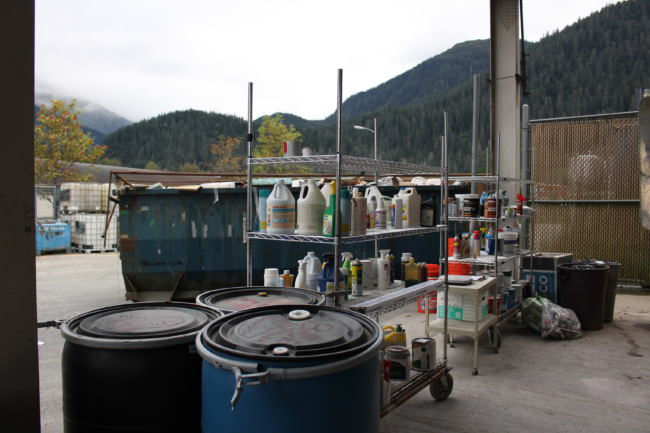
Juneau's hazardous waste facility (Photo by Elizabeth Jenkins/Alaska's Energy Desk)
Juneau’s Hazbin program diverts about 2,000 pounds of hazardous waste a month from having to be shipped to the Lower 48. (Photo by Elizabeth Jenkins/Alaska’s Energy Desk)

When a household cleaner or a box of batteries is barged to one of Alaska’s remote communities and sold in a store, it’s commerce.

But many of those items aren’t destined for a one-way transaction.

A lot of hazardous waste shouldn’t be tossed in a landfill: radioactive smoke detectors, flares that can explode, chemicals that can poison you. 

At great expense, small municipalities are stuck trying to fix the problem: How do you get the potentially dangerous trash back out of town?

“This is where we put all the waste in containers when we’re offloading cars,” Aaron Widmyer said.

He’s leading me around a bulky Sony TV, a spray can of Raid and grease from a high-end restaurant.

We’re at Juneau’s hazardous waste facility, where people drop off their stuff that shouldn’t go in the dump.

Widmyer works for a company that contracts with the City and Borough of Juneau. He makes sure the trash is safely packaged, so it can be shipped out.

And he says the job comes with a few perks.

“The amount of free of stuff that I get,” he said with a laugh. “I haven’t had to pay for anything for the past two years. Household cleaning supplies, laundry, soap, car oil for my oil changes.”

It’s not just Widmyer who picks up the schwag.

Anyone in Juneau can stop by and look for a half-used bottle of their favorite cleaner or bug spray.

But what isn’t scavenged has to go somewhere else.

Alaska doesn’t have any permitted hazardous waste treatment or disposal plants. So regulated hazardous waste has to be shipped back down to the Lower 48.

Around the corner, in a city office occupied by one man, is where the negotiations for that happen.

Jim Penor is Juneau’s solid waste coordinator, and he knows this business inside and out. He got his start in Washington state.

“I grew up as a landfill kid rat,” Penor said. “I’d go around and have fun in the landfill and it wasn’t a landfill. It was a burn pit operation.”

Penor has been in Juneau for close to a decade, trying to make the math of shipping the city’s hazardous waste pencil out.

If you ask him, it doesn’t.

But during his time, he’s been able to make it more affordable. He saved the city about  $120,000 a year — just by figuring out a way to treat latex paint so it can safely go in the landfill.

And the capital city is one of only two communities in Southeast with a weekly drop-off site, which Penor says makes the whole operation run a lot more smooth.

“We have time to work the waste stream,” Penor said. “Before, at a one time even per month, you don’t have time to work the waste stream.”

Literally, a stream. It’s a term that’s used to describe the lifeflow of garbage from beginning to end.

Still, there’s some trash that’s so risky to transport, the cost makes it nearly impossible to barge.

Old smoke detectors and exit signs are radioactive, so Juneau has to shell out extra to ship those. Then, there are out-of-date boat flares, which are considered highly flammable. Right now, there’s no way to get those out of town.

This creates a giant paradox, Penor said.

Commercial products wind up on store shelves with relative ease. But once it becomes hazardous waste, it’s a lot harder to transport out.

“I mean, even Juneau here. We’re the capital city. We’re the biggest city in Southeast and we’re 32,000 people,” Penor said. “We struggle with it.”

Jim Penor -- Juneau's solid waste coordinator (Photo by Elizabeth Jenkins/Alaska's Energy Desk)
Jim Penor said after he retires this spring, he’ll travel on his yacht to small Southeast communities to discuss trash. (Photo by Elizabeth Jenkins/Alaska’s Energy Desk)

In rural parts of the state, the struggle is even worse and the stakes can be much higher.

The state’s Department of Environmental Conservation used to have a program that helped barge out hazardous waste, but it was cut in 2004. And since then, it’s been up to the communities to figure out their own method.

Sandra Woods, who inspects landfills for the state, says a lot of small municipalities are just trying to do their best. But the funds are limited and money is usually needed for other things, like clean drinking water.

“By the time you get to solid waste, the money is usually gone,” Woods said.

A federal program helps Alaska Native villages barge out hazardous wasteBut it’s being discontinued in 2020.

Lynn Zender, an Anchorage doctor who specializes in solid waste management and health risks, calls it an impending catastrophe.

“It’s very worrisome from a public health perspective,” Zender said.

She helps run an environmental nonprofit and is a member of the Solid Waste Alaska Taskforce, a group that’s trying to help villages prepare for the change.

Zender worries, as more hazardous waste goes into the ground, it could leach into the environment and contaminate subsistence foods.

“Those landfills will expand out to rivers. They can expand out to town,” Zender said. “The access can be so horrendous that people start just keeping their garbage in town.”

Penor thinks the state needs to step up and help more communities get rid of their hazardous waste.

He acknowledges it’s an unlikely scenario, given the state’s current budget deficit. But he envisions a fund that could earn interest — designed specifically for trash.

In the meantime, he said consumers should view that half-empty bottle of nail polish or antifreeze differently. There’s a branding issue.

“I don’t like the term hazardous waste,” Penor said. “Because you went to the store and purchased it.”

Penor said he’s never used a jug of Drano to unclog his sink. Even after it’s tossed, someone’s going to pay for it.

Congress could decide fate of Tongass plan to move away from old-growth timber

The Tongass National Forest, near Ketchikan, Alaska. The spruce, hemlock and cedar trees of the Tongass have been a source of timber for the logging industry. (Photo by Elissa Nadworny/NPR)
The Tongass National Forest, near Ketchikan, Alaska. The spruce, hemlock and cedar trees of the Tongass have been a source of timber for the logging industry.
(Photo by Elissa Nadworny/NPR)

Congress can now deny the U.S. Forest Service’s move to transition away from old-growth logging in the Tongass National Forest.

Conservationists and timber industry groups thought the Forest Service’s decision was finalized last year. But a letter submitted by Sen. Lisa Murkowski prompted the Government Accountability Office to look into it.

The office determined Monday that Congress can review the forest service’s decision. The agency is now evaluating whether is should operate under the old or new plan.

Owen Graham, the executive director at the Alaska Forest Association, says it’s a step in the right direction.

“I’ve been working hard trying to persuade people to rescinded or reject it or withdraw it. Choke it to death or something,” Graham said. “Because it’s literally going to put our industry completely out of business.”

Timber industry groups, like Graham’s, worried the Forest Service wouldn’t make enough young growth trees available, as the agency moved away from selling valuable old growth.

Meredith Trainor, from the Southeast Alaska Conservation Council, says she didn’t agree with everything in the plan. She thought it left too much old growth on the table. But for conservationists, there were also some substantial wins.

Trainor says when she heard that Congress can decide the Tongass’ fate her “heart sank a little.”

“We hope Sen. Murkowski won’t use her position to attack the Tongass land management plan amendment,” Trainor said.

In a written statement, Murkowski praised the Government Accountability Office’s decision.

Congress now has 60 days to decide whether to step in to deny the Forest Service plan.

Editor’s Note: This story has been updated as new information has become available. 

This Juneau homeowner’s energy savings afforded the ultimate way to beat the chill

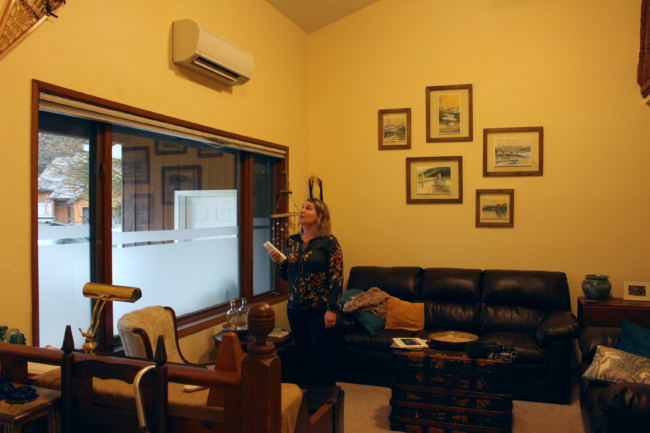
Traci Heaton points a remote up at her wall-mounted heat pump. (Photo by Elizabeth Jenkins/Alaska’s Energy Desk)

Hundreds of Juneau homeowners will stay warm this winter using an improved technology. Heat pumps are nothing new. But upgrades over the past thirty years have made the systems a lot more reliable. Now local installers are racing to keep up with growing demand.

Inside Traci Heaton’s home, next to a pair of snowshoes hanging on the wall, is a white rectangular box.

“At first I really didn’t like it,” Heaton said. “But now it just blends in with the house.”

Heaton had this wall-mounted air source heat pump installed about a year ago. 

She used to keep her house warm with a combination of electric baseboard heating, a wood pellet and oil stove. But these days, the $10,000 heat pumps are mostly doing the job. Though, she says there are times when the backups come in handy.

To pay for the heat pumps, Heaton tapped into a state program that awarded homeowners money for efficiency upgrades. That program was cut in 2016 because of Alaska’s budget deficit. Heaton says that’s too bad, because installing them has meant big savings.

“They have cut our heat bill down dramatically,” she said.

Last winter, Heaton’s monthly bill fell by half. The savings can be very different from home to home. Still, there’s growing demand for heat pumps in Juneau and for companies that do the installations, this is a busy time of year.

Northern Refrigeration opened in 2013 and since then, owner John Howard says his business has installed around 300 heat pumps.  He says the fervor over heat pumps spread quickly. By his second year in business, he was doing three  or four estimates every week. 

“It was crazy,” he said.

The capital city, like the rest of region, doesn’t have a natural gas distributor. So it’s common to burn heating fuel or rely on standard electric heating to stay warm.

Heat pumps first came on the market in the 1970’s and 80’s as an option for regions with a temperate climate. There are a lot of different types; everything from air source to the more expensive ground source or geothermal.

But Howard says the older generation of heat pumps gave the technology a bad rap.

“They’re extremely noisy, they’re big and they cost a lot of money to operate,” he said.

Howard says today, the units run a lot more efficiently. If you’ve eaten ice cream you probably already know how the science works.

He explains it to his clients like this: When you bring a gallon of ice cream home, maybe it sat in your car too long and melted a bit.

“Well, you put it in the freezer and pull it out the next day and it’s hard again,” Howard said.

He says your freezer is actually pulling the heat out of the ice cream — making it cold. Similarly, heat pumps can pull warmth from the ground or air. That warm air might not be detectable to the human touch, but it’s there.

The heat pumps themselves run off of electricity. And as more people get them, Juneau’s local utility is monitoring the electric demand closely. The utility says it hasn’t noticed a large impact yet since the past few winters have been normal to mild. But it is keeping tabs, as fewer people fire up their stoves.

Traci Heaton, from before, says overall she’s happy with the technology.

“I thought I’d take out the baseboard heaters,” Heaton said. “But we have had to use them a couple of times.”

John Howard didn’t install Heaton’s unit. He says there can be some sizing issues with heat pumps but it is possible to find the right fit.

Even so, Heaton says using heat pumps saved her about $250 dollars a month. With the extra money, she was finally able to beat the chill. She took her family on a winter trip to Mexico.

Environmental group to sue Trump administration over Pacific walrus

A young Pacific Walrus bull in coastal Alaska waters. (Photo by Joel Garlich-Miller/USFWS)

An environmental group announced on Thursday that it plans to sue the Trump administration for refusing to list the Pacific walrus under the Endangered Species Act.

The Center for Biological Diversity first petitioned the feds to list the walrus in 2008 — the same year the polar bear was listed as threatened. The Center argues the same forces that threaten polar bears — including climate change and disappearing sea ice — also put the Pacific walrus at risk of extinction.

Retreating Arctic sea ice has caused more female walrus to crowd onto beaches in coastal Alaska and Russia. The crowding can turn deadly when stampedes occur.

But the U.S. Fish & Wildlife Service said the animal has “demonstrated an ability to adapt to changing conditions.” The agency declined to grant the walrus more protections because it said the population “appears stable.”

The Center for Biological Diversity asserts there’s evidence from government scientists to refute that claim. The organization can sue the Trump administration after 60 days — if nothing changes with the listing decision.

Is the Pacific walrus adapting to warming? Feds say no need for more protections

A curious Pacific Walrus calf checks out the photographer in 2004. (Photo by Joel Garlich-Miller, USFWS)

The Pacific walrus won’t be protected under the Endangered Species Act. The U.S. Fish and Wildlife Service announced Wednesday that the “species has demonstrated an ability to adapt to changing conditions.” The announcement angered the environmental group that petitioned the agency to protect the walrus, but a number of Alaska groups were pleased with the decision.

Shaye Wolf from the Center for Biological Diversity says she’s been glued to her computer this week, waiting to hear about the protection status for the Pacific walrus.

Her organization, which is an environmental nonprofit, petitioned for more federal protections for walrus back in 2008 — the same year the polar bear was added as a threatened species under the Endangered Species Act.

She says hearing the news that the marine mammal wouldn’t receive the same protections was alarming.

“This read exactly like a political decision,” Wolf said. “If the Fish & Wildlife Service had protected the Pacific walrus because of threats of climate change, the Trump administration would have to admit that climate change is real and it’s causing real world harms.”

Wolf says there’s evidence from government scientists to suggest the walrus population will decline.

As Arctic sea ice has diminished, more female walrus have been forced to come onshore in the summer. It’s become a yearly occurrence in late summer to see tens of thousands crowding on the beach at Point Lay — a village along the coast of the Chukchi sea. This year was the earliest haulout on record since the walrus first started appearing in 2007.

Still, Patrick Lemons, a marine biologist with the U.S. Fish & Wildlife Service, says the decision not to the list the Pacific walrus isn’t political. He says the federal agency acknowledges “environmental change” is happening.

“The decision was based on the best available science and that was the recommendation that came out of the region,” Lemons said. “I don’t think it would have changed under either administration.”

Walrus use sea ice as a kind of floating platform. It gets them out to rich foraging spots and provides an important place to nurse their young or rest.

Lemons says scientists started to see a rapid population decline in 1980s, as sea ice disappeared.

But, recently, Pacific walrus have been observed making long trips offshore for food.

“That suggests that some of our assumptions before, where we didn’t have any certainty about how walruses would react, now we actually have some information about how walruses would react,” Lemons said. “Now, we actually have some information that walruses can change their behaviors as sea ice declines.”

Lemons says stampedes, which were thought to be a big threat onshore, aren’t killing as many of the animals as expected. Overall, he says, the population appears stable.

That was good news for Vera Metcalf, the director of the Eskimo Walrus Commission, who lives in Nome. An Endangered Species listing wouldn’t have impacted subsistence harvest of walrus. But Metcalf says it confirms what the community already knows.

“I think we’re all relieved, and we’re going to work on a common vision to move forward,” Metcalf said.

Several state agencies in Alaska, including the governor, have also released statements applauding the decision not to list the Pacific walrus. Congressman Don Young said he was glad the federal agency ignored “the extreme political pressures” to add a new listing.

The Center for Biological Diversity says it plans to appeal the decision.

Site notifications
Update notification options
Subscribe to notifications