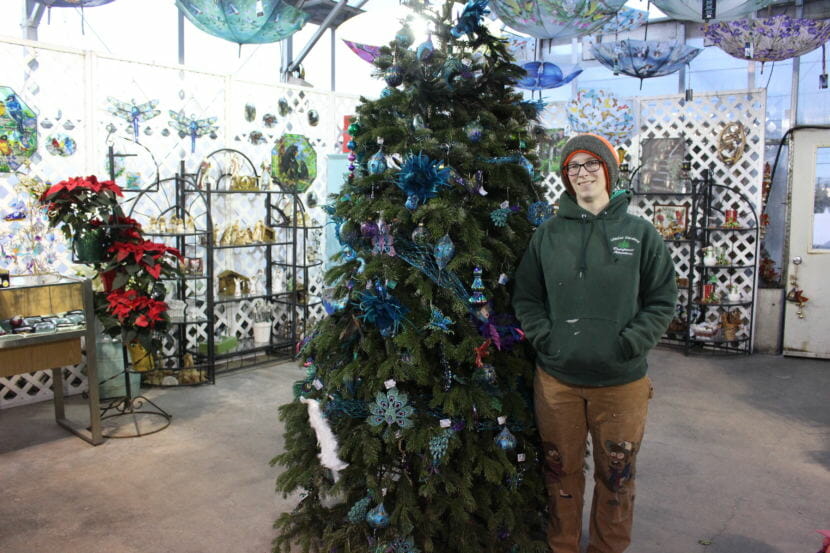
Cari Bowhay stands in front of her favorite decorated tree at Glacier Gardens Nursery, dubbed the “peacock tree.” (Photo by Elizabeth Jenkins/Alaska’s Energy Desk)
This year, the Governor’s Mansion is decorated for the holidays with a Sitka spruce tree from the Tongass National Forest. But Alaskans in the capital city aren’t just decking the halls with local greenery.
Cari Bowhay has worked through nearly 16 holiday seasons at Glacier Garden Nursery. And although it’s busy, she thinks there’s something special about being here this time of year.
“It always smells like Christmas,” Bowhay said. “It’s better than smelling like dirt the rest of the year and everybody seems to be 90 percent happier this time of year.”
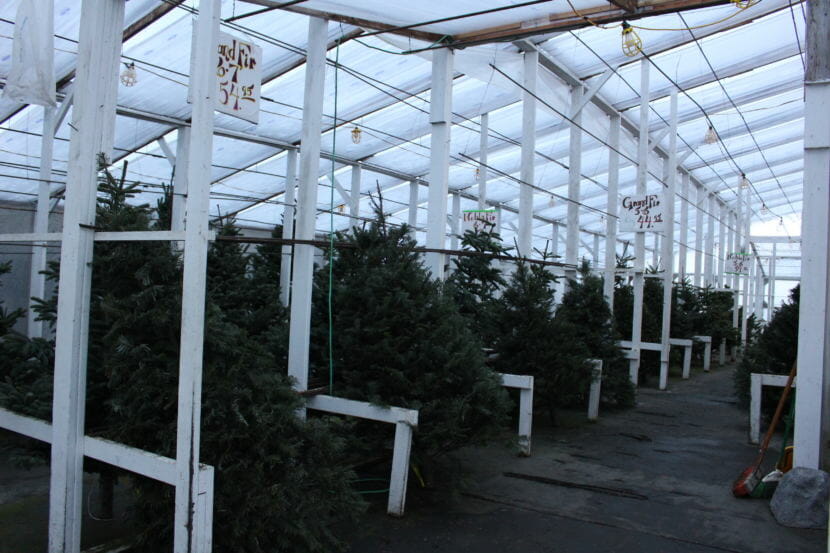
Outside the nursery, a variety of fir trees are leaned up against posts separated by type in different corrals. These evergreens were barged up by the thousands from tree farms in Washington state. Most of them have sold. There’s only about 40 left.
Bowhay gestures to a Grand Fir that looks like a perfectly symmetrical cone.
“The tree farms definitely prune and shape all the trees to where they have that … nice tapered look.”
Southeast Alaska has no shortage of trees growing outside. In fact, the City and Borough of Juneau and the Tongass National Forest allows people to harvest their own, within certain guidelines. You can cut hemlock or Sitka spruce, although you might poke yourself carrying it out of the woods. Spruce has sharp needles.
Due to a national Christmas tree shortage this year, the price of trees at Glacier Gardens Nursery did go up. (Photo by Elizabeth Jenkins/Alaska’s Energy Desk)
But that classic-looking commercial Christmas tree, typically fir, has a hard time growing in the state.
“Well, Douglas Fir doesn’t grow up here, presumably because it’s a little too cold for it,” said Brian Buma, an ecology professor at the University of Alaska Southeast.
There is a tree farm in Kodiak growing non-native Fraser firs.
But Buma says typically fir trees do well in places with dry, hot summers. It’s not exactly that they can’t handle the cold. They grow in the mountains of Colorado, for instance. But access to sunlight and a long growing season is important for the tree’s competitive survival.
Still, Buma says fir trees growing wild in Alaska isn’t out of the question.
“That’s something we’re actually thinking about,” he said. “There’s things like silver fir that will presumably be moving north as the climate warms.”
And he says they already have. Silver firs have been spotted in parts of Southeast.
Even so, he says it can take decades for that type of tree to make a natural migration north.
“But the climate may be warming fast enough that people will start planting them in their yard far sooner you see them grow up naturally,” Buma said.
Buma says he likes the tradition of tromping through the woods and cutting down his own tree. His home is decorated with a Sitka spruce.
“I’m looking at it right now. It’s a very sad looking spruce,” Buma said with a laugh. “The only spot we can put it in our house is right in front of our heater.”
Back at the Glacier Garden Nursery, Cari Bowhay says everyone has their own holiday tradition.
Hers includes buying fir trees barged up from Washington state.
“So we started coming here as a kid to get our Christmas tree. So I’ve been coming here a long time, and now I work here,” Bowhay said. “I get to enjoy the joy of seeing people coming in with their kids and bringing them in to see Santa and all that fun stuff.”
She says spending time with family and friends — no matter where you get your tree — is what the holiday spirit is all about.
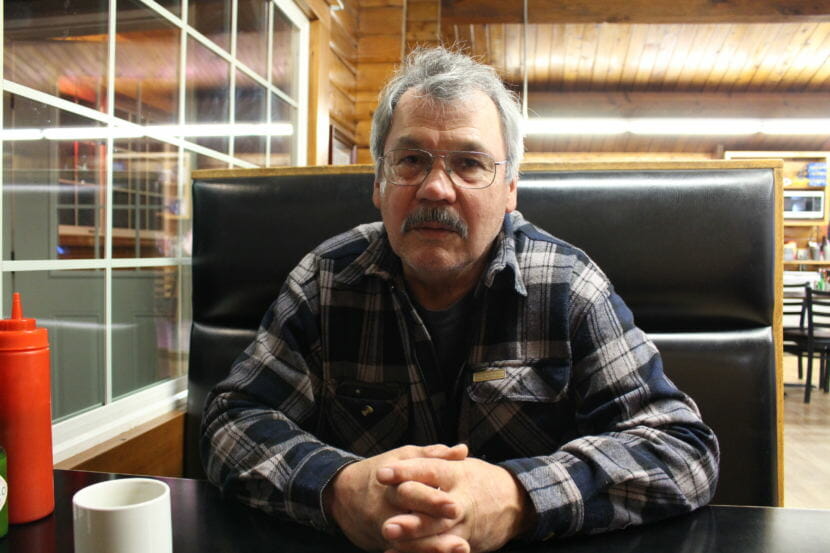
Mike Douville at the Dockside Cafe in Craig. (Photo by Elizabeth Jenkins/Alaska’s Energy Desk)
This deer season has been the worst in recent memory for a lot of hunters on Prince of Wales Island. In the past, large-scale industrial logging damaged important winter habitat, and some locals believe there’s another reason there’s so few deer on the island: too many wolves.
Go anywhere in Craig and you’re likely to overhear bits of conversation about the deer season.
That includes the local diner, the kind of place that displays its homemade pies behind glass. Mike Douville has just returned from a long day of hunting.
Over sips of coffee, he explains how he bagged one deer today. But it’s taken him longer to fill his freezer this year. He remembers more plentiful seasons, and that’s not the only change he’s seen on the island during his lifetime.
Douville says nearly all the big trees were standing when he was young. The first logging camps were just getting started.
“The island was pristine. There was no clear cuts on it,” he says. “So I’ve watched it turn from that into what it is today.”
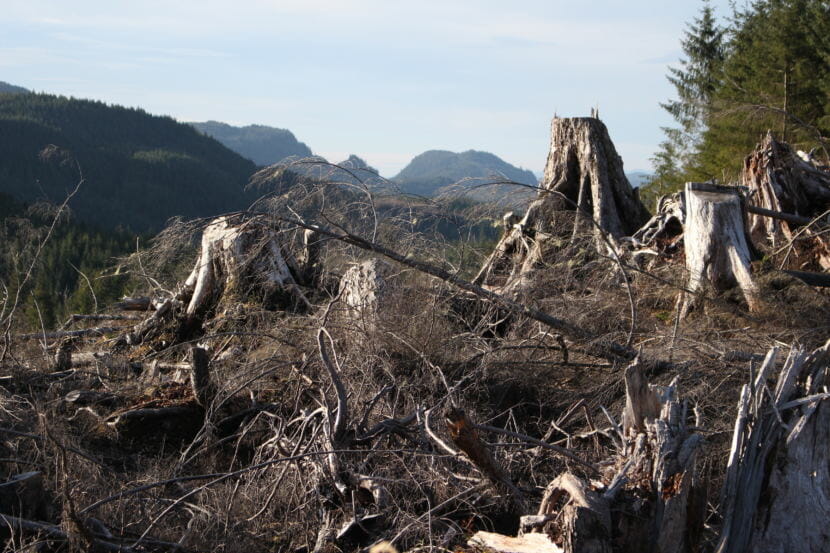
Large swaths of trees have been logged here since the 1960s. It’s left poor habitat for deer and the other wildlife. Without a canopy of old growth, snow can easily fall to the ground — obscuring important feeding spots.
Douville serves on the regional advisory council that makes recommendations to the federal subsistence board and the state.
He says finding fewer deer on the island is affecting people’s livelihood.
“This is rural Alaska. It’s bush Alaska,” Douville says. “We don’t like to buy meat. It’s eight or nine bucks a pound.”
Still, he says logging is just one factor. The other is a rapidly growing wolf population. The wolves are devouring the deer.
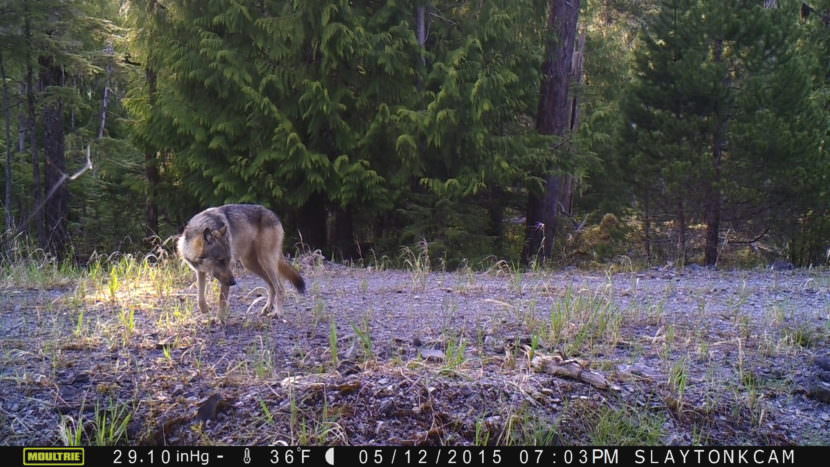
A wolf on Prince of Wales Island, as captured by a trail camera. (Photo courtesy of the Alaska Department of Fish & Game)
“If you’re going to harvest deer, you have to harvest wolves,” Douville says.
But not everyone agrees killing wolves is a good idea.
In 2011, conservation groups petitioned the feds to protect the Alexander Archipelago wolf under the Endangered Species Act. Around that time, it was estimated there were about 89 wolves living in the unit — less than half of what was there 20 years before. But the wolves didn’t wind up receiving additional federal protections.
Instead, there have been joint-efforts with the state to stabilize the population, and the numbers of wolves has been increasing. Estimates from 2016 suggest there are 231 wolves in the unit.
Still, it’s not easy getting a handle on how many wolves there are.
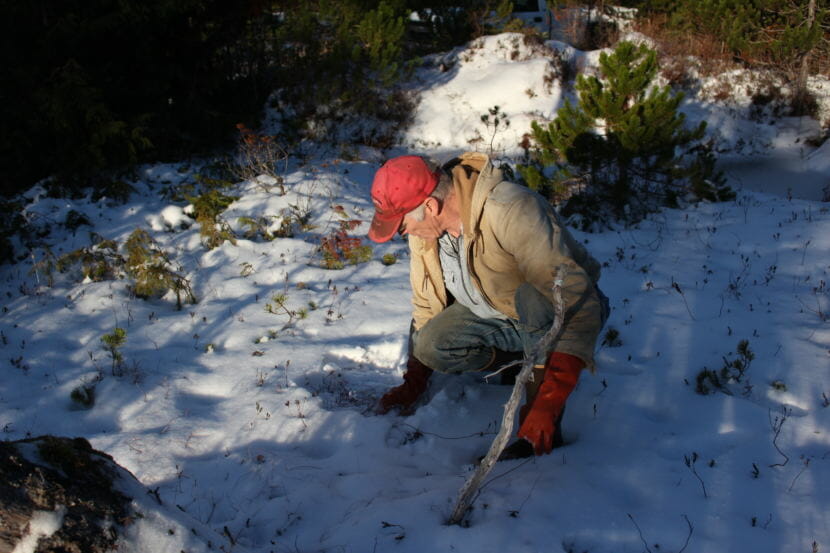
Mike Kampnich is driving his pickup truck to the top of a snowy ridge. He makes this rough ride regularly to collect hair samples from the Alexander Archipelago wolf.
Kampnich used to be a logger when he arrived on the island more than 30 years ago. But now, he works for the The Nature Conservancy.
“You know, some of the guys I worked for in the past. They’re like, you work for who?” he says with a chuckle.
We stop at one of the hair board sights. Essentially, a piece of plywood nailed to the ground and rigged with barbed wire. A stinky goo is placed on top. The wolves like to rub up against it, so it’s the perfect comb for capturing their fur.
Kampnich is careful to cover his tracks as we walk over to it.
He puts on his glasses to get a better look. But there are no strands tangled in the barbwire. This is just one of 21 locations he’ll check on the island over the course of two days. When he does hit the jackpot, the hair is sent off to a lab to be analyzed by the state.
Mike Kampnich from the Nature Conservancy says he likes working at the local-level to bring people together. (Photo by Elizabeth Jenkins/Alaska’s Energy Desk)
The Alaska Department of Fish & Game uses the individual animal’s DNA to calculate the wolf population, and a percentage of that becomes the wolf quota — the number of wolves that can be trapped or hunted each year.
Kampnich says it can be a touchy subject, locally. On a couple of occasions, he’s seen hair boards vandalized and trail cams disappear.
“It’s really frustrating,” Kampnich says. “But you know, some people will mess with your stuff.”
He doesn’t think it’s all related to tensions over the wolf population. Sometimes it looks like petty crime.
“It’s probably a little of both,” he says.
But Kampnich says wolf hunters have helped him, too. They’ve shown him good spots to place the hairboards.
“I’ve helped him quite a bit because I’ve lived here. I’ve trapped wolves,” Mike Douville says.
Douville wants there to be accurate wolf population estimates. And although he’s helped Kampnich in the past, he thinks using just the hairboards misses the mark.
The wolf population, he says, is bigger than the science alone suggests. So the wolf quota should reflect that.
Douville thinks anything above 175 wolves should be a harvestable surplus. Below that, hunters should be able to take up to 20 percent of the population.
“I don’t think anybody here is interested in wiping them out,” Douville says. “We’ve always got one or two that might think that way. But for the most part, they’re OK with wolves. Just not so many.”
Douville would like to see more traditional knowledge factored in to how the state gauges the number of wolves. But he says getting the wolf population figured out isn’t the only step to securing a future for the island’s deer.
He thinks big timber sales on Prince of Wales should become a thing of the past — even if that means the last remaining sawmill dries up.
“I’m not willing to sacrifice this island to keep it running,” Douville says. “I think there’s a limit on how much you donate to the cause and I think that we’re there.”
Douville says he wants to live on the island from his childhood. It includes a healthy forest for humans, deer and wolves.
Tongass in Transition is a series about trees told through the stories of people. Reporting for this was made possible by an award from the Institute for Journalism and Natural Resources.
Logging from the Big Thorne timber sale. (Photo by Elizabeth Jenkins/Alaska’s Energy Desk)
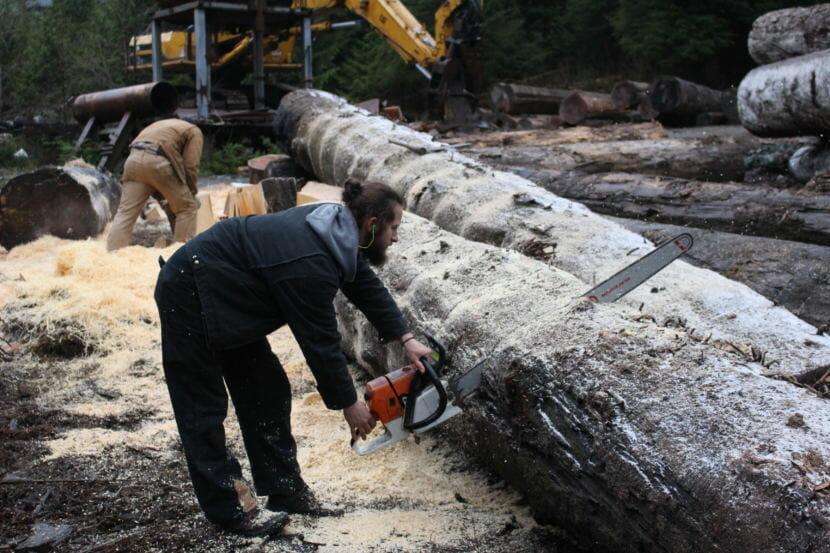
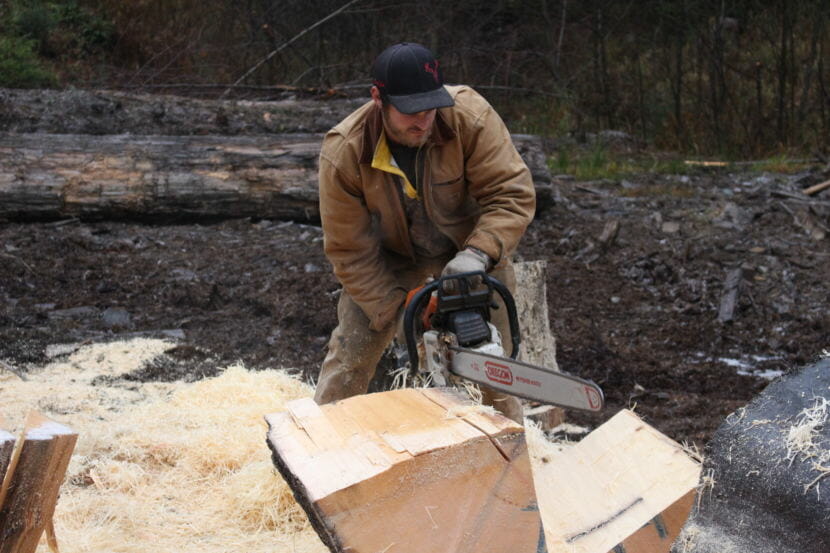
Brent Cole Jr. cuts into a tree that was once part of an Alaska Pulp Corporation logging raft. (Photo by Elizabeth Jenkins/Alaska’s Energy Desk)
The last sizable timber mill in the state has struggled to find enough trees to keep the saws running. But down the road, a small mom and pop operation is thriving with a unique business model.
Alaska Specialty Woods uses salvaged trees to make instrument tops, which are shipped all around the world. But this sustainable company still wants the timber industry to stick around.
Near the end of windy gravel road, Brent Cole Jr. fires up a chainsaw.
With his dark hair piled into a bun, he runs the blade through an enormous log sitting on the ground. His brother is next to him, cutting the section into smaller and smaller chunks.
The tree they’re slicing has been dead for decades. It’s salvaged from an old logging raft that was used to transport heavy machinery in a bygone era.
This is how the family business gets its wood: from bridges no longer used on old logging roads to trees that have been blown down or are dead standing.
Cole says there are millions of acres in the Tongass National Forest, and finding these trees can be like a scavenger hunt.
“We’d always make fun of my dad because he’s been doing it for years and he’d get all excited, and we’d be like you’re such a goof ball,” Cole Jr. said with laugh. “But now we see.”
And if you spend enough time with his dad — Brent Cole Sr. — it’s obvious how that enthusiasm could rub off.
At his workshop, a few towns over from the log yard, Cole Sr. shows me a thin, blond piece of wood.
“This here’s got indented grain, and look at the loud visual energy of that!” Cole Sr. says excitedly. “You go, ‘Wow!'”
He says the trees have a story to tell. Take the logging raft, for example. It’s riddled with holes from a worm-like mollusk. Other pieces of wood have a gray tinge. The result of mineral exposure from being buried in the soil.
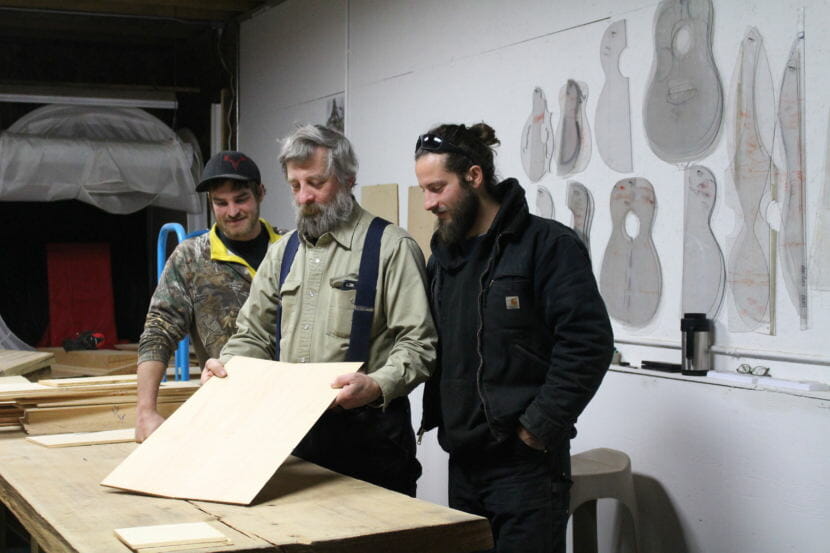
Cole Sr. embraces those imperfections and shapes the wood into tops for acoustic instruments, like guitars.
The workshop doesn’t have any finished guitars lying around. Cole Sr. jokes that he only plays the band saw.
So he taps on a slice of Sitka spruce to show me why it’s sought after by nearly every guitar maker. With each thwack, you can hear the wood vibrate.
Ryan Cole, Brent Cole Sr. and Brent Cole Jr. examine a piece of wood they’ll turn into an acoustic instrument top. (Photo by Elizabeth Jenkins/Alaska’s Energy Desk)
Cole Sr. used to drive trucks for a big logging company on Prince of Wales Island. Then he started his own business back in the early 90s: Alaska Specialty Woods.
At first, it was just a matter of buying whatever he could get his hands on. For a small operation, that usually meant buying individual trees from the Tongass National Forest. Most of that was salvaged. Some of it was cut down.
But in 2014, Cole Sr. says it became nearly impossible to find any living Sitka spruce that wasn’t off limits in the Tongass.
“We just said, ‘No.’ This is what we’re going to do,” Cole Sr. said. “We are just going to be the salvage people.”
Alaska Specialty Woods now produces as many as 10,000 guitar tops a year — shipping them to 80 different countries. They have name brand customers, like Gibson Guitars.
Cole Sr. says he knows at least on the surface being the “salvage people” could look like a more eco-friendly way doing business. Especially at a time when clear cutting the big trees remains up in the air.
The U.S. Forest Service wants to end old growth logging in the Tongass National Forest. It could be the death of the larger neighboring mill. The last of it’s kind in the state.
But Cole Sr. says here’s the thing:
“For us, it really behoves us — Alaska Specialty woods — and our customers, if there is an active timber industry here,” he said.
Through the years, Alaska Specialty Woods and Viking Lumber have used the same barges. They’ve flown the same helicopters to remove logs in the Tongass. Cole Sr. says if the big mill closes, that would be bad for his business.
Still, he doesn’t want to see the region return entirely to its past logging days.
“I want to see a slowdown of the amount of old growth clearcut,” Cole Sr. said. “But I also want to see a transition for a management for that.”
Which, he says, means the bigger mill should have longer to adapt.
Unlike Alaska Speciality Woods, Viking Lumber doesn’t make it’s own niche products. The company mills the wood on the island and ships the boards to the Lower 48.
Cole Sr. has invited Viking to stop by and see his operation.
In the meantime, he says he gets why people are concerned about the Tongass. But he says the economy should be able to flourish, too.
“They got good ideas and good intentions. Save the planet. But I think there’s common ground and using common sense and utilization,” he said. “And I think we can do it all.”
He doesn’t think the timber industry will ever be as big as it once was in the region.
But like his guitar tops, he says the wood in the Tongass still has a story to tell.
Tongass in Transition is a series about trees told through the stories of people. Reporting for this was made possible by an award from the Institute for Journalism and Natural Resources.
Ryan Cole at Alaska Specialty Woods’ log yard in Hollis. (Photo by Elizabeth Jenkins/Alaska’s Energy Desk)
Bryce Dahlstrom says he’s been working on the floor of his family’s sawmill for as long as he can remember. (Photo by Elizabeth Jenkins/Alaska’s Energy Desk.)
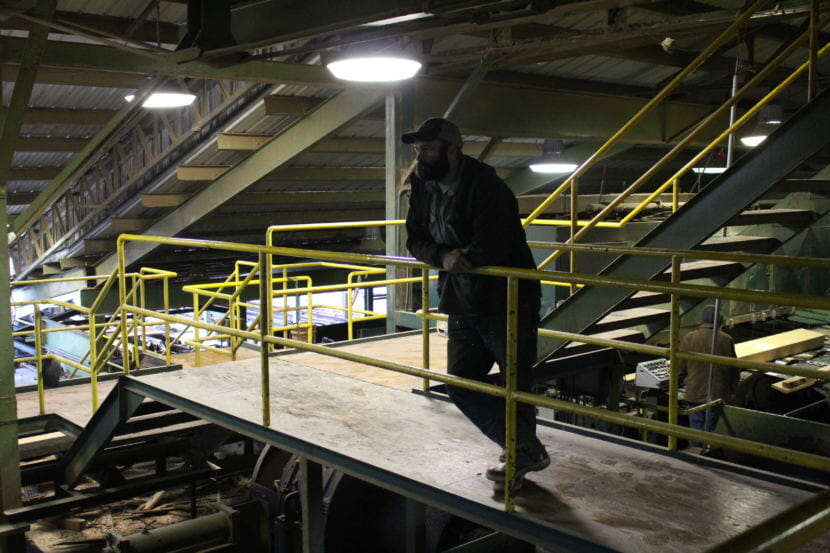
In the spring, the last sizable timber mill in Alaska considered turning off the saws for good. Viking Lumber on Prince of Wales Island cuts large trees like Sitka spruce and yellow cedar. It buys most of those old growth trees from timber sales in the Tongass National Forest. But those sales could become a thing of the past.
The timber industry in Southeast Alaska is a shadow of its former self. But looking around the lumberyard at Viking, you wouldn’t know it. The ground trembles with heavy machinery.
There’s a smell — sweet and woodsy.
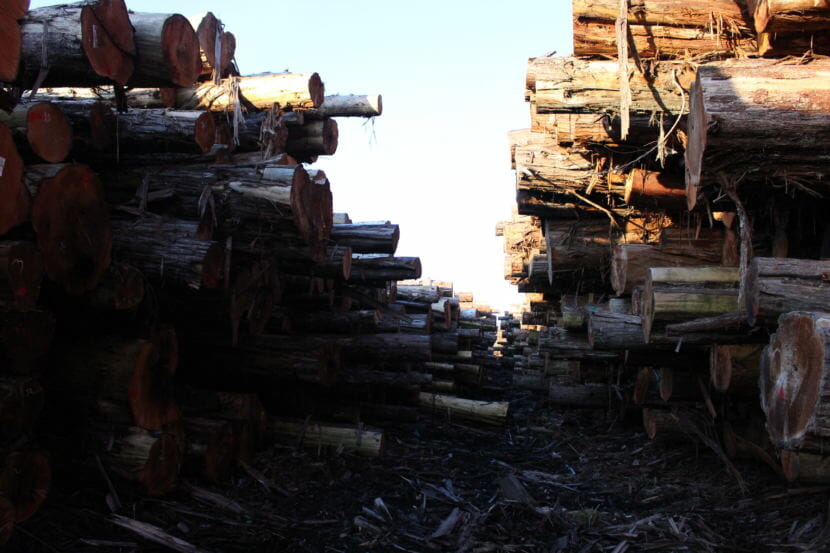
In the distance, you can see rows of old growth trees stacked nearly two stories high.
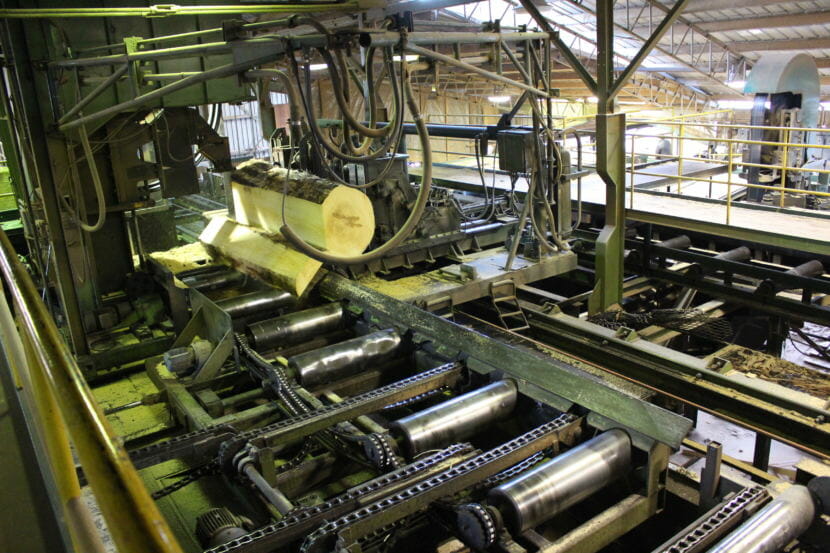
Logs are funneled into a warehouse, where a saw the size of a hot tub slices through the tree’s bark and rounded sides.
The mill produces around eight truckloads of lumber a day. It’s barged and then shipped to 40 states to be turned into door frames, crown molding and sound boards for pianos.
“You try to stay in what you know and you do it well,” said Bryce Dahlstrom, one of the owners.
His family has operated the mill for about the past twenty years. But today, he says he would be reluctant to pass it on to his son.
“If he would have showed interest in the sawmill I think I would have discouraged it. Because it doesn’t look like there’s a future here a lot of the times,” Dahlstrom said. “To be a logger anymore is frowned upon.”
The saws at Viking Lumber have to be sharpened by an employee up to four times a day. (Photo by Elizabeth Jenkins/Alaska’s Energy Desk)
Back in the 1980s, the timber industry in Southeast Alaska was booming, and families, like Dahlstrom’s, saw the state as a land of opportunity.
In the Northwest, tensions were ratcheting up between loggers and environmentalists. More federal protections for the spotted owl added new limits on what areas could be clear cut.
Dahlstrom grew up going to the pro-logging rallies with his parents in Washington state. He says the prospects looked better farther north.
“Alaska at the time had pulp mills. A big timber industry… Shortly thereafter things took a dive here,” Dahlstrom said.
Viking Lumber bids on regional timber sales to supply the mill. Most of the sales are from the Tongass National Forest. In the past, the U.S. Forest Service has allowed large scale industrial logging in the Tongass — damaging salmon streams and deer habitat. That’s led to tighter environmental regulations through the years, which has meant less of the Tongass is available for harvest. Dahlstrom says there have been fewer timber sales, too.
“We’ve fought and we’ve fought and there’s been a lot times since the late 90s that if we didn’t get that next timber sale, we weren’t going to have any wood,” he said.
Viking’s log yard is stacked with trees from the Big Thorne timber sale and a smaller state sale. (Photo by Elizabeth Jenkins/Alaska’s Energy Desk)
Then last year, the forest service made a monumental decision. It would move away from selling old growth trees in the Tongass altogether, phasing it out entirely after 15 years. Dahlstrom says it looked like the plan would finish off the mill for good.
His employees have come up to him with concerns, worried about the future.
“You know, they just bought a house, and they just bought a car, and they got a baby on the way,” Dahlstrom said. “And they’re like, what are we going to do?
There is one option: the forest service can sell young-growth trees.
But Dahlstrom says those trees are much different than the tight-grained, high value wood they process at Viking. He says the market for young growth just isn’t there. Plus, he’s skeptical the sales would be frequent enough since so much of the national forest is already off limits.
He says with younger trees, it’s a numbers game. You need many more of them to turn a profit.
A short drive down the road from Viking Lumber is the largest community on Prince of Wales Island. About 1,200 people live in Craig.
My tour guide is Dennis Watson, the city’s former mayor of more than 20 years. In his white van, we pass lodges that cater to sport fisherman in the summer.
Watson says the community was bustling with loggers when he arrived here a few decades ago. For a while, he worked at the mill. But today, the economy has shifted mostly to commercial fishing. That’s what Watson does.
Even so, he says logging still plays an important role.
“If you took timber away from this place right now, the impact on this town would be huge,” Watson said.
Dennis Watson says he moved to Craig in the 1980s because there were plenty of timber jobs and he wanted to get out of California. (Photo by Elizabeth Jenkins/Alaska’s Energy Desk)
Only 40 people work at Viking Lumber. But the mill is the local electric utility’s biggest year-round customer, and it offers some of the few jobs available in the off-season.
Watson says he’s traveled to Washington D.C. to try to explain that to federal agencies. But on those trips, he’s walked away feeling ignored.
He hopes President Donald Trump can turn things around.
“Like anyone else, I just roll my eyes at some of the things he does. But I couldn’t have voted for Hillary Clinton if somebody had a gun at my head.” Watson said. “I thought that if Clinton had been elected, we’d be pushed aside and our communities would start drying up here in Southeast Alaska.”
Still, not everyone in town thinks there’s a timber industry worth saving here. Bob Claus has lived on the island for decades. He’s also a member of conservation group that’s argued for more environmental protections in the Tongass.
Claus says he knows loggers who have successfully transitioned to a new job in Craig, and he thinks the town can survive just fine without Viking Lumber.
“I think the logging era is over in Southeast Alaska and nowhere else in the national forest system do people even contemplate logging old growth,” Claus said. “And I think it’s a mistake to be logging the last bits of it on the Tongass.”
But Bryce Dahlstrom, the owner of Viking Lumber, says in the past year, he’s started to think the mill may have a future on Prince of Wales Island.
A federal watchdog agency recently decided Congress will have the chance to weigh in on what happens in the Tongass National Forest. Cutting old growth trees could still be on the table.
Still, he’s not exactly optimistic. And he says if his community is going to turn into a tourist town, he doesn’t plan on sticking around.
“I guess to see one of my employees in a grocery store after we weren’t able to keep them working would be pretty tough,” he said.
Dahlstrom says no one wants to be on watch when the last big sawmill in the state shuts down.
Tongass in Transition is a series about trees told through the stories of people. Reporting for this was made possible by an award from the Institute for Journalism and Natural Resources.
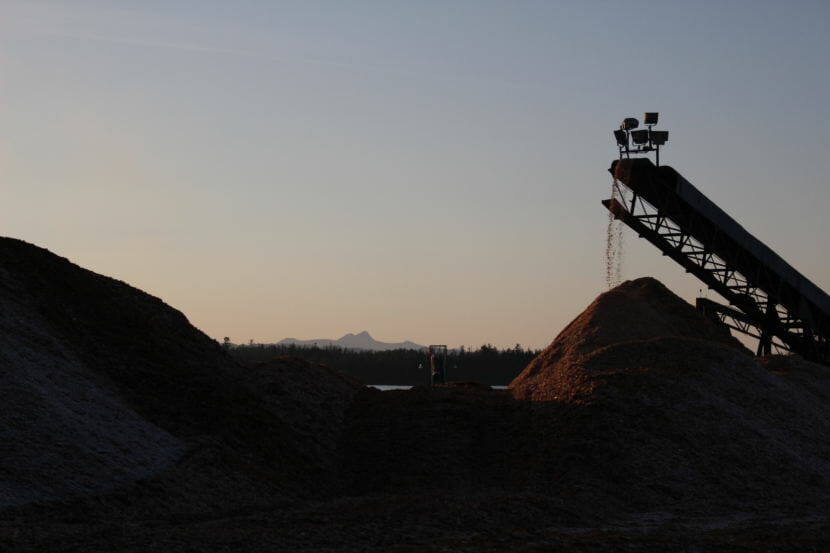
Wood chips spill onto the ground at the Viking Lumber yard. Later, they’re be compressed into flammable bricks and sold to start fires. (Photo by Elizabeth Jenkins/Alaska’s Energy Desk)
The Tongass National Forest, near Ketchikan, Alaska. The spruce, hemlock and cedar trees of the Tongass have been a source of timber for the logging industry. (Photo by Elissa Nadworny/NPR)
Congress could be one step closer to undoing a U.S. Forest Service decision to end old growth logging in the Tongass National Forest.
On Monday, Sen. Lisa Murkowski added the measure to a Senate Interior and Environment appropriations bill.
Last year, the forest service included new directives to its Tongass plan. Timber industry groups and conservationists thought the decision was final. It called for the forest service to transition away from cutting old growth trees.
But in October, the Government Accountability Office decided the forest service plan was subject to congressional review.
It would be up to both the Senate and House to make the final call. There are no committee meetings scheduled yet to discuss the issue.
Scientists don’t know exactly which Alaska volcano contributed to the drought. But Joseph Manning says that information could be available in the future. (Photo courtesy John Lyons/Alaska Volcano Observatory/U.S. Geological Survey)
Extreme weather has caused chaos recently in places like Puerto Rico and Texas. But to better understand how humans react to these types of events, one historian is looking at the distant past.
Joseph Manning says if you want to study past climate events, ancient Egypt is a good place to start.
The Egyptians kept detailed records. There was everyday bookkeeping on crops, land leases, letters and legal documents, usually written on papyrus.
And Manning says a lot of that has survived.
“Well, ironically because of the dryness of Egypt but also the fondness for mummification, which is interesting,” Manning said. “So a lot of documents get recycled as mummy wrappings or mummy stuffing sacred animals and human.”
As odd as that may seem, some of these old records were found in the body cavities of mummies.
But when you look at the documents as a whole, Manning says a story starts to emerge and it’s one that includes Alaska.
As a history professor at Yale University, Manning studies the Ptolemaic Period. You probably know it as a time when Cleopatra reigned as queen. But to historians, it’s a period marked by social unrest and revolts.
That’s been linked, in part, to changes in the Nile River. The river didn’t flood for two to three years, which meant crops didn’t get vital nutrients and irrigation. “People recall a time in the past when there was widespread famine, and they worried that might happen again,” he said.
But he says an important part of the story was missing — what caused the Nile to stop flooding every year?
So Manning looked for scientists to compare notes. He remembers a colleague showing him a newly published paper on volcanic eruptions.
“I told him the sort of dates I was interested in and they kind of lined up in a spooky sort of way, I would say,” Manning said. “And then we got to work.”
Beyond the historical documents, like the mummy wrappings and exact measurements of the Nile, Manning teamed up with scientists to examine what he calls “natural archives.” That is, layers of ice thousands of years of old.
Below the surface of the ice is a record of major climatic events. Scientists can pull up core samples and test it for particulates that may have been deposited from a distant volcano.
And Manning was able to use that data, comparing volcanic activity with the timeline.
“You can tell specific eruptions, you can tell approximately where the eruption is located, and you can tell the size of the eruption which also matters,” he said.
Manning says large volcanic eruptions can cause cooling and drought.
In the case of the Nile River, the eruption may have caused less rain to fall in Ethiopia so the Nile didn’t flood. That, in turn, set off a chain of tumultuous events, that would have been impossible for ancient Egyptians to comprehend.
“Egyptians have no idea there’s a volcano in Alaska,” Manning said.
Manning says scientists have posed the volcano theory before. But this kind of approach is a new way of understanding how history and climate are connected.
“For the first time you can see a dynamic society,” he said. “It’s like pulling a curtain back and actually seeing a society moving around as opposed to a static picture of an ancient society.”
Manning thinks today, as we see weather shifts caused by warming and human activity, we can learn something from the past.
The ancient Egyptians can help us understand how environmental change influences behavior and potentially leads to political unrest or war. He says there are skeptics to this approach.
Some other historians have pushed back, saying the research is short sighted.
“Actually I’ve seen some people say we’re part of a fad,” Manning said. “Climate change is such a fad these days that will pass.”
But Manning doesn’t think so.
Unlike ancient times, he says we have some control over how things play out. We can reduce carbon emissions and imagine solutions.
He wonders what the Egyptians would have done with the same knowledge.
Close
Update notification options
Subscribe to notifications
Subscribe
Get notifications about news related to the topics you care about. You can unsubscribe anytime.