Elizabeth Jenkins, Alaska's Energy Desk - Juneau
This halibut hook is an innovation for the past, present and future

Photo credit should be "360 North / JEDC".
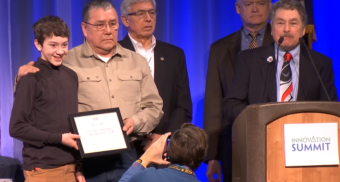
Thomas George and his grandson accept an award on behalf of Tlingit, Haida, and Tsimshian people for the traditional halibut hook. (Photo courtesy of 360 North/Juneau Economic Development Council)

The Alaska Innovators Hall of Fame recently inducted its first indigenous tool. Few people still use the hand-carved halibut hook, once popular with Southeast tribes. But there’s a push to make sure the tradition sticks around for future generations.

Standing on a stage with his grandson at the Juneau Innovation Summit a few weeks ago, Thomas George accepted an award.

“I’ve been trying to get help to keep this part of our heritage alive for years or decades,” George said.

The Alaska State Committee on Research gives credit to people and inventions which have made a lasting impact in the state.

George accepted the honor for a collective achievement: the halibut hook, which has been used by Tlingit, Haida and Tsimshian people for thousands of years.

Even though the technology is old, George says it isn’t a relic.

“Over the years everybody thought it was decoration for the wall,” George said. “But my hooks never did hang on the wall. They hung out on the porch.”

George only knows of one other person — in all of Southeast Alaska — who fishes with the traditional halibut hook, and he’s a big proponent for bringing them back. He’s taught classes at the Sealaska Heritage Institute on how to make them.

Growing up in Klawock, he says carving the hooks was part of his childhood. His grandmother was one of the people who passed on the knowledge, and he remembers some advice she gave him: All of the measurements you need to know are in your own hand.

“And if you got small hands you don’t need a big fish,” he said.

Typically, people jig for halibut on their boat using a metal circle hook. But the traditional design and method is different. The hook itself is shaped like a V, with a more buoyant wood like yellow cedar on one side and a denser wood on the other. This makes it float in a certain direction.

George says the best part about this way of fishing is you can set the line in the water and come back later. It’s suspended by floats.

“You could go to the beach and build a fire and boil coffee,” he said.

A traditional halibut hook at Sealaska Heritage Institute. Photo by Elizabeth Jenkins/Alaskas Energy Desk
A traditional halibut hook at Sealaska Heritage Institute. (Photo by Elizabeth Jenkins/Alaska’s Energy Desk)

Each of his hooks is named after a different girlfriend, which he admits can sometimes be confusing.

“It’s getting harder to remember all of my girlfriend’s names, Tlingit names,” George said with a laugh. “Catching less and less fish.”

But over the years he says there’s been plenty of fish in sea. Just one hook alone, he estimates, has caught around 800 halibut.

He says even though the practice is sustainable and effective, fishing the traditional way hasn’t always been encouraged.

Back in the 1970s, before there were subsistence permits, he invited a state trooper to see the halibut hooks’ in action. After about five minutes, George had a halibut on the line.

“And we rolled them in, and he pulled up beside us and he said, ‘My god! I was going to confiscate your gear and write you a citation.’ But [the trooper] said, ‘That was truly amazing just to witness.'”

George begged the state trooper to write him a citation because he wanted to challenge the issue in court. But the trooper was elated. He never bothered him again.

In 2000, the North Pacific Fishery Management Council established a subsistence program for halibut. But George thinks there’s still roadblocks to preserving the traditional ways. Having to obtain a subsistence permit at all, he says, creates an additional barrier, and he’d like to see more people use the hand-carved halibut hook.

“So that part of our heritage does not die,” he said.

George wishes the state legislature would address the issue and take it up with the regional fishery management council.

In the meantime, he’s doing his part to make sure the next generation knows how to make the traditional hooks. His 14 year-old grandson has already picked up the skill.

“Well, he hasn’t said much except ‘let’s go fishing’,” George said.

George says the state recognizes the halibut hook is an important innovation. It’s a technology worth keeping around.

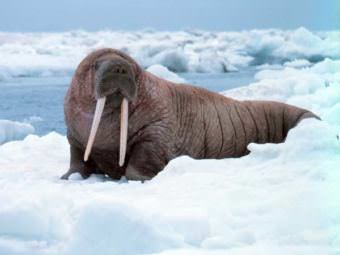
Trump administration sued over Pacific walrus

Pacific walrus. (Photo courtesy National Oceanic and Atmospheric Association)

The Center for Biological Diversity is suing the Trump Administration for not granting an Endangered Species Act listing for the Pacific walrus. The environmental advocacy group filed the lawsuit on Thursday, March 8, 2018, in U.S. District Court.

In October 2017, the U.S. Fish & Wildlife Service decided the Pacific walrus didn’t warrant additional federal protections. The agency said the population appeared “stable” and had “demonstrated an ability to adapt to changing conditions.”

But some conservation groups say the decision was politically motivated and not based on the best available science.

In 2008, polar bears were granted an Endangered Species Act listing under President George W. Bush. But the U.S. Fish & Wildlife Service says the two animals aren’t the same.

Polar bears face a host of challenges with declining sea ice — more than what’s been observed of walrus.

Trying to solve a moose-sized mystery in the tundra near Nome

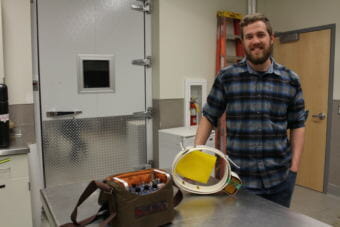
Warren Hansen with the ADF&G in Nome (Photo by Elizabeth Jenkins) 03/05/17
Warren Hansen stands beside a white radio collar used to track moose. (Photo by Elizabeth Jenkins/Alaska’s Energy Desk)

Moose weren’t always a staple in Western Alaska. The animals migrated to the region sometime after the turn of the century. But outside of Nome, the population has been continuing to decrease, following years of heavy snow. 

Warren Hansen is counting down the days until he can fly over the tundra to look for moose. Although he’ll be searching the landscape with his eyes, his ears will be doing most of the work.

“Listening to static and beeps all day and trying not to get motion sick,” Hansen said.

Hansen is a wildlife biologist with the Alaska Department of Fish & Game (ADF&G).

In the aircraft, that beeping sound will be transmitted from Hansen’s moose to a radio receiver. Or rather, the 16 calves he collared last fall.

Right now, those calves are somewhere outside of Nome, wearing the chunky white collars Hansen gave them. Hopefully, they’re emitting a sound that indicates they’re alive. But a mortality signal could be closer to the truth.

In an area north of Nome, the moose population is decreasing by about 12 percent annually. Hansen says moose are an important subsistence food, so a shrinking population is concerning.

About a year ago, the department of fish and game received federal and state money to look into the issue. 

But if this were a detective story, Hansen says it’s only the first chapter in figuring out what’s going on with moose.

Moose turned up near Nome around the 1930s, and scientists aren’t totally sure why. It’s possible they could have just naturally migrated into the area, much to the delight of local hunters. 

“Well, [moose] may not have been barreling through,” said Tony Gorn, a management biologist for ADF&G. “But it was probably an impressive sight to see this long-legged animal standing on a hillside.”

Gorn has lived in Nome for 20 years, and he’s spent most of that time working with ADF&G.

Back in the 1980s the moose population was booming. So much so that biologists wondered if the landscape could even sustain it. And by the late 2000s, Gorn was on the job — capturing calves to weigh them and see how the animals were getting on.

At first, the young moose were a normal weight. But for the next two years, heavy snow fell in Nome, and their weight dropped. Management biologists wondered if there were too many moose, so they increased the hunting quota to ensure a sustainable population.

But since then the population started to decline more rapidly.

Gorn says it’s too early to tell exactly what’s going on. It’s complicated. But nutrition could be a factor.

“There’s definitely not one thing we could call the silver bullet,” Gorn said.

Still, one thing’s for certain: winters in Nome are not as cold as they used to be. At around 30 degrees, you get warm, wet conditions, which can lead to more snow and ice.

Measuring snowpack is challenging because it can blow across the tundra. But the National Weather Service has recorded more seasonal snowfall than what was typical just a few decades  ago.

As for moose, Gorn says the animals are hardy. They’re built to handle heavy snow, but their environment, at least around Nome, appears to be changing.

Moose eat shrubby plants like willow.

“You know, we see our willows completely encased in ice,” Gorn said. “Those are things that we need to begin to understand. Particularly, if they’re going to be become long term events.”

But for now, he says the emphasis is on what is happening to moose. Not necessarily why. Are they malnourished? Migrating farther north? Are the calves being eaten? Those are the big questions.

When this study is done in about three years, ADF&G hopes to have a better understanding. This research could influence management decisions down the line to help stabilize the population.

Gorn says the goal is to achieve the best science possible within the confines of public support.

In the meantime he plans to go back out into the tundra this spring with his colleague to check on the young moose.

“If the weather was beautiful tomorrow, we’re not flying,” he said.

Gorn says right now the plane is a solid block of ice. The mystery is when the weather will be clear enough to fly.

This man wants to bring more electricity to Juneau. What’s the hold up?

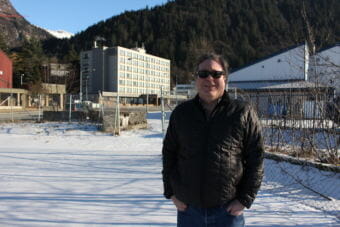
Duff Mitchell of Juneau Hydropower (Photo by Elizabeth Jenkins/Alaska's Energy Desk) 02/20/18
Duff Mitchell says he wants to build a hydroelectric dam to power a downtown district heating facility and the Kensington Gold Mine. (Photo by Elizabeth Jenkins/Alaska’s Energy Desk)

For years, a Juneau company has been trying to bring an innovative heating system to the capital city. But those plans have hit a snag. It says tapping into the local electric utility’s transmission lines has been a tough process for the little guy.

Duff Mitchell has a big vision for a small rectangular plot on the Gastineau Channel in downtown Juneau. His company — Juneau Hydropower — bought it back in 2017. He envisions it as the future site for a district heating facility. 
District heating is popular in Scandinavian countries. Essentially, it’s a central source of heat that would be circulated through pipes around the city. In this case, that source would be a seawater heat pump.

The state is currently considering hooking up its downtown buildings. But for the time being, this is still an empty lot. Mitchell doesn’t think it will stay that way for long.

“What I’d really like to do is have pipes stored on the property and some heavy equipment and some other things getting ready for this,” Mitchell said. “And  it’s a beautiful day out here today. There future’s bright out here with this kind of technology.”

But that bright future requires a new source of electricity. So, in addition to district heating, his plans also include constructing a multimillion dollar hydroelectric dam.

Mitchell needs to link up to the local electric utility’s transmission lines in order to connect his heat pump to the dam, and that’s what he says is slowing him down.

“But here I am. I’m shovel ready. I’m ready to put people to work. I’m ready to do things for my community. I’m ready to roll,” Mitchell said. “And I would like to have a handshake commitment and let’s work together.”

Of course, there’s no promise an electric utility will want to shake your hand.

In most states, this process would be governed by the Federal Energy Regulatory Commission (FERC). But Alaska is different.

“We are not subject to those same FERC rules,” said Chris Rose, the Executive Director of the Renewable Energy Alaska Project, a nonprofit.

He says FERC is hands-off when it comes to interconnection with independent power producers here.

“So what is good for everybody else in the lower 48 does not apply in Alaska,” Rose said.

In large part, he says it’s up to the utility to decide how they want to work with people.  And not having that guarantee that’s it’s going to happen can make investors in renewable energy projects in Alaska skittish.

“They’re never going to feel comfortable if they don’t know what the cost of doing business is going to be. Or if they don’t even know whether they can do business because they can’t interconnect to the grid,” Rose said.

And here’s the issue Juneau Hydropower is having: Even though FERC doesn’t regulate transmission lines in Alaska, it does permit hydroelectric dams — like the one Duff Mitchell is trying to build to power the seawater heat pump.

He has a FERC license for the dam, but it turns into a pumpkin on Sep. 8 of this year if his company can’t submit a financial closing.

“I need that transmission agreement to close financing,” Mitchell said. “It won’t happen without it. You can’t start a project with this loose end.”

Although he says he has the financing lined up, the transmission line agreement is the missing link. Without it, he says his project looks risky to potential investors. FERC can grant an extension for the license. But it’s not always a given.

In the meantime, Mitchell has started the conversation about interconnection with the local utility, Alaska Electric Light & Power (AEL&P).

A Canadian company is trying to purchase the utility’s parent company, Avista. In a written statement, AEL&P said Juneau Hydropower would “continue the process” of interconnection with AEL&P. 

Still, for a small energy provider like himself, Mitchell says there’s too many hoops to jump through.

Debbie Driscoll, a spokesperson for AEL&P, says this is an industry standard process.

“It’s not something we’ve made up,” she said.

Right now, the ball is back in Mitchell’s court. Driscoll says the next step is an engineering study that would look at the potential impacts on the grid, and she says there’s a lot to consider. Mitchell’s hydroelectric dam wouldn’t be small, compared to the overall system, so it’s important to make sure everything is carefully vetted, for safety and reliability. AEL&P doesn’t want a new hydro dam to negatively impact its customers.

“Because Juneau’s grid is what we term an electrical island, the proposed project could have a very large impact on our system operations and our reliability,” Driscoll said. “This is a similar process to what we would use to any interconnection of this size.”

Duff Mitchell says Alaska’s capital city is changing: There are more electric vehicles and electric buses could be on the way. The way he sees it, the added hydroelecticty from his dam could only be a good thing, and a downtown seawater heat pump would be a fitting innovation.

“I know at the end of the day I’m going to win. I have a good product. It helps,” Mitchell said. “I think we need to go with the rest of the flow of America, and I think it is going to help our state immensely where we can get rid of these barriers.”

Mitchell says he wishes it were easier for more independent power producers in Alaska to get their projects up and running.

Another year, another round of proposed Trump cuts for marine mammal programs

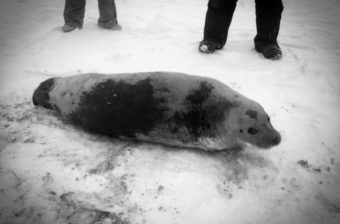
The bearded seal was released back into the wild at Nome’s west beach. (Photo by Gay Sheffield/University of Alaska Fairbanks Alaska Sea Grant)

There was good news for some marine mammal advocacy groups Monday. An appeals court upheld an Endangered Species Act listing for ringed seals. But with the release of President Donald Trump’s 2019 budget, the entire day wasn’t a victory.

Trump proposes eliminating federal dollars for several programs with a presence in Alaska. One of them is the Marine Mammal Commission, an independent oversight agency that reviews the federal management of marine mammals.

Peter Thomas, the executive director, says he wasn’t necessarily surprised by the cuts. Trump proposed zeroing out the funding for last fiscal year.

But he says the work the Commission does in Alaska is especially timely and important. It focuses on issues like subsistence hunting and climate change.

And Thomas says the Commission helps communicate Alaskans’ concerns to policy makers in D.C.

“I mean, we’re in Washington, we’re a long ways away,” Thomas said. “And just having a better understanding of how things operate in Alaska and Alaska Native communities can only help to bring understanding here to Washington.”

The Commission has brought Alaskans to the nation’s capital to advocate and held “listening sessions” in the state to learn about climate impacts on marine mammals.

Trump’s 2019 budget also proposes nixing federal dollars for Alaska Sea Grant, which supports research funding at the University of Alaska Fairbanks, among many other things.

Sen. Lisa Murkowski had this message for those worried about the proposed cuts:

“Don’t get too exercised about things if you see it’s been zeroed out,” Murkowski said. “This is just the first step in a very multi-step process.”

Murkowski stated she hopes Alaskans will make it clear to the delegation what the funding priorities should be.

Liz Ruskin contributed to this report. 

New federal report looks at wildlife in a changing ANWR

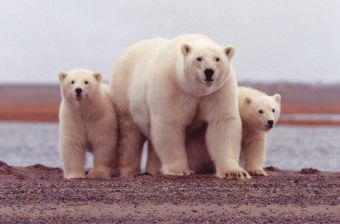
A polar bear mother watches carefully with her cubs along her side along the Beaufort Sea. (Photo courtesy USFWS)

When the Arctic National Wildlife Refuge (ANWR) opens up to drilling, this largely untouched land could have new visitors as oil and gas exploration gets underway.

So, what does that mean for the animals who already live there? A new federal report doesn’t answer that question. But it does provide some context for what to expect.

When Congress passed the Republican tax overhaul bill in late December, Todd Atwood didn’t realize opening ANWR was part of the package deal.

He’s a polar bear biologist with the United States Geological Survey. And while he says the speed of the decision was unexpected:

“You know, from a science perspective, we’re not caught off guard by this.” Atwood said. “This is stuff we’ve been thinking about for a while.”

By “stuff,” Atwood is referring to the place where humans and polar bears meet.

Polar bears are listed as threatened under the Endangered Species Act.

Atwood says, historically, Beaufort Sea bears would den in the winter on ice. That was the case 15 years ago when his agency put together a report on animals living in ANWR. But an update to that report suggests that larger numbers of polar bears are denning on land.

Also, the bears are coming ashore to scavenge for food, as the quality of sea ice diminishes.

Atwood says it’s like two worlds more frequently coming together.

“People and polar bears in the same place and then a big pile of tasty bow head whale scraps to attract the bears and keep them focused on that area,” Atwood said.

Now, add to that the industrial activity one could expect in a newly opened ANWR. Roads would have to be built, and down the line, platforms for oil rigs.

Atwood says there are some uncertainties.

“How many people are we going to have sharing space with how many bears that doesn’t shake out in a way that bears aren’t at risk and people aren’t at risk?” Atwood said.

He says the concern is that polar bears could be driven from their den earlier than normal from all the racket — especially during a build up phase.

But Atwood says wildlife biologists aren’t completely in the dark with how it could play out.

The far north has experienced something like this before.

 “The Prudhoe Bay industrial footprint,” he said. “They’ve been sharing space with polar bears for decades now.”

Once the infrastructure is built, Atwood says there are ways to mitigate harm. Oil companies have to comply with federal guidelines and report polar bears denning nearby. Infrared technology has been used to make that detection easier.

A mother polar bear and cub on the Endicott Road in Prudhoe Bay. (Photo courtesy of the United States Geological Survey)

Last year, Hilcorp shut down a road for a few weeks, as a mother bear emerged from a den with her cubs.

But polar bears aren’t the only iconic animal to use the national wildlife refuge. The Porcupine caribou herd migrates through and their calves are born in the refuge in the summer months.

While oil production is still a ways off, Todd Atwood says the more we can learn in the interim about the wildlife, the better.

“My attitude is science can only help us in understanding what’s likely to happen,” he said.

He says an abundance of research is how you make management interventions — if the time comes.

Atwood is going into the field with his team this spring to study denning polar bears and cubs.

Site notifications
Update notification options
Subscribe to notifications