Elizabeth Jenkins, Alaska's Energy Desk - Juneau

How can the U.S. Forest Service keep up with Alaska’s tourism boom?

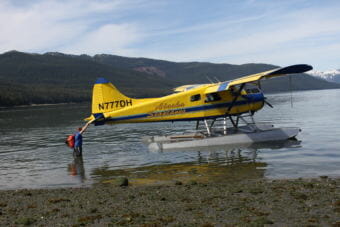
Dan Kirkwood says the part of this location’s appeal is that float planes could make due without a dock. (Photo by Elizabeth Jenkins/Alaska’s Energy Desk)

Southeast Alaska is projected to see upwards of one million tourists this year. Many of those visitors will venture into the wilder parts of the Tongass National Forest for a guided hike or bear viewing, and that requires a special use permit from the Forest Service. But as tourism increases and federal budgets shrink, a permitting backlog has been growing.

Dan Kirkwood, a guide with Pack Creek Bear Tours, recently took a float plane to a remote spot in the Tongass National Forest. But the purpose of his trip wasn’t to spot a bear. 

“We’re here because this is an outstanding, cool location that we have the opportunity to explore in the Tongass,” Kirkwood said. “And we’re really excited about getting access to a new place. So we want to scope it out.”

The scenery includes a big broad meadow and rapids that will squirm with salmon when the fish spawn.

This is Kirkwood’s and his guiding partner’s first time here. They want to see if it’s a good place to bring small tours of up to five people: visitors who want to experience brown bear country up close with the safety of a guide.

“For us, this is the wilderness. This is a place that’s unfamiliar,” Kirkwood said. “But [for bears] this is main street. This is their living room. The trails in here having probably been used for centuries.”

But to be able to bring people into this bear’s house, Kirkwood must first receive what’s called a special use permit from the U.S. Forest Service, and he might he have bit of wait.

There’s a backlog of well over 6,000 of these permits nationally. That includes a variety of commercial interests. In the Tongass specifically, there are dozens of recreation outfits waiting to hear back.

Kirkwood wonders how the forest service will manage to process all of the special use permits, which seem to be piling up.

“I think that we just really need the forest service to really buckle down and focus on tourism and plan long term,” he said.

Dan Kirkwood and Bjorn Dihle get ready to check out this area in the Tongass National Forest, which could be the sight of future bear tours. (Photo by Elizabeth Jenkins/Alaska's Energy Desk)
Dan Kirkwood and Bjorn Dihle get ready to check out this area in the Tongass National Forest, which could be the sight of future bear tours. (Photo by Elizabeth Jenkins/Alaska’s Energy Desk)

The reason for the backlog has nothing to do with bears. Wildfires are burning a massive hole in the agency’s budget.

Twenty years ago, wildfires accounted for 16 percent of the forest service’s annual funds. In recent times, that number has ballooned to more than half of the budget, a phenomenon attributed to longer burning seasons due to climate change.  

Patrick Shannon manages the Alaska Forest Fund for the National Forest Foundation, which was created in 2015 to help the forest service maintain its national lands in Alaska after funding continued to be slashed. 

“What that has done is it’s taken away money the forest service could use, for instance, for recreation,” said Shannon.

Shannon is hopeful that more help is on the way. Congress recently granted the forest service the ability to tap into additional emergency funds.

“They haven’t identified where that other money is going to come from yet,” he said. “But the first step is to give them the authority to spend other money.”

That won’t happen until 2020.

In the meantime, Congress did increase the forest service budget for this fiscal year. But it’s still too early to tell if it’s enough to compensate for the wildfire season to come and how that will shake out for recreation funding.

Packing up after scouting out the area, Dan Kirkwood concludes this spot in the Tongass has plenty to offer.

“We would definitely apply for permits here,” he said. “It’s fabulous bear habitat. The scenery is off the charts.”

But he’s uncertain how long it will be before he can show it to tourists. According a regional forest service spokesperson, a special use permit can take up to two years.

And Kirkwood doesn’t see the demand to explore these wilder places slowing down.

State wants public input on how to spend Volkswagen settlement money

The Volkswagen emlbem on the grill of a Jetta.
The Volkswagen emblem on the grill of a Jetta. (Creative Commons photo by Ben)

The state wants feedback on how to allocate millions of dollars of settlement money from the car company Volkswagen.

Between 2009 and 2016, the company sold vehicles that were equipped with so-called “defeat devices,” which illegally masked the cars’ actual pollution during emissions tests.

Alaska will receive $8 million as part of Volkswagen’s settlement with a federal agency. Last year, the governor appointed the Alaska Energy Authority to help manage the funds.

Spokesperson Katie Conway said the public has until July 1 to weigh in.

“I think the highlight here is that we’ve been hearing about this case for a really long time, and now it’s Alaska’s opportunity to figure out the best use of the funding that we get as a state for what Volkswagen did,” Conway said.

The legal settlement defined the type of projects that could receive funding, including investments in electric vehicle infrastructure or upgrades to diesel-powered transportation, like ferries and buses. The energy authority wants public input on what to prioritize.

Based on those comments, the agency hopes to finalize a plan this summer and start accepting proposals by August.

Awards could be announced later this fall.

Wolves are eating sea otters near Gustavus. What does that mean for the deer?

Sea Otters
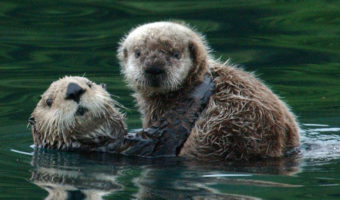
Sea otters eat clams, mussels, sea urchins and crab. (U.S. Fish & Wildlife photo)

Biologists are investigating a surprising connection between two animals that aren’t exactly well loved in parts of Southeast. Gustavus locals suspect wolves are picking off deer at a popular hunting spot on an island near the mainland. The wolves started swimming over to feast on the deer about five years ago.

But on a recent camping trip, a Gustavus man realized the wolves weren’t just eating deer. One notorious marine predator appears to be the prey.

Greg Streveler has worked as a field biologist all his life. He’s retired now. But that doesn’t mean he doesn’t find plenty of work.

When he camped on Pleasant Island — just off the coast of Gustavus — he saw another opportunity to spring into action.

On his trip in March, he noticed numerous wolf signs and six dead sea otters.

“Well, it varied from bleached out bones … to blood on the ribs,” he said.

He says it looked like the wolves were so hungry, they were eating everything they could find, and he wondered if scavenging sea otters was a last resort.

Then he noticed something else that could help answer his question.

“Concentrations of scats like I’ve never seen,” Streveler said.

In that moment he knew how he could be of service. He asked his daughter to bring an entire box of plastic bags which kept him pretty busy. Thankfully, his family was OK with his unusual hunt. His daughter even helped out.

They collected more than 40 bags of wolf scat, but they still needed a place to send it. As a former employee of the Alaska Department of Fish & Game, Streveler felt like he knew the right place.

“Oh, I just put it in a five gallon bucket and put it on the airplane,” he said.

Gretchen Roffler holds one of the bags of wolf scat collected by Greg Streveler. (Photo by Elizabeth Jenkins/Alaska's Energy Desk).
Gretchen Roffler holds one of the bags of wolf scat collected by Greg Streveler. (Photo by Elizabeth Jenkins/Alaska’s Energy Desk).

 In an industrial area in the capital city, Gretchen Roffler fiddles with a lock on what appears to be a metal shed.

“This is a big freezer,” she said. “This is where we store the animal parts.”

Inside this freezer in Juneau there are goat skulls and moose jaws and Streveler’s five gallon bucket.

Roffler, a biologist with fish and game, says she appreciated the find because she’s been amassing wolf scat from areas around Southeast for about three years. Just looking at it, she can guess what the wolves are eating.

“So for example, here you can see these hairs sticking out of the edge,” she said describing the contents of the plastic bag.

But to get a more detailed snapshot, you have to analyze the DNA of all the different prey. She plans to send these samples off for analysis in the summer.

Roffler knows what wolves eat for dinner varies seasonally and from place to place. Wolves are opportunistic. In some locations, they eat moose or deer. Around Point Gustavus, however, the common prey that’s showed up in past lab results has been sea otter.

“It’s not something we’ve seen so far in other parts of Southeast,” she said.

Biologists aren’t sure why that’s happening. But better understanding the various prey species in scat could provide a clue and influence management decisions down the road.

Streveler says Gustavus hunters weren’t thrilled when more wolves started swimming over to Pleasant Island to eat the deer.

“That was our main meat source,” he said. “People are big time disgusted about it.”

He wants to know if this is still one wolf pack swimming over. He doesn’t think that would bode well for the island’s deer. It’s like finishing your dinner at one restaurant and moving on to the next. Chances are you’ll want to go back to your favorite restaurant again.

“One thing we really want to know is what’s the connection between the wolves on the island and the wolves on the mainland.” he said.

The scat he collected could help make that distinction.

As for the gnawed on sea otters, Streveler acknowledges how people in Southeast could read that as some kind of poetic justice. If fisherman had to pick their most disliked marine mammal, sea otters might win. They’ve sunk their teeth into favorite fishing spots, and now the predator is becoming the prey.

But Streveler says both animals teach us the same thing about our ecosystem and ourselves: Everything has its up and downs. Streveler knows that.

He helped reintroduce sea otters to the region nearly sixty years ago.

“I’m not wearing it on my lapel. Let’s put it that way,” he said.

But now he’s keeping plastic bags at the ready to document the unexpected places sea otters are popping up.

How tourists could see the glacier after it retreats

Mendenhall Glacier Visitor Center (Photo by Elizabeth Jenkins/Alaska's Energy Desk)
The Mendenhall Glacier Visitor Center was built in 1962. (Photo by Elizabeth Jenkins/Alaska’s Energy Desk)

The Mendenhall Glacier Visitor Center is preparing for a future that includes more tourists and a melting attraction.
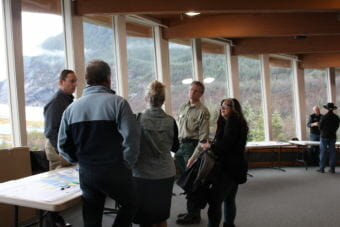
On Thursday, more than 50 people attended an open house to catch a glimpse of the new concepts. That includes expanding some of the national forest trails and creating a shuttle system to reduce traffic.

But some of the biggest proposed changes could help people get closer to the retreating ice.

John Neary, the visitor center’s director, says his agency is trying to adapt.

“The glacier we know is going to disappear within that 20 years time frame. We’re pretty sure of that,” Neary said. “So given that, and given that most people are coming here to see the glacier, we’re going to chase the glacier up the valley.”

He says small commercial boats — possibly electric — could be the solution to getting up close. The boats could take you to some kind of mobile visitor center, near the old ice caves, which would move with the glacier over time.

Docks would be built along Mendenhall Lake.

The ideas were collected after nearly two years of meetings with locals, facilitated by Corvus Design.

First, the plans have go through a federal environmental study. But the U.S. Forest service hopes to announce which projects to take on by December of this year.

Making a better “hot dog of the sea”

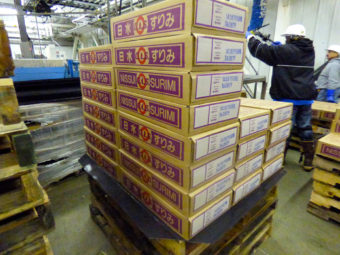
A pallet of raw surimi at UniSea's plant in Unalaska. UniSea planned to export about 500 tons of raw surimi to Russia this season. (Photo by Lauren Rosenthal/KUCB)
A pallet of raw surimi at UniSea’s plant in Unalaska. UniSea planned to export about 500 tons of raw surimi to Russia this season. (Photo by Lauren Rosenthal/KUCB)

When people think of Alaska seafood, salmon and halibut come to mind. But the state also produces a lesser-known fish product sought after all around the world: surimi, the base for imitation crab.

Now the guy who helped establish surimi in America — more than 30 years ago — is on a mission to improve how it’s made.

Tyre Lanier is a food scientist at at North Carolina State University, where he’s been since the 1970s. He has a background in the science of hot dogs.

So, working on seafood initially was a bit of a stretch for him.

“I started off trying to make hot dogs out of fish believe it or not,” Lanier said. “Then I heard about surimi.”

Or as Lanier refers to it, “the hot dog of sea.”

For thousands of years, surimi seafood has been part of Japanese cuisine. Sometimes referred to as kamaboko, it comes in a variety of flavors and shapes. 

You probably know it as the fake crab meat in most California rolls. But until just a few decades ago, you could scarcely find surimi seafood in the United States.

Lanier says there were a few reasons why early 1980s America seemed ready to adopt a version of the food. One of them was the king crab fishery in Kodiak was on the verge of collapse, and the food industry was in a race to supply an alternative.

“So they said, ‘OK, here’s this imitation that looks very much and taste very much like king crab. We can’t get king crab. Let’s bring this stuff from Japan and flood it into that market.'” Lanier said.

There was also huge potential to produce surimi domestically from pollock in the Bering Sea. But first, the state’s fisheries would have come on board. Lanier visited Alaska to talk about the possibility.

Surimi didn’t get a warm reception.

Tyre Lanier says fish bologna also didn't work out. So he turned to surimi. (Photo courtesy of North Carolina State University)
Tyre Lanier says fish bologna also didn’t work out. So he turned to surimi. (Photo courtesy of North Carolina State University)

“It was basically like ‘what is that stuff?’ and ‘we’ll never do that in the United States’,” Lanier said. “And I knew that is was going to be done here because we were buying all this imitation crab from Japan and it was taking off like a rocket.”

Eventually, though, companies came around to Lanier’s way of thinking. And the first surimi processor opened in Kodiak in 1985. Lanier credits the Alaska Fisheries Development Foundation for taking an early lead.

And now, decades later, Lanier has another big idea for Alaska. He says surimi plants are losing profits down the drain, literally. Around 40 percent of the soluble protein — from the surimi making process — winds up in the water.

“Whether it’s good or bad for the environment, I’m not qualified to say,” Lanier said. “But whether or not it’s good for food waste? It’s terrible.”

He says that wasted product could account for upwards of $60 million dollars of savings each year.

Then, there’s the impact on the ocean. According to Alaska Sea Grant, the surimi wash water can form an “oxygen-depleted goo” and “smother marine life.”

“You can look at Google Earth and look down on the vicinity of any surimi plant, and some of these are quite large, and on a given day you’ll see a big white cloud in the water,” Lanier said.

So, to reduce waste, he helped develop a technology to recapture the solids.

“Imagine making cheese. You make cheese and you get curds and whey, like Little Miss Muffet” he said. “Well, we’re doing the same thing. We basically have surimi whey.”

And that “surimi whey” can be turned into a lower-grade surimi product. He says the water that filters into the ocean would run crystal clear.

Trident Seafoods has already shown interest.

Lanier thinks, for surimi producers, this technology is a win-win.

“It solves many problems and it creates much more product for them,” he said. “For the same amount of fish, the same amount of money they’ve spent catching those fish, they can now make more product.”

Lanier doesn’t think America’s love affair with imitation crab will go away anytime soon, and now there’s now a more efficient way of getting it to market.

Site notifications
Update notification options
Subscribe to notifications