
Elizabeth Jenkins, Alaska's Energy Desk - Juneau
Alaska’s regulatory authority OKs Hydro One acquisition

Hydro One's logo on a tower at its headquarters in Toronto on May 20, 2015. Hydro One says it's Canada's largest electricity transmission and distribution service provider.
Hydro One’s logo on a tower at its headquarters in Toronto on May 20, 2015. Hydro One says it’s Canada’s largest electricity transmission and distribution service provider. (Public domain photo by Raysonho @ Open Grid Scheduler / Grid Engine)

One of Canada’s largest power companies is another step closer to acquiring electric utilities in the Pacific Northwest, including one in Juneau.

The sale hinges on multiple states’ regulatory authorities granting approval. This week, Alaska became the first state to give the okay.  

The Toronto-based power company, Hydro One, calls the decision a “milestone.” The company has spent the past year going through the process of trying to buy Avista, which is the parent company of the electric provider in Juneau.

But Hydro One will still need to get the go ahead from regulatory authorities in other states where the utility operates, like Washington, Idaho, Oregon and Montana.

If one of those states declines, the entire sale could fall through.

The Canadian acquisition of the utility has drawn some scrutiny.

In Juneau, there have been concerns over the prospect of a foreign company owning the hydroelectric dam that helps power the city, which was constructed by the U.S. federal government. Right now, the state of Alaska owns it.

One of the stipulations laid out between Avista and the City and Borough of Juneau is that things will essentially stay the same.

A spokesperson for Hydro One says — with all the states on board — it hopes to close the transaction by the end of the year.

Editor’s Note: Hydro One’s corporate headquarters are in Toronto — not Ottawa as previously stated. This story has been updated to reflect that change. 

No bids on controversial old growth timber sale … again

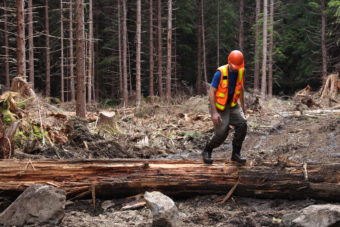
In 2014, the U.S. Forest Service repaired streams on Kuiu Island damaged by logging in the 1970s. (Photo by Elizabeth Jenkins/KTOO)

The U.S. Forest Service won’t be facilitating a controversial old growth timber sale in the Tongass National Forest. At least, not in the immediate future. The agency received zero bids on the Kuiu Island timber sale before its closing deadline on Tuesday.
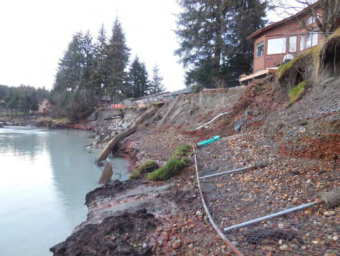
The forest service tried to sell these trees in 2016, but did not receive any offers back then either — even after all of the wood was approved for export.

The agency made changes to this latest version of the sale, reducing it by half and removing some of the more sensitive watershed areas.

But, the sale still faces a lawsuit filed by conservation groups and a tour company over its outdated environmental analysis.

One of the plaintiffs in the case says old growth logging in the Tongass is a practice that needs to end.

‘Little slice of heaven’ Juneau subdivision threatened by river erosion

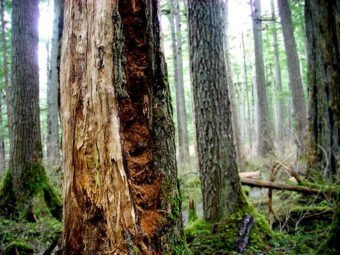
Erosion along the Mendenhall River. (Photo courtesy of City and Borough of Juneau)
Erosion along the Mendenhall River. (Photo courtesy of the City and Borough of Juneau)

In Western Alaska, the village of Newtok is in the process of leveraging federal funds to relocate. It has taken decades to find a solution. Meanwhile, in Juneau, a similar conversation is happening on a much smaller scale, where a couple of homes are at risk of crumbling into a glacial-fed river. The neighborhood can’t seem to agree: As the erosion gets worse, who should pay for it?
At first glance, the neighborhood on Meander Way looks like any ordinary subdivision built in the 1980s. But there’s a unique feature snaking along some of the home’s backyards: the Mendenhall River.

Joyce and Curt Goehring wave at paddlers floating down the river. For the couple, having the river right outside their door was a huge attraction. On their deck, they can see things they couldn’t have imagined at their old home in Utah.

“We have beavers going up and down the river everyday … Sometimes we have harbor seals come up. I mean it’s just a wonderland,” said Joyce Goehring.

A wonderland that isn’t as idyllic as it seems. Besides paddlers and seals, there’s another sight visible from the Goehring’s: down the river, you can see a couple of homes that look dangerously close to river’s edge.

The situation was alarming enough to catch the attention of a federal emergency watershed program. And for the past few years, the agency has been trying to develop a solution so the neighborhood could be placed on a priority funding list.

That plan was to essentially build a large retention wall — big enough to protect 28 homes, including the Goehring’s. It would cut off several feet of their beloved backyard.

“So we’d a walked out the door to a fence,” said Joyce Goehring.

(Photo by Elizabeth Jenkins/Alaska's Energy Desk)
Joyce and Curt Goehring in their backyard on Meander Way. (Photo by Elizabeth Jenkins/Alaska’s Energy Desk)

Each homeowner would be responsible for paying up to $80,000 to build the wall, but that’s not what the Goehrings say upset them most about the plans. The vast majority of the money was to be spent from federal funds.

“Just the absurdity of it all really fired us up,” said Curt Goehring.

“Especially when you have all those people from California from the fires and the flooding and stuff,” Joyce Goehring added. “That, in our opinion, is what government funds of that nature should go to.”

The Goehrings say they knew the risks when they bought this property.

River erosion isn’t anything new. In fact, some of the homeowners who live on Meander Way built their own retention walls back in the 1990s. But what they couldn’t have expected was a surprise climatic event that would speed it up.

Seven years ago, the couple saw the river rise in a matter of hours. Water started seeping into their grass.

“We were just standing there watching going, ‘Wow, is this normal?’ And our neighbor over here said, ‘No, this is not normal,'” said Joyce Goehring.

Eran Hood, a professor of environmental science at University of Alaska Southeast, says when the water started to rise back in 2011 it was a “huge mystery.”

“It was July, it was sunny and it was a beautiful day,” Hood said.

After receiving concerned calls from the city’s emergency response coordinator, he boarded a helicopter to try to figure out what was going on. He flew above the Mendenhall Glacier, which feeds the river.

“You don’t have to fly very far up before you see Suicide Basin, and as soon as we pulled the helicopter into the basin you could see all these icebergs stranded,” Hood said. “So, it was very clear that it had been full of water.”

That water used to be ice flowing down from the Suicide Basin Glacier. But as that glacier retreated, due to warming, it carved out a bowl.

“That’s why this area is flooding now is because this basin is essentially a bathtub that can be filled up with millions of gallons of water,” Hood said.

And that’s bad news for the Meander Way neighborhood. Because once that water spills over, it flows under the Mendenhall Glacier and eventually floods into the river. It’s happened every summer since 2011 — with some years being worse than others. Hood says this type of event could go on for decades, and it’s possible the flooding itself could become more severe.

U.S Geological Survey webcam picture of Suicide Basin taken June 29, 2016.
U.S Geological Survey webcam picture of Suicide Basin taken June 29, 2016. (Photo courtesy of U.S.G.S.)

Back on Meander Way, Nico Bus describes some of the damage in one of the home’s backyards.

“All that is sloughing off, too. See where the rock is falling and the lawn starts sagging,” Bus said.

Bus has lived on Meander Way for about 30 years, almost as long as the neighborhood has been around.

Lately, he has been playing the role of community organizer, knocking on doors trying to get everyone to reach an agreement, so the neighborhood could get some kind of uniform fix for the river erosion.

He says the federal plan to build a giant retention wall between the river and the homes wasn’t perfect, but it was better than the alternative.  

“Without it, your backyard is going to be gone completely,” he said.

In the end, Bus wasn’t able to drum up enough support in all 28 houses along the river. And with the neighborhood divided, the Juneau Assembly decided in May it didn’t want to force the issue and facilitate the federal funds.

Bus says his backyard isn’t bad off. He’s done his own work to try to secure a barrier. But when he sees the river inching closer to his neighbor’s home — just a few doors down — he wonders if that’s his future.

Curt and Joyce Goehring, the couple from before, agree with Bus that something should be done about the neighborhood erosion, but not at the expense of millions of dollars of taxpayer money. They have considered contributing to some kind of community nonprofit, where the most vulnerable homes would pitch in more, so someday, they could all fix the erosion problem themselves — as neighbors.

But Joyce Goehring says right now she’s just ready to move on.

“I don’t care if their houses go down the river at this point. I am just done,” Joyce Goehring said. “We’re responsible for this little slice of heaven, and that’s what I’m concerned with right now.”

But the Goehrings are looking to share their “little slice of heaven” with someone else.

Their home will be up for sale this summer.

This old growth timber didn’t sell last time. Can it attract a buyer now?

A fire left its mark on this Tongass National Forest tree trunk, as seen in 2008.
The Tongass National Forest. (Creative Commons photo by Xa’at)

A controversial old growth timber sale in the Tongass National Forest has undergone a few changes before coming back on the market. The U.S. Forest Service removed some of the more sensitive watershed areas included in the original offer, which received zero bids back in 2016.

Owen Graham, with the Alaska Forest Association, says he chuckled when he saw the forest service was being sued by conservation groups over this latest version of the Kuiu Island timber sale.

“If somebody did buy it, I hope they could make it work,” Graham said. “But I’d be surprised. It looks like a loser to me.”

A “loser” — in Graham’s words — that he thinks wouldn’t pencil out for a buyer in the domestic or export market.

Kuiu is extremely remote. Plus, the sale is now almost half the size of what the forest service originally planned.

Those factors, Graham says, make it difficult to turn a profit. He thinks the forest service is trying to supply the last few remaining timber jobs.

But increased regulation has limited what areas can be logged, and he says the Kuiu sale reflects that.

“Now, the industry is in jeopardy,” Graham said. “And so, they’re scrambling around to find anything they can to keep the industry alive.”

Buck Lindekugel with the Southeast Alaska Conservation Council agrees with Graham on one thing: this latest attempt by the forest service looks like a scramble.

Lindekugel is a grassroots attorney, and his group is suing the forest service over the sale on Kuiu island. He hopes it discourages a buyer.

“Any purchaser is going to know that we filed this lawsuit before they decide whether they’re going to bid on it,” Lindekugel said.

The forest service started preparing the Kuiu Island timber sale eleven years ago, and it’s original plans probably wouldn’t fly today. The agency has since moved away from selling trees in valuable watersheds next to salmon streams. It dropped some of those areas in the sale this time around.

But Lindekugel says it didn’t update its environmental analysis.

“The previous environmental analysis they did for this over eleven years ago is stale,” Lindekugel said. “[It] doesn’t reflect current conditions and therefore, could not possibly evaluate the effects of this sale in today’s world.”

Lindekugel says the north end of Kuiu island has become a popular spot to take in the scenery for small cruise ships.

Tourism, he thinks, is a better investment for the future of the Tongass.

The forest service is accepting bids on the Kuiu Island timber sale until June 5.

The U.S. Forest Service sued over Kuiu Island timber sale

In 2014, the U.S. Forest Service repaired streams on Kuiu Island damaged by logging in the 1970s. (Photo by Elizabeth Jenkins/KTOO)

A controversial old growth timber sale in Southeast Alaska is going to court.

Conservation groups and a tourism operator are suing the U.S. Forest Service over the Kuiu Island timber sale. The lawsuit was filed on Wednesday in Alaska’s federal district court.

In 2016, the wood from the parcel was approved for export, but the forest service received zero bids in the sale.

On May 5 of this year, the timber sale went out for bid again. This time, with less acreage than what was originally planned. The forest service removed some of the more sensitive watershed areas.

The plaintiffs in the lawsuit allege the forest service’s environmental analysis is outdated and violates federal environmental protections. They’re concerned the logging would still damage important salmon habitat and wreck the view, which tour operators have come to rely on. The original environmental assessment was conducted by the forest service 11 years ago.

The forest service is accepting bids on the Kuiu Island timber sale until June 5.

Site notifications
Update notification options
Subscribe to notifications