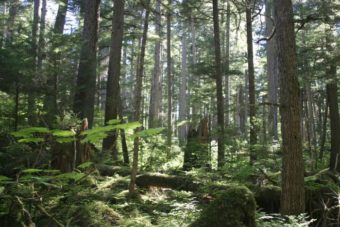
Tongass National Forest (Creative Commons photo by Henry Hartley)
Last month, the U.S. Forest Service announced it would be taking steps to build new roads in the Tongass National Forest. Now, the agency is asking for public comments.
Federal legislation prohibits most states from constructing roads on wilder parts of national lands. But Alaska has been in a decades-long battle to change that.
One of the reasons is having enough access to harvestable timber. Over the summer, Sen. Lisa Murkowski visited the last large mill in the region. But the forest service maintains that Southeast Alaska’s dying timber industry isn’t the only reason the agency is considering the state’s ask. There are other economic opportunities, like mineral exploration, which would benefit from new roads.
This process has drawn sharp criticism from environmental groups and tour operators, who say this conversation shouldn’t be rehashed — especially, since the forest service has already gone to great lengths to collaboratively manage the Tongass.
The forest service hopes to have a decision on Tongass roadbuilding by 2020.
The agency will be holding public meetings throughout Southeast Alaska in September and taking public comment until Oct. 15.
Public meetings are planned for Juneau on Sep. 13, Ketchikan on Sep. 17, Hoonah on Sep. 17, Craig on Sep. 18, Angoon on Sep. 18, Point Baker/Port Protection on Sep. 19, Wrangell on Sep. 24, Sitka on Sep. 24, Petersburg on Sep. 25, Yakutat on Sep. 25, Kake on Sep. 26, Anchorage on Sep. 26, and Washington DC on a date to be determined.
Editor’s note: A previous version of the story misstated when the U.S. Forest hopes to have a final decision. That’s planned for 2020, not next year.
The capital city has been one of the most enthusiastic adopters of electric vehicles in the state. There are now more than two hundred EVs on the road. But that technology isn’t limited to the pavement.
One man is on a mission to bring the first fully electric passenger vessel to the water in Juneau.
There’s no rumble of an internal combustion engine on the Tongass Mist. Instead, it glides along the water quietly — which is tranquil but weird.
You can hear the whine of the electric motors, the whoosh of the water and that’s it.
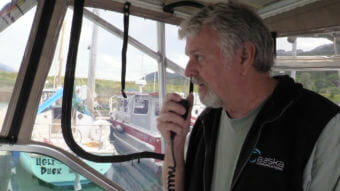
Bob Varness wanted to go fishing with the electric boat during the salmon derby. But he didn’t want to get fish slime in his electric battery hull. (Photo by David Purdy/KTOO)
“It turns a lot of heads,” said Bob Varness. “I mean, no matter where I go, and it will probably happen today, once we get over to the lightering dock, if there’s a vessel in there pitching fish off, people literally flag you down, ‘Come on over. Is that electric?’”
Sure enough, before we’re even out of the harbor, a woman leans out of the window of her houseboat, delighted. “That’s awesome.” she calls out. “So nice!”
The Tongass Mist wasn’t always a gleaming six-person catamaran.
Varness describes the dilapidated boat he bought off Craigslist as a “shell of corroded junk.” At one point, it didn’t even float.
“I think it’s sunk twice,” Varness said.
In a surprising twist of fate, this sunken vessel was resurrected from the watery depths and has now been outfitted to run off of hydroelectricity.
The boat can maintain a charge for several hours, and Varness says there’s virtually no range anxiety for a number short excursions. It’s powered by eight lithium batteries, which he charges at the boat harbor when docked.
Fully electric boats are rare in Alaska or anywhere in the United States — especially one’s licensed for commercial passengers. Few boat manufacturers make them, even though parts are available. For those skilled enough to take a DIY approach, like Varness, the U.S. Coast Guard permitting process can be lengthy.
Still, Varness says he started this complicated project out of principal. He first had the idea at one of his old jobs — captaining a whale watching tour.
“You look out at the horizon, and you could see the brown layer of soot looking up on towards Haines on backside of shelter island,” Varness said. “I thought, wow, there’s so many boats out here right now. Something needs to change.”
The 25-foot catamaran is powered with electric batteries and a small solar panel on top. (Photo by David Purdy/KTOO)
In retirement, Varness initiated that change. His first plan included designing a two story catamaran — big enough to carry almost 50 people. He worked with a naval architect for the past six years to turn that dream into a reality. The Tongass Mist is his smaller proof of concept.
It’s cost him $50,000 to build. He’s poured hundreds of hours of labor into it — meticulously wiring all the electrical components himself.
“Actually felt pretty hopeless at one point,” Varness said. “Thought that this boat’s going to sink on paper.”
But this summer, he finally completed the Tongass Mist. Now he’s working on getting coast guard approval for the big battery-powered boat: the Tongass Rain.
John Neary, the Director of the Mendenhall Glacier Visitor Center, says he appreciates locals, like Varness, helping advance the technology. In a couple of years, they might need it.
It’s projected the glacier won’t be visible from the visitor center in about 20 years. But tourists will still want to see it. Neary says the U.S. Forest Service is considering electric boats to bring tourists closer to the retreating glacier.
“We’re thinking it might be easier, cleaner, quieter to have a slow engine doing just a few knots that would be electric-powered,” Neary said. “Because the technology is there now, and it will soon be there as people push the technology forward.”
Varness isn’t the only entrepreneur eyeing the potential of electric boats. Gastineau Guiding, a tour company, is also designing a blueprint for a large electric vessel.
But for now, the Tongass Mist is the only fully electric tour boat in Juneau.
Back out on the water, Varness, says he hopes to have customers on board next summer.
“Basically, it’s my dream boat. It’s everything I ever wanted,” Varness said. “If I don’t build another one, that’s OK. I got mine.”
Varness recently got the Tongass Mist insured. By default, he received almost a million dollars in coverage if the vessel sinks and leaves an oily sheen.
He was thrilled to tell his insurance provider that would never happen.
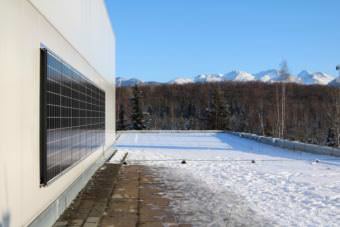
Solar panels installed at the Administration and Humanities Building on UAA’s campus. (Photo by Samantha Davenport, Alaska Public Media)
Governor Bill Walker’s Climate Action Leadership Team is trying to envision innovative ways to reduce carbon emissions in Alaska. For inspiration, task force members are looking to Connecticut, where a state-sponsored bank has helped loan millions of dollars for energy efficiency projects.
Bert Hunter has a favorite project the Connecticut Green Bank has helped fund. You can almost hear hear his eyes sparkling through the phone as he describes it. An old textile mill is being transformed into shops and affordable housing, and on site is a built-in hydroelectric dream.
“Literally, a river will run through it,” Hunter said with a chuckle.
That river will generate power for the building through two turbines — lowering energy costs for the residents.
Hunter is the Connecticut Green Bank’s Chief Investment Officer, and he admits this is unusual project for a conventional bank loan. He says those barriers to installing energy upgrades can exist for regular homeowners, too. Not just big ambitious commercial projects. That’s because in the eyes of a traditional bank, a loan for something like a kitchen remodel is typical.
“But if you start talking about solar and energy efficiency … you know, most bankers don’t know how to approach that,” Hunter said.
Hunter says the concept of renewable energy is still relatively new, which can make traditional banks cautious. But the Connecticut Green Bank has enough leverage to put those lenders at ease.
Hunter explains the Connecticut Green Bank partners with credit unions and community banks, acting like a conduit. For residents who apply, that’s where the money comes from. If a homeowner does default on their loan, it’s the Green Bank that shares the burden of paying back those cost.
This lowers the perceived risk for lenders, and it’s how Hunter says they can offer single digit interest rates for energy efficiency projects.
In the six years it’s been around, the Connecticut Green Bank has more than doubled its initial investment of $70 million dollars, and states like Alaska are starting to take notice.
“We’re talking about setting up an enterprise that is going to make money,” said Chris Rose, who serves on Governor Walker’s climate action task force.
Rose is a big fan of establishing a green bank here. It’s included in a draft policy, which is expected to be submitted to the governor next month.
Rose thinks Alaskans could save a lot of money by making their homes more energy efficient.
“In the past, the state spent over a half a billion dollars to do that very successfully. But we don’t have that grant money anymore,” he said.
Rose says a system that operates like a business makes a lot of sense. You put money in and that money comes back in the form of interest.
But Alaska has a huge budget deficit. So, where would that initial money come from?
“I don’t think a green bank would be a huge lift,” Rose said. “I do think the issue of where the money is going to come from is a big question. A carbon tax is just one potential source of revenue.”
Rose says to look at what other states are doing. At least seven have proposed carbon pricing legislation. Alaska should be thinking long term.
Connecticut didn’t establish its green bank with a carbon tax. It transformed an existing energy program and collects a small fee on utility payments.
However Alaska decides to go about it, Bert Hunter has some advice: get the state on board and start with a pot of money.
“Alaska is no stranger to making these kinds of investments,” Hunter said.
Hunter is talking about Alaska’s Permanent Fund Corporation. It invested close to a hundred million dollars in a leading financier of renewable energy this year.
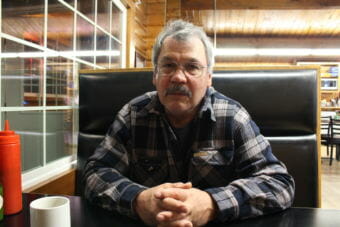
Mike Douville in a diner in Craig. Douville serves on the regional advisory council that makes recommendations to federal subsistence board. (Photo by Elizabeth Jenkins/Alaska’s Energy Desk)
On Thursday, the U.S. Forest Service said it was taking steps with the state to allow new roads to be built in the Tongass National Forest. It’s been a decades-long battle, and people have expressed mixed feelings about the announcement.
Mike Douville has lived on Prince of Wales Island his entire life. But he says the island doesn’t look the same. Now, there are large clear cuts where old growth trees used to be. He’d like to see an end to industrial logging — at least, in his lifetime.
So, hearing that new roads could be built in the Tongass, which would increase access to timber, was a huge disappointment.
“You got to look at the impacts on wildlife as well as people who live here,” Douville said. “I’ve said this before, I’ve lived here since 1949. All of the trees were standing here when I was kid. Now we don’t have that much left.”
But logging isn’t the only reason the forest service and the state want the ability to build roads in the national forest. There are communities in the Tongass that don’t have clear cell phone reception.
Greg Mickelson, with Alaska Power & Telephone, doesn’t provide cell service, but the company could potentially provide the electricity if there were new roads.
“Personally, I think because I’m in the power business, the Roadless Rule [exemption] will be beneficial to us to be able to access future hydroelectric sights,” Mickelson said.
The forest service has already allowed some exceptions for hydro projects like this in the past.
But Mickelson says the ability to construct new roads in the Tongass is also important for local economies — dependent on timber and mining.
The last large mill on Prince of Wales Island, for instance, is the utility’s biggest year-round customer.
“We’re all in this together,” Mickleson said. “I’m not a anti-environmentalist, but I also know that people have to be able to have a job if they want to be able to live.”
Dan Blanchard, the CEO and owner of UnCruise Adventures, says people don’t come to Alaska to see clearcuts. He says tourists want to experience the “pristine wilderness” of the Tongass — roadbuilding unchecked could hurt commercial interests.
But he’s not opposed to new roads being built entirely, and the state has said it will include tour operators in the conversation.
“So, with that I feel a lot more comfortable,” Blanchard said. “Or maybe comfort isn’t the word? Maybe I don’t feel as anxious.”
Blanchard says he’s open to hearing more dialogue. A state-appointed committee will discuss road building in the Tongass for the next two years.
They’ll be looking at the roadless rule — the federal regulation most states have to follow that Alaska has been fighting for years — and how it applies to the Tongass.
Chris French, who works in forest service’s Washington, D.C. office, says his visit to Alaska gave him some perspective.
“Everyone had a slightly different opinion and that made us say, ‘this is much broader than just a timber issue.'” French said. “And it’s important that we go through a process where we hear all those voices before we make any decision.”
French says new roads could allow access for cell towers to be built and mineral exploration.
Back in January, the state petitioned the forest service to consider an Alaska exemption to the roadless rule.
The forest service wants to finalize the details in less than two years — pending several rounds of public comment and an environmental assessment. First, the governor’s office will have to assemble an advisory committee to help oversee that.
In 2016, the forest service released a plan for the Tongass. It included phasing out old growth logging and was created with years of community input.
But French says that could change.
“The reality is yes,” French said. “Depending on what comes out of this. Whatever that rule is. If it changes from the status quo, then we’ll likely have to re-look at that plan.”
This latest announcement comes on the heels of a trip Sen. Lisa Murkowski made to a timber mill last month with a top federal official.
Colorado and Idaho have pushed for similar measures to build new roads on their national lands.
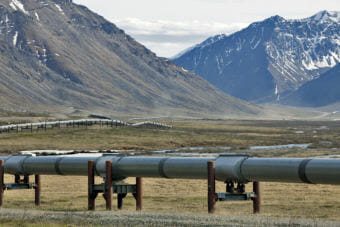
The Trans-Alaska Pipeline runs alongside the Dalton Highway near the Toolik Field Station on June 9, 2017, in the North Slope Borough. (Photo by Rashah McChesney/Alaska’s Energy Desk)
Governor Bill Walker’s Climate Action Leadership Team has been discussing a robust draft plan to tackle climate change. The draft mentions a number of ways to go about that: from beefing up efforts to monitor ocean acidification to better educating the public on the causes of warming.
But the state is going to need a way to pay for it all, and the plan addresses that, too: Alaska should consider a carbon tax.
Task force member, Luke Hopkins, lives in a home in Fairbanks built on permafrost. As the climate warms, he says his own foundation is changing.
“I would say that if I put a ball on the floor, one aspect of my house, it would roll a little bit,” Hopkins said.
It’s not a problem Hopkins sees going away. He thinks Alaska needs to update its engineering and design standards to better respond to homes like his on melting permafrost.
The draft climate action plan includes language to do that, but those efforts require more research and that requires money.
“Where’s that going to come from? Hopkins said. “Well, carbon pricing has been used elsewhere in the country and in the world. And so we think we think we ought to look at it.”
At least seven states have proposed carbon pricing legislation. Carbon pricing is basically this broad term for putting a price on CO2 emissions. It includes things like a carbon tax or a cap and trade program.
Alaska’s draft plan recommends the state should think about endorsing a national strategy to put a price on carbon while also taking steps to implement its own carbon tax. The most commonly talked about ways that could work is, as fuel comes out of the ground, oil and gas companies would pay a fee.
And that cash would be used to help fund various energy efficiency projects and more studies to better understand the impacts of climate change — like, how can homeowners like Hopkins stabilize their house as the permafrost thaws?
Hopkins says thinking long term about some form of carbon pricing is a good idea.
“Many of these things have to be looked at in-depth,” Hopkins said. “We’re just putting out what our recommendations would be for the goals that we have.”
Chantal Walsh with the state’s department of natural resources co-chaired a committee with industry representatives. The group has been providing some feedback to the governor’s climate action team.
As for a state or national carbon tax, Walsh says there’s more that needs to happen before they have that discussion.
“It doesn’t make any sense to do individual states by any means,” Walsh said. “And there’s also the question of: does it do any good to be one nation doing this?”
Instead, Walsh thinks scoping out some kind of policy for putting a price on carbon around the world makes the most sense.
In a letter submitted to the climate action team, BP expressed strong reservations about a state carbon pricing program.
Luke Hopkins believes there’s still a lot that could change in the draft plan before it’s submitted to the governor by September.
But something about carbon pricing will likely be in the final version.
“I think it will stick in the plan,” Hopkins said. “I don’t think there’s an overwhelming consensus in the group recently that says we don’t want to put anything about carbon pricing. That’s why it’s in the plan right now.”
The Climate Action Leadership Team will be looking at the draft policy statement on carbon pricing when they go through the plan at their in-person meeting on Thursday in Anchorage.
Close
Update notification options
Subscribe to notifications
Subscribe
Get notifications about news related to the topics you care about. You can unsubscribe anytime.