Elizabeth Jenkins, Alaska's Energy Desk - Juneau
Things are heating up for Alaska pollock — and it’s putting them in the mood to spawn

(Photo courtesy Wikimedia Commons)
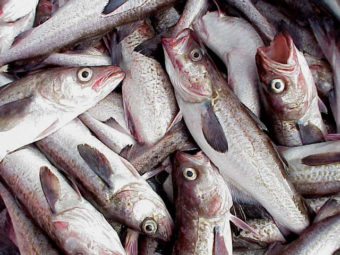
Alaska pollock. (Photo source: Wikimedia Commons)

Over the past three decades, pollock spawning times in the Gulf of Alaska have varied as much as three weeks.

That’s potentially deadly for baby fish that are spawned into an environment that’s not ideal.

Now, new research confirms what some scientists have long suspected: Warmer ocean temperatures are playing a role.

Pollock have been a big part of Lauren Rogers’ career. She works as a research fish biologist at the National Oceanic and Atmospheric Administration offices in Seattle, and you could say she takes her work home with her — and straight to the dinner table.

“I’ll go with my most common way. It’s got to be fish sticks,” Rogers said. “I have two little boys and, eating fish [sticks] that would be their preferred method.”

Chances are, those fish sticks could have originated from pollock caught in Alaska. It’s the nation’s biggest fishery.

The fish are caught in the Bering Sea and the Gulf of Alaska. In the Gulf, pollock typically spawn in the spring.

“So if it’s warmer, pollock generally spawn a little bit earlier. If it’s colder, they’re going to hold off and spawn later,” Rogers said.

But exactly when could be a crucial detail that determines the chance of survival for baby pollock. According to NOAA meteorologists, waters in the Gulf of Alaska have been warmer than normal.

Rogers said that warm water, in addition to some other factors, could signal to the pollock it’s time to spawn. Still, that doesn’t necessarily mean the food sources will be there. It could be too early.

For pollock, this could play out in two ways.

“Well, maybe you’ll get really lucky and the spring bloom will also be three weeks earlier, and then your babies are going to hit it right on time,” Rogers said. “They’re going to have lots of food. They’re going to grow up fast.”

They’re going to move out of the house, get their own apartment and go on to be productive members of the aquatic society. Or rather, take the form of those fish sticks mentioned before.

That is, if the pollock spawn their babies around the right time — when food sources are available.

“However, maybe you get it wrong?” Rogers said. “Maybe actually, it’s warm now. But it cools off all a sudden and production is a little bit delayed, and there’s not food available and your babies all die.”

Right now, the catch rate for pollock in the Gulf of Alaska has been consistent.

But scientists like Rogers are trying to understand how much variability exists in the spawn time. To get an idea, Rogers used more than 30 years of information consisting of samples from larval pollock.

“By looking at the ear bones of the larval pollock, you can actually see daily growth rings on there. And you can figure out how old they are,” Rogers said.

With some back calculating, she was able to figure out how spawning for pollock changed over time: a variation of as much as three weeks.

But the big question remains: Could this mean a future with less fish?

“Well, I think it’s not necessarily a doom-and-gloom story,” Rogers said. “But I don’t know if it’s going to be, ‘Everything’s great,’ either.”

Rogers said as the environment continues to warm, with less and less cold years, spawn time may actually become a little more stable from year to year. But that’s only one piece in the complex puzzle that is the ocean.

Scientists are trying to get a handle on how the new normal of climate change is going to affect everything else.

As the climate changes, Alaska’s DOT works to keep up

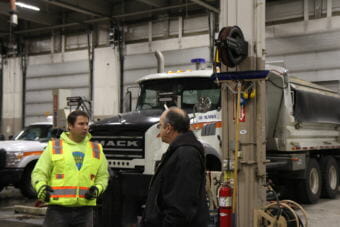
Brad Davis and Tom Grman at an Alaska Department Of Transportation garage in Anchorage. (Photo by Elizabeth Jenkins/Alaska’s Energy Desk)

Unpredictable weather events can make a daily commute a real headache. Unfortunately, that’s becoming more common in Alaska as the climate warms.

It’s something the state’s Department of Transportation is trying to adapt to.

Brad Davis often starts his days at the Anchorage Department of Transportation garage at the crack of dawn. He’s living every 4-year-olds’ fantasy, getting to sit behind the steering wheel of a big truck.

“It is fun to drive. There’s a lot going on,” Davis said.

Inside, there’s an intimidating array of buttons, switches and knobs. One deploys a watery solution on the road called salt brine; it’s a cure for slippery pavement.

It’s is a relatively new tool in the toolkit for DOT in Anchorage. The Department has been using it for about three years. Before, they relied on a mixture of sand.

To assume this is a simple operation wound be wrong. The trucks and some roads are outfitted with a sophisticated network of sensors that can detect the temperature of the asphalt. This tells drivers the ideal time to dispense the salt brine.

“These guys can be always be busy depending on a storm event,”said Tom Grman, the superintendent of the Department of Transportation in Anchorage.

He started at DOT more than a decade ago and says this refined strategy to combat ice wasn’t around then. 

“I can recall a time where we would have maybe one good freezing rain event a winter,” Grman said. “And then several winters ago, those were really prevalent.”
Now, Grman begins his day with a cup of coffee and an email notification of those temperature readings.

Meadow Bailey is a DOT spokesperson, and she said the Department has been forced to change the way it maintains its roads. Climate change has made it harder and more expensive to keep up.

There’s the freezing rain, of course. But there have been other issues, like damage to roads built on thawing permafrost and events that the department couldn’t have anticipated. In 2015, the Dalton Highway flooded, due to an extreme weather event. That limited access to the North Slope for weeks.

“Totally unique scenario no one ever heard of or thought of or could plan for,” Bailey said.

Keep in mind, this is all happening at a time when the state’s Department of Transportation has seen drastic budget cuts. For the past two years, the funding has remained flat. 

Dan Schacher, the superintendent in Fairbanks, recalls a time when his department spent $750,000 more than normal.

“We had five consecutive months during the winter that we had measurable rain in Fairbanks, which is unheard of,” Schacher said. “So it’s continuing to become more and more of regular occurrence for us, and it’s something that we’re changing our methods to respond to.”

The Fairbanks DOT was the pilot project for the salt brine trucks, which Anchorage has now adopted. It’s part of a list of efficiencies the department has incorporated, including the high-tech temperature gauges.

Schacher admits the brine solution wasn’t popular initially with some drivers who were worried about it corroding their cars. But it’s a common treatment in the Lower 48.  Alaska commuters can’t count on the winters of the past anymore.

“I think looking back it’s been good for us to go through some of the difficulties we’ve had because it made us reexamine some of our processes for the past 20 or 30 years,” Schacher said.

As for this winter, climatologists expect warm, wet conditions which can refreeze into ice.

The Department of Transportation will likely stay busy.

Gustavus households offered safe drinking water after latest PFAS scare

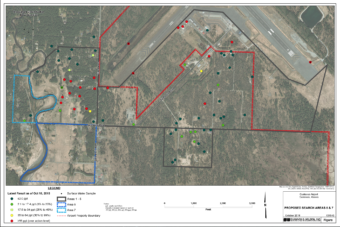
PFAS levels around Gustavus. (Image courtesy of the Alaska Department of Transportation)

There’s a kind of chemical foam used to suppress oil fires. But that foam can leach into the environment and contaminate groundwater. In Alaska, it’s been detected close to some airports and military bases in Fairbanks, where routine drills occur. It’s also cropping up in other places around the state.

Kelly McLaughlin’s family has owned property in Gustavus since the 1960s on what was once part an old territorial homestead. Most of it is close to the airport.

This past summer, she learned the state was testing water wells nearby for contaminants — specifically, a compound known as PFAS.

Many of the residents of Gustavus are on their own water system, including McLaughlin. So, she asked the state to test her water, too. She says it took some convincing, but in September, she got the results back, and she was floored. Her well tested positive for the contaminant. It had twice as much as the federal government advises for human health.

“You don’t think the water you’ve been drinking and assume is safe is poison,” McLaughlin said. “That’s not a thought that crossed my mind ever. I was wasn’t prepared for the results to be that bad.”

The state is now providing McLaughlin’s home with shipped-in jugs of water. Eleven other private wells also qualified.

A spokesperson for the Alaska Department of Transportation said this is a growing national issue, and that’s what tipped off the state to test the wells near the Gustavus airport.

Over the summer, the U.S. Centers for Disease Control and Prevention released a report suggesting that PFAS may be more hazardous to health than previously thought.

McLaughlin says she’s stayed awake at night thinking about the impact this could have on her family.

“My daughter of course drinks the bathwater and there’s no keeping kids from engaging with the contaminated water,” she said.

Exposure to the chemical compound has been to linked to an increased risk of cancer. It can affect growth and learning development in children and interfere with hormone levels.

McLaughlin says she’d like the state to offer some kind of blood tests to the residents, but so far, they haven’t made the offer.

“No. And I’ve asked and asked, and I’d given every reason I can think of,” she said. “I’d like my breast milk tested. I would like my blood tested and my kid’s blood tested. I think at the very least, it’s information that can be applied at a later date.”

The Alaska Department of Health and Social Services responded on Friday that the agency will not be conducting blood tests because “scientists do not know how blood levels correspond with effects on health from PFAS exposure.” 

In the meantime, McLaughlin is considering paying for her own test to get a baseline for her medical records. 

She’s still hoping the state will be responsive.

“This was nobody’s fault. As far as I know, nobody knew how bad these chemicals were,” McLaughlin said. “Nobody knew how far they would travel. The DOT did not intentionally poison the people in Gustavus. But it happened.”

Now, she says the ball is in the state’s court to to try to make this right.

A spokesperson for the Department of Transportation says they’re bringing in an engineer to start to develop some long term solutions.

The state is also currently taking public comment until Nov. 5 to institute some kind of enforceable levels for the chemical compound — beyond the federal guidelines.

Editor’s note: This story has been updated as new information has become available.

Will Alaska’s new governor keep Walker’s climate team?

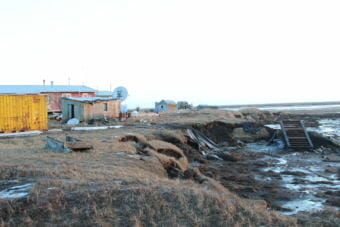
Erosion on the bank of the Ninglick River. The nearest house is now just forty feet from the edge. November 8, 2017. (Photo by Rachel Waldholz)

When a new Alaska governor takes office in December, they’ll be faced with choices: Which priorities from the previous administration should they continue to develop and which ones should they scrap? In September, a team appointed by Governor Bill Walker released a comprehensive plan to address climate change. But the work is far from over.

Lately, Kristen Lyda Rees has had her nose in a book about how huge catastrophes and natural disasters affect cultural change.

Rees is an anthropology major at the University of Alaska Southeast. And today, she’s leading a group discussion on Alaska’s Climate Change Action Plan. As a giant bowl of Halloween candy gets passed around, the conversation shifts between anxieties over the the future to questions about whether the action plan is enough to initiate change.

The plan is basically a big menu of options, including target reduction goals, establishing a bank for energy efficiency projects and considering a state carbon tax.

Rees admires some of the ideas in the document. But still:

“It is a paper report,” Rees said. “And I feel like when you focus so much of an effort into one place, it makes it easy to just sit that basket of eggs on a shelf somewhere and just not acknowledge it again. Especially, when you have something like elections, like last week.”

Last week, Governor Walker announced he would be suspending his reelection campaign. Rees already had her discussion in the works, as part of her senior project. She says the announcement changed the mood a bit — now that the policy Walker endorsed seems even more up in the air.

So, the question is: Will the two frontrunners in the governor’s race keep this team intact to work on climate change issues in the state?

“Yes, but I also want to underline that I don’t them to just meet to meet,” said Democratic hopeful Mark Begich. “I want to meet to get things done.”

Begich says that means identifying solutions that Alaskans can implement now. He points to things like improving energy efficiency in state and municipal buildings and incentivizing the private sector to invest in those projects.

But, would he support passing some kind of legislation to reduce emissions?

“I would be interested in that sure. But I want to be realistic,” Begich said. “You know, [for] the legislature to do something, while we’re waiting we’ll see a couple more villages disappear into the water. And I’d rather get busy while we’re trying to do things like that help deal with the emissions issue and not sit around and wait for things to happen.”

Begich says he wouldn’t support a state carbon tax, something that was even a sticking point for Governor Walker.

Republican Mike Dunleavy has also stated he’s not a fan of taxes. Still, his remarks about prioritizing the climate action team were different from his opponent’s.

Dunleavy’s staffers said he couldn’t squeeze in the time to talk about this. But in an earlier interview, he had this to say:

“I think we have a lot of issues that, in my opinion, are quite frankly and bluntly more important than the climate task force,” Dunleavy said. “And I’ll be focusing on these immediate issues for Alaska instead of focusing on the issues in this task force.”

Keep in mind, this isn’t the first time an Alaska governor has assembled a team to address climate change and priorities shifted after a change of power.

Luke Hopkins knows all about it. He served on Governor Sarah Palin’s work group in 2007 and recently spent months helping create the plan for the Walker administration.

“Yes, it very much could sit on a shelf,” Hopkins said.

Hopkins has been here before. In 2014, after Sean Parnell was elected governor, Hopkins jokes that report sat “high up on a shelf.” That is, until this year when some of those same ideas were incorporated into this more formalized policy.

Hopkins says now the real work to address climate change can start. But it’s hard to know what that might look like under new leadership.

“All of that has to be refined. How are you going to do some of these statements? How are you going to implement them? What is the next step for that?” Hopkins said. “Again, we certainly hope that continues. But we have to wait and see.”

Currently, Hopkins says there are no Climate Action Leadership Team meetings planned. But the team is appointed for the next two years. He expects a meeting could occur sometime shortly after the governor’s race, and Hopkins hopes it’s not another shelving of ideas, another send off.

Site notifications
Update notification options
Subscribe to notifications