Elizabeth Jenkins, Alaska's Energy Desk - Juneau
Amid environmental grief, finding hope in a graveyard of yellow cedar

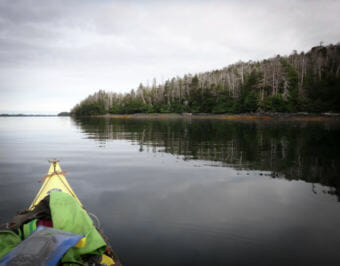
Lauren Oakes paddles to a research site in the West Chichagof-Yakobi Wilderness of Southeast Alaska. (Image credit: Lauren Oakes)
Lauren Oakes paddles to a research site in the West Chichagof-Yakobi Wilderness of Southeast Alaska. (Photo courtesy of Lauren Oakes)

Scientists have known for a while why yellow cedar is dying across its range. Without a blanket of snow in the spring, the roots can freeze during cold snaps.

Climate change has been linked to killing at least a million acres of trees across the Pacific Northwest. So one ecologist wondered, for the yellow cedar forests and the people who care about them, what comes after environmental loss?

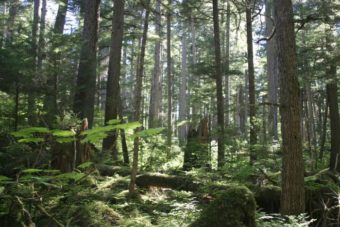
Lauren Oakes says a dead standing yellow cedar tree looks out of place, like a telephone pole on the landscape.

Over time, the branches fall off. What you’re left with is a ghostly hull. It’s the kind of image that leaves an impression.

“It made climate change that much more real to me,” Oakes said. “It often seems like it’s something future or far off or not affecting me yet.”

 Oakes is an ecologist, and she calls yellow cedar “the canary tree.” As in that old saying, “The canary in the coal mine” — a sign of impending danger. However, Oakes is quick to point out she doesn’t see yellow cedar’s fate as a doom-and-gloom story.

“It is a story of loss. But it’s also a story of regrowth,” Oakes said.

Yellow cedar is an iconic species that grows from the top of California all the way to Prince William Sound. It has been used for centuries by indigenous carvers and weavers. And commercially, it’s some of the most valuable timber for harvest. But yellow cedar is declining across its range, and that decline is expected to continue. The U.S. Fish and Wildlife Service is considering listing it as “threatened” under the Endangered Species Act.

Oakes says the science on why the decline is happening is pretty much settled: Warming is largely to blame. So, as part of her doctoral research, she traveled to Southeast Alaska with a different set of questions in mind: “How is the forest community changing in response to the death of these trees, and how might people be coping with those changes in their community?”

That is, how could she still find hope in a forest that’s turning into a graveyard?

To answer her first question — how the ecosystem itself is changing — Oakes set out to survey dead stands of yellow cedar across the region. A task she said was overwhelming because of the volume.

But she found the forest was adjusting: New tree species were growing in the newly-opened understory, and shrubs were coming up that deer like to eat. Oakes said focusing on that regrowth gave her some hope.

She also interviewed people affected by the loss and found they were adjusting, too. Oakes spoke to the late Tlingit weaver Teri Rofkar. During their conversations, Rofkar referred to yellow cedar as the “tree people.”

She appears in this Rasmuson Foundation video from 2013, gathering materials outside for weaving.

“So you look for an areas where there’s just moss starting to mature,” Rofkar explains.

In the video, Rofkar is looking for spruce roots. She explained to Oakes she was using them more in her weaving as a substitute for yellow cedar.

Rofkar thought yellow cedar could use “a break,” due to climate change.

“She was someone who had a real emotional tie to these trees,” Oakes said. “(She) certainly talked of the grief she was experiencing. But it was also something that inspired her to not only share with others the importance of offering some restraint for these trees, themselves, but then educate others about climate change.”

Like Oakes, other scientists are also starting to document more examples of environmental grief to understand how humans are adapting to a warming planet.

Oakes said acknowledging a personal loss — in this case, a culturally valuable tree species — may lead to less apathy and potentially more individual action.

It can spark a feeling of, “Wow, this is bigger than me. This is hitting home. How can I cope with that?”

Oakes recently wrote a book about this feeling called “In Search of the Canary Tree,” which is about her time spent doing research on yellow cedar in Southeast Alaska.

She said despite the tremendous loss, life is still growing. She thinks people can still change the narrative.

Alaska Made: There’s only one Christmas tree farm in Alaska. It’s on Kodiak, and it’s thriving.

xx
The Dorman Tree Farm now places small trees in a greenhouse to insulate them from the cold until they’re big enough to be transplanted outside. (Photo courtesy of Celeste Dorman)

Look around Christmas tree lots in town, and you’ll likely spot trees once rooted in the Lower 48. The trees are shipped up by the thousands during the holiday season. Varieties like Douglas fir can have a hard time growing in the state. As part of the CoastAlaska series “Alaska Made,” here’s the story of the one place to buy non-native species — grown in Alaska.

Todd Dorman moved to Kodiak in the 1970s after his family bought a cattle ranch. But his father dreamed of starting another venture.

“He looked around here and saw the native trees around here, and he said, ‘I think this would be a good place to grow Christmas trees.’ Or, they would grow here, anyhow, he thought.”

Dorman’s dad held on to the idea. He saw a niche for a Christmas tree farm, which is an unusual sight in Kodiak and most of the state.

Many of the favorite commercial decorative species don’t grow naturally this far north. It’s outside their typical ranges. Of course, native trees like Sitka spruce are just fine for decking the halls. But the needles can shed quickly, and the spindly branches aren’t to everyone’s liking.

So, in 2006, Dorman and his dad decided to embark on their long-talked-about experiment. They bought 500 small fir, pine and spruce trees from a nursery down south.

Dorman said they tried to manage expectations.

“The typical way that a farmer does something: It’s just kind of, (let’s) see what happens,” Dorman said. “So we just ordered some trees and worked up some ground and planted them out there and saw what happened.”

In the summer, the little trees looked like they were flourishing in the Kodiak soil.

“But after the first winter, it just looked like a desert,” Dorman said. “It didn’t look like anything was alive. So, it wasn’t very encouraging at all.”

The climate in Alaska is warming twice as fast as the rest of the U.S. Tree species that were once thought to thrive in lower latitudes are starting to migrate farther north.

But Dorman said the weather in Kodiak has felt unpredictable. His dad didn’t lose hope after that first harsh winter, when the little trees resembled little more than twigs sticking out of the ground.

“Out of all these bad trees, he’d find one that looked good,” Dorman said. “And (he’d) say, ‘Hey, look at this!’”

That optimism paid off. Dorman said it wasn’t a total wipeout. Most of the trees survived.

xx
Todd and Celeste Dorman at their tree farm in Kodiak. (Photo courtesy of Celeste Dorman)

The next year, the family planted 1,000 more trees. And the following year, even more.

Dorman’s father died about four years ago. But he was alive to see the tree farm make its first sale around 2012.

“I remember the very first one we sold. I’d been looking at this thing for seven years, I think,” Dorman said. “So when someone came along and wanted to buy it, I was a little freaked out.”

He remembers it was a standout Fraser fir. Noticeably, the most beautiful one on the farm. It quickly caught the attention of a father and son who borrowed a saw to cut it down.

Dorman said it’s hard to describe the feeling of letting that first tree go.

“It didn’t take long to get over it,” Dorman said. “But I was thinking, ‘OK, this is the point.'”

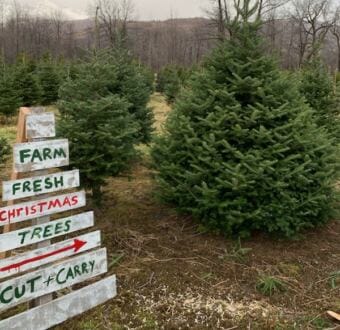
He hoped more trees would grow as lush and sturdy as that one, and they have. There are now two-and-a-half acres of Christmas trees on the Dorman farm.

Where’d the website for Walker’s climate change team go?

As of Dec. 3, this is the message you'll see if you try to visit climatechange.gov.alaska.gov.
As of Dec. 3, this is the message you’ll see in a Google Chrome browser if you try to visit climatechange.gov.alaska.gov. (Screenshot by Ryan Cunningham/KTOO)

As Gov. Mike Dunleavy was sworn into office Monday, the transition of power was also taking place online.
The Alaska Office of Information Technology is going through the process of updating the state website and editing pages with the former governor’s name.

That means websites you could access last week may not be available now. For example, the page with the state’s new climate change policy is offline.

Jeff Turner, Dunleavy’s deputy communication director, said he doesn’t know if the site will be restored. The administration is still discussing if the page will go back up.

Gov. Bill Walker appointed a climate change task force in December of last year to draft the policy, which they completed in August and formally submitted in September. But team members said that wasn’t the end of the process. Now, the state must figure out how to implement the strategies in the document.

During his campaign, Dunleavy told KTOO that the state has more important issues to deal with than those involving the climate task force.

Alaska DOT reports significant damage on Anchorage roads

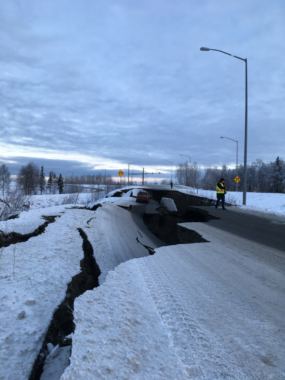
The Minnesota Drive airport off-ramp buckled by an earthquake in Anchorage, Alaska, on Nov. 30, 2018. (Photo by Nat Herz/Alaska’s Energy Desk)

There are multiple reports of damage on roads from the 7.0 magnitude earthquake.

The Alaska Department of Transportation in Anchorage has called in all available workers.

Shannon McCarthy, a spokesperson for DOT, called the earthquake “scary” and is cautioning drivers to be careful.
“I, myself, got to hide under a desk with a coworker this morning,” McCarthy said. “I think drivers, anything that’s flashing treat as four-way stop. If the lights are completely out, treat as four-way stop. Slow and steady and everyone will be able to check on their house and their family.”

Here’s a rundown of the sites DOT is currently working on:

  • Northbound and Southbound Seward Highway are back open.
  • An exit toward Palmer closed.
  • The Whittier Tunnel is currently open to traffic.
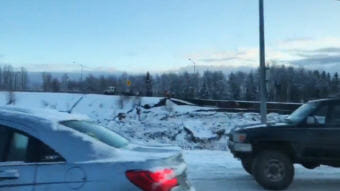
  • There’s a partial collapse of the ramp at the International and Minnesota Drive overpass.
  • There’s a sinkhole in the road at New Seward Highway at 36 Avenue, and there’s some damage on Glenn Highway at Thunderbird Falls.
  • The DOT Division of Facilities Services is conducting building assessments of state-owned buildings in the areas affected by the earthquake. Facilities staff will be working through the night and the weekend to assess damage and prepare for recovery.

DOT warns there are still many traffic lights out.

Editor’s note: This story will be updated as more information becomes available.

Can drivers feel safe on the road this weekend?

The Minnesota Dr. airport off-ramp buckled by an earthquake in Anchorage, Alaska, on Nov. 30, 2018. (Photo by Nat Herz/Alaska's Energy Desk)
The Minnesota Drive airport off-ramp buckled due to an earthquake in Anchorage, Alaska, on Nov. 30, 2018. Even though a vehicle was trapped in the middle of the damage, DOT said there were no reports of severe driver injuries. (Photo by Nat Herz/Alaska’s Energy Desk)

If you were on social media Friday, you likely saw that picture of a bridge in Anchorage that was ripped apart by the earthquake.

The area sustained massive damage to its roads. During all the chaos, northbound and southbound parts of the Seward Highway were closed. It has since reopened. But there’s still a lot of infrastructure that will need to be repaired.

So, should drivers be nervous about getting around this weekend?

Shannon McCarthy, a spokesperson for the Alaska Department of Transportation, was in the parking lot when she heard a noise that sounded like a freight train. The ground began to rumble. She said it made for a wobbly walk inside the building.

“But I walked in, and I joined one of my coworkers under her desk,” McCarthy said.

Under the desk, while the ground was still trembling, McCarthy went to work. She attempted to update DOT’s social media on a day that would be all-hands-on-deck for the department.

There were street lights out, a part of the highway closed and, most visibly, there was the partial collapse of the ramp at the International and Minnesota Drive overpass.

McCarthy said it looked almost rippled — like you could see where the earthquake waves went through it.

“It just wasn’t able to take that flexing of the earth and so that’s when you have the underlined structure the gravel of the pavement,” McCarthy said. “That’s what seems to have moved and collapsed.”

McCarthy said this is the worse damage she’s seen to roads, in recent memory, because of an earthquake — likely millions of dollars in repairs. But it could have been much worse. All of the bridges and overpasses seemed to have held up — except for the one.

Which begs the question: Can drivers feel safe going over those bridges and overpasses now, given what just happened? 

“Absolutely,” McCarthy said. “And here’s why: Bridges in particular are critical pieces of infrastructure. We don’t want anything to happen to them so we design them to be resistant to earthquake forces.”

The ramp at the International and Minnesota Drive overpass was the unfortunate outlier during the quake.

And McCarthy said in the days and weeks to come, the Department of Transportation will go out and test the structural integrity of bridges and roads, just to make sure drivers are safe.

But she does caution: If you have plans, schedule in some extra time to get from point A to point B. Commutes around Anchorage are expected to take longer.

Drivers pass the collapsed exit ramp from International Airport Road to Minn. Blvd. in Anchorage (Video still by Rashah McChesney/Alaska’s Energy Desk)

Is there something for everyone in a new vision for Tongass roads?

Tongass National Forest
Tongass National Forest. (Creative Commons photo by Henry Hartley)

Over the summer, Alaska got the go-ahead to propose its own alternative to a federal rule most states have to follow. The Roadless Rule prohibits new roads from being built in wilder parts of national lands.

It’s something the state has been battling for decades. But now, the issue seems to be moving forward fast. On Tuesday, a citizen advisory committee released new recommendations, which could shape the future of the Tongass National Forest.

The thing to keep in mind about the four new options being recommended is that they represent a spectrum of ideas about how the Tongass should be managed.

On one end of the spectrum, nothing new would really happen: Things would stay the same, and road-building would remain difficult in some parts of the national forest. On the other end, the national Roadless Rule basically wouldn’t apply to Alaska.

Andrew Thoms, with the Sitka Conservation Society, said the advisory committee weighed these options carefully.

“People saw that Southeast rural communities are facing challenges and there are no easy answers,” Thoms said.

Gov. Bill Walker appointed Thoms and 11 others to the Alaska Roadless Rule Citizen Advisory Committee in October to represent various stakeholders around Southeast Alaska. The state has long maintained the region needs better access to logging, energy and mining opportunities, and that would be easier without the Roadless Rule hanging over the Tongass.

Thoms said the group agreed they’d like to see a sustainable timber industry kept alive. But where do you strike the balance?

“I think new road-building that opens up new areas for logging, especially on landscapes like Prince of Wales that’s already been heavily impacted, could cause some big problems,” Thoms said.

Two of the options on the spectrum would scale back some environmental protections. Right now, the U.S. Forest Service can’t build roads through areas with the top salmon producing watersheds, known as the Tongass 77, or Audubon-designated habitat important for wildlife and fish.

One of the options would do away with both of those protections.

Thoms said the message the committee heard from a lot of the community meetings was this: Keep things as they are. The Forest Service has already received over 140,000 public comments on this. In fact, they’re still combing through them.

But Thoms said the Forest Service hasn’t analyzed the responses yet.

“What we’re hearing from the public … is that they want to keep the Roadless Rule in place,” Thoms said. “And the public testimony seemed to indicate that people were leaning toward a ‘no action’ alternative.”

At the public meeting in Ketchikan, the community input was more split.

Bert Burkart said that’s not surprising. He’s the President of the Alaska Forest Association, a consultant with Viking Lumber and part of the citizen advisory committee.

Burkhart prefers option D — the very end of the spectrum. The one that said the Roadless Rule basically doesn’t apply to Alaska. Still, he said he’d take the closest other outcome.

“But it’s still not what we’re shooting for,” Burkhart said.

It’s not what the state is shooting for either.

Chris Maisch, the state forester, said the state’s perspective hasn’t changed: Alaska shouldn’t have to follow the Roadless Rule.

“But we think the body of work that was done by the committee, it did reflect well what we heard,” Maisch said. “I think everyone that participated could find something about their opinion on this matter.”

Ultimately, it’ll be up to the Forest Service to decide which of the advisory committee’s options will move on for an environmental analysis — with the state acting as a cooperating agency.

It’s expected the public will get another chance to weigh in this summer. A final decision on Alaska’s Roadless Rule is anticipated by 2020.

Site notifications
Update notification options
Subscribe to notifications