Elizabeth Jenkins, Alaska's Energy Desk - Juneau
Of 140,000 comments, most favor keeping the Tongass Forest Roadless Rule

Tongass National Forest
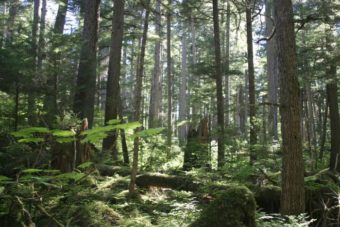
Part of the Tongass National Forest on Douglas Island pictured in 2004. (Creative Commons photo by Henry Hartley)

The U.S. Forest Service released a summary of public comments on changes to the Roadless Rule in the Tongass National Forest. The takeaway is that the majority of the comments are in favor of leaving the rule in place in Alaska, which limits most road building in wilder parts of the forest.

Over 140,000 people submitted an opinion on the controversial topic. Back in August, the Forest Service said it would consider the state’s ask for an exemption that would make it easier to build new roads through the federal land.

It was prompted by a decades-long battle over access to timber and mining.

But the themes expressed in most of the comments suggest the Tongass is more valuable without the addition of new roads. People mentioned the tourism and fishing industries as examples of business that could be negatively impacted.

Though the consensus was to essentially do nothing, the Forest Service is still working on plans to create an Alaska-specific rule.

The agency plans to release a draft environmental impact statement that the public can comment on this summer.

Alaska’s latest climate policy is still offline. So these students made a delivery to the governor.

xx
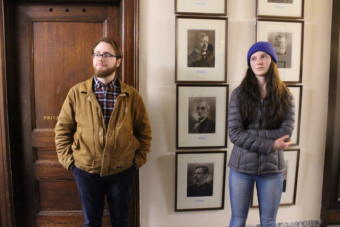
Griffin Plush and Linnea Lentfer are both former and current members of Alaska Youth for Environmental Action. (Photo by Elizabeth Jenkins/Alaska’s Energy Desk)

Shortly after Gov. Michael Dunleavy was sworn into office, the website with the state’s latest plan to address climate change went offline. It was created with months of planning by a team appointed by former Gov. Bill Walker.

Now, more than 1,000 Alaskans have signed a petition asking the new administration to consider restoring the policy to the state’s website.

On Thursday, two students arrived at the Capitol building with a delivery for the governor.

Cook Inletkeeper started collecting the digital signatures back in mid-December, after the website containing Alaska’s newest climate policy vanished.

Griffin Plush, a senior at the University of Alaska Southeast, said he thinks Alaskans should have access to these public documents. He wanted to help hand over the petition to get that message across to the governor.

“It’s really disappointing, and it’s really aggravating as a young person,” Plush said.

What these students want to see back up on the state’s website is a robust policy that responds to everything from village coastal erosion to ocean acidification.

During a transition of power, it’s not uncommon for a new administration to take things in a different direction. When Gov. Sean Parnell took office, he didn’t have much to do with a climate change report created under Gov. Sarah Palin.

However, the state’s website is still linked to it. That’s not the case with this latest policy.

Up on the third floor of the Capitol building, Plush and the other student waited to see if Dunleavy would come out of his office to receive the petition.

After about a minute, someone did come out. But it wasn’t the governor. A staffer tells them she’ll take it, but it’s not what she’d consider a legal petition since the signatures are digital and not handwritten. She says those are harder to verify.

15-year-old Juneau-Douglas High School student Linnea Lentfer said she didn’t feel like it was the most welcome reception.

But she’s going to keep asking the governor to restore the website.

“Whether we get a response or not that doesn’t mean it’s the end of advocating for it,” Lentfer said.

A spokesperson for Cook Inletkeeper said their intention with the petition wasn’t to go through the state’s legal rule-making process. The group wanted to put it on Dunleavy’s radar that a number of Alaskans are concerned.

In an emailed statement, Dunleavy’s press secretary said, “This administration has no requirement to promote a previous administration’s work product or political agenda … The working group and report in question are currently under review.”

Meanwhile, the Climate Action Leadership Team — appointed by Walker — is still having informal discussions. The plan they created is archived, and it could be hosted on another website in the future.

Forest Service reschedules meeting on Southeast Alaska timber sales

Tongass National Forest
Tongass National Forest (Creative Commons photo by Henry Hartley)

The U.S. Forest Service is allowing more planning time for a series of controversial timber sales that could take place on Prince of Wales Island.

The agency worked on the project during the partial government shutdown, which drew sharp criticism from environmental groups.
A public meeting was announced and then canceled within the same week in January.

Now, the Forest Service has rescheduled that meeting for Feb. 20 in Klawock.

Buck Lindekugel from the Southeast Alaska Conservation Council opposes large-scale logging on these lands. But he’s pleased the Forest Service is taking longer to consider his objections.

“They should have extended it, and they shouldn’t have been working on this when the government was shut down the first time,” Lindekugel said.

An email from the regional forester says that February meeting date is firm — even if another government shutdown happens again.

Crafting a story of romance and resiliency with Tongass bowls

xx
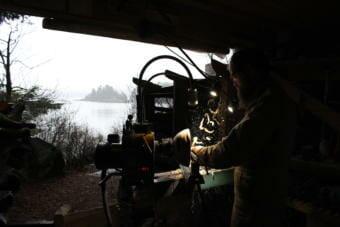
Zach LaPerriere’s workshop in Sitka. (Photo by Elizabeth Jenkins/Alaska’s Energy Desk)

There are very few products made in Alaska from lumber produced in state. That’s despite an ongoing battle over how the Tongass National Forest should be managed.

While timber sales have declined for decades, there are some new initiatives on the table now that could open up more logging.

But one Sitka craftsman doesn’t want that to happen. He’s content using dead old growth, and he makes his living creating bowls from the Tongass without cutting down living trees.

Zach LaPerriere has heard some surprising comments about the wooden bowls he sells at markets.

People reach out to touch them, admiring the detail of an exposed scar and the smooth curves.
“Some would say even sensual,” LaPerriere said with a chuckle. “They’re not my words. I’m just repeating them. I’ve think I’ve heard even more racy words than that,” LaPerriere said.

LaPerriere makes his bowls in an open-air workshop below his cabin, overlooking the water.

Before his creations made customers blush, he was employed as a carpenter.

But he said those skills didn’t necessarily translate when he took up professional woodturning five years ago.

“It really took me a year to become even mildly proficient,” he said.

For starters, the wood is spinning.

While shaping a gnarly chunk of alder into a bowl with a sharp tool, LaPerriere had to think in three dimensions. He spotted a scar that looked like pair of lips, and ribbons of alder went flying.

“I have to walk that line between being efficient and being creative,” he said.

In Southeast Alaska, not many people do this kind of work for a living. There are plenty of hobbyists, but LaPerriere is spending a thousand hours a year creating wooden bowls. He helps support a family of five this way.

Though one of his bowls can fetch up to $1,500, he admitted it’s not always a lucrative business.

Still, LaPerriere said taking this huge career leap aligned with his values.

He wanted to show people what’s inside the trees from nation’s largest national forest and help translate that story.

“Being deeply in love with our rainforest here, I want to understand what’s going on in the tree,” LaPerriere said. “I look for whatever is most unique. It might be a scar. It might be tiny little ambrosia beetles.”

Beetles that leave tiny black holes in the tree. Those are the kind of imperfections LaPerriere wants to highlight when he’s turning a piece of wood. He’s found bullet holes, axe marks from the turn of the century and one of his favorites: buck rubs. Those are the antler markings of a deer looking for a mate.

“Hunters are always looking for buck rubs,” he said. “To see a buck rub from 20 or 30 years ago, that’s an exciting thing!”

Especially spotting it as you dig into a salad bowl.

So the characteristics of the trees vary wildly. But there’s a type of wood LaPerriere said he wouldn’t consider using.

“There’s no need to cut a living tree,” he said.

xx
Some of the bowls LaPerriere creates will dry up to a year or longer before he can bring them to market, depending on the type of wood. (Photo by Elizabeth Jenkins/Alaska’s Energy Desk)

All of the wood piled up in his workshop comes from dead and down trees, which LaPerriere scavenges off the beach or hauls out of the forest himself. He has to goes through a permitting process to be able to do that on national land.

Today, there’s less large-scale industrial logging happening in the Tongass. However, recent changes at the federal level could open up new sites.

That doesn’t sit well with LaPerriere.

“I would liken it to selling your furniture to make your credit card payment,” LaPerriere said.

Instead, he imagines a future where fewer trees are harvested from the national land. And the old growth that is cut down is made into things produced in-state. Things people will want to buy and cherish. That was also identified as a priority by a former Tongass Advisory Committee, which included timber industry representatives.

Even so, LaPerriere recognizes creating wooden bowls like his isn’t the boost to the region’s economy the state is looking for. After all, he’s just one guy. But he thinks there’s something to the model.

“You know, I’m a logger, and I feel great about that because it’s something I can believe in,” LaPerriere said.

Back at his workshop, LaPerriere prepared his alder bowl for a long hibernation in the drying shed. He scribbled the location of where he found the wood on the rim.

In another six months or so, he’ll pull it out again and sand it — putting the finishing touches to get it ready to sell.

He said he likes the idea of bringing beauty into people’s lives with trees from the Tongass. Or, as some customers see it, a little romance.

Shutdown not stopping review of Alaska’s Roadless Rule

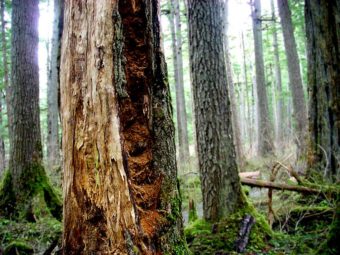
A fire left its mark on this Tongass National Forest tree trunk, as seen in 2008.
The Tongass National Forest. (Creative Commons photo by Xa’at)

The bulk of federal employees will miss two paychecks by Friday, Jan. 25, as the partial government shutdown continues. But the U.S. Forest Service is dedicating paid staff to a controversial initiative in Alaska.
The agency released an update on its website earlier this week, saying it’s still working on “high-priority projects,” such as reviewing how the Roadless Rule applies to Alaska. The rule is a federal regulation most states have to follow, which makes it difficult to build new roads on wilder parts of national lands. Alaska has asked for an exemption to the rule.

It’s been a decades-long battle in the state — centered mostly on the timber industry and energy development in the Tongass National Forest.

In August, the Forest Service said it would review the state’s ask and deliver a draft environmental impact statement by the summer of 2019. Now, despite limited staffing, the agency is still working to meet that deadline.

The Forest Service is using leftover federal funds from last year to pay its employees.

Recently, conservation groups in Alaska criticized the agency for planning a timber sale during the shutdown and for a lack of transparency.

Despite the shutdown, it’s been a dizzying week for a Southeast Alaska timber sale

Logging from the Big Thorne Timber Sale. (Photo by Elizabeth Jenkin/Alaska's Energy Desk) 12/18/17
The Prince of Wales Landscape Level Analysis Project would dwarf the Big Thorne timber sale pictured above. (Photo by Elizabeth Jenkins/Alaska’s Energy Desk)

Despite the partial federal government shutdown, some U.S. Forest Service staffers are still working on a plan for a large timber sale in Southeast Alaska.

Those who oppose the logging are worried their concerns aren’t visible enough during the shutdown. Leaving them to wonder how the agency can keep up with the public record when it’s not fully staffed.

The Southeast Alaska Conservation Council, or SEACC, opposes a federal timber sale that could take place on Prince of Wales Island.

The group wanted to file its objections by the December deadline and managed to submit its complaints the day before the government shutdown.

Buck Lindekugel, SEACC’s attorney, assumed the proceedings would be on ice. After all, dozens of Forest Service staff in Alaska aren’t receiving a paycheck, and many of them aren’t even at work.

“We were surprised there was any activity going on with the Forest Service,” he said. “Particularly with this controversial timber sale.”

According to the Forest Service’s website, work that should be prioritized during a government shutdown includes protecting public safety and assets.

For example, there’s avalanche forecasting still happening in the Chugach National Forest. On Prince of Wales, some Forest Service employees are responding to a recent landslide.

On Tuesday, SEACC received an invitation confirming another thing. Forest Service staff are continuing to work on the timber sale SEACC objected, and the project is seemingly on schedule.

The Forest Service planned to hold a public meeting next week in Klawock to address the objections to the plan — basically, another milestone that moves the process along. But there’s no notification of it on the agency’s website.

Lindekugel said there’s also another thing missing.

He tallies up the people who’ve submitted some kind of objection. Their names are visible from the Forest Service’s website, but not the content of their objections.

“The way for the general public to participate in this process is to go onto this page and click on these objections,” Lindekugel said. “And see what the problems people have with this proposal, and they can’t.”

Lindekugel said it makes it difficult for his organization, too. How do you prepare for a meeting that’s a week away when you don’t have all the information?

Owen Graham, the executive director of the Alaska Forest Association, said that’s not an issue for him.

“There’s not an opportunity to sit around and talk with the other objectors and horse trade or bargain,” Graham said.

Graham represents a timber industry group. He has objections to the Forest Service’s plans, too. He doesn’t object to the sale itself, but he wants to see a different version of the sale to go through.

So he’s glad things are moving along, and he wants the meeting in Klawock to happen.

“If they delay these objection meetings, then it will be that much longer until we get a timber sale,” Graham said. “And there will be greater risk that people will be out of work because of it.”

The Forest Service did send Lindekugel the other objections this week after he requested them.

Still, he believes important documents are slipping through the cracks that would inform a public meeting.

“Call a timeout on this damn thing,” Lindekugel said. “Slow down. There’s not need to rush ahead. Push the clock back to where it was before before the shutdown occurred.”

On Thursday, Lindekugel received yet another email from the Forest Service. It said next week’s objection resolution meeting in Klawock is canceled. It didn’t give a reason why or provide another timeline.

A spokesperson for the Forest Service said they’ll update the website about other happenings on Prince of Wales Island soon.

Site notifications
Update notification options
Subscribe to notifications