Elizabeth Jenkins, Alaska's Energy Desk - Juneau
Caring for Alaska’s seniors during tense budget talks

xx
Lala Toetuu says she enjoys showing up to work at Wildflower Court and spending time with residents. She calls them friends. (Photo by Elizabeth Jenkins/Alaska’s Energy Desk)

The Alaska Legislature has been looking at ways to scale back how much the state spends on Medicaid. It’s one of the state’s biggest expenses.

Gov. Mike Dunleavy’s budget proposes eliminating more than a third of the state’s funding for the program. To achieve that, some hospitals and nursing homes could be paid less to provide skilled labor.

But for one nursing home in Juneau, it’s still business as usual for the staff and the people they care for.

Once a week, Wildflower Court has a jam session led by a volunteer. One of the residents picks up an acoustic guitar to join in.

Lala Toetuu is watching from the sidelines. She’s an activities and nursing aide at Wildflower Court, where everyone loves calling her by her first name.

“They’re like, Lala? Just La-la-la?” Toetuu said with a laugh. “So they’ll be singing my name as I walk in the hall. I think even my name brings out a more fun side to things.”

During a rendition of an old Scottish folk song called “My Bonnie Lies over the Ocean,” Toetuu agrees to play a game. She had to do a squat every time the residents sing a lyric starting with the letter “b.”

They seem to enjoy watching her get a workout.

This is just one of the many hats Toetuu wears during her shift at Wildflower Court. She’s part party captain — making sure the residents are active and having a good time — and part caregiver.

Toetuu said she enjoys doing both roles.

“What I really love about it is I’m able to see two different sides of the residents,” Toetuu said. “I’m able to be with them when we’re having jam sessions and playing basketball … and I’m also able to see them on this side where I’m able to care for them in a different way.”

Such as helping seniors with tasks like eating, dressing and bathing. She said she likes making residents feel confident, so they can present the best version of themselves.

Up to 90% of the people who live at Wildflower Court are Medicaid recipients.

Mickey Lovell is one of them. She moved to Alaska from Oregon in 1953 after her dad booked a one-way ticket north, because he didn’t like the boy she was dating.

“If I’d had the money, I’d gone right back home,” Lovell said. “But I didn’t have the money.”

So Lovell settled down in Alaska. She raised her kids here. In her 20s, she was diagnosed with multiple sclerosis. But she wasn’t able to get regular insurance until she was much older because of her pre-existing condition.

“Not many people want to get to be 65. But I did,” Lovell said.

At 65, she became eligible for Medicare and Medicaid. Medicare pays for recovery after an injury. But it’s Medicaid that’s paid for Lovell’s more-than-decade-long stay at Wildflower Court.

However, a battle is brewing between the state and providers over how much Medicaid should cost. Dunleavy’s budget proposal suggests cutting state payments for skilled nursing by 5%.

That’s what Toetuu, and 50 other staff, does at the nursing home.

Ruth Johnson, who oversees operations, said it’s created an air of uncertainty.

“You know, it would probably mean we’d have to eliminate some positions,” Johnson said. “That we’d have fewer caregivers on the floor.”

Wildflower Court is a non-profit, 57-resident long-term-care facility in Juneau. (Photo by Ed Schoenfeld/CoastAlaska)
Wildflower Court is a non-profit resident long-term-care facility in Juneau. (Photo by Ed Schoenfeld/CoastAlaska)

Right now, each resident at Wildflower Court gets about three hours of individual care broken up throughout the day. Johnson isn’t sure how that would change if the cuts are applied to Medicaid.

But she said the nursing home is sometimes only operating at a 5% profit margin. So even if a 5% cut seems small, it would make it difficult for Wildflower Court.

Still, Johnson is quick to point out she’s remaining optimistic the Medicaid cuts won’t be as deep as the governor’s initial proposal.

She’s trying to look at it as the start of a much larger conversation.

“Elder care is expensive to deliver in Alaska,” Johnson said. “We have a completely different economy of scale than the Lower 48.”

Johnson said that’s because the state is big and spread out. A typical nursing home size is 34 beds — compared to the national average of more than 100.

So the issue here is a smaller pool of people responsible for a big expense.

The Alaska State Hospital and Nursing Home Association says scaling back the state’s Medicaid payments isn’t the answer. But finding places to cut back within the program will take more time and dialogue than what can be achieved in a single legislative session.

In the meantime, Johnson is trying not to worry her Wildflower Court staff and residents. There’s still singing, laughter and community in the halls.

This week, Johnson lost a game of cribbage to 86-year-old Mickey Lovell.

Southeast Alaska researchers get rare opportunity to study a sperm whale

Johanna Vollenweider/NOAA A team of marine mammal experts perform a necropsy on a male sperm whale.
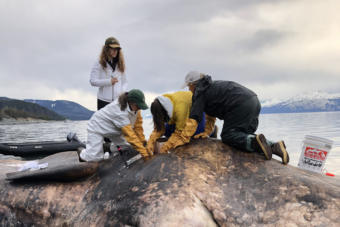
A team of marine mammal experts perform a necropsy on a male sperm whale. (Photo courtesy Johanna Vollenweider/NOAA)

An endangered sperm whale carcass was spotted on the beach recently near Juneau. It’s a rare sighting along the Inside Passage waters. Sperm whales typically feed in the open ocean.

Kate Savage, with the National Oceanic and Atmospheric Administration, was the lead veterinarian on the job. Normally, she’s decked out in teal scrubs teaching students how to do necropsies on much smaller marine mammals, like frozen sea lions.

But last week, she got to help lead a team to work on a 48-foot-long sperm whale.

“People were just, like, really into learning as much as we could and excited to be working on a species no one had worked on before,” Savage said.

Only two dead sperm whales have washed up on Alaska shores to study since the 1990s: one in Homer and another near Kenai Fjords National Park. So the opportunity to examine the whale was particularly exciting for local scientists.

Living sperm whales have been spotted in the Inside Passage before. But sightings are infrequent. Savage said marine biologists have theorized this young male may have been following a group and feeding on squid, based on the contents of its stomach.

A team of marine mammal experts perform a necropsy on a male sperm whale.
A team of marine mammal experts perform a necropsy on a male sperm whale. (Photo courtesy Johanna Vollenweider/NOAA)

A plane reported it dead last week north of Berners Bay in Lynn Canal.

Upon arrival on the scene, Savage and a team went to work trying to determine the cause of death. Immediately, they noticed long slices around the dorsal fin — injuries consistent with a vessel strike.

Savage said it looked like significant trauma.

“Just jumbled vertebrae and lots of fractures,” Savage said. “Big fractures and small fractures. I could see some of the spinal cord.”

There were other signs that indicated this whale probably wasn’t floating dead in the water before a vessel collided with it. Savage said a tissue sample will ultimately determine the whale’s time of death.

Last year, seven whales in Alaska were killed by vessel strikes.

But her team members weren’t the only ones to marvel at the strange sight. Someone took most of the whale’s lower jaw before researchers went back for their second examination.

NOAA Enforcement is asking whoever took the body part to return it. It’s illegal to possess any piece of an endangered marine mammal.

Will Alaska endorse climate science education?

xx
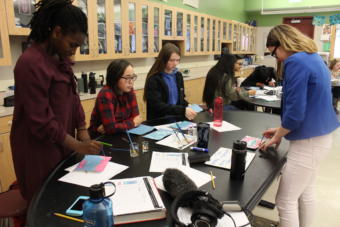
This school district in Sitka has already adopted Next Generation Science Standards. (Photo by Elizabeth Jenkins/Alaska’s Energy Desk)

It’s been more than a decade since the Alaska State Board of Education and Early Development updated its classroom science standards. What’s missing is a thorough explanation of one of the biggest problems on Alaska’s doorstep: climate change.

But on Friday, the board unanimously approved a draft framework of a growing national model, which makes that point clear.

Alaska’s 13-year-old science standards would not make the honor roll according to Glenn Branch, the deputy director at the National Center for Science Education.

“They’re very short and undetailed,” Branch said.

But Branch thinks the new standards under review are a big improvement.

“It’s about as good as one can realistically expect,” he said.

Alaska could be joining dozens of other states by adopting the framework of Next Generation Science Standards. Some school districts are already ahead of the curve.

It’s becoming the benchmark for how science should be taught in the classroom. Think: less memorizing the periodic table, more experiencing how different metals react. Or getting an explanation of why much of Alaska has been able to shed a layer of clothing earlier in the spring.

The standards don’t shy away from attributing climate change to human activity, due to increased carbon emissions.

And Branch said classrooms need to be informed about the overwhelming scientific consensus.

“The effects of climate change are increasingly visible and dangerous,” Branch said.

Temperature data showing rapid warming in the past few decades, the latest data going up to 2018. According to NASA data, 2016 was the warmest year since 1880, continuing a long-term trend of rising global temperatures. The 10 warmest years in the 139-year record all have occurred since 2005, with the five warmest years being the five most recent years.
Temperature data showing rapid warming in the past few decades, the latest data going up to 2018. According to NASA data, 2016 was the warmest year since 1880, continuing a long-term trend of rising global temperatures. The 10 warmest years in the 139-year record all have occurred since 2005, with the five warmest years being the five most recent years. (Graphic by NASA’s Earth Observatory)

This addition hasn’t gone smoothly in some other states. In New Mexico, for example, the state’s Public Education Department released draft science standards, leaving out concepts about climate change and evolution. The department eventually included those concepts after public outcry.

But in Alaska, it seems to be moving right along. The State Board of Education hasn’t wavered, so far, from adopting the language.

Does that mean all classrooms in Alaska could get a lesson on climate change soon?

Branch said not necessarily.

“Standards aren’t magic,” Branch said.

According to a spokesperson from the Alaska Department of Education and Early Development, it’s still largely up to the school districts to decide how to incorporate the updated standards.

Furthermore, not all schools require students to take an earth science class. That’s where the conversation about climate change typically shows up.

But Branch thinks there are things the state can do to reinforce the message and help bring classrooms into this decade.

“You have to get new textbooks. You have to get new lab equipment,” Branch said. “You have to get new statewide testing set up, and really importantly, you have to get the teachers trained.”

Last year, the Washington State Legislature allocated $4 million for climate science learning.

That doesn’t seem likely to happen in Alaska anytime soon, given the state’s current budget deficit and proposed cuts.

Meanwhile, the Alaska Board of Education has approved the draft standards, which will soon be available for public comment. The board is expected to vote on the new science standards this summer.

Alaska lawmakers learn about a subsistence superfood

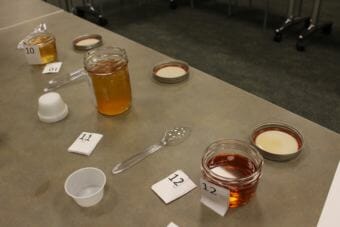
There were two categories for the seal oil: with and without crackling. (Photo by Elizabeth Jenkins/Alaska's Energy Desk)
Seal oil from Southeast Alaska. (Photo by Elizabeth Jenkins/Alaska’s Energy Desk)

The House Resources Committee got an update Monday on the traditional foods movement in Alaska.

It’s becoming more common for public facilities in the state to accept wild-harvested donations, such as deer or seafood. Seal soup has been added to the menu at the Alaska Native Medical Center in Anchorage.

But places like schools, nursing homes and hospitals have yet to incorporate one of the most requested subsistence foods. Melissa Chlupach, from the University of Alaska Anchorage College of Health, called it “Alaska’s condiment.”

“Seal oil is a superfood. It has a high amount of omega-3s that are so healthy for us,” Chlupach said.

The state’s food safety codes don’t allow seal oil in public facilities yet. That’s because it’s been implicated in several botulism outbreaks in Alaska. Rep. John Lincoln, a Democrat from Kotzebue, asked why a food considered safe to eat by many villages raised red flags.

Chlupach and a colleague explained that the rendering process differs across Alaska. There’s a lot of variability.

Chlupach told lawmakers there’s still more work to be done to incorporate a variety of subsistence foods on the menu at public institutions. She encourages people to tell their stories.

“That’s how we can get these foods into our facilities and help heal our patients, help provide foods to the Elders so they can eat the foods they’ve grown up on,” Chlupach said.

Maniiḷaq Health Center in Kotzebue is on the forefront of this effort.

The long-term care facility there has been working with the state’s Department of Environmental Conservation, the University of Wisconsin and the Kodiak Seafood and Marine Science Center to determine the safest rendering techniques for seal oil, with the hopes of someday serving it to residents.

Watch the latest legislative coverage from Gavel Alaska:

The Alaska Roadless Rule decision is moving along. Some tribal governments say it’s moving too fast.

The Tongass National Forest near Wrangell, Alaska, 2016.
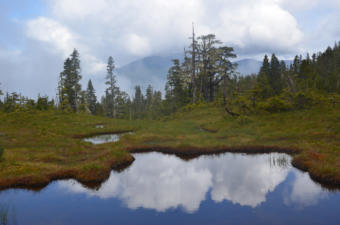
The Tongass National Forest near Wrangell, Alaska, in 2016. (Creative Commons photo by Rob Bertholf)

The U.S. Forest Service quietly hit another milestone in its ongoing efforts to consider building new roads in the Tongass National Forest. Last month, it received comments on an important document from cooperating groups.

The state has been providing feedback that could shape the outcome of the new rule, and so have Southeast Alaska tribes.

But some of the tribal governments say the timeline has felt rushed for a decision that could have a major impact on rural Alaska.

Joel Jackson, the tribal president of the Organized Village of Kake, said it’s impossible to separate the Tongass National Forest from the dinner table.

“That’s the way I was taught from my father,” Jackson said. “He never liked the word ‘subsistence’ either. He always explained it to me, it’s our way of life.”

And Jackson feels like that way of life could be threatened if new roads are built in the national forest surrounding Kake. Historically, large-scale industrial logging in the region damaged deer habitat and salmon streams.

Jackson said the village can’t afford to have its main food source jeopardized again.

“We have no other choice but to stand up and say, ‘No more logging. No more road-building in our area,'” Jackson said.

This decades-long battle isn’t centered on the roads themselves. For Alaska’s congressional delegation, it’s about access. Or, as Sen. Lisa Murkowski put it, making sure the Tongass is a “working forest.” Much of the remaining harvestable, old-growth trees are in areas that are hard to get to.

Last summer, Murkowski and a top federal official toured the last remaining large sawmill. And in August, the Forest Service announced it would revisit how — and if — the Roadless Rule should apply to Alaska.

Jackson said he wanted Kake to be a part of that conversation. The plans include Southeast Alaska tribes as cooperating agencies — providing crucial input.

But he said it hasn’t always felt that way.

“That remains to be seen,” Jackson said.

In February, the Organized Village of Kake and the other cooperating agencies received a robust, 500-page document, detailing the various options on the table for the Tongass. From one extreme to the other: from the Roadless Rule staying in place, to the Roadless Rule going away for Alaska. And of course, everything in between.

In any case, Jackson said it was a lot to take in for the small tribal government, and the Forest Service gave them just two weeks to make comments.

“We’re not lawyers or anything. We have to get help to understand a lot of what they’re saying,” he said.

Jackson said he asked the Forest Service for more time — a few more days, so the tribe could sort everything out and make meaningful suggestions.

“They said they had a timeline and they were going to stick to it,” Jackson said.

In an emailed statement, the Forest Service didn’t directly address why it didn’t grant the tribal government the extension. But it said there are other ways for cooperating agencies to participate.

Raymond Paddock, the environmental coordinator at Central Council of the Tlingit and Haida Indian Tribes of Alaska, said he thinks the Forest Service is trying to do its best with the directions it was given.

However, Paddock said, “It was definitely a rushed process.”

Central Council is also a cooperating agency providing feedback on the Roadless Rule.

But ultimately, the tribal government decided not to weigh in on this latest comment period because Paddock said they wanted to defer to the smaller tribes.

“Where we feel those are the most impact areas,” Paddock said.

The Forest Service is shooting for a summer release of its draft environmental impact statement on the Roadless Rule.

As for the Organized Village of Kake, they made the two-week deadline and got their comments in.

But Jackson said it wasn’t without a struggle.

“It just takes a lot of time to go page-by-page,” Jackson said.

Now he’s looking forward to getting back to another big project.

Kake is in the process of restoring a cannery with the hopes of attracting more small cruise ships.

Jackson thinks that’s the future, and he wants those visitors to be able to appreciate the old growth trees that are left.

Site notifications
Update notification options
Subscribe to notifications