Elizabeth Jenkins, Alaska's Energy Desk - Juneau
Could climate change research in Alaska be put on ice?

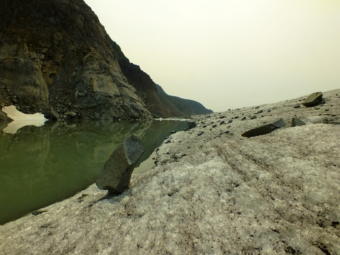
This dog-sized piece of granite rock, called a glacial erratic, stands naturally balanced on the edge of Mendenhall Glacier. The adjacent pool of water has spilled over from an ice dam that is holding back most of the water in Suicide Basin.
This dog-sized piece of granite rock, called a glacial erratic, stands naturally balanced on the edge of Mendenhall Glacier. The adjacent pool of water has spilled over from an ice dam that is holding back most of the water in Suicide Basin. (Photo by Matt Miller/KTOO)

Alaska is experiencing an unusually hot summer and researchers across the state are tracking the effects. The University of Alaska system is known as a leader in climate change research — studying melting permafrost to shrinking glaciers.

But there’s growing uncertainty about the future of such projects with steep cuts to state funding.

One faculty member in Juneau is hoping he doesn’t have to relocate.

Eran Hood is a professor at the University of Alaska Southeast. He’s training the next wave of environmental scientists, and he’s helping the capital city track potential climate disasters.

He researches avalanches and glacial flooding events, among other things. Hood says all of the money for those types of projects is generated by him and his collaborators.

“I’ve brought in more funding to the university then the university has paid me in salary over the years,” Hood said.

That helps pay for things like travel logistics, lab analysis and research assistance.

But for nine months, when class is in session, Hood’s salary comes from the university. And right now, there are some big unknowns about potential cuts to programs and if enough funding will be available.

Gov. Mike Dunleavy vetoed $130 million dollars in University funding. The Alaska Legislature has yet to decide if it will restore any of that cut. 

And Hood says that’s leaving a lot of researchers hanging in the balance. He thinks if the cuts are that deep a lot of faculty are going to leave the state.

“And when they leave the state that expertise goes with them,” Hood said.

And so could tens of millions of federal dollars for climate change research. That money isn’t necessarily tied to the university. Many of the projects belong to the faculty who applied for the federal grants.

So Hood says some expansive research projects — involving teams of people across the state — could unravel.

“We could leave a tremendous amount of federal research money on the table,” Hood said.

Earlier this week, university President Jim Johnsen addressed how the institution will weather these cuts and the potential loss of research funding.

He acknowledged eyes are on Alaska. The University of Alaska Fairbanks is known as a global leader in Arctic research, and climate change in the Arctic, Johnsen said, is an issue of national security.

Eran Hood, at the University of Alaska Southeast, says his work is also crucial for the state and the rest of the world.

Alaska glaciers are contributing to more sea level rise than any other mountain glaciers on Earth.

Despite these uncertain times, Hood says he isn’t ready to move his family.

“I still feel like I want to stay here,” Hood said. “I want to do research here. So I’m pretty committed to making that work.”

The University system is still trying to figure out if it will make a declaration, which would make it possible to more rapidly downsize and reduce staff.

In the meantime, Hood is spending his summer doing what he’s always done: Monitoring the changes in his backyard.

Editor’s note: This story has been updated to reflect the Alaska Legislature could choose to restore the University system funding. However, the deadline to override the Governor’s vetoes has passed. 

How hospital ERs in Alaska are helping patients with opioid use disorder

xx
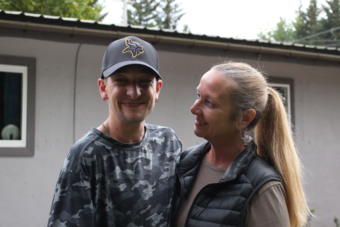
Justin and his mother, Vicki Brokken, at their home in Juneau. (Photo by Elizabeth Jenkins/KTOO)

Some hospitals in Alaska are changing the way they treat patients with opioid use disorder. A trip to the emergency room can be a crucial window to help people in their recovery.

Now some providers are giving patients a medicine to ease the transition so they can seek additional care.

Recently, a hospital in Juneau completed one year of this program with encouraging results.
Justin Brokken, 33, has a ritual with his parents. They regularly engage in friendly competition with handmade cornhole set. Earlier in the day, his mom, Vicki Brokken, beat him 21-1.

“Now, I’m not even going to be able to hit the board. The pressure is on,” Justin Brokken said with a laugh.

The Brokkens are enjoying this new family dynamic. For years, Vicki said her relationship with Justin wasn’t like this.

“Every single time he walked out that front door. I knew, and it went through my head, that could be the last time I ever saw my son,” Vicki Brokken said.

Justin Brokken was first introduced to opioids like a lot of Americans: at the doctor’s office.

At 14, he was given a prescription for painkillers after badly burning his hand in an accident. His injury left him with a permanent scar, and he said the craving for opioids didn’t go away.

“Anybody who’s had an addiction knows it’s hard to say no to something that makes you feel better,” Justin Brokken said.

For more than a decade, he said he felt like he was stuck in a volatile cycle. He was in and out of jail on drug-related charges. He started using heroin. He had moments when he wanted to quit, but they were fleeting.

Then, earlier this year, he experienced a huge turning point.

He checked himself into the emergency room at Bartlett Regional Hospital in Juneau, prompted by swollen ankles.

“Fairly certain I was dead,” he said. “But nope. I got lucky.”

Justin Brokken learned he qualified for a new program that’s becoming the standard for how to treat opioid addiction in hospital emergency rooms across Alaska — from Petersburg to Anchorage. He hadn’t used opioids the day he visited the ER. He was in what medical staff call “acute withdrawal.” So they could give him a pill to help block the cravings.

Next, they’d connect him with a network of providers to continue medication-assisted treatment.

“It gives you time to change your life,” he said.

xx
Justin Brokken said he likes to stay busy spending time with family and going fishing. (Photo by Elizabeth Jenkins/KTOO)

In 2016, federal legislation made it possible for a wider array of medical providers to prescribe buprenorphine, also known by the brand name: Suboxone. And since then, the numbers of prescribers in Alaska has more than doubled, according to the state.

As a result, more clinics are able to offer medication-assisted treatment, and some hospital ERs are acting as a point of contact.

Before working in the Bartlett emergency room, Dr. Lindy Jones was one of only a handful of providers in Juneau who prescribed buprenorphine.

“Initially, there was resistance because it was something new,” Jones said.

He said there’s been a shift in the way the medical community views medication-assisted treatment. In the past, there could be a misconception that it was trading one addiction for another.

Jones said more and more providers recognize it helps stabilize patients. They typically receive counseling and can eventually go back to school or work.

“I find it one of the most effective interventions for the right person that there is,” Jones said.

Claire Geldhof, a case manager at Bartlett, checks in with the same 15 former patients or their families on the phone at least once a month. Up until last summer, the emergency department was limited in how it could treat people with opioid addiction.

Emergency providers tried to make their patients comfortable.

“But it wasn’t necessarily the right medicines to be giving patients with acute opioid withdrawal,” Geldhof said.

Geldhof thinks the buprenorphine has made a big difference in the life of the ER patients.

Of those 15 people she calls regularly, 11 of them — including Justin Brokken — have continued to access services or medication-assisted treatment.

Shortly after his visit to the ER, Justin Brokken had surgery to repair a valve in his heart damaged from a bacterial infection by injecting heroin. He said he took pain medicine for a couple of days. But after that, he stopped. He talks to counselors and takes a Suboxone pill to help block the craving for opioids.

Justin Brokken credits that initial meeting in the emergency room with helping him navigate his recovery. But he thinks these new treatment options in Alaska are just the beginning.

“I think there’s still a lot more progress that needs to be done,” he said. “I think there’s a lot more spending that needs to be put into it and give it an actual shot.”

The Alaska State Hospital and Nursing Home Association is concerned Gov. Mike Dunleavy’s cuts to Medicaid could affect these kinds of programs down the line. The cuts could impact providers ability to offer services.

As for Justin Brokken, he’s adjusting to life at home and healing from his surgery. Recently, he was able to tell his mom about a big improvement: He no longer has to take blood thinners.

“The lady just called a minute ago and told me I’m off of them,” he said. “I don’t have to take them. Not even tonight. I’m done. That’s a big step!”

And that’s how Justin is approaching his recovery: one day at a time. Tonight, maybe another game of cornhole and sloppy Joes for dinner.

Alaska schools now have more guidance on how to teach science in the classroom

xx
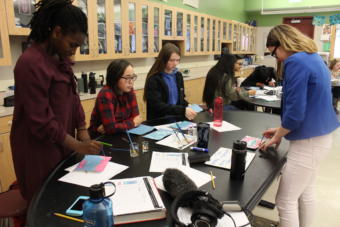
Students work together in a science classroom at Mt. Edgecumbe High School in Sitka. The Sitka School District had already adopted Next Generation Science Standards before the Alaska State Board of Education unanimously approved the standards for the entire state. (Photo by Elizabeth Jenkins/Alaska’s Energy Desk)

The Alaska State Board of Education unanimously approved new science standards on Friday, which are much more detailed about topics like climate change and evolution than the ones previously recommended for schools.

It’s been more than a decade since the state reviewed how science is taught in the classroom.

The new standards are based on a model called Next Generation Science Standards, which encourages more hands-on learning. Dozens of other states have already adopted a framework of these new standards.

All of the public comments at the meeting were in support of adopting the change.

However, this doesn’t mean all students across the state will get the same science lessons. It’s still largely up to the school districts to decide how to incorporate the new material.

Meet the Juneau couple who brush their teeth next to history

xx
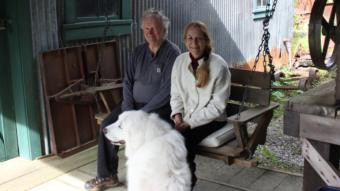
Gary Gillette and Renée Hughes help run the Gastineau Channel Historical Society. In addition to Last Chance Mining Museum, they also oversee the Sentinel Island Lighthouse. (Photo by Elizabeth Jenkins/Alaska’s Energy Desk)

Alaska’s capital city is home to the ruins of what was once the world’s largest gold mine.

You can still see the remnants of the Alaska-Juneau Mine tunnels, which burrow 1,500 feet down into the earth. And the building that powered it all is still around, too.

It’s now the Last Chance Mining Museum, which is celebrating 25 years of continuous operation. But it’s been a permanent residence for longer than that.
Visitors to the Last Chance Mining Museum are often enamored by the huge machinery, antique homesteader tools and a photograph of a miner holding a lit fuse of dynamite. But Gary Gillette and Renée Hughes joke those aren’t the only relics.

“I tell people sometimes we’re just one of the artifacts,” Renée said with a laugh. 

Gary has lived in this building for decades. The first time I stopped by the museum, I was curious about the stairs leading up to what appeared to be a small apartment overlooking the interior of the warehouse. Imagine a kind of house inside a building.

It’s the home of Gary, Renée and a fluffy white dog named Galena.

The couple have a view from their kitchen sink like no one else. When Gary and Renée scrub pots and pans, they’re looking through a window back in time — to the epicenter of the AJ Mine, which started operations in Juneau around 1914.

The building is actually owned by the City and Borough of Juneau. Gary, who’s an architect and interested in historic preservation, became its caretaker in 1983.

“Took a look at it, and it was pretty dismal,” Gary said.

He has a unique arrangement with the city. He’s put in sweat equity and helped run the nonprofit. In exchange, he’s gotten a roof over his head — a roof that he helped install.

When he first moved in, Gary recalls that the building was hardly designed to be a home. The windowless living space was only accessible by climbing up a ladder.

You couldn’t even stand in it,” he said. “It was a sloped roof. So you had to kind of get on your knees and crawl into bed.”

So Gary settled into what could be considered an above-ground man cave and made much-needed repairs to the building.

He met Renée in the summer of 1991.

“I’d come up on vacation. A friend of mine said, ‘Go see Glacier Bay.’ I had come from New York City,” Renée said. “And I was sitting downtown watching ‘Monday Night Football,’ and in walked Gary, and I thought, ‘Oh, hmm.’”

On one of their first dates, the two hiked the Perseverance Trail. Back at the warehouse, Gary made Renée dinner.

Her first impression of his bachelor pad?

“It’s quite different than my pad in New York City. That’s for sure!” she said.

Gary said he isn’t sure his unusual home was what initially won her over. 

“I had a great cat at the time,” Gary joked.

“I think it was a little combination of everything,” Renée said, turning to Gary. “You were a big part of the package.”

After three months of dating, Renée moved in with Gary. In 1995, they opened the Last Chance Mining Museum to the public.

They’ve now been living here for the past 28 years.

Renée admits it isn’t always easy having a home that’s essentially on display.

“Living up here is kind of like living in a fishbowl,” Renée said. 

As if on cue, a couple wearing backpacks wandered in. The museum wasn’t open that day. Gary and Renée told the couple it’s fine to poke around outside. They’ll be open tomorrow.

xx
The Last Chance Mining Museum was open sporadically before Gary Gillette became its caretaker in 1983. But he’s run it consecutively for the past 25 years. (Photo by Elizabeth Jenkins/Alaska’s Energy Desk)

What catches everyone’s eye as they walk through the door is a giant piece of machinery.

“I consider the compressor to be the heart and soul, because that’s what powered all their tools,” Renée said. 

The compressor looks like two human-sized wheels set between a long tangle of rope. The electricity came from 2,300 volts generated from the Salmon Creek Dam. But the air is what kept drills running in the mine shafts below.

It’s one of the innovations that made the AJ so profitable back in the day. It could operate using a relatively inexpensive form of energy.

Of course, it’s not connected to the electric grid now. Still, Renée doesn’t miss an opportunity to enthrall the museum’s youngest visitors. When explaining the machinery to groups of kids, she invites the toughest-looking one to flip the switch that turned on the compressor. As they bring the handle down, Renée makes a startling, mechanical noise. 

“They jump about a foot off the ground, and everybody laughs,” she said. 

But tourists aren’t the only guests Gary and Renée think they share this space with. Occasionally, they hear things. One volunteer claimed to have seen a man peeking through a window wearing a miner’s helmet and holding a light.

Most of the time, Gary and Renée just shrug it off. They like to think of the spirits as friendly ghosts. 

“Because we’re keeping their place alive and safe and taking care of things,” Renée said. “And they, I think, respect that.”

Renée and Gary don’t have any current plans to leave the home at the museum they’ve created for themselves.

They’re content to be a small part of the building’s history — a specter of a couple sitting outside the warehouse in a porch swing.

This ice cream stand was constructed out of local wood. Here’s why that’s unique.

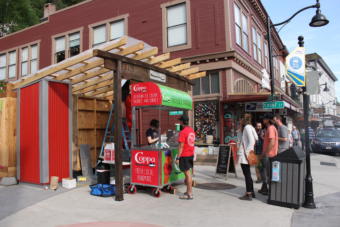
Marc Wheeler, the owner of Coppa, is enthusiastic about ice cream and wood. He has a couple of pieces constructed from old growth trees at his brick and mortar store. But he's not in favor of large scale industrial logging. He opted to use young growth wood at his latest location. (Photo by Elizabeth Jenkins/Alaska's Energy Desk)
Marc Wheeler, the owner of Coppa, is enthusiastic about ice cream and wood. He has a couple of pieces constructed from old growth trees at his brick and mortar store. But he’s not in favor of large scale industrial logging. He opted to use young growth wood at his newest location. (Photo by Elizabeth Jenkins/Alaska’s Energy Desk)

Some big decisions are being made right now that could affect how the Tongass National Forest is managed. The conversation has largely centered on old growth logging.

Should the U.S. Forest Service move away from selling its oldest trees? Originally, the plan was to transition to a different type of timber economy altogether: young growth.

But there are still questions about how to make that industry viable.

One business owner wants to have that talk over ice cream.

Lately, there’s been a bit of a building frenzy at a new Juneau food cart alley. It’s tucked away from the typical bustle of cruise ship passengers.

But you can still spot them with cameras wrapped around their neck.

One of the flagship carts wants those visitors sample a taste of Alaska. It’s an unusual way to eat a salmon.

“You know, it’s kinda fun to think of, ‘Oh, when you’re in Juneau, you have to have the salmon ice cream,’ right?”

Marc Wheeler is the co-owner of Coppa. Other selections from his cart include spruce tip and devil’s club ice cream.

He wants his customers to consider where these flavors come from: the Tongass National Forest. And today, Wheeler is taking another step to reinforce that message.

A flatbed truck arrives carrying a large wooden arch. It’ll be the focal point for Wheeler’s operation. A kind of mini-carport for the ice cream stand, where customers can lick their spoons without getting caught in the rain.

What sets this structure apart is the material it’s being built from: locally milled spruce trees that are only about 50-years old. On an ecological scale, that’s a young tree.

For Wheeler, it was about more than creating something from a niche product. It’s a statement.

He doesn’t think there should be large scale old growth logging in the Tongass.

“Being a business owner, you have all these ways to have a positive impact,” Wheeler said. “These choices of how you buy things can make a big difference.”

Wheeler intentionally sought this wood out and found one family sawmill near Tenakee Springs producing the material.

To be clear, you can run down to any hardware store and buy two-by-fours made out of young growth trees. The lumber just won’t be from Alaska.

That’s something Conor Reynolds from The Nature Conservancy would like to see changed.

“Maybe it’s idealistic or optimistic. But it’s a nut that needs to be cracked,” Reynolds said.

Right now, the nation’s largest national forest is at a crossroads. Federal old growth timber sales were supposed to be phased out over the span of 16 years.

But recent efforts by the State of Alaska and Sen. Lisa Murkowski could undo that. A top federal official is making a decision this summer that could impact transitioning the region’s economy to young growth.

Still, Reynolds thinks the already struggling timber industry can’t sustain itself on a supply of old growth trees forever.

“The death knell is kind of sounding on it,” he said.

He says much of the old growth in the Tongass has already been logged. And the Forest Service has had trouble making the timber sales it does offer pencil out. There’s also ongoing litigation from environmental groups.

So, if there’s going to be a timber industry in Southeast Alaska at all, Reynolds believes cutting young growth trees is the future.

But he acknowledges there are challenges, like convincing investors to take the leap in an already crowded market.

“Some entrepreneur up here would have to find a product that they can make from it that isn’t in direct competition with a place, you know, in Shelton, Washington that’s going through half a billion board feet a year.”

Some small sawmills are creating products in limited runs — making items like shingles and lumber to be sold in state. But, Reynolds says creating more jobs from this is still in its early days.

Back at the food cart alley, builder Steve Klinger is drilling red corrugated metal on top of the young growth wood.

The showpiece — an arch which will be the gateway to Coppa’s ice ice cream stand — has been charred with fire.

Klinger explains it’s a Japanese technique called shou sugi ban that prevents the wood from molding. But another one of the design elements isn’t intentional.

One of the pieces of lumber warped in the sun. There’s a reason young growth typically fetches a cheaper price than old growth. Younger trees have fewer rings in them, which means the wood isn’t always as strong as its counterpart.

Klinger says that might faze some builders.

“An older guy that’s cut wood his whole life would look at it and sort of probably kind of spurn it a little bit,” Klinger said.

But Klinger just saw it as a happy accident. It’s now the curved top of the arch, where customers can nibble bites of spruce tip ice ice cream under what was once a young spruce tree.

A note of disclosure: Marc Wheeler serves on the Alaska Public Broadcasting Commission.

Climate change looks different in Southeast Alaska. Here’s how tribes are planning for that.

xx
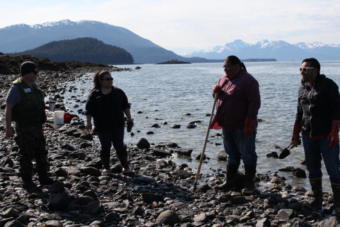
Tlingit & Haida is one of 16 tribes that contribute to the shellfish monitoring network. The new climate change adaptation plan is intended for tribes across the region to use as a template to add to. (Photo by Elizabeth Jenkins/Alaska’s Energy Desk)

Alaska’s most recent plan to address climate change was removed from the state’s website back in December. Meanwhile, some municipalities and tribal governments are moving ahead with their own ideas about how to respond to the growing problem.

And now, Southeast Alaska’s largest tribe has a plan. It wants the region to be included in the climate change discussion.

At a point near the Auk Village Recreation Area in Juneau, Kenneth Weitzel jokes that he’s drawn the short straw. Today, he’s going in the water.

“The boss told me,” he says with a chuckle.

His coworkers at the Central Council of the Tlingit & Haida Indian Tribes of Alaska are on the shore — dragging rakes across the sand to collect butter clams, mussels and cockles to be tested for paralytic shellfish poisoning.

But Weitzel is doing a different task.

He’ll be sampling the water for the two types of phytoplankton that can cause those shellfish to become unsafe for humans to eat.

He says it’s kind of ironic this is part of his job now, as a natural resource specialist. He grew up in a community where he saw jars of smoked cockles stacked on his neighbor’s shelves. It was frequently on the menu at his home, too.

But he admits it wasn’t always his favorite food.

“I remember all the times as a kid in Hoonah crying because I wanted McDonald’s and not something out of the ocean,” he said.

He appreciates eating smoked cockles now.

But Weitzel says consuming this important subsistence resource can be a little like rolling the dice, as warming ocean temperatures become increasingly persistent.

This monitoring program — started by the Sitka Tribe of Alaska six years ago — is addressing a huge need.

Weitzel says it’s an example of what the region needs more of.

xx
About a month ago, the butter clams at this location in Juneau tested positive for paralytic shellfish poisoning. (Photo by Elizabeth Jenkins/Alaska’s Energy Desk)

For the past three years, Weitzel has been working on Tlingit & Haida’s climate change adaptation plan — a kind of first attempt to lay out more of the tribal governments’ priorities. A big one is building a more robust network of scientific research.

Weitzel said as he started to the put the policy together, he noticed gaps.

“All the data was focused on Northern Alaska, where the squeaky wheel is getting the oil,” he said.

Of course, in some parts of Alaska, the wheel has nearly fallen off the axle entirely. Sea ice was virtually nonexistent in the Bering Sea this winter.

Davin Holen said he isn’t surprised there’s not more research that’s relevant to Southeast Alaska. Holen works with Alaska Sea Grant and helps coastal communities with climate change policies. He assisted Tlingit & Haida with the creation of their plan.

And he said, for the most part, federal agencies have focused their research efforts on offshore projects — in deep ocean waters.

“A lot of Southeast is the near-shore environment, where the state has more jurisdiction,” Holen said. “But right now, they don’t have the resources to do a lot of the monitoring that needs to be done.”

Like the shellfish testing, tribal governments are doing it themselves.

Raymond Paddock, the environmental coordinator at Tlingit & Haida, described the changes that Southeast Alaska is experiencing as “more nuanced.” Aside from the rapidly-retreating glaciers, there’s a host of slow-moving disasters to consider, like depleting fish stocks and the decline of yellow cedar, a culturally valuable tree species.

Paddock said the region doesn’t necessarily fit the mold for the rest of state. But the concerns are still valid.

“We really couldn’t model ourselves after what’s happening in the north,” Paddock said. “Granted, our brothers and sisters up there are having big problems and issues. But ecologically, it’s different up there.”

So Tlingit & Haida looked to its neighbors south — the Jamestown S’Klallam Tribe in Washington state — for a framework to adapt their climate change adaptation plan.

In April, the tribal executive council approved it.

The 53-page document begins with an acknowledgment: The region is at a disadvantage. There needs to be more scientific research and monitoring efforts to better prepare for the future.

Paddock sees this as an opportunity.

“As administrations change, priorities change as well, and we see that on national level as well as here on the state level, though, too,” Paddock said. “So it always comes back to our communities being those leaders.”

Within the next year, Tlingit & Haida hopes to identify a couple of actionable items, like collecting more data on what’s happening to salmon.

At a time when climate change information has disappeared from federal and state websites, Paddock said owning that research will give tribal governments some added assurance.

“Data is power,” Paddock said. “And that’s what we’re trying to build our tribes to have, is to have that power in their back pocket when needed.”

Back on the shoreline, a class of kindergartners randomly show up, as the Tlingit & Haida environmental team finish collecting the shellfish to be sent off to a lab in Sitka. In about a week, the lab results will be back, indicating whether or not the shellfish are safe to eat.

A man tending to a beach fire nearby asks the team if they’re testing on behalf of the state or the feds.

They tell him neither. They’re working with tribal governments.

Site notifications
Update notification options
Subscribe to notifications