Elizabeth Jenkins, Alaska's Energy Desk - Juneau
Tribal government group supports keeping Alaska’s Roadless Rule

An organization of 57 tribal governments across the Northwest says the Roadless Rule should stay in place in Alaska. 

The Affiliated Tribes of Northwest Indians passed the resolution at its annual conference last week in Suquamish, Washington, at the request of the Organized Village of Kake. 

Right now, the U.S. Department of Agriculture is considering changes to the federal Roadless Rule. It could open up new areas to road building and logging in the Tongass National Forest. 

Tribal governments in Southeast Alaska, such as the one in Kake, are opposed to that. They’re concerned about the impact to traditional food sources, which rural communities rely on. 

The USDA is expected to release a draft decision about the Roadless Rule sometime this fall.

A tiny insect is causing major tree damage in Southeast Alaska. Scientists hope it’s a blip.

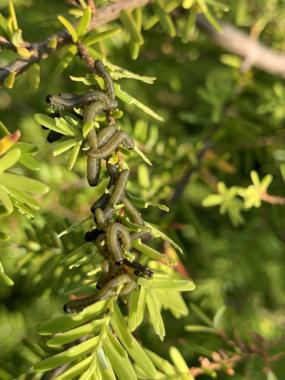
Hemlock sawfly in its larval form. (Photo courtesy of U.S. Forest Service)
Hemlock sawfly in its larval form. (Photo courtesy of the U.S. Forest Service)

The hemlock sawfly is native to Southeast Alaska. But for the past few years, the tiny insect has been causing some big problems. Bug scientists think drought conditions played a major role in a recent outbreak.

And it’s alarmed some residents who’ve noticed more brown trees in their rainforest backyards.

Elizabeth Graham doesn’t get what you’d consider normal text messages from her friends.

She’s an entomologist with the U.S. Forest Service. So, rather than pictures of people’s cats or puppies, she might get a text with a question mark and a wolf spider. And sometimes she has to deliver bad news.

“I like it a lot better when someone sends me a picture and says, ‘Is this a bedbug?’ And I can tell them, ‘It’s not.’

Graham does this for the public, too: identifying weird insects or insect behavior. And in the summer of 2018, her office received something much more descriptive than a text message: a bag of frass. That’s hemlock sawfly poop. A sandy, green-looking concoction.

It was collected outside a cabin on Killisnoo Island in Southeast Alaska. The residents had lived in the cabin for 40 years, and they’d never seen anything like this.

They explained to Graham the insects were causing them — and the trees — major stress.

“It was so dry and there were so many sawflies in the canopy, that it was literally raining down,” Graham said. “And you could hear the frass hitting the devil’s club and skunk cabbage.”

Here’s how Mary McDowell — the resident who gathered the insect poop — describes it:

“If you took a walk in the woods, you could feel the frass on your scalp and in your hair,” McDowell said.

In their squirmy larval form, sawflies devour old hemlock and, occasionally, spruce needles.

Last year, the sawfly munched on about 40,000 acres of hemlock in the region. This year, that number ballooned to close to 400,000 acres of damage.
It got so bad McDowell stopped collecting rainwater from her roof to drink. Her gutters were often clogged with the sawfly poop.

She said this event was upsetting for a variety of reasons.

“One of my favorite little rituals is: First thing in the morning, I’d open the curtains in this lush green forest,” McDowell said. “One of my joys is to open that curtain and look out. And now, the two trees that are right in front of that window are totally brown.”

If the trees lose all their needles, they can die. McDowell is anxious about that happening to her beloved trees.

“It’s just heartbreaking to see the changes, and we’re so fearful,” McDowell said.

This is one of the worst hemlock sawfly outbreaks the Forest Service has documented in Alaska since the 1950s.

To understand why and how it could be remedied, you need to understand the lifespan of a sawfly.

Outside on a hiking trail, Graham plucked the insect off a hemlock branch. This sawfly was wrapped up in a cocoon.

“They’re just real small. I like to say Tic Tac size,” Graham said.

Like butterflies, sawflies start out looking like tiny caterpillars. They eat, cocoon and reemerge with wings. Their lifespan is short — only a few months — but it’s enough time to reproduce and ensure the cycle continues.

To make it through this is a gauntlet of horrors. It’s nature’s way of keeping the sawfly numbers in check.

Normally, with average rainfall, a type of fungus covers the trees and the sawflies eat the fungus. It can bloom inside them — killing some of the sawflies.

But with the recent drought in Southeast Alaska, Graham said that plan has gone a bit wonky.

“Because of that, those sawflies that should have been killed weren’t,” Graham said. “And we just ended up with a huge population.”

Fungus isn’t the sawfly’s only nemesis. In fact, Graham has some sinister hopes for this Tic Tac-sized sawfly in the cocoon.

Entomologists are rooting for a parasitic wasp to help knock down next year’s population.

“A lot of people compare them to aliens, because they bore inside and feed on them,” Graham said.

Still, what if the drought conditions are as terrible as they were for the past few years? The parasitic wasp alone probably won’t drastically reduce the sawfly’s numbers.

Graham said the sawfly’s voracious appetite could ultimately be its downfall. Remember: The insects only eat the old needles, and they munched on much of that this year. A lot of them have already starved.

Graham thinks the sawfly population has likely peaked in some places.

“It’s sort of like a blip,” Graham said. “You kind of think in the long run it looks dramatic. But hopefully it’s not going to have long lasting impacts.”

But there’s at least one more frightening scenario that could play out. An insect called the western blackheaded budworm eats the new needles on hemlock trees. It could present a double whammy after the sawfly has eaten so many of the old needles.

Scientists like Graham are monitoring carefully and hoping the trees in the rainforest have time to heal.

Climate change is causing yellow cedar decline. But not enough for an ESA listing.

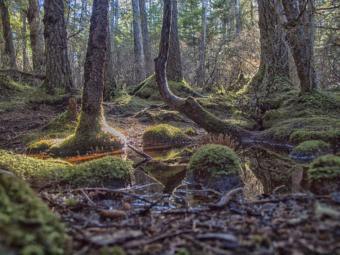
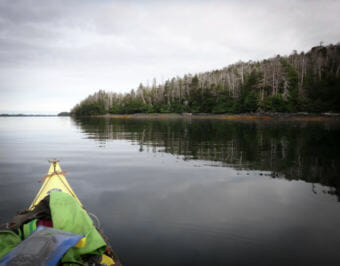
Lauren Oakes paddles to a research site in the West Chichagof-Yakobi Wilderness of Southeast Alaska. (Image credit: Lauren Oakes)
Dead stands of yellow cedar in Southeast Alaska. (Image credit: Lauren Oakes)

Yellow cedar — the culturally and commercially valuable tree species found throughout Southeast Alaska — will not be protected under the Endangered Species Act.

On Oct. 7, the U.S. Fish & Wildlife Service published its decision.

And while the agency suggests climate change is the reason yellow cedar has been declining across its range, it said there’s still “wide distribution [of yellow cedar] on the landscape” and that factored in to its decision not to list it.

So far, about a million acres of trees have died from Alaska to California. An Endangered Species Act listing would have made it difficult to log the tree.

Brian Buma has been tracking yellow cedar’s decline. He’s an ecologist at the University of Colorado. He says researchers don’t understand why some stands of yellow cedar have been resilient to warming and others have not.

Still, Buma says, the decision not to list it shouldn’t be a reflection of the tree’s long term status.

“It’s not a clean bill of health,” Buma said. “Them saying, ‘It’s not listed,’ I’m afraid people will see that and say, ‘Oh, it’s fine.’ And it’s not fine.”

Buma says yellow cedar might not go extinct in the next 20 years or so. But the tree’s decline is expected to continue as the temperature warms.

Faced with an important decision on the Tongass, why is the federal government supporting Alaska’s timber industry?

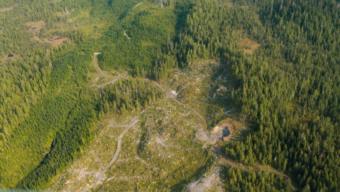
A clearcut section of the Tongass National Forest in August 2010.
A clear-cut section of the Tongass National Forest in August 2010. (Creative Commons photo by Alan Wu)

The U.S. Department of Agriculture is in the middle of making a crucial decision about how it manages the Tongass National Forest.

In 2018, the state of Alaska was granted millions of dollars in federal funds to help facilitate dialogue about potential changes to the Roadless Rule, which could open up new areas of the Tongass to old-growth logging.

But a state records request reveals that a timber industry group was paid out of that grant for additional input, and some people involved in the rule-making process say that’s not fair.

What is the Roadless Rule?

The Roadless Rule debate has dragged on for decades. Last summer, when the U.S. Forest Service announced it would be looking at how the rule applies to Alaska, it was a big deal.

And the state wasn’t looking for a compromise. It wanted a full exemption — meaning Alaska wouldn’t be burdened by the same restrictions nearly all national lands have to follow, making it easier to build new roads through parts of the Tongass.

Access roads for logging have been a sticking point for the region’s struggling timber industry, which employs less people than a Walmart store. The remote location has made harvesting trees difficult, and the federal red tape made it nearly impossible, or so the argument goes.

Still, throughout this process, U.S. Sen. Lisa Murkowski has said that’s not the only reason she supports full exemption. In an interview this month, the Alaska Republican reiterated that she supports more access in the Tongass.

“Not necessarily just to access to timber, but access at all,” she said.

The state gets federal money to work on a state-specific rule

The Alaska Division of Forestry was awarded $2 million shortly after the Forest Service’s announcement last summer. It’s actually a modification of a grant that’s part of the USDA State Fire Assistance program. It’s typically used for things like fighting wildfires or insect prevention.

Click to view document.

But in this case, it was awarded to the state to work on the Roadless Rule as a cooperating agency. Essentially, the state would be a point person to the federal government leading up to a final decision.

“I was kind of astonished about that,” said Andy Stahl, the executive director of Forest Service Employees for Environmental Ethics, a watchdog group.

He said it’s not uncommon for the federal agency to grant states money. But given the circumstances in Alaska, he thinks this grant presents a conflict.

“The state has said, ‘Change the rule.’ And the federal government, which wrote the rule … turns around and says, ‘Here’s $2 million to help you convince us to change the rule.’ And that’s just weird,” Stahl said.

How the state spent the money

To date, the state has spent close to $500,000 on a variety of things, like putting together a citizen advisory committee. Last fall, former Alaska Gov. Bill Walker appointed a team of people representing diverse perspectives for that committee, from conservation groups to timber interests.

Together, they provided important feedback to top federal officials on how the Roadless Rule should apply to Alaska.

But the Alaska Forest Association — a timber industry group — has gotten another opportunity to weigh in. An opportunity that comes with a payment.

Click to view document.

So far, the Alaska Forest Association has been given more than $200,000 in funds from the $2 million grant the state got from the Forest Service in 2018.

And there’s potentially more coming.

The Alaska Forest Association is under two contracts with the state, signed in March of this year, worth up to $360,000. The group is providing the industry’s perspective — how its business will be affected by changes to the Roadless Rule and work plans moving forward.

Stahl said the the Forest Service couldn’t have granted this money to the Alaska Forest Association directly, because the grant is being managed under state laws.

But he’s confused why the money is being given to a group with a clear agenda.

“Nobody in their right mind would turn to that organization for the unvarnished, dispassionate facts,” Stahl said. “You’d go hire a private consultant.”

But Chris Maisch, the director of the Alaska Division of Forestry, disagrees.

“We want a party that has the expertise and knowledge to give us an accurate answer, so that will inform our policy,” Maisch said.

He said spending a portion of the federal grant this way shouldn’t come as a surprise. The state regularly partners with stakeholder groups.

And since the fate of the timber industry is being considered, an industry group like the Alaska Forest Association makes the most sense in this role.

“The state has a vested interest in continuing the industry, and that’s what we’re trying to do,” Maisch said. “That’s the whole purpose behind the Roadless Rule petition.”

Another cooperating agency

Joel Jackson, the tribal president of the Organized Village of Kake, doesn’t think that’s OK.

Like the state, the tribal government is another cooperating agency. They’re also supposed to be providing context to the Forest Service as the decision gets made.

But unlike the state, Kake wasn’t granted any federal money to help make its case.

“We didn’t get any funding for staff to be working on (the Roadless Rule),” Jackson said. “And that’s very, very important, because we have limited funds.”

At times, Jackson said the small tribal government has scrambled to meet deadlines and provide meaningful comments.

If major changes are made to how the Tongass is managed, he said there’s a lot at stake for the village.

For example, he’s worried about food security. Historically, large-scale industrial logging damaged salmon streams.

“I want the people to know who don’t live out in the rural villages how important the salmon are to our people,” Jackson said.

The Forest Service wouldn’t provide comments for this story. Though the state said the Forest Service is aware of how the grant money is being spent.

An announcement on the Roadless Rule decision was expected to come out in draft form this summer, but it’s been delayed. A national report suggests, at Gov. Mike Dunleavy’s urging, that President Donald Trump’s administration is now working on a full Alaska exemption.

Alaska’s sales pitch: Vast resources and a melting Arctic

xx
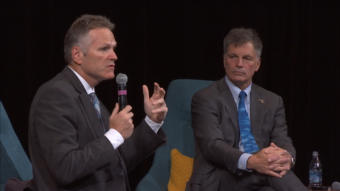
Alaska Gov. Mike Dunleavy and Wyoming Gov. Mark Gordon speak at a panel discussion at the International Forum of Sovereign Wealth Funds. (KTOO image from video)

Juneau is home to the Alaska Permanent Fund Corp. And this week, the capital city was also home to the International Forum of Sovereign Wealth Funds.

It was the first time the annual meeting has been held in the United States, and it offered a unique chance for the state to pitch itself as a great investment opportunity to wealth managers from across the globe.

The International Forum of Sovereign Wealth Funds isn’t a conference you can easily crash. There are several security guards posted by the entryways. It would be a tough feat to sneak into the buffet line.

In two days of closed sessions, attendees traded info on best practices for investing billions of dollars on behalf of nations or states. But Thursday was open to the media and broadcast to the public.

At a morning panel discussion, the conversation turned to the Arctic.

“Is a warming Arctic the next gold rush?” asked a representative from the Kuwait Investment Authority, a sovereign wealth fund with assets of more than $500 billion.

He posed the question to Alaska Gov. Mike Dunleavy. Dunleavy stopped short of comparing the melting of Arctic sea ice to the Alaska gold rush. But he encouraged the audience to consider the investment potential in the state.

Dunleavy suggested Alaska is uniquely positioned to benefit from a new trade route in the Arctic.

“That’s something people in this room and this world should think about,” Dunleavy said. “Because we need to build infrastructure in that area. We need to start to develop that area in anticipation of what’s going to happen.”

Earlier in the discussion, Dunleavy mentioned there are vast resources in Alaska “barely being touched.”

He added that the Trump administration has been very pro-development.

“I’d say, take a look at Alaska for a whole host of reasons. We have our traditional resources. We’re a new state,” Dunleavy said. “So imagine America, in some respects, 100 years ago.”

A big topic of conversation at the forum this week was digital disruption: machine learning and the use of personal data.

It’s something sovereign wealth funds try to key into: How will this disruption shape the market, and what are the investment opportunities?

In Alaska, you could say the climate is being disrupted. The Arctic is warming twice as fast as the rest of the world.

“At the same time, retreating glaciers leave behind access to great mineral wealth and the potential for new resource development,” said Angela Rodell, the CEO of the Alaska Permanent Fund Corp., speaking on the panel.

After the session, Rodell said this forum is one of the ways sovereign funds get ideas for where to invest.

“Being on the ground, talking to the people who live and work in a region, nothing beats that for creating a sense of happening, possibility, opportunity, trust,” Rodell said.

Next year, the Alaska Permanent Fund Corp. will have a 5,000-mile-plus commute to attend the conference.

It’s happening in Baku, the capital city of Azerbaijan.

Editor’s note: KTOO is under contract with the Alaska Permanent Fund Corp. to produce video coverage for this event.


Is the USDA now leaning toward a full exemption of the Roadless Rule in Alaska?

Lena Loop trail near Juneau in the Tongass National Forest.
Lena Loop trail near Juneau in the Tongass National Forest. (Creative Commons photo by Gillfoto)

President Donald Trump is pushing for a full exemption of the Roadless Rule in Alaska, according to a Washington Post story published this week.

It’s what Alaska Gov. Mike Dunleavy and U.S. Sen. Lisa Murkowski, R-Alaska, have been advocating for. But it’s a big departure from what most people say they’d like to see happen in the nation’s largest national forest.

Recently, the president made a dad joke about Dunleavy on a phone call at a private political event in Soldotna. But he also referenced a few of the governor’s priorities.

“He’s doing something with your logging and all your other things.” Trump said. “We’re working on that together, and that’s moving along now.”

The U.S. Department of Agriculture is deciding right now if new roads should be built in the Tongass National Forest and to what degree. It could increase access to new stands of old-growth trees and, Murkowski says, renewable energy projects.

One option is to fully roll back the Roadless Rule in Alaska. But that’s one extreme.

The Roadless Rule has been in place for two decades across the country. And it makes it difficult to build new roads on national lands.

Niel Lawrence, a senior attorney with the Natural Resource Defense Council, thinks fully exempting the Tongass from the Roadless Rule is a bad idea.

“I think what we would see, as a practical matter, is a substantial increase in road building,” Lawrence said.

Lawrence doesn’t think repealing the Roadless Rule would restore Alaska’s struggling timber industry. Despite an increase in access, he said it’s not easy to make federal timber sales pencil out.

“Southeast Alaska is a really challenging, difficult, terrible place to run a logging industry,” Lawrence said. “It’s one giant wetland. It’s remote.”

But he said a full exemption could open up the floodgates for other types of environmental damage. For example, the agency could be allowed to build roads in areas designated as important habitat for deer or salmon.

Read more coverage on Alaska’s Roadless Rule debate

Murkowski thinks that’s jumping to conclusions.

“If you were to have a full exemption, it doesn’t mean that all of a sudden anywhere anyone wants to put something, it’s going to happen,” Murkowski said. “I think it’s reactionary, and I would just urge greater caution.”

Residents in the Organized Village of Kake are concerned sweeping changes could affect the habitat in their backyard.

Kake Tribal President Joel Jackson said the salmon streams in Kake are still healing from the industrial logging of the past. He doesn’t want the see a full exemption being considered today, though he suspects it might be a possibility.

“As we move forward here and the economy gets tighter and tighter, it’s going to be more important to our community that we have food security,” Jackson said.

In an emailed statement, the U.S. Forest Service said it was still looking at a “range of alternatives to roadless management.” The agency expects a draft environmental impact statement to be released this fall and a final decision in 2020.

Site notifications
Update notification options
Subscribe to notifications