Elizabeth Jenkins, Alaska's Energy Desk - Juneau
Petersburg borough assembly defeats on-street ATV law

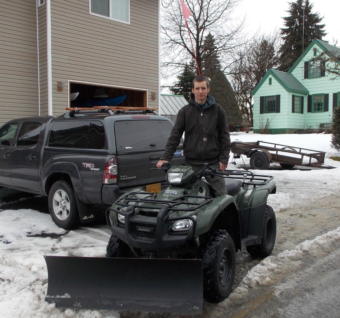
Richard Burke plows outside his home in 2017. (Joe Viechnicki/KFSK)

Petersburg’s borough assembly Monday voted down a proposed law to allow off-highway vehicles (OHV) on local streets. That was a little over two years after voters also said no on the issue. But supporters may look to have the issue back on the ballot at some point.

The proposed ordinance would have allowed ATVs and other off highway vehicles on borough streets with a number of conditions. It was similar to the proposed ordinance voted down by nearly 59 percent of those turning out to the polls in 2017.

Local resident Richard Burke headed up the signature gathering effort to put the issue on the ballot that year. He told the assembly this month that things have changed since then, including a similar ordinance passing in Wrangell.

“I understand that some of you may have reservations about allowing OHV use on our borough roads,” Burke said. “This does not have to be an all or nothing issue. If you don’t like certain parts of the ordinance I urge you to amend it. Make it better that Wrangell’s ordinance. Make it work for Petersburg. If you’re still concerned about safety then add other safety requirements to the ordinance. If you’re concerned about noise then amend the ordinance to prohibit two strokes (engines). If you’re concerned about teenagers racing up and down the streets then add language to make it easier for the police to impound a teenager’s vehicles.”

Burke and other supporters have argued the change would make parking easier in downtown and offer a lower cost mode of transportation. He had support among some on the assembly.

“The downsides I had been told was well they’re hard to see,” said assembly member Taylor Norheim. “Well so are people on bikes and motorcycles and they’re allowed on the roads and they’re allowed, so are diesel trucks and motorcycles. They’re allowed on the road. And the vote was close. Most of the people who had voted no really that I had spoken to, the same as was stated that they weren’t really a hard line opposed to it. Some of them were but the majority of them really weren’t, they just I guess didn’t like change as was stated. And the fact that Arizona allows ATVs everywhere even downtown Phoenix, like really? But we’re not going to, why exactly?”

The proposed ordinance would have set up a schedule of fines for infractions like impeding traffic, driving without insurance or without a helmet for drivers under 18. It would also have allowed the borough to charge 100 dollars for a two-year registration sticker for Mitkof Island.

Opponents have been concerned with safety for drivers of these off-road vehicles, especially around highway cars and trucks. Other assembly members did not agree the 2017 vote was close and were reluctant to make the change against the will of local voters.

“I share the concern of overriding a recent relatively decisive vote and so I would only be comfortable putting it on the ballot, not making the decision at the assembly level, I don’t think that’s appropriate,” said assembly member Chelsea Tremblay. “And so if you want to make the change to have it be something that would go on the ballot and have it be focused on that, because my also issue is not just running the same thing again and again until eventually it passes. I want it, having it be substantially different than what went to the voters before. We don’t necessarily ask them the same questions repeatedly.”

Still others on the assembly thought the vote was no in 2017 because ATV owners didn’t want to have to register those vehicles just to plow snow during the winter time. While technically it’s illegal to plow snow using an ATV at the moment, police in Petersburg do not enforce that law. Assembly member Brandi Marohl made a motion to change the proposed law to clarify that off highway vehicles wouldn’t need a registration sticker for snow plowing.

Norheim was the only other in support of that change and it failed 5-2. That was also the vote on the main motion on the ordinance in its first reading so it does not advance. The assembly encouraged supporters of the change to rewrite the proposal to something they thought the local electorate could support for a future ballot.

Environmental review underway for long-awaited Sitka seaplane base

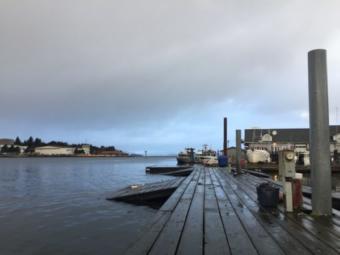
The current seaplane dock, off Katlian Street, has limited capacity and lacks modern amenities. (Photo by Ari Snider/KCAW Photo)

Sitka may finally get a new seaplane base that has been in the works on and off for the last two decades. During a meeting at Harrigan Centennial Hall Dec. 11, representatives from the city, the Federal Aviation Administration and the DOWL consulting group updated the public on planning process.
DOWL, the engineering firm contracted by the city to work on the project, is conducting an environmental impact study.

The city accepted an $842,629 federal grant in August to pay for an environmental review. If that process is successful, the city will be able to move ahead with land acquisition, and eventually, construction.

The new base is expected to cost around $16 million and the FAA will cover 93.75% of that. The city would have to put up $1 million in matching funds. The FAA would also provide ongoing funds for maintenance and future development.

Kelli Cropper is the city project manager overseeing the effort. She says the current base, off Katlian Street, has outlived its useful lifespan and has a number of shortcomings, starting with limited docking capacity.

“It has eight spaces,” Cropper said. “Four of them, on the land side, you can’t access at low tide. So they go dry.”

Additionally, the current facility has no on-site fueling infrastructure, is expensive to maintain, and requires pilots to navigate a channel already busy with ship traffic.

The proposal calls for a new base on the northeast side of Japonski Island, across from Thomsen Harbor. It would have 14 permanent slips and space for five transient planes, according to designs presented at the meeting. It would also have on-site fuel storage, a drive down ramp, and more car parking, among other potential features.

About 30 people attended the meeting. Many expressed support for the new base but also frustration at how long the process is taking — the city began scouting potential locations in 2000.

One of those people was pilot Kevin Mulligan, who runs the floatplane company Baranautica along with his wife, Karen. Kevin emphasized the potential region-wide impact of improved seaplane infrastructure, including better support for the NSRAA and Armstrong hatcheries.

“It is such an important thing that not only Sitka needs, and the fishermen need to support NSRAA, and Armstrong-Keta, and NOAA research at Little Port Walter, and all the small communities that don’t have an airport,” he said.

Despite the eagerness to see the base finally come to fruition, Cropper notes several important steps remain beyond the environmental impact review. Steps that will each take time.

“We’d have to bid the work, and know how much that costs, in order to get the construction grants,” she said. “So figure, allow two years just for timing the grant cycle.”

She says the goal is to have the new base operational by 2024.

Activists take to social media as comment period for Roadless Rule draws to a close

The final deadline for public comments on a proposal to exempt the Tongass National Forest from the Roadless Rule is Tuesday, Dec. 17.

As the deadline loomed, environmental groups increasingly tried to get the word out to encourage people to weigh-in.

Those conversations have taken place in physical spaces and also — increasingly — online.

Mary Catharine Martin works for Salmon State, an environmental advocacy group that works to protect waterways for salmon.

She pulls up Salmon State’s Instagram feed to show some of their recent efforts. She says the videos the group created with its partners about the Tongass has had a big reach.


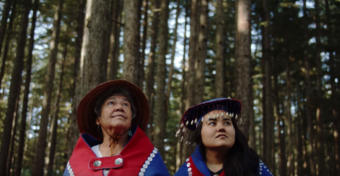
In a video called Breathe, a Tlingit woman and a Yup’ik woman dressed in regalia talk about the cultural and environmental significance of the nation’s largest national forest. Salmon and eagles make an appearance.

Then the pacing of the video speeds up as chainsaws and falling trees blink on the screen.

Martin estimates the video has been viewed on Instagram by more than 32,000 people, and her group is still adding up the numbers.

She says the goal isn’t just to get people to watch and share the content.

“The main purpose of all of this, besides informing people about what’s going on and the different ways the Tongass is valuable as an intact Forest, is get people to comment,” Martin said.

In February, the U.S. Forest Service documented over 140,000 comments on a draft version of changes to the Roadless Rule in the Tongass.

Most of the comments suggested keeping the rule in place. But in November, Dept. of Agriculture Secretary Sonny Perdue announced that — despite all those comments — the agency would recommend the Tongass be completely exempted from the Roadless Rule.

During this final comment period that started in October, 220,000 people had weighed in, according to the U.S. Forest Service.

Over the weekend, Audubon Alaska helped host a webinar to guide people through the process of crafting their comments. The instructors for the video appear to be in their homes. They include activists and a tribal government leader.

One hundred and fifty people watched on Facebook live. Another 150 people have streamed it again since then.

Natalie Dawson, Audubon Alaska’s Executive Director, says environmental groups have been making a special effort this go-round to bolster the numbers.

“I mean there’s definitely been a bigger social media push for this … then there has for other issues on the Tongass,” Dawson said. “100 percent hands down.”

Dawson says people have asked her if official public comments really matter. After all, the last comment period didn’t sway a top federal official from seeking a full rollback of the Roadless Rule in the Tongass.

But Dawson thinks it does carry weight.

“If the agency chooses to ignore the public and the public has made substantive comments then that’s grounds to pursue litigation and lawsuits,” Dawson said.

At a church in Juneau, the Southeast Alaska Conservation Council took a different approach.

In addition to the group’s social media outreach, Executive Director Meredith Trainor says they wanted to invite people to draft comments, on the eve of the deadline, over bowls of salmon chowder.

“It’s also important to feel together to feel a part of something bigger and see each other and make eye contact,” Trainor said.

The U.S. Forest is taking public comments on the Roadless Rule decision until midnight Dec. 17, 2019 Alaska time.

The agency is expected to make its final decision on how the Roadless Rule applies to the Tongass in 2020.

Proposed Nuyakuk Falls hydroproject to test impacts on salmon

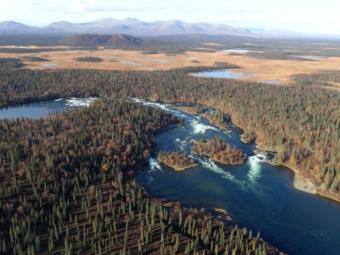
A shot of the Nuyakuk Falls. Nushagak Cooperative is proposing to build a hydroelectric project at the falls, located three miles inside the Wood-Tikchik State Park. (Photo credit Alison Eskelin)

If you look at the Wood-Tikchik State Park on a map, you’ll see a bump on its eastern boundary line, jutting out to include Nuyakuk Falls, just three miles inside the park.

“Well, it’s absolutely beautiful,” said Pat Vermillion, one of the owners of the Royal Coachman Lodge, situated about two miles upstream from the falls. “It divides the river into three shoots that are pretty intimidating to even get close to them, they’re pumping so much water through.”

Nushagak Cooperative, a regional utility co-op, wants to harness that force, moving the region away from diesel fuel and toward clean, renewable energy, which could also lower high energy costs for its members. It has identified Nuyakuk Falls as an ideal location for a hydroelectric generator. Now it’s beginning the federal permitting process in earnest.

Its model would divert up to 30% of the river’s flow through a generator and return it to the river at the bottom of the falls. The preliminary design includes a 750-foot tunnel through the bluff and a diversion dam which directs that flow through two turbines.

Nushagak Co-op has said that if studies show that more of the flow can be diverted without adversely impacting fish in the area, it may lobby the legislature to push the 30% limit higher.

The generator would produce an estimated 58,200 megawatt hours a year. That’s more than two-and-a-half times the region’s current energy needs of 23,000 mWh — enough power for the member communities to turn off their diesel generators most of the time. The river’s flow increases during the summer, and its energy output would as well, meaning the generator could not only meet the energy demands of salmon processors, but also lower their energy costs.

But Nuyakuk River is also a highway for one of the region’s major salmon runs. Vermillion said that has prompted concerns about the development.

“Nuyakuk Lake, Tikchik Lake, and Chauekuktuli Lake are all upstream of these waterfalls, and they have massive amounts of sockeye salmon that spawn in the creeks that flow into them. And they also swim right through that waterfall,” he said.

The co-op has yet to determine whether the generator would impact fish. A state bill passed this summer allows them to do so, by conducting feasibility studies at the site over the next few years.

“We’re looking for a reason why we shouldn’t move forward,” said Robert Himschoot, the CEO for Nushagak Cooperative. “So far, there hasn’t been any fatal exclusion on the desktop feasibility. There hasn’t been anyone come forward in our outreach to say, ‘no matter, no how, no way.’”

The co-op has considered other rivers in the park before, but the Nuyakuk site is different. Its waters are fast-moving, and rush around a the U-shaped bend in the river, called the oxbow, where the project would be situated. That means the water can be diverted over 2,000 feet, which is a relatively short distance to produce a lot of energy.

The communities of Dillingham, Aleknagik and Koliganek have issued statements supporting feasibility studies at the site. Nushagak Co-op says it has held more than 80 meetings on the project so far. But at a kick-off meeting in November, people expressed concern about the accessibility of the meetings for local residents.

Himschoot is cautiously optimistic about the project’s potential to generate power without harming fish.

“I think the potential benefits for the communities in the watershed, along with the design that we are putting forward — the diversion with no dam — until you have the actual hard studies, you have the boots on the ground, you know what’s going on… there’s enough potential there, enough benefit,” he said.

The area around the proposed Nuyakuk project. (Image credit Nushagak Cooperative)

The park comprises 1.6 million acres of forest, mountains, lakes and streams. Himschoot says the site’s location on public lands raises the stakes for the project. Still, he thinks there is enough initial support to move forward in the permitting process.

But many are worried about building infrastructure on public lands. Kurt Hensel is the superintendent for the Chugach/Southwest state parks. He says that building a hydroelectric facility in the park isn’t necessarily off-limits, but he also pointed out that in these early planning stages, there are a lot of questions, like the placement of the proposed airstrip and roads.

“One of the bigger concerns that I’m looking at, of course the water diversion, but also the transmission lines, and just how it looks like from the air,” Hensel said. “It’s going to be a manmade facility in a natural park, and so scenic views are pretty important for us.”

It would cost and estimated $120 – $140 million to build the project. Along with how the project would impact the environment, a big question is how much residents would save. Analyzing its financial feasibility requires some speculation.

If the co-op borrowed all of the money to build the project, it would stabilize energy rates. According to Himschoot, that’s the worst case scenario. But they are hoping to reduce that debt through federal grants, and say that when the debt is paid off, he said, the rates will drop significantly.

In the coming year, Nushagak Co-op plans to conduct some fundamental assessments and data collection. Further studies will be planned through 2022, focusing on cultural, aquatics and fisheries resources.

The co-op filed a pre-application document on October 7. The federal energy regulatory commission will be holding a scoping meeting on December 11. The public can submit scoping comments on Nushagak Co-op’s pre-application document until February 4, 2020. The project number to reference is P-14873.

FERC meeting and study schedule through August 2020:

Dec. 11, 2019 – FERC Scoping Meeting and Project Site Visit 

Dec. 20, 2019 – Wood-Tikchik State Park Management Council meeting 

Feb. 4, 2020 – Deadline to submit scoping comments on Nushagak Cooperative’s pre-application document

March 20, 2020 – FERC issues scoping document 2 if necessary

March 20, 2020 – Nushagak Cooperative files proposed study plan

April 19, 2020 – Proposed study plan meeting, open to the public 

June 18, 2020 – Deadline to submit comments on proposed study plan

July 18, 2020 – Nushagak Cooperative files revised study plan

Aug. 2, 2020 – Deadline to submit comments on revised study plan

Aug. 17, 2020 – FERC issues study plan determination 

Salmon returns are down in Metlakatla. These junior scientists are discovering possible reasons why.

xx
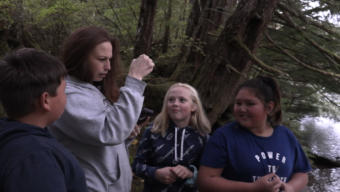
The Metlakatla Boys & Girls Club was recognized in 2019 at an annual international GLOBE conference for the their scientific achievements. (Still from video by Joey Mendolia/Alaska Public Media)

Ocean temperatures were well above average for much of the state this year.

And fish biologists throughout Southeast Alaska are monitoring salmon streams carefully. There are questions about how warm water and abnormally dry conditions could affect salmon returns.

In Metlakatla, a group of young scientists are logging their own data to better understand the future they’re inheriting.

On the trail to Hemlock Creek, the Boys & Girls Club members were nervous about running into a black bear. The forest is thick with trees and brush.

But Sesilynn Schleusner, the club manager, knows how to put the kids at ease. She lets out a loud whistle.

There were no bear sightings on the rugged path to the stream. But a curious seal popped its head out of the water to examine the adults and three preteens standing on the shore.

Schleusner takes this group here about once a week during the school year to test the water. They’re part of GLOBE, a NASA program which has trained over 100 teachers and mentors in Alaska since 1996 to engage students in science questions.

The Boys & Girls Club in Metlakatla has collected water samples from two salmon streams since 2018. The kids collect data on water temperature, pH and dissolved oxygen levels — that’s what helps salmon breathe through gills. But when the water temperature warms, dissolved oxygen decreases. It can kill fish or make the streams less desirable for returning salmon.

Both streams the club monitors have seen low salmon returns for the fish that spawn during even years. And these kids want to know why.

Mia Winter, 11, said that’s something on her mind.

“Almost everyone here fishes, or almost everyone in someone’s family fishes that lives here,” Mia Winter said.

Mia Winter’s uncle, Dustin Winter, also wants to know more about the health of salmon streams.

“We need our salmon runs to be strong, so we can survive here in Metlakatla,” he said.

Dustin Winter is the director of Metlakatla’s Department of Fish and Wildlife, which manages the Annette Island Reserve’s fisheries. A few years ago, the department started tracking salmon streams in the area by measuring water levels and temperatures in creeks.

Winter thinks the recent drought that’s played out in Southeast Alaska is likely contributing to fish numbers, overall, being down. He said biologists need more long-term data to fully understand how the ecosystem is changing.

Still, he thinks it’s “definitely related” to the drought.

“We can see it specifically in that one system we’re talking about now,” Winter said. “Water levels are down to just a trickle. In one case, we’ve had water temperatures as high as 80 degrees.”

Normally, water levels are a flow — not a trickle. Optimal temperatures for salmon production are around 40 or 50 degrees. But with warmer conditions, there’s less dissolved oxygen. Salmon have a tougher chance at survival.

xx
Mia Winter concentrates as she goes through the many steps to discern dissolved oxygen levels in the creek. (Still from video by Joey Mendolia/Alaska Public Media)

Back at Hemlock Creek, the kids at the Boys & Girls Club rushed to the van to start testing a vial of water for dissolved oxygen.

Mia Winter put on goggles and gloves to handle the chemicals she carefully added to the water. In total, there are about 13 steps she has to follow to get the data.

“It’s hard to do that, because you can’t mess it up at all or you’ll mess up the whole entire thing,” she said.

But Winter didn’t mess it up. She handled the experiment with the cool demeanor of a scientist.

The dissolved oxygen levels in the creek looked pretty good that day.

On the drive back to the club house, Sesilynn Schleusner said she’d like these kids to continue collecting the research throughout high school. Contributing to the NASA program in their young years could be just the beginning.

“I’m hoping that it really gets their foot in the door to get in with a good natural resources program and bring what they learned back home,” Schleusner said.

After all, it’s a home they’ll come back to as oceans continue to change.

This story was supported by a grant from the Robert Wood Johnson Foundation.

Dunleavy defends the use of a federal grant used for Roadless Rule decision

The Ketchikan headquarters of Alcan Forest Products and Alaska Forest Association. (Photo by Elizabeth Jenkins/Alaska's Energy Desk)
The Ketchikan headquarters of the Alaska Forest Association. (Photo by Elizabeth Jenkins/Alaska’s Energy Desk)

The Dunleavy administration is defending how it spent federal grant funds as it was working with the U.S. Department of Agriculture to consider a rollback of the Roadless Rule in the Tongass.

On Nov. 18, two Democratic members of Congress requested an investigation into why some of the grant funds were used to pay an Alaska timber industry group for additional input while an important federal rule — one that could open up areas to logging — was being examined.

But the state maintains it spent the money appropriately.

The money was given to the state of Alaska by the USDA in 2018, after the state got a “yes” on a longstanding ask to reexamine — and possibly exempt — the Tongass National Forest from the Roadless Rule.

It received the money as a cooperating agency on the decision.

The state used more than $200,000 of that federal grant money, typically designated for fire prevention, to pay an industry group for more perspective on economic timber sales.

On Monday, Sen. Debbie Stabenow, D-Mich., and Rep. Raúl Grijalva, D-Ariz., requested an investigation, seeking more details about “potential misuse” of those federal funds.

In their request, they said the Tongass is “essential to addressing the climate crisis. It is critical that we ensure this taxpayer funded grant was properly awarded and used.”

“We see no misuse of funds,” said Gov. Mike Dunleavy on a phone call from Florida, where he’s attending the annual Republican Governors Association meeting.

Like the state, the Organized Village of Kake was also a cooperating agency providing important feedback on the Roadless Rule decision. Tribal government President Joel Jackson opposes large-scale logging in the Tongass.

From the grant money the state received, the Organized Village of Kake got some travel funds to be able to participate. Jackson estimates it was a few thousand dollars.

Still, he said, they struggled with limited staffing to be able to make meaningful comments.

He said whether the money was administered and divided up legally or not isn’t the entire point.

“We don’t view the process as being fair,” Jackson said.

Ben Stevens, the governor’s chief of staff, reiterated there’s no evidence to support the claim that funds were misused.

“There’s none,” Stevens said. “And so whether it’s fair or not doesn’t — we don’t understand what that means. If there’s anybody, any another entity, that could have done that economic analysis, we’d be happy to hear who it is and have them come forward.”

The entity is the Alaska Forest Association, a timber industry group.

Alaska’s Energy Desk obtained documents through state and federal records requests that show how some of the $2 million given to the state was spent.

Funds were used to help facilitate a conversation about the Roadless Rule.

Former Gov. Bill Walker appointed a diverse group of stakeholders. The committee came up with a menu of six options for the Tongass to be considered by Agriculture secretary, Sonny Perdue.

Later, the Alaska Forest Association was offered contracts to add additional industry perspective: analyzing the six alternatives and providing an economic analysis of the timber.

The group has received over $200,000, so far, from the grant.

A press release from the state Department of Natural Resources says it hasn’t billed the U.S. Forest Service for the work yet. It could still use the state match for that.

Stevens said it makes sense the Alaska Forest Association would do this work.

“They’re the ones that know the value of the timber industry there,” Stevens said.

The request for an investigation into how the federal funds were spent is set against the backdrop of the Forest Service now seeking a full exemption of the Roadless Rule in the Tongass.

The decision has been met with some skepticism in the public Forest Service meetings throughout Southeast Alaska. People have questioned the agency about the state’s influence in the process, largely drawing on a Washington Post report that suggested — at Dunleavy’s urging — President Donald Trump directed the secretary of Agriculture to select the full exemption.

Dunleavy said he has talked with the president about the Tongass.

“So any conversations I’ve had with the president and asking questions, if he’s asked questions about the Tongass forest, ‘How can we help Alaska?’ etc., my response was to get it back to being operated as a national forest,” Dunleavy said. “The Roadless Rule doesn’t necessarily help that forest act like a national forest. It makes it act more like a preserve or a national park.”

The USDA Office of the Inspector General has 60 days, upon notice of the request, to issue a response about whether it will be pursuing the investigation that the two members of Congress have asked for.

As for the Organized Village of Kake, they sent an email to the Forest Service recently saying they no longer want to be a cooperating agency.

The Forest Service declined to comment for this story.

Site notifications
Update notification options
Subscribe to notifications