
Elizabeth Jenkins, Alaska's Energy Desk - Juneau

Body ID’d as missing Kake woman; troopers investigate homicide

One of several missing posters distributed online following Shirley Skeek’s disappearance. (KFSK)

A woman from the Southeast Alaska community of Kake who vanished a year ago has been found dead on the Kenai Peninsula.

Alaska State Troopers said Monday that Shirley Skeek’s disappearance and death are now being investigated as a homicide.

“Investigation into the circumstances of Skeek’s death are under investigation by the Alaska Bureau of Investigation,” the agency said in a statement. “Anyone with information regarding Skeek, her disappearance, or her death are asked to contact the Alaska State Troopers.”

The 28-year-old woman was living in Anchorage. Her body was discovered on May 27 off Seward Highway, near the Hope Cut-off on the north end of the Kenai Peninsula.

But it wasn’t until December that the state medical examiner’s office linked the remains to Skeek using dental records. Police say her family has been notified.

Corps won’t require more fieldwork for final Pebble mine report

Activists hold anti-Pebble Mine posters at an EPA meeting in 2012. Photo by Daysha Eaton.

The U.S. Army Corps of Engineers announced Monday it will delay its final environmental review of the proposed Pebble Mine for three months. But the Corps will not perform any more fieldwork, and it won’t issue a supplement to its draft report, even though multiple state and federal departments have said the report lacks critical information.

Sheila Newman, deputy chief of the Corps’ regulatory division in Alaska, said her agency will use the extra time to respond to concerns raised during the public comment period.

“We’re making sure that the answers are thorough and well understood,” she said.

The Corps is the lead agency preparing the Environmental Impact Statement for the proposed mine in southwest Alaska. The Pebble Partnership says the gold mine would provide as many as a thousand jobs. Opponents say the mine risks polluting salmon streams and threatens the huge Bristol Bay commercial fishery.

Newman, in a phone call with reporters, downplayed the Corps’ role. She said her agency has no authority over things like how Pebble plans to operate the mine or how it will restore the land once the mine shuts down.

“Most of the fieldwork that will be required in the future, if this project goes forward, falls under the direct authority of the State of Alaska, not the federal government,” she said.

A spokeswoman for Commercial Fishermen for Bristol Bay said the response is disappointing. Lindsey Bloom said it sounds like the Corps has no intention of using the delay to fill the information gaps other agencies identified.

“That is exactly what I heard: ‘We’re going to take 90 days, to try to explain ourselves better, without doing any more work, collecting any more data, or being any more thorough,’” Bloom said.

Congress passed a bill last week with a section authored by Sen. Lisa Murkowski that essentially tells the Corps it has to thoroughly address potential impacts of the mine and address the concerns of other government agencies, even if that means additional study.

Newman, from the Corps, said the new timeline came out of six days of technical meetings with other agencies cooperating on the environmental review. She said the final report is now expected in late June or early July, with a final permitting decision likely a month or two later.

A Pebble spokesman said the Corps is doing a thorough review and the mining company is not worried about the 90-day delay.

Haines, Skagway Lego League clubs compete virtually in Juneau competition

(Creative Commons photo by Tim Ellis)

Diminished ferry schedules prevented Lego League clubs in the Upper Lynn Canal from traveling to a Juneau robotics qualifier. Neither the Haines Robohobos nor the Skagway Krosswalk Kangaroos let that keep them from participating.

The Robohobos, Haines’ Lego League team, put their Lego robot to the test and performed a skit for judges at the Juneau Robot Jamboree over the weekend.

But they weren’t actually in Juneau. Cuts to the ferry schedule made travel to the capital impractical for the team. The Robohobos and the Skagway Krosswalk Kangaroos competed by teleconference.

“Some parts, they froze a little, but we did pretty good,” said rookie Robohobo Corbin Wright. He said that didn’t spoil his chance to compete against two dozen other teams from across the state. The team and its robot simply completed challenges for judges on the other side of a video call.

“It felt really exciting,” he said.

Teams are judged in several categories, including a robotics challenge and real world problem solving. This year’s theme, “City Shaper,” challenged students to invent a solution to a problem in their community.

Both Haines and Skagway teams chose transportation infrastructure projects. The Robohobos designed a safer parking and pick-up zone for the elementary school, and the Krosswalk Kangaroos devised a crosswalk system for busy downtown streets. Meanwhile, the state is working to solve a transportation infrastructure puzzle of its own.

The Tazlina was servicing Angoon last weekend instead of making the Lynn Canal run. That left only the weekly Matanuska sailing. Haines Coach Patty Brown said it wasn’t enough to get Lynn Canal teams to the competition.

“In order for us to actually participate in the event and take a ferry, we would have had to stay in Juneau for two weeks. That of course was out of the question,” she said.

It’s not unusual for Lego League competitions to be virtual, but it was a first for the Robohobos.

“We’d never done it before. We had to move projectors and set up the board and get used to a new space, etc.,” she said.

Brown says some of the camaraderie between teams was lost in a long-distance competition. But she was proud of the team for giving it their best shot despite the distance.

Krosswalk Kangaroos took home top honors at the qualifier, despite competing virtually. And their crosswalk project was approved by the Skagway Borough Assembly. It’s now in committee.

Coach Mary Thole says they will have their first in-person competition at State Championships in Anchorage in January.

“This win was huge for this team,” she said.

“This team started out last year and they competed virtually and they were a brand new rookie team and they were taken under the wings of the Prickles, so the Prickles really supported them last year.”

Skagway’s veteran team, the Prickles, aged up this year. They’re now rookies in a new division and took 2nd place at their first competition in Juneau at the beginning of the month.

The state championships are January 17th and 18th. Coach Thole says there’s a ferry to get them to their flight in Juneau.

BP Alaska agrees to pay $125k fine over hazardous waste violations on North Slope

BP’s operations center at Prudhoe Bay. (Elizabeth Harball/Alaska’s Energy Desk)

Oil company BP Alaska has agreed to pay $125,100 in fines over hazardous waste violations on the North Slope.

The U.S. Environmental Protection Agency announced the agreement last week.

The federal agency claims BP failed to properly label hazardous materials in two buildings at Prudhoe Bay. It also alleges that the oil company didn’t have adequate insurance to cover injuries or property damage that could come from storing and handling hazardous waste.

“They’re required to have significant insurance or at least financial resources on hand to handle any claims and we discovered during an inspection that, for several years, they had not,” said Bill Dunbar, a spokesman for the EPA Region 10 Office in Seattle.

BP Alaska has neither admitted to nor denied the claims, according to the consent agreement reached between the oil company and the government.

In a written statement, BP Alaska spokeswoman Megan Baldino said the company worked closely with the EPA to resolve its concerns over the insurance for the Prudhoe Bay operations.

BP is now in compliance with the federal requirements, Dunbar said.

The violations stem from an inspection of BP’s Prudhoe Bay facility in the summer of 2018, he said.

The EPA discovered seven waste aerosol cans in a flammable storage locker at a seawater treatment plant that weren’t labeled or marked “hazardous waste,” according to the consent agreement. At a production center, the agency found a 21-gallon can that stored waste solvent rags and wasn’t properly labeled.

The federal agency also claims that BP Alaska failed to maintain adequate liability coverage for five years, starting in 2014. That’s in violation of the company’s federal hazardous waste permit, according to the EPA.

Under the permit, BP Alaska can “store in excess of 200,000 pounds of hazardous waste, such as flammable and toxic wastes from oil exploration, on leased state land in a sensitive tundra environment,” said a statement from the EPA last week.

The EPA’s claims against BP come as the oil company prepares to exit Alaska. BP intends to sell its entire Alaska business to Hilcorp in a $5.6 billion deal, including its stakes in the Prudhoe Bay oil field and the trans-Alaska pipeline. The sale is still pending.

In recent years, the EPA has stepped up its efforts to ensure facilities permitted to handle hazardous waste have the required liability coverage, Dunbar said.

“The communities that live around facilities that store or manage or dispose of hazardous waste should know that were something to happen, that they could seek damages and get the damages paid,” he said.

State releases new guide on medication assisted treatment

Medical assistant Sarah Martin sits at the reception desk of Ideal Option, a medication assisted addiction treatment clinic in Juneau. In Dec. 2019, the Alaska Department of Health and Social Services released a new guide for offering medication assisted treatment to patients. (Photo by Kavitha George/KTOO)

As more Alaskans seek treatment for opioid use disorder, the state is taking measures to ensure that enough medical providers are there to help.
On Friday, Dec. 20, the Department of Health and Social Services released a new guide for offering medication assisted treatment to patients.

In 2016, a change in federal law made it possible for a wider array of medical providers to offer medication to people with opioid addiction. Known as medication assisted treatment, it’s an extremely effective way to stabilize patients on the spot with medicine like Suboxone.

Kathryn Chapman, with the state’s Division of Behavioral Health, says about 400 medical providers in Alaska are able to provide that service. However, estimates show that only about half of them are treating the population and prescribing for them. Chapman says the reason more providers aren’t offering medication assisted treatment is varied, but it may be the same barrier that some patients experience when they try to get help: not knowing what resources are available.

“That’s part of the challenge is that to provide opioid treatment, you need a multidisciplinary team, really, to support the treatment and recovery,” Chapman said.

So, the Department of Health and Social Services spent two years creating a Medication Assisted Treatment Guide for providers, modeled off one used in New Hampshire.

It details best practices for treating opioid use disorder and helps providers connect patients with behavioral health services around the state.

Chapman says assisting people in their recovery should include a broad package of care.

“Not just their medicine is provided to them,” Chapman said. “But that they’re safe, that they have a safe home, that they have food to eat, that their families have support, too.”

The Alaska Department of Health and Social Services hopes to update the guide as new information becomes available.

New deer count method shows promising results for Southeast Alaska

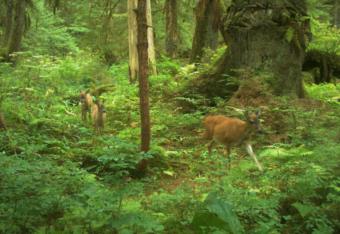
This doe and her fawns were photographed on Mitkof Island using a wildlife game camera. (Photo courtesy of Dan Eacker/ADF&G)

For decades it’s been challenging for scientists to survey Sitka black-tailed deer in Southeast Alaska’s forested landscape. Now, a new way of counting the deer is showing some promising results.

Thousands of black-tailed deer are harvested by hunters every year in Southeast Alaska. Scientists have relied on harvest data and some seasonal alpine surveys to manage the population. But they’ve been searching for a better prediction model for decades. Scientists are now experimenting with a three-year study on Petersburg’s Mitkof Island and if it pans out, it could have many applications elsewhere.

“The first season of sampling went really well,” said Dan Eacker, who is leading the study. He’s a research biologist with the Alaska Department of Fish and Game. He’s trying to find a better way to estimate the local deer population by using a combination of data collecting, DNA tests, game cameras, and collaring.

The DNA tests involve gathering deer fecal pellets and sending them to a lab to identify individual deer through genotyping or the sample’s genetic make-up. Results are back for the first year of the study and Eacker says they were able to identify 68 different deer. That’s much better than he expected.

“It turned out that we got 90 percent success rates on the genotyping,” Eacker said.

That’s a big deal because past attempts had success rates of just 20 to 30 percent. Eacker says sampling is difficult in the local rainforest.

“It’s so wet out here, it rains all the time, that degrades DNA,” said Eacker. “It degrades so fast that it’s hard for the lab to actually get that back, successfully amplify that DNA, and be able to tell one individual from another.”

Telling deer apart helps scientists get a better population count.

So, why has Eacker’s sampling been more successful? He’s focused efforts in the winter when pellets are better preserved in cold. Plus, he’s tracking deer in the snow to get the freshest samples.

Every sample costs $60 to process so getting more results from fewer samples is important.

“It saved a lot of money but it also means that this technique will be viable to get better information about deer population; deer density,” said Eacker.

Getting a good deer count could help managers in Southeast set appropriate harvest limits. In some areas, managers believe there is an abundant deer population, like Admiralty, Baranof, and Chichagof Islands, which have harvest limits up to six deer per resident hunter in most areas.

That’s not the case near Petersburg where the harvest is limited to one buck.

Eacker says scientists have used theoretical data on the number of deer that certain landscapes can support. There are still many unknowns, like how logging affects the species.

“It’s one of the main questions that’s been unanswered since all the logging started,” Eacker said. “Even folks like, Matt Kirchhoff, some of the early deer biologists out here were trying to get at this same thing, they just didn’t have the technology at the time that we do now.”

New technology Eacker is using includes wildlife game cameras mounted in remote areas of Mitkof Island. He is able to identify individual deer through their markings. These 64 cameras capture high definition images and have battery lives of a year or longer.

Eacker also plans to use 20 high-tech GPS collars this winter, which will show biologists important information like the deer’s range and habitat selection.

“This habitat selection can be used to provide better spatial predictions of deer density,” Eacker said.

Eacker hopes that the next two years of the Mitkof Island study will continue to bring in solid data. By combining all three types of data collecting—the collars, the cameras, and the DNA– wildlife managers will be able to calculate more accurately how many deer are in a given area.

And in the future, Eacker says, the method wouldn’t have to be limited to deer. It should also work well for moose.

Site notifications
Update notification options
Subscribe to notifications