Elizabeth Jenkins, Alaska's Energy Desk - Juneau
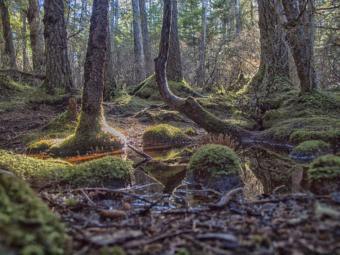
Metlakatla, which depends on water, has moved quickly to accommodate the realities of drought

When you think of extremely dry conditions, California wildfires probably come to mind. But drought looks very different in a temperate rainforest.

Southeast Alaska has gotten enough precipitation in the last few years to flood some parts of the country. But it’s not nearly enough to sustain a way of life dependent on rain.

In an average year, Metlakatla receives around 110 inches of precipitation. That’s down significantly to 80 or 90 inches a year. Over the summer, when Alaska’s temperatures broke records across the state, Metlakatla was classified as having an extreme drought. More recent fall rains have eased conditions to moderate.

Still, the overall lack of rain means the community is having to navigate a different relationship with water. Parts of Southeast Alaska are still grappling with the effects of the most significant drought in a wet season in over 40 years.

(Map by Hannah Lies/Alaska Public Media)

Warmer, wetter conditions are expected in the future. But climate scientists caution: It’s potentially a future with more big swings.

Metlakatla is one of Alaska’s southernmost communities, on the Annette Island Reserve just a short ferry ride from Ketchikan. There’s a common saying: Metlakatla has some of the best-tasting drinking water in the world. In fact, a water bottling company briefly opened up here.

Gavin Hudson, who serves on the Metlakatla Indian Community Tribal Council, said having an abundance of water is an important part of the culture.

“The Tsimshian have always been people of the water,” Hudson said. “People of the salmon.”

Hudson said locals have been noting dry conditions — and the changes they’ve brought — for a while: low salmon returns in streams typically fed and cooled by rain. The blueberry bushes haven’t been as plump or abundant.

And a big difference: Grownups haven’t been able to fall back on a familiar summer joke they would say with a wink.

“The usual thing that you’d hear is, ‘Mom or Dad, can I go swimming on the beach?’ And the usual response, ‘Is there still snow in the mountain?’”

The catch, he said: There used to almost always be snow on top of the mountain all the way through July.

“Now we don’t say that,” Hudson said. “Because even if we get some snow, it’s not deep. It’s just a light dusting … that’s unusual.”

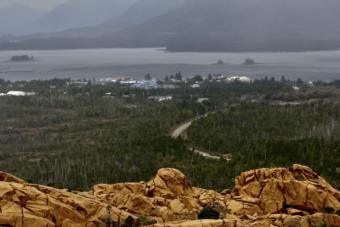
The view from Yellow Hill overlooking Metlakatla. (Still from video by Joey Mendolia/Alaska Public Media)

The meaning of drought

Drought isn’t defined by less rain. It’s defined by less precipitation. Snowmelt helps feed Metlakatla’s lakes. It’s like money in the bank. But recently, there’s been more climate variability. Less snow and rain.

Gavin Hudson, member of the Metlakatla Indian Community Tribal Council. (Still from video by Joey Mendolia/Alaska Public Media)

Hudson said all this has been making the community feel uneasy.

“I think most of our people who just want to provide for their families … I think those folks have just another thing to worry about,” Hudson said. “High light bills. Oceans that are changing. Forests that are changing.”

The high light bills are because Metlakatla is primarily powered by hydropower, but drought has taken a toll on that, too.

Carl Gaube has worked at Metlakatla Power and Light for more than 30 years.

Generating enough hydroelectricity for a town of 1,500 residents is a big part of his daily life. So much, he sometimes answers to a different name.

“Mr. Power. I have friends out there that call me that when we play basketball,” Gaube said. “’You’re a powerhouse.’”

But Gaube has seen a combination of events unfold that has made providing enough power to his community extremely difficult. With water in short supply, Metlakatla has had to run on diesel, which can make it expensive to turn on the lights.

He said a few decades ago, times were different. Businesses like a local sawmill paid a premium to tap into the microgrid. In years with low precipitation, that helped the electric company buy enough diesel to burn to keep the lights on.

But the sawmill has long since closed. A local fish packing plant recently shut its doors, too. And in the last few years, the Metlakatla Indian Community is having to figure out how to adjust to a new identity: An island surrounded by water and in the middle of a severe drought.

“I just pray that it never happens like this again,” Gaube said.

Carl Gaube helped install this diesel generator, which is more than 30 years old. It helped power Metlakatla after a newer generator broke. (Still from video by Joey Mendolia/Alaska Public Media)

Can we call it that?

Genelle Winter noticed a dramatic shift after hiking up a mountain to scope out Metlakatla’s main reservoirs.

“When you could see all three of those dams and you could literally walk across that channel … you’re like, this is not a normal condition,” Winter said. “And you probably should never be able to do that.”

Genelle Winter, climate and energy grant coordinator in Metlakatla. (Still from video by Joey Mendolia/Alaska Public Media)

You shouldn’t be able to do that, she said, because you would be completely soaked.

Winter’s work previously focused on invasive species. But around 2015, her job title changed. She became Metlakatla’s climate and energy grant coordinator.

She said at first, she struggled with how to describe the unusually dry conditions. It just felt “wrong that you could be in a temperate rainforest and be in a drought.”

Still, Winter said she knew the community needed to scale back its energy use to build its reservoirs back up.

For a time, that’s meant burning diesel for the traditionally hydro community. Metlakatla received funding from the Bureau of Indian Affairs for a one-time purchase of bulk fuel, which can be as high as $4 a gallon.

Winter said that’s been a big help restoring the levels of the lakes.

And a phone call from the National Weather Service last year finally gave her a way to put the experience into words.

They told her yes, you are officially in a severe drought, and so are other communities in Southeast Alaska.

“Really helped us to define and really take more ownership of what was going on,” Winter said. “This was something we needed to learn how to deal with now, so that when we met the challenge again in the future, we’d already know how to do it.”

Spillover from one of the main reservoirs. (Still from video by Joey Mendolia/Alaska Public Media)

Changing to adapt

But the Metlakatla Indian Community has already taken steps to prepare. Winter has taught students about the drought, even when no one was calling it that. She’s talked to elementary and middle school classes.

And Metlakatla has cut its water use in half since 2016. In part, because the fish packing plant didn’t reopen last summer. Winter also credits the local conservation efforts.

“Trying to teach grown people to change behaviors is really, really hard,” Winter said. “But getting kids excited about changing behaviors is much easier. And if you can get them passionate about it, then they take that message home.”

But the community isn’t out of the woods yet. One of its newest diesel generators broke last year, resulting in an emergency declaration.

If another extremely dry spell comes along, the town will be powered by a generator that’s over 30 years old.

As for today, though, the community is back on hydro.

On a final stop, Winter points to a landmark waterfall cascading down the mountain. It’s likely spillover from one of the main reservoirs. During the worst parts of the drought, this waterfall was dry.

The flow should be a happy sight. But Winter said it’s more complicated than that.

“I used to just see it as this beautiful thing. And now, wish we could capture that water somehow,” Winter said.

This system, constructed with the understanding there would always be enough water, was built for a different time.

This story was supported by a grant from the Robert Wood Johnson Foundation.

Why was fire prevention funding used on the Roadless Rule process in Alaska? Congress members want to know.

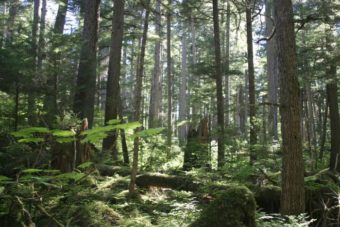
Lena Loop trail near Juneau in the Tongass National Forest.
Lena Loop trail near Juneau in the Tongass National Forest. (Creative Commons photo by Gillfoto)

A United States senator from Michigan and a representative from Arizona want an investigation into why federal dollars — typically used to prevent wildfires — were given to the state of Alaska to work on the Roadless Rule.

On Monday, Sen. Debbie Stabenow and Rep. Raúl Grijalva sent a request to the U.S. Department of Agriculture inspector general, asking for more transparency into how the federal grant was awarded and how the state is spending the money.

In September, records requests obtained by Alaska’s Energy Desk showed the USDA gave the Alaska Division of Forestry $2 million.

That money was used for the state to act as a cooperating agency in the rulemaking process regarding how the Roadless Rule should apply to the Tongass National Forest. But the state also paid a timber industry group more than $200,000 from those funds to provide additional input.

Other cooperating agencies, such as tribal governments, didn’t receive any money.

Currently, the Trump Administration is seeking a rollback of the Roadless Rule in the Tongass, which could increase access to logging.

Stabenow, a ranking member of the U.S. Senate Committee on Agriculture, Nutrition and Forestry, is concerned about climate change and said in the letter that the Tongass is “essential to addressing the climate crisis.”

Forest Service kicks off Roadless Rule discussion in Juneau

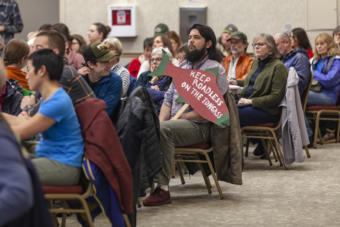
Conor Lendrum, of the Southeast Alaska Conservation Council, listens to a presentation on the Roadless Rule on Monday, Nov. 4, 2019, in Juneau. (Photo by Rashah McChesney/Alaska’s Energy Desk)

The U.S. Forest Service kicked off a series of public meetings Monday, Nov. 4, in Juneau to discuss why it is seeking a full exemption to the Roadless Rule in the Tongass National Forest.

The federal agency explained it didn’t anticipate big changes in the Tongass as a result of the exemption. But some in the crowd weren’t convinced.

People who attended the meeting had a lot of questions for the Forest Service: especially, questions about why verbal comments weren’t being documented at the meeting and questions about why a previous comment period, where most of the public told the agency they wanted to keep Roadless Rule in place, was ignored.

Chris French, who works at the Forest Service’s D.C. office, told the audience of a few hundred people their feedback was still influencing the final decision.

“I hear you,” French said. “And that is certainly something, as we look at those comments that have come in, and we think we need to shift, we certainly can.”

The Clinton-era Roadless Rule makes it difficult to build new roads through national lands. But state officials and Alaska’s congressional delegation have long maintained there’s not enough access to valuable stands of timber or energy and mining opportunities in the region.

In October, the Forest Service announced it was moving ahead with the full exemption. Tribal governments, tourism operators and environmental groups have expressed concern about the impact this change could have on deer and salmon habitat.

That’s why gillnetter Sommers Cole wanted to be here. He fishes in “waters that are fed by terrestrial habitat,” and he’s concerned that “terrestrial habitat” could be damaged by logging and affect salmon streams. The Forest Service explained to Cole that a full Roadless Rule exemption in the Tongass would have virtually no impact on fisheries.

But Cole’s not sure.

“I’ll never claim to speak for other fisherman,” he said. “But I do know it’s on a lot of people’s radar.”

The Forest Service was supposed to be considering a suite of options for the Tongass that allowed road building to varying degrees.

But over the summer, the Washington Post reported Gov. Dunleavy had the ear of the President. And at Dunleavy’s urging, President Trump directed the Forest Service to choose the full exemption.

Murray Walsh is OK with that. He doesn’t like the Roadless Rule because he thinks it impedes business. And he thinks exempting the Tongass from the Roadless Rule is a step in the right direction.

“You have a governor of a state who wants a full exemption and has asked for it and will keep asking for it,” he said.

Richard Peterson is the president of the Central Council Tlingit and Haida Indian Tribes of Alaska, a tribal government that’s a cooperating agency with the state on the Roadless Rule decision.  He also thinks Alaskans should have a say in how the Tongass in managed. But he doesn’t think that’s what’s currently playing out.

“I’m really frustrated,” he said. “The process has been abbreviated.”

Recently, six tribal governments in the region sent a unifying letter to the Forest Service opposing a full rollback of the Roadless Rule.

“People here who have been born here have 10,000 years of descendancy from this forest,” he said. “We matter just as much as the timber and anything else. And so we should be the ones in Alaska that decide what happens in Alaska.”

On Tuesday, Nov. 5, the Forest Service will hold another public meeting in Ketchikan. Here’s a roundup of all the meetings happening across Southeast Alaska. Public comments will be accepted until Dec. 17.

A new inventory of old growth trees could be coming. Will it be too late?

xx
The Ketchikan headquarters of Alcan Forest Products and Alaska Forest Association. (Photo by Elizabeth Jenkins/Alaska’s Energy Desk)

The Trump Administration is seeking a full exemption from the Roadless Rule in the Tongass National Forest.

Public comments found most people want to keep the federal rule in place. But state officials have been pushing hard to exempt Alaska — in part to help the state’s declining timber industry.

But one logging company says the industry is facing other challenges: Chinese tariffs. So they aren’t counting on a new inventory of trees just yet.

For Eric Nichols, head of Alcan Forest Products, times are hard.

In his Ketchikan office, he said calls to fix broken logging equipment can start rolling in at the crack of dawn.

Nichols oversees logging camps in remote locations, sometimes only accessible by boat or a small plane. Last year, the timber industry in Alaska employed just over 300 people. Nichols supplies paychecks for 50 of them. He said those jobs are important.

Still, it’s not always easy doing business.

“It’s a challenge up here,” Nichols said. “Especially a challenge because it’s government ownership on all the lands, and it’s an expensive place to operate.”

But that’s not Nichols only headache.

He now has to pay a tariff to export logs to his biggest customer: China. Over the summer, President Donald Trump’s trade war with the country escalated, and Alcan Forest Products’ tariff on spruce doubled.

“The 20% (tariff) hit us outta the blue,” Nichols said. “I really expected those guys to resolve their differences and solve this.”

At nearly 17 million acres, the Tongass National Forest engulfs most of Southeast Alaska. It’s part of the largest intact temperate rainforest on Earth.

The proposed exemption from the Roadless Rule means prohibitions on logging could be removed for millions of acres of old growth trees in the region.

Nichols said being able to log more valuable old growth trees in the Tongass would give him some flexibility to ride out the current global market. But he expects this change to the Roadless Rule could be litigated for years. And he’s not not sure if he can wait.

“We’re in our 60s, most of the people in this industry is,” Nichols said. “You gotta decide … is there a next generation coming or not?”

The U.S. Forest Service is holding public meetings across Southeast Alaska to discuss the proposed exemption to the Roadless Rule. A final decision is expected next year.

A version of this story first appeared on NPR’s “Morning Edition.”

Forest Service substantially weighed the ‘state’s preferences’ in Roadless Rule decision

Tongass National Forest
Part of the Tongass National Forest on Douglas Island pictured in 2004. (Creative Commons photo by Henry Hartley)

On Friday, the U.S. Forest Service explained its decision to seek an exemption from the Roadless Rule for the Tongass National Forest. The agency published the information in the federal register.

The Forest Service acknowledged it gave “substantial weight to the state’s policy preferences” to be exempted from the federal rule. The agency also said this change would allow more “flexibility” in how the nation’s largest national forest is managed.
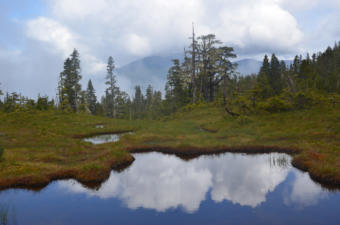
Austin Williams, an attorney with Trout Unlimited, doesn’t think that justification makes sense.

“What flexibility is going to mean … is that the Forest Service is going to have flexibility to plan timber sales in new areas that it has previously had off limits,” Williams said.

A change in the federal rule could open up over 9 million acres in the nation’s largest national forest. Though the federal agency says those lands “would not be scheduled or expected to be subject to timber harvests.”

The Forest Service could not be reached in time to provide additional comments.

In 2018, former Gov. Bill Walker signed off on a petition, asking for the Alaska exemption.

It’s something Gov. Mike Dunleavy has also pushed hard for. The Washington Post reported a conversation between Gov. Dunleavy and President Donald Trump in August encouraged the administration to lean toward granting Alaska a full exemption.

Tribal governments have expressed concern over the impact the exemption would have on hunting and fishing in the region. According to the Forest Service’s own summary of comments, most of the public said they wanted to keep the Roadless Rule in place.

The Forest Service is accepting public comments on the draft plan starting Oct. 19, 2019 until Dec. 17, 2019. A final decision is expected by 2020.

After months of speculation, Forest Service recommends lifting Roadless Rule for the Tongass

The Tongass National Forest near Wrangell, Alaska, 2016.
The Tongass National Forest near Wrangell, Alaska, 2016. (Creative Commons photo by Rob Bertholf)

The U.S. Forest Service announced Tuesday that it’s seeking a full exemption from the Roadless Rule of the Tongass National Forest.

The rule, which has applied to Alaska for more than a decade, makes it difficult to build new roads through national lands. But the U.S. Forest Service is proposing changes that could make Alaska the only state that doesn’t have to follow it.

Of six alternatives listed in the plan, a full exemption is the Forest Service’s recommended choice.

Alaska’s congressional delegation has long pushed for the full exemption in the state, saying there needs to be more access to timber and energy opportunities in the region.

Owen Graham, President of Alaska Forest Association, agrees. He calls Tuesday’s announcement a “great thing.”

“What we want is year-round manufacturing jobs and a lot more stability,” said Graham.

But, he says, this is just one step in the right direction. Retaliation tariffs placed on logs shipped to China have been hitting some sectors of the small industry hard.

Graham is uncertain how long it will take to see big systemic changes in how the Tongass National Forest is managed.

“Right now the industry’s just crumbling apart. There’s hardly anybody left,” he said. “Every year we lose more of our loggers because there’s not enough to keep everyone going.”

The Forest Service has been considering a range of options for the Tongass. But in August, the Washington Post reported that a conversation between Gov. Mike Dunleavy and President Donald Trump tipped the scales, and the U.S. Forest Service started working on the full exemption.

Joel Jackson, the President of the Organized Village of Kake, says he’s worried about what these changes could mean for his community. Kake is a remote village that depends on the wild food the Tongass provides. Historically, large-scale industrial logging damaged salmon streams.

“You know it’s sad that we have to continue to fight our own government to protect our forests and streams,” Jackson said.

He says the Organized Village of Kake is considering filing a lawsuit against the Forest Service. He suspects many other organizations will, too.

“We don’t throw our hands up in the air. We just buckle down and start talking [about] what’s the next step,” he said.

The full exemption would release 9.2 million acres of wilderness from Roadless Rule protection and open 165,000 old-growth acres and 20,000 young-growth acres to logging. The change would only apply to the Tongass National Forest. The Chugach National Forest would remain under the Roadless Rule.

According to Chris French, a top Forest Service official, this could change how the Tongass is federally managed and undo a 2016 plan amendment to move away from old growth logging in the region.

The U.S. Forest Service will publish its justification for the change in the federal register later this week.

The public will have a chance to weigh in on the proposed change, which is included in the draft environmental impact statement, until Dec. 17.

A final decision is expected to be reached by 2020.

Site notifications
Update notification options
Subscribe to notifications