Archives for:

"Roadless Rule"

Lingít elders, Tongass advocates in Juneau gather in favor of keeping Roadless Rule

Seikoonie Fran Houston, spokesperson for the Áak’w Ḵwáan, speaks out against the potential rescinding of the Roadless Rule on Sept. 13, 2025. (Photo by Yvonne Krumrey/KTOO)

The U.S. Department of Agriculture announced this summer it was moving to rescind the Roadless Rule, a 2001 law that protects large swaths of National Forest land from development. 
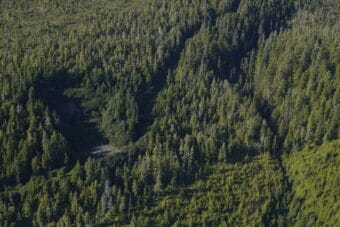
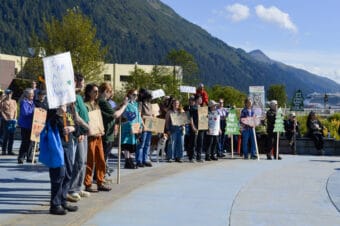
That includes more than half of the Tongass National Forest, where Juneau is located. On Saturday, more than 100 people gathered in the state capital to protest the move. 

It’s not the first time protections for the Tongass have been in question. The first Trump administration repealed protections for the Tongass National Forest specifically, which were reinstated by the Biden administration.

The USDA’s announcement called the Roadless Rule “burdensome, and outdated.” It said the rule threatens livelihoods and stifles economic growth. 

Alaska’s Congressional delegation unanimously supports the rollback of the Roadless Rule. U.S. Sen. Lisa Murkowski has said that most of the Tongass would still be protected without it — the parts of the forest that are already designated as wilderness. U.S. Sen. Dan Sullivan said rescinding the rule would open the door for economic growth in rural Alaska, and U.S. Rep. Nick Begch said the rule inhibits local management of forests. 

But protesters say Alaskans have more to lose in risks to the land and waterways than what they have to gain through further development. Lingít elders and fishing and tourism industry experts took the mic Saturday to deliver a message: the Roadless Rule should be left alone.

Protestors gathered at Overstreet Park on Sept. 13, 2025 to advocate against the potential rescinding of the Roadless Rule. (Photo by Yvonne Krumrey/KTOO)

Kaatssaawaa Della Cheney told the crowd her mother had protested clear cutting on Haida Gwaii in Canada in the 1980s. She said when young people stepped up to form a blockade, their parents and grandparents came too. 

“The elders showed up with their regalia and put the young people aside and said, ‘We are going to form the line to keep machines away from our lands, our trees, are ways of life,’” Cheney said. “And that’s what they did.”

Now Cheney said, as an elder herself, she is speaking up in favor of keeping the Roadless Rule. 

Seikoonie Fran Houston is Áak’w Ḵwáan, who originally lived in Juneau. She said development threatens sacred salmon runs and Lingít burial sites.

“This was our territory, and it was taken away from us,” she said. “And now hundreds of hundreds of years later, here I am standing on the grounds of my ancestors fighting to try and protect what they had.” 

Houston said the damage to sacred land isn’t worth the potential financial gain.

And others said the financial math doesn’t actually add up in favor of rescinding the rule. 

Kate Troll has worked in fisheries and climate management in Southeast Alaska for more than 30 years. She says old growth logging, which the rule limits, is a very small piece of Alaska’s economy. And the rule protects resources the tourism and fishing industries rely on, which make up a far greater piece. 

“If doing right by the numbers — right by our economy — was the real objective, we wouldn’t be having this debate,” she said. “If facts really mattered, the Trump administration would realize there’s absolutely no overall economic benefit to be gained by tossing the Roadless Rule out.”

Activist Xaawk’w Tláa Yolanda Fulmer and her granddaughters read words prepared in Lingít and English in support of the Roadless Rule on Sept. 13, 2025. (Photo by Yvonne Krumrey/KTOO)

She said the forests serve as irreplaceable carbon sinks, which combat the effects of climate change.  

Xaawk’w Tláa Yolanda Fulmer advocated for the codification of the Roadless Rule, which is being considered by Congress. She said she wants the future of the Tongass to be guaranteed for her grandchildren. 

“So we don’t keep going back and forth with this whiplash politics that keeps happening to us, where one day we’re feeling safer and we’re feeling protected,” she said. “And the next it’s being ripped from us, just like our trees are being threatened.” 

Fulmer referenced a comment Rep. Begich made last month, saying that he’s heard Southeast Alaskans asking for the timber industry to be revived.

“You’re not listening to the people I’ve been talking to from Kichx̱áan all the way to Yaakwdáat that says, ‘Stay out of our lands. Leave our trees alone. Find another way,’” she said, using the traditional names for Ketchikan and Yakutat. 

The public can comment on the proposed rescission of the Roadless Rule through Friday, Sept. 19 at federalregister.gov

The Roadless Rule is on the chopping block, and the public has less than a month to comment on it

Logging roads crisscross the Tongass National Forest near Excursion Inlet. (Photo by Alix Soliman/KTOO)

Listen to this story:

The Roadless Rule protects more than half of the Tongass National Forest from road development, and it’s on the chopping block again. Tribes and environmental groups are strategizing to keep it in place. 

A host of Alaska Native communities in Southeast Alaska, which rely on the Tongass National Forest for their food and culture, say they want to make the Roadless Rule permanent. 

Tlingit advocate Xaawk’w Tláa Yolanda Fulmer presented one tactic at the Southeast Tribal Environmental Forum in Juneau this week. She explained how a bill that was reintroduced to the U.S. House of Representatives this summer called the Roadless Area Conservation Act, or RACA, could codify the Roadless Rule once and for all.

“The current situation is a political struggle between the proposed repeal of the Roadless Rule and the introduction of RACA,” Fulmer said. “The outcome of RACA will determine the future protection of vital national forest lands, including the Tongass.”

She said that if the bill passes into law, it could end the political ping pong between promoting extractive industries and preserving traditional foods and practices in National Forests. 

“Road construction often leads to logging, mining, forest fires and development — development which fragments ecosystems,” she said. “The Roadless Rule helps maintain intact forests, streams and shorelines where traditional foods thrive.”

The Roadless Rule has flip-flopped multiple times since it was established to protect undeveloped lands in 2001. It was rolled back during President Donald Trump’s first term before being reinstated in 2023 by former President Joe Biden. 

The proposed rollback aligns with Trump’s executive order earlier this year to end a ban on constructing roads in undeveloped areas of the forest. The USDA’s announcement comes on the heels of Representative Nick Begich’s visit to Juneau, where he said that he supports the expansion of logging in the Tongass National Forest. 

“This is something I hear from folks from Ketchikan all the way up to Yakutat on a regular basis,” he said. “How do we bring timber back?”

Tribal leaders at the forum in Juneau spoke to the value of keeping the forest ecosystem intact. Joel Jackson is President of the Organized Village of Kake, an Alaska Native tribe based on Kupreanof Island. He said it’s vital to keep the forest healthy, in part because the salmon that feed his tribe rely on it. Old growth trees shade the streams, making the water cold enough for salmon to swim up.

“If the stream isn’t cool enough, those fish aren’t going to be able to spawn,” Jackson said.

After the fish spawn and die, their decaying bodies feed the forest with nutrients they gathered at sea — and the cycle continues.

The U.S. Department of Agriculture announced Wednesday that the public can comment on the proposed rollback from Friday through Sept. 19. 

“This administration is dedicated to removing burdensome, outdated, one-size-fits-all regulations,” said U.S. Secretary of Agriculture Brooke L. Rollins in a press release. 

Nathan Newcomer advocates for the Tongass with the Southeast Alaska Conservation Council. He worries that the USDA won’t listen to the public’s wishes to keep the rule in place. 

“We know what they’re going to do,” Newcomer said of the department. “They’re not going to listen to anybody, but we still need to get on the record and make it sure and clear that people in Southeast Alaska and across the nation want to see the Roadless Rule kept in place.”

When the first Trump administration rolled back the Roadless Rule in 2020, people had about 90 days to comment and nearly all of the public comments were in favor of keeping the rule.

Newcomer said that he’s organizing quickly since the federal government has expedited the public process to allow for less than a month of public comment. 

Kate Glover is an attorney at Earthjustice, an environmental law firm that has challenged past rescissions of the Roadless Rule on behalf of tribes, conservation nonprofits, tourism and fishing groups. She said a few weeks is not enough time for a meaningful public process.

“It doesn’t allow time for the agency to meet its obligation to consult with tribes on a government-to-government basis,” she said. “Typically, at least 120 days is needed for that.” 

Glover said she had not seen such short comment periods before this administration.

Trump administration announces plans to rescind Roadless Rule once again

The Tongass National Forest is the largest temperate rainforest in the country. With exceptions, the Clinton-era Roadless Rule restricted road building and industrial activity in around 55% of the national forest. Advocates for its repeal said it posed unnecessary hurdles to development projects, like logging, mining, and renewable energy. (Erin McKinstry/KCAW)

The U.S. Department of Agriculture announced plans to rescind the Roadless Rule yesterday, aligning with President Donald Trump’s executive order earlier this year to end a ban on constructing roads in undeveloped areas of the Tongass National Forest in order to stimulate more logging in the region.

The Roadless Rule has flip-flopped multiple times since it was established to protect undeveloped lands in 2001. It was rolled back during Trump’s first term before being reinstated by former President Joe Biden. 

Mike Jones is the Tribal President for the Organized Village of Kasaan on Prince of Wales Island, an area of the Tongass that has been logged heavily. 

“It’s the largest temperate rainforest in the world … it’s the northern lung of the planet,” Jones said of the Tongass.

He said new roads and additional logging would degrade the landscape and harm salmon streams that people rely on. 

Rolling back the Roadless Rule in Alaska hasn’t been popular in the past. When the U.S. Forest Service considered exempting the state from the federal Roadless Rule back in 2019, more than 144,000 people submitted public comments and most were opposed to opening up the Tongass to new roads. 

U.S. Senators Lisa Murkowski and Dan Sullivan both welcomed the rollback. 

“Repeal will not lead to environmental harm, but it will help open needed opportunities for renewable energy, forestry, mining, tourism, and more in areas that are almost completely under federal control,” Murkowski said in a statement today.

Kate Glover is an attorney at Earthjustice, an environmental law firm that has challenged past rescissions of the Roadless Rule on behalf of tribes, conservation nonprofits and tourism and fishing groups. 

“It’s disappointing to see the administration doing something that’s so clearly contrary to what the public is asking for and is contrary to the public interest,” Glover said. 

More than 9.2 million acres of the Tongass are inventoried as roadless areas under the rule. Nearly 330,000 acres of the 16.7 million-acre forest are considered suitable for logging, according to the U.S. Forest Service’s latest 2016 management plan. That plan is currently going through a revision

The USDA did not respond to a request for comment. Viking Lumber and Alcan Timber, the largest logging companies operating in the Tongass, also did not respond.

Trump’s executive orders to stimulate logging could fall flat in the Tongass

The Tongass is the country’s largest national forest at 17 million acres, and it’s one of the last protected temperate rainforests in the world. (Photo by Alix Soliman/KTOO)

Listen to this story:

President Trump issued two new executive orders on March 1 to expand logging in national forests. They come after he suspended the Roadless Rule, which banned the construction of new roads in undeveloped wilderness and has flip-flopped with each presidency. Together, the orders could increase timber harvest in Tongass National Forest, but some locals aren’t so sure that will happen. 

One order aims to get forestry projects approved more quickly, even if it means scraping out exemptions under the National Environmental Policy Act and the Endangered Species Act. The other order directs the U.S. Department of Commerce to investigate whether importing lumber is a national security risk, and how the government could step in to address that. 

The Tongass National Forest is the country’s largest national forest at 17 million acres, and it’s one of the last protected temperate rainforests in the world. Locals say it has environmental value, but the main reason the orders probably won’t lead to more logging is that much of the industry has moved out. 

Joel Jackson is president of the Organized Village of Kake, a tribe based on Kupreanof Island, and has seen logging come and go. 

In economic terms, Jackson said that the real value of the forest is in tourism. 

“People don’t want to come from down south and look at a scarred landscape,” he said. “They come up here because they like to look at the Tongass — the wildness of it.”

Millions of tourists travel to Southeast Alaska each year to experience the environment Jackson’s village depends on. 

“The berries and medicinal plants and just everything it provides out there, and the animals — the deer, moose, bears — the shade from those old-growth trees along our streams that the salmon return to every year,” he said. 

Now, since most lumber yards and pulp mills have closed shop, it’s costly for loggers to come harvest the trees and ship them out, Jackson said. He believes Trump’s orders won’t change the financial constraints of logging in this rugged and remote region. 

Gordon Chew runs Tenakee Logging Company, a small father-son timber operation on Chichagof Island. He echoes Jackson’s sentiment, and said the industry would have to be completely redeveloped for the Tongass to deliver more timber. 

“We don’t have people sitting on their hands that can’t wait to get into the forest and mow down all the trees,” he said. 

Chew said he’s an environmentalist and his company sustainably harvests about 100 trees each year. They’re second growth — young trees that have grown back in areas that were heavily logged in the past. 

“We live here in the heart of the Tongass National Forest, and don’t want to be a part of any deforestation or destruction. So we’ve always only purchased selective timber sales,” he says.  

The Forest Service marks one out of no more than three trees in the selected tract, then Chew and his son carefully fell them by hand. He’s not convinced that Trump’s executive orders will accelerate logging in the Tongass, since the U.S. Forest Service is likely overwhelmed due to recent firings.

“They’re dealing with distraught human beings that have been cast aside,” Chew said. “So I know the hope was efficiency, but you don’t get more efficient with fewer people doing more work.”

If the administration is serious about increasing timber production, Chew suggests they go through Congress to streamline the approval process under the National Environmental Protection Act for small, sustainable operations like his. 

“You can still have industry and do it responsibly,” he said, adding that environmental laws should be geared toward preventing wreckage, not preventing a couple of guys from thinning the over-crowded second-growth forest to build local cabins, boats and musical instruments. 

Viking Lumber, a well-known logging company in the region, did not respond to a request for comment.

Robert Venables is the executive director of Southeast Conference, an organization that advocates for economic interests in the region. He said that there is room in the Tongass for additional logging, especially in second-growth areas, but it’s unlikely that the industry would scale up to the behemoth it once was.

“I believe it’s more likely to colonize the moon,” he said. 

Because of the way the timber market has changed, Venables said that the past isn’t able to inform the future of the industry here.

The U.S. Forest Service declined an interview, but a spokesperson wrote that the agency will “continue to meet its commitments to protecting vulnerable wildlife while also meeting the President’s directive to provide the nation with abundant domestic timber, unhampered by burdensome, heavy-handed policies.”

Legal battles over logging in the Tongass roiled during Trump’s first term, and more could be on the way. 

Correction: A previous version of this story misidentified the name of the National Environmental Policy Act.

With Trump’s new pro-timber order, Alaska conservationists poised to rehash Tongass Roadless Rule

A Naukati Bay resident looks out over a clear cut northwest of his home on Prince of Wales Island in Alaska in September 2021. (Eric Stone/KRBD)

In the first two days of his new term, President Donald Trump signed more than 200 executive ordersOne was aimed at accessing more natural resources in Alaska. It attempts to roll back protections on over 9 million acres of Tongass National Forest, potentially opening them up for logging.

Trump’s executive order is titled “Unleashing Alaska’s Extraordinary Resource Potential.” The order alleges that restrictions on mining, logging, oil drilling and other resource extraction on Alaska’s federally protected lands is “an assault on Alaska’s sovereignty and its ability to responsibly develop these resources for the benefit of the Nation.”

The Tongass is the world’s largest remaining temperate rainforest. The Trump administration is seeking to rescind the Roadless Rule, which prohibits road construction and timber harvest on over 58 million acres of national forests across the country.

The Jan. 20 executive order won’t have any immediate effect on the ground. Normally, an executive order like this would kick off a lengthy public process with the U.S. Forest Service and its parent agency, the U.S. Department of Agriculture.

The Juneau-based Southeast Alaska Conservation Council has been fighting to keep most of the Tongass roadless for decades. Council Director Maggie Rabb said it’s hard to predict what this administration will do next.

“This president has proven to be unusual sometimes, and so we’re not sure,” she said. “It is possible they could just try to remove it and skip the public process.”

The Tongass covers most of Southeast Alaska and is the largest national forest in the country. The conservation council was formed in 1970 specifically to combat wide-scale, industrial old growth logging in the forest.

During his first term, Trump took action to exempt Alaska from the Roadless Rule, only to be reinstated by the Biden administration. Rabb said the rule has been rolled back and rolled forward by various presidents pretty much since its inception – but not without a fight.

“If they do remove the Roadless Rule, it would start – it could start new litigation that we would join to put the Roadless Rule back in place, and then we would be suing against the Forest Service,” she said.

The conservation council has been involved in litigation around the Roadless Rule off and on, but as the presidential administrations change, so do their legal allies.

“The parties on our side change whether we’re with or against the federal government,” said Rabb.

During the Biden administration, the conservation council was suing the State of Alaska on behalf of the federal government to support its protections of the Tongass. That case is now on hold.

It’s possible the current administration could completely remove the Roadless Rule in short order and begin fielding proposals for new logging roads through the forest.

“How quickly that happens is very much a question, because logging has not proven to be that profitable for quite some time,” said Rabb. “Why would you push to further grow a logging industry that’s costing the taxpayers money and supports less than 1% of our regional economy?”

Rabb referenced a 2020 report from nonpartisan federal watchdog group Taxpayers for Common Sense that found that the federal government was actually losing money on timber sales in the Tongass.

“These sales have consistently generated less revenue than the USFS spends to administer them, resulting in large net losses for U.S. taxpayers,” the report said, adding that taxpayers were subsidizing the region’s logging industry to the tune of $1.7 billion over the last 40 years.

Rabb said that the conservation council is not anti-logging. There is still active logging in the Tongass. For Rabb, the Roadless Rule has been an effective tool to protect old growth without actually ending logging.

“The push to roll back the Roadless Rule has very little to do with on-the-ground realities in Southeast Alaska or market demand, and it’s very much about external agendas that are disconnected from our region,” she said.

According to Rabb, the removal of the Roadless Rule has been a conservative talking point for years and was outlined in Project 2025, an infamous conservative policy roadmap for the Trump administration aimed at reshaping the federal government. Trump has at various times embraced the document and its architects and distanced himself from its ideological extremes.

“If you actually look at the language there, one of the reasons they articulate for getting rid of the Roadless Rule is that it ‘forces residents to rely heavily on a subsidized ferry system,’” Rabb said, referencing the Alaska Marine Highway System. “But I would love to have someone explain to us how removing the Roadless Rule would allow you to drive from Ketchikan to Sitka. It’s just preposterous. It has very little to do with our realities.”

President Donald Trump signs an executive order at the White House supporting natural resource development in Alaska on Monday, Jan. 21, 2025 in Washington. (C-Span screenshot)

Keith Landers has operated a small sawmill on Prince of Wales Island for the last 30 years. If you flown to Alaska in the last few years, you’ve probably passed beneath a wooden, mushroom-like sculpture in the N Concourse of Seattle-Tacoma Airport. Landers brags that his mill supplied the wood for that sculpture, as well as the cedar-planked ceiling above passengers’ heads.

He doesn’t think more logging in the Tongass is a bad thing.

“We need to be truthful about our forest,” Landers said. “This is a big forest. It grows over a billion board feet a year. No one’s going to clearcut the whole thing.”

Landers said he hasn’t had a winning bid for Tongass timber in two years because larger competitors outbid small mills for the limited inventory. Most of that wood, he said, doesn’t stay in Alaska.

“I’m really looking for an honest program, something that supports stuff besides outside influence,” Landers said. “Over the 30 years I’ve been here, nothing has been done. I have never felt like I have been supported by anybody.”

Landers said he’s glad for anything that would open more timber for his mill, but only if it prioritizes Alaskan operations and supplies locals first. As opposed to “more large corporations buying up the Tongass and shipping the lumber overseas.”

“I’ll be honest with you, under the first Trump administration, he rolled back the Roadless (Rule) and never did a darn thing,” Landers said. “We have to have a serious conversation about what we want to do with our forest and to create some jobs here because their word is worthless. It’s worthless. It’s not for local people.”

Landers hopes the new Trump administration can guarantee reasonably priced, sustainable Tongass lumber, without environmental groups like the Southeast Alaska Conservation Council taking them to court over each timber sale. But he’s not optimistic. For Landers, the rules changing every four years makes it hard to run his small business.

“We just can’t continue to have timber for four years and then under the next administration, have no timber at all. It just doesn’t work real well,” Landers said, adding that what the Tongass needs is a balanced timber program that both political parties can get on board with.

“That’s what I would tell Mr. Trump. I would say, ‘We got to have a forest plan that works and that’s guaranteed for people to invest,’” Landers said. He added that it’s a waste to spend millions of dollars on timber sales and logging infrastructure, “and then turn around and tear it down in four years. Don’t bother us.”

Landers recalled that when he first got into the logging business, there were “probably around 30 small mills” in Thorne Bay. Now, his mill is one of three. He said his children will inherit the mill when he retires but something has to change.

“This will continue to go on,” he said about the mill. “But I’m not putting my family through what I went through over the years. It’s been nothing but a dogfight with the environmental groups.”

Joel Jackson is the president of the Organized Village of Kake, an Alaska Native tribe located on Kupreanof Island in the heart of the Tongass. He’s been supporting the Roadless Rule since it was enacted, because he says the old growth trees it protects are essential for preserving their way of life.

“It took thousands of years to become what it is today,” he said. “The canopy of the old growth trees are spaced in such a way that it allows growth underneath the trees, and that’s where we collect our medicines and our berries and everything else that’s there.”

Jackson respects anyone trying to make a living – he worked in industrial logging himself during its heyday decades ago. But he’s also seen huge swaths of clearcut forest change the landscape.

“I’m not against anybody working, but, gosh, we got to be able to manage our resources better than what we’ve done in the past,” Jackson said.

“There is broad, sweeping support of keeping the Roadless Rule on the Tongass. And so I think our job is to bring those voices together again and show that we can have a healthy Southeast Alaska with the Roadless Rule here in place, and that it is an important tool that we don’t want to throw out,” said Rabb.

Trump hasn’t made his picks for who will lead the USDA or the Forest Service so he hasn’t formally staffed the agencies or roles that he’s giving direction to.

USDA spokesman Wade Muehlhof said in an email that they are in the process of reviewing Trump’s executive orders. Afterwards, he wrote, they’ll tell agencies how to implement them as soon as possible.

Dunleavy praises Trump orders calling for more drilling, logging and mining in Alaska

Gov. Mike Dunleavy speaks about President Donald Trump’s executive orders at a press conference in Anchorage on Jan. 22, 2025. (Wesley Early/Anchorage)

Gov. Mike Dunleavy on Wednesday welcomed a series of executive orders President Donald Trump issued shortly after taking office.

“Happy days are here again, to be perfectly honest with you,” Dunleavy told reporters at a news conference in Anchorage. “This is like unwrapping a gigantic sled of Christmas presents for the state of Alaska.”

Trump’s Alaska order, titled “Unleashing Alaska’s Extraordinary Resource Potential” was one of dozens the president signed on his first day in office. Among other things, the order calls for new oil and gas leases in the Arctic National Wildlife Refuge, reinstates approval of the controversial Ambler Road in Northwest Alaska, and instructs federal officials to reinstate a 2020 decision removing protections for more than 9 million acres of the Tongass National Forest.

Ahead of Trump’s inauguration, Dunleavy submitted a transition plan — something of a wish list — to the incoming administration requesting an “Alaska specific Executive Order” rolling back Biden-era decisions limiting resource development. Many, though not all, of those wishes were granted by Trump’s order.

The executive order did not directly address the Biden administration’s veto of the controversial Pebble Mine under the Clean Water Act. Dunleavy, a supporter of the copper and gold prospect whose administration has sued to overturn the veto, said he would continue to advocate for its approval.

“I see a path forward on discussions on Pebble, absolutely,” Dunleavy said. “We’re going to let the dust settle and really go through these (executive orders), but I think that conversation is going to happen.”

Whether those discussions will prove fruitful is unclear. The Trump administration denied a permit for Pebble in the waning days of his first term.

State lawmakers offered mixed reactions to Trump’s order.

Senate Majority Leader Cathy Giessel, R-Anchorage, said she thought the state should take a bigger role in managing Alaska’s land and waters, a priority Dunleavy communicated in the transition plan. But she said casting aside environmental protections could be unwise.

“We’re not a colony to be pillaged,” Giessel said. “By throwing open all of the regulations related to resource development, we could be jeopardizing our own land and waters.”

House Minority Leader Mia Costello, R-Anchorage, said she was proud of what she said was Alaska’s record of responsible resource development and looked forward to the policy changes outlined in the order.

“We’re very pleased to see that action taken,” she said. “It actually puts Alaska on the map where it should be, which is at the tip of the spear, as far as providing energy for our country.”

State lawmakers were less divided on another of Trump’s orders, one renaming the mountain known as Denali to Mount McKinley.

“We want it named Denali,” Costello said by text message.

Rep. Maxine Dibert, D-Fairbanks, invoked her own Koyukon Athabascan heritage, saying Denali is one of many place names across the state that “reflect the diverse cultures, traditions and languages of Alaska.”

“Alaskans from all backgrounds and political persuasions embrace Denali as a rightful name for the tallest peak in America,” she said. “Changing the name of Mount Denali to Mount McKinley would be costly, and if enacted, would be disrespectful to Alaskans.”

Dibert and Rep. Ashley Carrick, D-Fairbanks, each introduced resolutions on Wednesday urging the federal government to retain the name Denali. The Obama administration officially renamed the peak to Denali in 2015.

Alaska’s U.S. senators, Republicans Lisa Murkowski and Dan Sullivan, have spoken out against renaming the mountain. Newly elected Republican Congressman Nick Begich III told Politico that “what people in the Lower 48 call Denali is none of my concern.”

Dunleavy, though, declined to share his thoughts on what the mountain should be called. He said he wanted to speak with Trump before offering up his own position.

“Until I have the conversation, I’m going to refrain from saying what it should be or shouldn’t be,” Dunleavy said.

Site notifications
Update notification options
Subscribe to notifications