Archives for:

"Roadless Rule"

Lingít activist recalls history of Indigenous women protecting the Tongass: ‘The momentum has only grown’

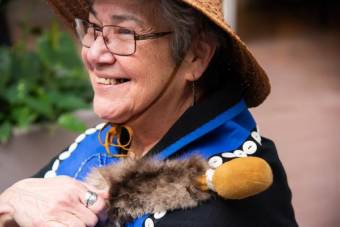
Lingít activist Wanda Culp. (Photo by Melissa Lyttle, courtesy of Southeast Alaska Conservation Council)

It has been 21 years since the 2001 Roadless Rule for the Tongass National Forest was first established. 

For the people involved in the battles between industry and subsistence, the tug-of-war over land use in the Tongass National Forest has been going on even longer. 
KTOO’s Lyndsey Brollini sat down with Lingít activist Kashudoha Wanda Culp to talk about the impact of such a long history and the role that Indigenous women have played in this conflict.  

Listen:

This interview has been edited for length and clarity.

Lyndsey Brollini: Do you think you could kind of go a little bit into the background on the issue? How it came up?

Wanda Culp: My involvement came about in the early 1980s when I moved from Juneau and into Hoonah and needed to know firsthand how to hunt, fish and gather. And through that process, I was literally taken under the wings of my Lingít grandmothers, who taught me a lot about the history of our people and where we come from.

When the clear cut started in Hoonah, it happened right in one of our hunting areas. We always, you know, would drive around when we had vehicles just for something to do. And I was up on Hoonah mountain, ran into one of my grandmas. Her and her husband were driving around, and she looked at the fresh clear cuts. And she was crying. And she said, “See what they’re doing to us. Do you see what they’re doing to us?” It broke my heart, and I did not realize because we’re so isolated in Hoonah — those days with no, you know, no access to internet technology like today — so I had no idea that others in Southeast were also voicing their objections to the clear cut business happening all around us. So it was our combined voices that I believe helped create the 2001 Roadless Rule. It was so politically controversial back then, after the 1990s when the boom basically busted. I became a recluse. It was pretty harsh. 

Maybe six years ago, Osprey Orielle Lake in WECAN International — Women’s Earth in Action Climate Network — called me up, got my name somewhere, and literally pulled me out of moth balls as she made me aware of what was occurring politically with the Roadless Rule again. We’ve been to Congress through WECAN and partnering with Earth Justice. They helped us, four of us from Hoonah, in early 2019 to meet with 14 Congress people in D.C. face-to-face. We wore our regalia and spoke to them through our regalia representing who we are as Indigenous women. 

So once it was a change of hands through our last administration, it beefed up the temperature, you know, in the realization that we can no longer allow the Roadless Rule to be a political puppet at their whim. We need to put it into law now. 

When we really began rolling and boiling here, and it was early 2019 Lisa Murkowski tried slipping the weakening of the Roadless Rule in a budget rider. That’s how easy it is to manipulate that rule. And had we not been alerted to that, that would have happened a long time ago. 

There’s been plenty of silence to what we have brought forward and publicized. One of my elders told me when it comes to us, when I was worried about why isn’t anybody saying anything, she’s like, “It’s called tacit approval.” Silent approval. And we have that. The need for grassroots solutions, we just need a way to process it and get it out from the ground up all the way to D.C. this way, not from the top down.

Lyndsey Brollini: Do you think that the momentum is already there, that grassroots momentum?

Wanda Culp: It is. It was already there in the 80s and 90s. That momentum created the 2001 Roadless Rule. And that rule never stopped being challenged. This is old hat, what we’re doing, always defending the Roadless Rule. The momentum has only grown. 

And at one meeting, there was ex-loggers, teachers, and, you know, they were so relieved to hear when I said, “You folks have a right to say your objections to what’s happening on this clear cut logging.” 

They were being quiet because they thought — they didn’t want to step on our toes— and they thought that we initiated the clear cut logging to destroy our own land. 

So once that conversation was opened, I began to realize how many people love the Tongass and realize that it’s not so controversial within our own region.

What’s controversial is the misuse of it. 

Lyndsey Brollini: It was really good to hear from you.

Wanda Culp: Yeah, it’s good to talk about this. Thank you for the opportunity. 

Public comment period opens as Biden moves to restore Roadless Rule protections to Tongass

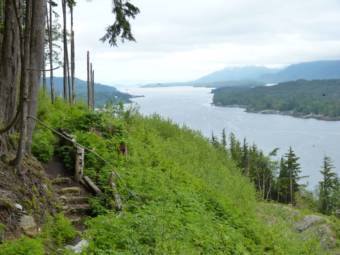
Portions of the Tongass National Forest can be seen from Ketchikan’s Rainbird Trail.
Parts of the Tongass National Forest seen from Ketchikan’s Rainbird Trail. (KRBD file photo)

The Biden administration on Tuesday formally began the process of restoring ‘Roadless Rule’ protections to millions of acres of Southeast Alaska’s federal forestlands.

It opens a 60-day comment period to undo action taken by the Trump administration that critics say could lead to more old growth logging in Tongass National Forest.

notice in the federal register published Tuesday says that Southeast’s timber industry is shrinking.

Tongass National Forest-related logging and sawmilling fell from just shy of 200 jobs in the early 2000s to around 60 workers in 2018.

The U.S. Department of Agriculture argues that restoring the 2001 Roadless Rule reflects the Biden administration’s priorities to build on the region’s tourism and fishing sectors.

The U.S. Forest Service has already frozen old growth timber sales under the current administration.

“…. a policy change for the Tongass can be made without significant adverse impacts to the timber and mining industries, while providing benefits to the recreation, tourism and fishing industries,” the notice reads.

Trout Unlimited’s Austin Williams in Anchorage says Alaska Gov. Bill Walker’s 2018 petition to exempt the Tongass National Forest from Roadless Rule protections put too much emphasis on commercial logging.

“It’s really time that we just move past that,” Williams said Tuesday. “And we recognize that there’s more value on the forest, keeping it and conserving it so that we can have, you know, fish and wildlife so that we can have tourism so that we can have cultural and traditional uses and to help fight climate change.”

The Roadless Rule would apply to about 9 million acres of the Tongass. But in practical terms, it could protect at most about 168,000 acres of old growth forest from clear cut.

Alaska elected leaders decry ‘federal overreach’

Gov. Mike Dunleavy and Alaska’s congressional delegation strongly supported the Trump administration’s exemption of Roadless Rule and has called the Biden administration’s move “federal overreach.”

“We think that discretion for the forest to be managed should continue to be at the local level,” the governor’s chief of staff Randy Ruaro, who grew up in Ketchikan when it was a lumber town, told CoastAlaska. “We don’t need Washington, D.C. with a one-size-fits-all rule for every forest in the nation.”

A lawsuit by the state to block the Biden administration’s initiative to bring back Roadless on the Tongass was dismissed last week by a federal appeals court.

A separate lawsuit by a coalition of tribes and ecological groups in favor of roadless protections remains pending but could be rendered moot by the new change in direction.

Tuesday’s action opens up a two-month comment period required before the agency can move forward.

If the Roadless Rule is applied to the Tongass, it could be reversed again by a future administration. More permanent protections would take an act of Congress.

Biden administration begins Roadless Rule do-over for Tongass

A portion of the Tongass National Forest along Peril Strait is seen from the ferry Chenega in Sept. 3, 2015. (Photo by Ed Schoenfeld/CoastAlaska News)
A portion of the Tongass National Forest along Peril Strait seen from the ferry Chenega in Sept. 3, 2015. (Photo by Ed Schoenfeld/CoastAlaska)

The Biden administration announced Friday the start date of its formal process to reinstate the Roadless Rule, which protects about 9 million acres of Tongass National Forest.

“Restoring the Tongass’ roadless protections supports the advancement of economic, ecologic and cultural sustainability in Southeast Alaska in a manner that is guided by local voices,” U.S. Agriculture Secretary Tom Vilsack said in a statement.

Successive Alaska governors have opposed the Roadless Rule since the Clinton administration put it in place in 2001. It’s been an on-again, off-again situation since then, with legal battles and politics coming into play.

The most recent whip-saw came last year, when the Trump administration exempted the Tongass from the rule.

Vilsack, who oversees the Forest Service, is again calling a do-over. He says a two-month comment period will be its first step to reinstate the Roadless Rule. And it’s a similar announcement to one made earlier this year that the Trump-era rule would be reversed.

“I don’t know how many times Vilsack can announce the same thing and have it sound like news,” said Juneau attorney Jim Clark, who has been coordinating a legal effort with some local governments and resource industries to preserve the Tongass exemption from the Roadless Rule.

He says the rhetoric around the rule’s protections of ancient forests is overblown.

“All this new exemption would do is open up 168,000 acres to timber harvest that wasn’t previously previously open,” he said Friday. “You wouldn’t know that from listening to the news — you’d think that all of the Tongass is going to be subject to clear cutting.”

And it’s true that while the rule change could affect more than 9 million acres, less than 170,000 acres of that would be old growth timber that could be logged under the current exemption.

Alaska state lawsuit rejected by federal Court of Appeals

Gov. Mike Dunleavy directed the state to join a lawsuit filed by resource industries, but the Court of Appeals dismissed the lawsuit earlier this week saying last year’s Roadless exemption is still in force, and the case was moot. But the governor’s office says the fight isn’t over.

“I would anticipate a very big vigorous response to the the efforts to control Alaska out of Washington, D.C.,” said the governor’s chief of staff Randy Ruaro, who hails from the former logging boomtown of Ketchikan. He told CoastAlaska on Friday that the Biden administration’s freeze on old growth timber sales ignores laws on the books that direct the Forest Service to make timber available to industry.

“We dispute the discretion of the Secretary to arbitrarily decide from Washington, D.C., to not follow those federal statutes and impose the Roadless Rule on the Tongass,” Ruaro added.

But opinion polls and the public record from hearings show healthy support for the Roadless Rule both in Alaska and Outside.

In Southeast, it has defenders from growing non-extractive industries like commercial fishing and tourism. Tribes whose traditional homelands are in what’s now Tongass National Forest also railed against the Trump administration’s rollback, both at hearings and in court filings.

Commercial logging of Tongass impacts subsistence

That’s because the legacy of clear-cutting and other development conflicted with rural residents’ hunting and fishing traditions.

Don Hernandez chairs the Regional Advisory Council on federal subsistence. It spent hours taking testimony over the Roadless Rule.

“It had just become pretty obvious over a long period of time that the areas of the Tongass that were most significantly impacted by past logging were all suffering harms to subsistence uses,” he said from his home on Point Baker on the northern edge of Prince of Wales Island, which is almost completely blanketed by federal forestland.

Hernandez is a commercial fisherman. He says the council heard loud and clear that people were worried about more old growth logging.

“And to expand that into other areas of the Tongass that people have come to rely on to meet their subsistence needs was just not going to be acceptable,” Hernandez said.

Tongass National Forest’s value as a carbon sink

To federal policymakers, the Tongass is seen less from a lens of conserving hunting and fishing grounds and more as a bulwark against climate change.

The Pew Charitable Trusts’ Ken Rait, who worked on developing the Roadless Rule under the Clinton administration in the 1990s, says there’s a recognition by the Biden administration that forests need to be kept intact to sequester carbon.

“And you know, there’s nowhere in the U.S. where this is more important than the Tongass National Forest,” Rait said from Portland, Oregon. “And so the decision is the right one for the Tongass, but it’s also the right one for the nation as a whole.”

The resource extraction industry and many of Alaska’s elected leaders complain that red tape will further lock up federal lands to energy and mining.

But Rait says there are safeguards in the rule. The Forest Service can — and does — issue waivers for projects in the public interest. More than two dozen to date have been granted, he says.

“The view that this is a blanket rule that will stop any development whatsoever from occurring on the Tongass just has not been borne out by the history of this issue,” Rait said.

How exactly the Biden administration plans to reverse the Trump administration policy still isn’t clear, says Clark, who served as chief of staff to former Governor Frank Murkowski, another strident Roadless Rule critic.

“It’s just a situation where we have to wait and see what the administration is actually doing,” he said.

Nov. 23 is when the Biden administration rolls out its plan for bringing back the Roadless Rule. If the last go-around is any indication, it’ll be a drawn out affair. It took more than two years to exempt the Tongass from the rule.

The federal government says more than 95% of people nationwide supported keeping the Roadless Rule in place during those hearings.

The Trump administration overturned it anyway.

A 60-day comment period will begin on Nov. 23, 2021 with the publication of a proposal to repeal the 2020 Alaska Roadless Rule. Comments can be submitted electronically using the Federal eRulemaking Portal; mailed to: Alaska Roadless Rule, USDA Forest Service, P.O. Box 21628, Juneau, Alaska 99802–1628; hand-delivered to Alaska Roadless Rule, USDA Forest Service, 709 W. 9th Street, Juneau, Alaska 99802 or emailed: sm.fs.akrdlessrule@usda.gov

Biden to freeze Tongass timber sales, invest in other Southeast Alaska sectors

The Tongass National Forest is the largest temperate rainforest in the country. (Erin McKinstry/KCAW)

The Biden administration announced Thursday it’s freezing any remaining old growth timber sales in Tongass National Forest and will pivot to investing in other sectors of Southeast Alaska’s economy.

statement from the U.S. Department of Agriculture said the federal government will invest $25 million and work with tribes, communities and Alaska Native corporations to provide technical assistance for projects and employment programs in the region.

“This approach will help us chart the path to long-term economic opportunities that are sustainable and reflect Southeast Alaska’s rich cultural heritage and magnificent natural resources,” Secretary of Agriculture Tom Vilsack said.

Thursday’s statement follows a recent announcement that the agency will start a lengthy process to reinstate the Roadless Rule in the Tongass, which restricts road building on federal forest lands.

That reverses the Trump administration’s decision to exempt the nation’s largest national forest from the Clinton-era rule that’s been fought by successive Alaska governors.

Dunleavy administration lambasts USDA

In a statement, Alaska Gov. Mike Dunleavy called out what he called President Biden’s “efforts to put Alaska workers permanently into unemployment lines and wipe out small businesses” with Thursday’s announcement.

“Narrow election results and political donations from environmental groups do not justify this federal agency’s policy flip-flop,” the governor said.

But the pivot away from forest products and toward other sectors was met with applause from the visitor industry.

“As we’ve been saying for a long time there’s so much else going on in Southeast Alaska that needs the Forest Service’s attention,” said Dan Kirkwood, a guide and general manager of Alaska Seaplane Adventures in Juneau. “We’re finally seeing some recognition that Southeast Alaska is really diverse in its economy and its cultures and the Forest Service’s trying to work on that. So that’s interesting.”

There have been few details released on the USDA’s $25 million “Southeast Alaska Sustainability Strategy,” but Southeast Conference’s executive director says meetings have been set up to discuss mariculture opportunities on and around Prince of Wales Island.

“The Tongass needs to be a multi-use forest. And unfortunately it’s still very much a political football that goes back and forth,” said Robert Venables. “So my hope is that we can work with the Forest Service’s stakeholders to really create more stability and at least many of the economic sectors and provide a longer term blueprint and map to go forward.”

Freeze on old growth logging announced

The practical effect of Thursday’s announcement would be to freeze any remaining old growth timber sales except for those used in small scale salvage projects for cultural use by Alaska Native tribes and others.
“The announcement that large scale, old growth logging is going to be ceased is very positive for that because those mass clear cuts are not going to occur here anymore,” said Marina Anderson, tribal administrator for the Organized Village of Kasaan on Prince of Wales Island.

“We hear commonly that we’re doing this for the next seven generations, or the seventh generation down the line,” she said. “However, we’ve been here for over 10,000 years, and we plan on being here for well over 10,000 years — we don’t have an expiration date on ourselves because we are part of this ecosystem.”

The largest timber sale in Tongass was already blocked by litigation. And only two old growth timber sales on Prince of Wales Island and near Ketchikan are in the works. A Tongass spokesperson says the local office is awaiting guidance following the announcement.

The announcement also didn’t mention amending the 2016 forest plan, which laid out a 15-year transition from old growth to second-growth logging. That would require a formal rulemaking process to ensure protections would last another political transition.

Proponents of ending old growth logging say they hope the shift in policy represents a long-term move away from Southeast Alaska’s federal forestland as primarily a supply for forest products.

“Any future administration is going to have the opportunity to pick its own policies and implement its own direction,” said Austin Williams, Trout Unlimited’s Anchorage-based legal director. “But I think what we’re seeing is that, as time goes on, the value of fish and wildlife, the cultural assets in the forest, the value of scenic beauty and climate resiliency — those values are becoming more and more important.”

The USDA notes that the Tongass has global significance as the largest intact temperate rainforest in the world. It also captures more carbon than any other national forest in the country.

Fate of lawsuits uncertain

There have been lawsuits filed on both sides of the Roadless Rule exemption issue. A coalition of tribes and conservationists has sued to overturn the Trump administration’s decision. And a separate lawsuit is defending the Roadless Rule exemption backed by local governments and industries.

Juneau attorney Jim Clark has been coordinating that effort to defend the Trump administration’s action. He says it’s not clear how the Biden administration plans to carry out its goals.

“We know where they’re headed and where they’re trying to go,” said Clark, who served as chief of staff for Republican Gov. Frank Murkowski. “And what we’re going to need to see is how they move to achieve those things.”

White House moves to reinstate Roadless Rule for Tongass

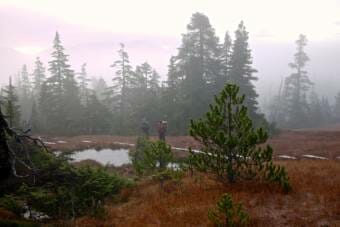
A pair of hikers in the Tongass National Forest in 2014. (Creative Commons photo by Joseph)

The Biden administration appears poised to reinstate a rule dating back to the Clinton White House that restricts new roads in the Tongass National Forest in Southeast Alaska.

The rule also restricts tree harvest in more than half of the Tongass — about 9.4 million acres. President Donald Trump ended the protections for the forest three months before leaving office.

The U.S. Department of Agriculture, parent agency of the U.S. Forest Service, has published a regulatory notice saying it plans to “repeal or replace” a Trump administration regulation from October that removed Roadless Rule restrictions in the Tongass.

The notice says USDA is proposing the change to be consistent with President Biden’s executive orders on climate.

Environmental organizations such as the Alaska Wilderness League have long argued that the Tongass — which is one of the world’s largest intact temperate rainforests — plays a critical role in combating climate change.

Research shows the rainforest stores about 40% of all of the carbon in the country’s national forests. 

“This is a globally significant resource,” said Trout Unlimited’s legal director Austin Williams, on Friday. “There’s absolutely no reason for us to continue to clear-cut log old-growth forest, it’s a critically important resource, and something that we need to be taking much better care of.”


“Taking an axe to Tongass old-growth protections was among the most reckless and irresponsible of the previous administration’s environmental rollbacks. Indigenous communities, hunters and anglers, the tourism and fishing industries, those who care about protecting our planet’s biodiversity and climate — all opposed removing roadless protections on the Tongass, wrote Andy Moderow, the organization’s Alaska director, in a prepared statement on Friday. “We applaud the Biden administration’s and the Forest Service’s commitment to addressing that rollback, but also want to make clear that a full reinstatement of roadless protections is a necessity and crucial to preserving America’s ‘Amazon’ and one of our most valuable assets in the climate fight.”

Joel Jackson, president of the Village of Kake, a federally recognized tribe on Kupreanof Island, welcomed the announcement. His tribe was among those that joined a lawsuit filed by conservationists and fishermen seeking to overturn the Trump administration’s Roadless Rule exemption in Southeast Alaska.

“As Native people, we are tied to the land,” he said Friday morning. “We go shopping in our forests and our waters to get our food, traditional food that we eat mostly. So it’s important that we have the old growth timber.”

Since its adoption in 2001, the Roadless Rule has been subjected to regular litigation and has pitted the State of Alaska against the federal government, with tribal, environmental, tourism, fishing and industrial organizations all weighing in.

Robert Venables, executive director of Southeast Conference, a regional civic and business organization, says the announcement injects further “uncertainty” over access to Southeast Alaska’s natural resources.

“It’s yet again another instance where the federal government — every single administration — is coming out there to change the rules,” he said Friday morning. “It’s very disappointing to see the continual back-and-forth every four years.”

Alaska’s politicians have long argued that the rule restricts Southeast Alaska’s ability to support itself — and the rest of the state — economically.

Gov. Mike Dunleavy expressed his disappointment in a statement on social media Friday, saying “North to the Future means North to Opportunity, and we will use every tool available to push back on the latest imposition.”

Correction: A previous version of this story misnamed the federal agency responsible for managing national forests – it is the U.S. Forest Service. 

Tongass and Bristol Bay protection can help Biden meet new climate goal, fishing and conservation advocates say

Habitat for sockeye salmon is vulnerable to climate change. (U.S. Fish and Wildlife Service)

The Biden administration issued a conservation plan Thursday called “America the Beautiful.”

At 22 pages, it’s more of a statement of principles. The centerpiece is a goal of conserving 30% of the nation’s lands and waters by 2030, in part to combat climate change.

Republicans in Congress immediately criticized it as vague and an attempt to lock up natural resources.

Meanwhile, conservation groups are eyeing parts of Alaska they’d like to see protected. Their eyes are on salmon.

“It’s hard to think of two better candidates than the Tongass in Southeast Alaska and Bristol Bay in Southwest Alaska,” said Tim Bristol, executive director of Salmon State.

He said conservation measures in the Tongass and Bristol Bay would protect fish, wildlife and save thousands of jobs which depend on renewable resources.

“It just seems like they’re no-brainers. They’re places where you could make the 30-by-30 concept real and also have a real positive impact on many people’s lives,” he said.

Bristol’s group is among those campaigning to have the Roadless Rule reinstated for the Tongass. They also want the EPA to reapply Clean Water Act protection to the Bristol Bay watershed, to preclude a new permit application for the proposed Pebble Mine.

The Alaska Longline Fishermen’s Association and other groups that advocate for small-scale commercial fishermen are also joining the call to protect Bristol Bay and the Tongass.

Kelly Harrell is chief fisheries officer at Sitka Salmon Shares, a processor and direct marketer which buys from small-boat fishermen. She said Biden’s goal caused some apprehension at first.

“Initially, we and many other Alaskans and fishermen were concerned that the 30 by 30 efforts could mean no-take marine areas and marine reserves that would exclude small boat fishermen,” she said.

But the plan shows the administration sees fishermen as stewards of the resource, she said. Harrell wants to see the administration succeed in reducing carbon emissions, in part because climate change is a threat to healthy fisheries.

“Ocean acidification, we know, is having impacts on things like our food webs in the Gulf of Alaska and the Bering Sea,” she said. “It’s a huge concern. And we need action.”

Alaska’s congressional delegation opposed the Roadless Rule and the EPA’s so-called “pre-emptive veto” when they were imposed during prior Democratic administrations.

Site notifications
Update notification options
Subscribe to notifications