Archives for:

"Roadless Rule"

Petersburg assembly skips legal debate over Roadless Rule exemption for Tongass National Forest

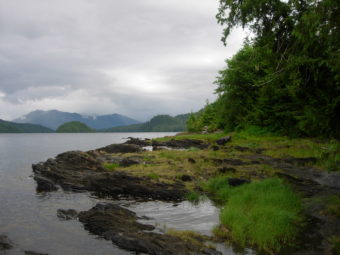
A portion of the Tongass National Forest along Peril Strait is seen from the ferry Chenega in Sept. 3, 2015. (Photo by Ed Schoenfeld/CoastAlaska News)
A portion of the Tongass National Forest along Peril Strait is seen from the ferry Chenega in Sept. 3, 2015. (Photo by Ed Schoenfeld/CoastAlaska)

Petersburg’s borough assembly on Monday was not interested in chipping in money to defend a Tongass National Forest exemption from the Clinton-era Roadless Rule. It didn’t even come up for debate or a vote for that matter.

The Trump administration last year granted a Tongass exemption to the nationwide rule that prohibits new logging and forest roads in parts of the national forest that do not have roads. It was something requested by multiple Alaska governors.

A coalition of environmental groups, tribes and fisherman sued to overturn that decision.

At a borough assembly meeting Monday, local resident Eric Lee testified in favor of keeping roadless prohibitions for the Tongass and against an exemption for the nearly 17 million acre forest.

“Language in the Roadless Rule is aimed specifically at preventing the construction of logging roads in areas that have not already been roaded,” Lee said. “It does not prevent the development of infrastructure projects in roadless areas. What it does do is make the permitting process for such projects more thorough, which is necessary to ensure the health of the forest. This is as it should be if we are to protect the forest that we’re all depending on.”

Alaska under Gov. Mike Dunleavy has intervened to defend the Tongass exemption and allow new logging and roadbuilding in undeveloped areas, calling those restrictions damaging. Others signing on to defend the exemption include the cities of Craig and Ketchikan, along with Southeast Conference, which is a coalition of panhandle municipalities and businesses. Some have agreed to contribute to that legal effort. Also on that side are former Gov. Frank Murkowski, shipping companies, chambers of commerce in Ketchikan and Juneau, and Juneau’s electrical provider.

Petersburg Mayor Mark Jensen asked for the assembly to consider contributing as well.

“Gov. Dunleavy welcomes support from Southeast communities and businesses in defense of the 2020 Tongass exemption rule drafted by the U.S. Department of Agriculture in October of 2020. Like it says here, I requested this to see if the assembly … the Petersburg Borough would like to support the Tongass exemption,” Jensen said.

Borough assembly member Bob Lynn moved to support the Tongass exemption but his motion received no second, meaning it doesn’t come up for a vote or any debate.

In recent years, the assembly has been pretty split over the topic, even voting down multiple resolutions for or against a Tongass exemption. In 2019, assembly members agreed to take no position on roadless.
But contributing to a legal effort wouldn’t have been a first for the Petersburg assembly. They voted last June to donate to the defense of commercial salmon trolling offshore of Southeast Alaska.

Tongass holds more than 40% of all carbon stored by national forests

Tongass National Forest near Ketchikan, Alaska. (Creative Commons photo by Mark Brennan)

New research reaffirms the global importance of Southeast Alaska’s temperate rainforest for combating the effects of climate change. That’s according to data released Tuesday by a coalition of environmentalists and tribes opposed to old growth logging in Tongass National Forest.

Oregon-based researcher Dominick DellaSala says protecting forests is key to maintaining their function as a carbon sink.

“There’s no magic wand,” DellaSala said. “We only have a big vacuum cleaner that we can [use to] just suck CO2 out of the atmosphere and store it safely. Forests are doing that for us.”

He and his colleagues at the Woodwell Climate Research Center analyzed carbon data and found that the Tongass National Forest holds 44% of all the carbon stored by the United States’ national forests.
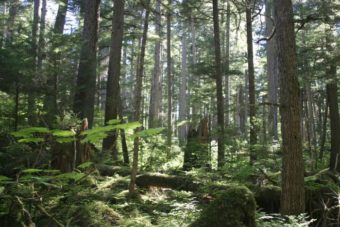
“Basically, when you go through an old growth forest, you’re walking through a stick of carbon that has been built up into the forest for many, many decades. Centuries,” DellaSala said. “And the largest trees in those forests store about 50% of the above ground carbon, so they are enormously important from a carbon standpoint.”

Trees store carbon by using photosynthesis to transform carbon dioxide from the air into food, which then fuels tree growth.

DellaSala introduced the findings Wednesday at a press conference organized by the Southeast Alaska Conservation Council, a Juneau-based conservation group opposed to clear cuts.

Exempting Tongass from the Clinton-era Roadless Rule was widely supported by state leaders and Alaska’s congressional delegation, who say it hindered resource development on federal forestlands. The state of Alaska recently joined a federal lawsuit seeking to oppose efforts to overturn the Trump administration’s exemption for the Tongass.

But tribal president Joel Jackson of the Organized Village of Kake added that the erosion control that healthy forests provide is key to sources of subsistence food from fish to wild game.

“My focus has always been the protection of the Tongass old growth — the remaining timber — for providing shade and pristine water for our salmon to return to the streams,” Jackson said. “That’s the most important thing to me because our life is salmon. We rely on being able to put away enough salmon for the winter — for a whole year until the salmon return. That’s our people’s main staple.”

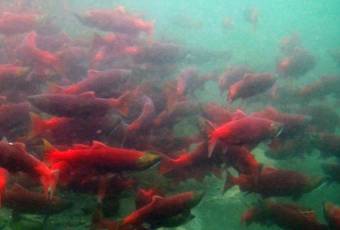
Salmon returns to Southeast Alaska have plummeted in recent years. Last year’s commercial harvest was one of the lowest on record.

DellaSala was one of 111 scientists to sign a letter earlier this month urging the Biden administration to protect old growth and roadless areas of Tongass National Forest as part of its climate plan expected to be presented at the United Nations 2021 Climate Change Conference in November.

State of Alaska, cities, business groups file to defend exemption of Tongass from Roadless Rule

Tongass National Forest
Part of the Tongass National Forest on Douglas Island pictured in 2004. (Creative Commons photo by Henry Hartley)

The state of Alaska and a former governor along with a host of municipalities, trade groups and businesses have filed to defend the Tongass National Forest’s exemption from a Clinton-era rule that limits development on federal land.

The Trump administration decided to get rid of the Roadless Rule for the Tongass last year. Shortly afterwards, a group of tribes, conservation groups, fishermen and tourism companies sued the federal government, seeking to overturn the decision. They say the decision to lift the rule on more than 9 million acres of the Tongass is based on a flawed environmental analysis and ignores the input of Alaska Native tribes and the public.

But the state and the rest of the coalition looking to defend the exemption for the Tongass say the rulemaking process was proper and that an exemption is critical to the state’s economy.

“The Tongass holds great economic opportunity for not only Southeast Alaska, but the State as a whole,” Gov. Mike Dunleavy said in a news release. “From resuming our timber industry to attracting tourism, this region has the potential to create good-paying jobs and it is my administration’s intent to defend our state’s rights and improve access to public lands.”

Robert Venables is executive director of Southeast Conference, an economic development group. He said projects in the Tongass are already held to high standards under state and federal laws and regulations.

“What really is the issue, in my mind, is having a conversation of, how does Alaska really access and control and have more of a conversation about how the forest is managed? Because this is very unique, where you have almost 96% of the region in direct federal control,” Venables told Alaska’s Energy Desk in a phone interview.

He said the Roadless Rule places unnecessary hurdles in front of development, pointing specifically to renewable energy projects. While developers can apply for exemptions to the Roadless Rule — and most are granted — he said the rule adds to the cost and time required to complete projects.

“This is not about extraction of resources. This is about every single economic sector meeting having unique needs for the forest, and we need a management plan that can reflect that,” Venables said.

Roadless Rule supporters disagree. They see increased resource extraction and development as an inevitable consequence of the rule going away in Alaska.

President Joel Jackson from the Organized Village of Kake said he’s concerned development could hurt the region’s other economic drivers.

“Our region, before COVID, was heavily reliant on tourism, and sport fishing, and commercial fishing and subsistence fishing. And it still is. And those areas provide way more jobs and more economic value to Southeast Alaska,” Jackson said in a phone interview.

Jackson said it’s also a threat to Alaska Native tribes’ way of life, since they harvest food and medicine from the forest and nearby waters.

Ketchikan’s city and borough have joined the state in defending the exemption. City Mayor Bob Sivertsen said development doesn’t have to harm the environment.

“Well, there are mitigations for everything we do,” Sivertsen said via phone. “We have the technology these days to do construction and other things that would lessen the impact on environmental issues, whether we’ve got to put in fish culverts, silt fences, the design and placement of the roads, all those types of things.”

Roadless Rule advocates say that logging and other development could accelerate climate change because the Tongass stores vast amounts of carbon.

Other parties defending the exemption include the city of Craig, statewide and Southeast chambers of commerce, electric utilities, shipping companies and resource development advocacy groups.
Without cruise passengers, Ketchikan borough officials project $3.4 million budget shortfall

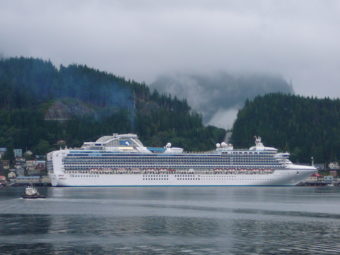
The Sapphire Princess docks in Ketchikan. (Ed Schoenfeld/KRBD).

Faced with the prospect of another canceled cruise season, Ketchikan’s borough is projecting a multimillion-dollar deficit. But despite the estimated $3.4 million shortfall, officials say the borough won’t burn through all of its savings.
Ketchikan’s borough finance director, Cynna Gubatayao, told the borough assembly last month that she was expecting a vastly reduced cruise season to weigh on sales tax revenues. Those are the biggest source of the borough’s general revenue — property taxes go towards funding the school district.

Now, after Canada announced it would keep its ports closed until next year, Gubatayao is revising those projections further. But she told KRBD Friday that the borough still has money in the bank.

“So the borough is fortunate in that we do have strong reserves, and even having to revise our revenue figures downward for the loss of the cruise ship season this year, or potential loss, we still have enough reserves that we do not have to take immediate drastic action,” Gubatayao said.

Gubatayao says that doesn’t mean they’re going ahead as if it’s a normal year — she’s recommending that the borough not start any new capital projects, not hire its seasonal workforce and continue a freeze on almost all travel. But she and borough manager Ruben Duran say services shouldn’t be cut and nobody should lose their jobs.

“At some point, if the cruise industry, and if the economic decline here goes too deep, I would expect that we would have a much more severe hiring freeze, and I don’t at this point — the manager and I are not recommending making any kind of fee increases or adding any new fees or taxes,” she said.

Part of the reason for that is that the deficit for fiscal year 2021 — which runs from last July through the end of this June — wasn’t nearly as big as local officials initially thought it would be: a projected $3.2 million deficit was revised down to roughly $1 million. Gubatayao says federal pandmeic relief filled some of the gap.

She said those transportation grants were separate from the roughly $10 million in CARES Act funds local officials spent on relief programs in 2020.

The smaller-than-expected deficit is projected to leave the borough with an estimated $11.6 million in the bank at the beginning of July. That’s more than three times the borough’s projected deficit for this coming year.

And more help could be on the way — the finance director says a Biden administration package now pending in Congress could provide as much as $2.7 million in federal relief for Ketchikan’s borough.

Gubatayao is scheduled to take questions about the impact of a canceled 2021 season on the budget at the borough assembly’s meeting on Tuesday.

In other business, the assembly is set to consider a joint resolution with the cities of Ketchikan and Saxman urging the state’s congressional delegation to waive federal laws that require foreign-flagged cruise ships to stop in Canada. The delegation issued a statement earlier this month saying they were “exploring all potential avenues, including changing existing laws, to ensure the cruise industry in Alaska resumes operations as soon as it is safe.”

The document also asks the federal Centers for Disease Control to issue guidance that would allow cruise lines to start sailing again.

And finally, the assembly is set to consider coming to the defense of the Trump administration’s decision to roll back the federal Roadless Rule for the Tongass National Forest.

A coalition of conservation groups and tribes — including the local Organized Village of Saxman — is suing the federal government to reinstate the rule.

The assembly briefly considered spending $5,000 to intervene in the suit at its last meeting but postponed action. Ketchikan’s City Council voted to defend the rollback last month.

The Ketchikan Gateway Borough Assembly is scheduled to meet at 5:30 p.m. Tuesday via videoconference. The full agenda is available online. The meeting is broadcast on local cable channels and live-streamed at the borough’s website. Members of the public will have an opportunity to address the assembly at the beginning of the meeting, but they must register by 3 p.m. Tuesday by calling the borough clerk at 228-6605.

Ketchikan borough assembly to consider opposing Roadless Rule lawsuit

Ketchikan Assembly (Photo courtesy KRBD)
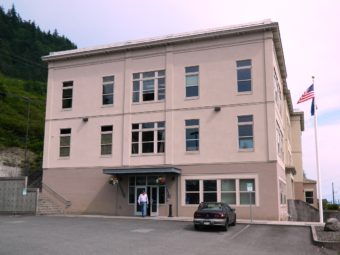
The Ketchikan Gateway Borough Assembly meets in the White Cliff building at 1900 First Ave. (KRBD photo)

The Ketchikan Gateway Borough Assembly will consider opposing a lawsuit seeking to reinstate the Roadless Rule in the Tongass National Forest.

The Trump administration’s Tongass exemption opened up approximately 9.4 million acres of federal forest land to potential road building and other development. A legal challenge seeking to overturn the exemption was filed by Southeast Alaska tribes and conservation groups late last year.

The Ketchikan City Council recently voted 6-1 to spend up to $5,000 to intervene on the federal government’s behalf. Elected officials in Wrangell recently considered a similar request but decided not to intervene.

In other business, the Ketchikan borough assembly will consider taking over operation of the entire Rainbird Trail located above the Third Avenue Bypass. The University of Alaska Southeast requested transfer of maintenance responsibilities for the portions located on UAS lands to the borough. The borough’s portion of the trail has been closed since a landslide last fall. The trail is popular with residents and cruise ship passengers.

If approved, trail maintenance and repair would be included in the 5-Year Capital Improvement Program. Work would occur in phases with a proposed budget of $100,000 in the first year, and $150,000 annually for two more years after that. Most of the funding could come from grants and head tax paid by cruise passengers.

The Ketchikan borough assembly is also slated to hear two reports. Rep. Dan Ortiz is scheduled to provide a legislative update. The borough auditor will deliver an annual report on the local government’s finances for the fiscal year ending June 2020.

The meeting begins at 5:30 p.m. Monday in the Ketchikan Borough Assembly Chambers at the White Cliff Building. It is also live streamed on the borough website and available on local cable channels. Public comment will be heard at the beginning of the meeting.

Ketchikan’s City Council votes to defend Roadless Rule rollback in court

A timber sale sign is posted in the Tongass National Forest on Prince of Wales island. (KRBD file photo)
A timber sale sign in the Tongass National Forest on Prince of Wales island in 2015. (KRBD file photo)

An overwhelming majority on Ketchikan’s City Council wants to defend the Trump administration’s decision to exempt the Tongass National Forest from the Roadless Rule.

A legal challenge by Southeast Alaska tribes and conservation groups seeks to overturn the rollback, which could ease road building and other development on some 9.4 million acres of federal forest land.

Ketchikan City Council member Riley Gass said the collapse of the cruise season in 2020 in the face of the pandemic shows that the region needs to tap its natural resources.

“I think this is important because as we all know, and we’re all seeing, there’s not a whole lot of industry going on in our region, there’s not a lot of — there’s just not a lot of industry. And if we can try to help out to bring back some amount of timber industry in the region, I think it’s prudent,” he said.

The Ketchikan City Council voted 6-1 Thursday to spend $5,000 on legal work to intervene in federal court.

Roadless Rule critics say there’s little chance the region will again see large-scale logging, as it did in the mid-to-late 20th century. But they say the rule is an obstacle to mining, energy and other development in the Tongass.

The lone vote against came from Janalee Gage.

“I won’t be supporting this because, one, they were working with Native tribes on this issue, and they had come to several different points where they all agreed, and then they decided to ignore everybody’s input. And that is why they’re in this position,” she said.

The Biden administration can’t easily overturn the rulemaking process that exempted the Tongass National Forest from the Clinton-era rule. But Congress could — Democrats from Washington, Arizona and Colorado have filed a bill to restore the rule.

The exemption was championed by Alaska’s congressional delegation.

Site notifications
Update notification options
Subscribe to notifications