Archives for:

"Roadless Rule"

Sitka fish and game committee speaks out about climate change

Members of the Sitka Advisory Committee expressed concern that climate change is impacting habitat for fish and game resources that commercial, sport and subsistence users rely on. (Photo by Erin McKinstry/KCAW)

Sitka’s local fish and game advisory committee is speaking out again about climate change and its impacts on commercial, sport and subsistence activities.

When the group met on Wednesday, they signed off on a letter to other advisory committees around Alaska urging them to take action. Last November, the group unanimously passed a climate emergency resolution, and in February, they were part of an effort that unsuccessfully petitioned the city assembly to do the same.

The city has since formed a task force to address climate change locally.

Member Stacey Wayne who holds the shellfish seat, said at the meeting that part of the Sitka advisory committee’s job is to advise others on wildlife conservation and use, including matters related to habitat.

“We’re fighting as user groups to have fish to fish, and our seasons are collapsing and our stocks are collapsing, and all of these are related to climate change,” Wayne said. “And so our job is to preserve opportunities to fish and hunt for the community.”

Support for the letter was almost unanimous, but member Luke Bastian, who holds the guide seat, did have some concerns.

“I think there’s unforeseen consequences there, and I don’t know if it actually gains us anything,” he said.

Wayne and others disagreed, saying that calling on other advisory committees to take action could have a tangible impact.

“Maybe with many voices pressuring local governments to become louder in support of stopping climate change and taking actions at the local level, there can be an impact to help preserve and protect the habitat for the species that we’re supposed to be protecting,” she said.

The committee also signed off on a letter opposing the decision to reverse the Roadless Rule in the Tongass National Forest and filled or renewed positions on the trapping, processing, alternate and sport fishing seats.

Democrats renew push to restore Roadless Rule in Tongass National Forest

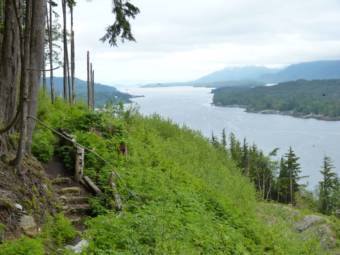
Portions of the Tongass National Forest can be seen from Ketchikan’s Rainbird Trail.
Portions of the Tongass National Forest can be seen from Ketchikan’s Rainbird Trail. (KRBD file photo)

Democratic lawmakers in Congress have begun trying to reinstate the Roadless Rule for Alaska’s Tongass National Forest

They’ve filed a bill that would reverse the Trump administration’s decision to exempt the nation’s largest national forest from the 2001 rule that restricts road-building and other development. 
And with the U.S. Senate slated to change hands, the bills filed in both chambers on Tuesday have better prospects than previous efforts. 

The Roadless Area Conservation Act of 2021 mirrors past bills. It was introduced by U.S. Sen. Maria Cantwell (D-Washington) and Reps. Diana DeGette (D-Colorado) and Ruben Gallego (D-Arizona).

“The looming climate crisis has only increased the need to protect America’s last remaining wild forestlands, which reduce wildland fire risk and store huge amounts of carbon,” Sen. Cantwell said in a statement.

Alaska’s Congressional delegation and many state leaders hailed the Tongass exemption, finalized last October.

It could open up 185,000 acres of old growth forest in Southeast Alaska to logging.

But it’s proven controversial. Forest Service hearings in recent years showed the Clinton-era rule had strong support both in Alaska and Outside. 

A coalition of 10 conservation groups including Alaska Wilderness League, Alaska Audubon and Southeast Alaska Conservation Council released a statement on Tuesday supporting the bills.

“This legislation preserves roadless areas for hunting and fishing, activities that support a subsistence lifestyle and define a way of life for many people living in rural forested areas,” the groups wrote.

A coalition of conservationists and Southeast Alaska tribes filed a lawsuit last month to compel the U.S. Department of Agriculture to reinstate the Roadless Rule. 

Absent legislative action or a court ruling that reinstates the Roadless Rule, an incoming presidential administration couldn’t easily reverse the exemption. 

In lawsuit, groups ask that ‘Roadless Rule’ protections be put back in place for the Tongass

Tongass National Forest
Part of the Tongass National Forest on Douglas Island pictured in 2004. (Creative Commons photo by Henry Hartley)

A coalition including environmental groups, tribes and fishermen filed a lawsuit on Wednesday to restore Roadless Rule protections to 9 million acres of Tongass National Forest.

Alaska’s governor and Congressional delegation applauded the Trump administration’s decision to exempt the Tongass from the Clinton-era Roadless Rule, which restricts development on federal forestlands. Supporters say the rollback will boost Southeast Alaska’s ability to log trees, extract minerals and boost hydroelectric energy production on federal forestland.

But a coalition of Southeast Alaska tribes, fishermen and environmentalists argue the decision disregarded overwhelming opposition from Alaskans for the sake of a few hundred timber jobs.

Kate Glover, a Juneau environmental attorney with Earthjustice, says the U.S. Forest Service’s environmental review is fatally flawed. She says the rollback of the Roadless Rule was in part justified by helping Southeast Alaska’s logging industry.

“But their analysis shows that removing the Roadless Rule will not provide any additional jobs or income through the timber industry over the next 100 years,” she said. “And because they’ve made that assumption that there isn’t going to be any more logging, despite opening up all these acres to clear cutting, they’ve failed to disclose the effects of the action through their environmental impact statement.”

The five Southeast Alaska tribes that have joined the lawsuit all withdrew from consultations with the federal government in September, complaining that their input was being ignored.

Tribal president Joel Jackson of the Organized Village of Kake says the Tongass is his people’s traditional homeland. And the rainforest is tied to food security through subsistence hunting and fishing.

“We’ve lived here for 10,000 years or more,” he said. “And we’ve practiced our way of life, in these ports on these waters, all around our communities, and, you know, if we lose that, we’re going to lose part of our identity.”

The lawsuit also includes support from the visitor industry and commercial fishermen.

Linda Behnken of the Alaska Longline Fishermen’s Association in Sitka says Southeast Alaska’s commercial fishing sector depends on healthy forest habitat. A point reinforced in last year’s report by the Alaska Sustainable Fisheries Trust.

“And there’s a lot of information there that really we drew on in in saying, ‘Boy, the best value for the coastal communities in the Southeast economy is to keep this forest intact’ — particularly in the face of climate change,” she said.

For critics of the Roadless Rule, a court challenge was inevitable.

Jim Clark is a Juneau attorney and longtime political operative. He’s been working to overturn the Roadless Rule in Alaska since at least Gov. Frank Murkowski’s administration.

“I don’t think there’s really any reason for people to be frightened by the exemption we’ve had in the past and these problems haven’t occurred and that there’s no reason that will occur now,” he said.

That’s because he says the 2016 Tongass management plan and federal environmental laws remain in place to conserve the region’s natural resources. And he says that includes the projected 185,000 acres of old growth forest that lifting the Roadless Rule could now be logged.

“And there will be litigation to double check what the Forest Service does,” Clark added, “every time a some kind of action is approved by the Forest Service.”

The federal lawsuit names U.S. Secretary of Agriculture Sonny Perdue or his successor. That’s in recognition of the incoming administration of President-elect Joe Biden.

Kate Glover  says a Biden administration could start the formal process of reinstating the Roadless Rule.

“We think they’ll recognize the importance of the timeliness for climate change for the whole world,” she said, “As well as the wrongs that happened to Tribes throughout this process and the importance of keeping the forest intact.”

But in the meantime, the lawsuit asks the courts to reinstate the Roadless Rule restrictions across Southeast Alaska.

Tongass National Forest spokesman Paul Robbins Jr. said Wednesday that as a policy, his agency doesn’t comment on pending litigation.

Investigation blames U.S. Forest Service for giving Alaska grant used for Roadless Rule fight

The Tongass National Forest is the largest temperate rainforest in the country. With exceptions, the Clinton-era Roadless Rule restricted road building and industrial activity in around 55% of the national forest. Advocates for its repeal said it posed unnecessary hurdles to development projects, like logging, mining, and renewable energy (Photo by Erin McKinstry/KCAW)

A federal watchdog agency says the U.S. Forest Service acted illegally when it awarded a $2 million firefighting grant to the state of Alaska in 2018. The state had asked for the grant to gather input on a proposal to exempt the Tongass National Forest from the Clinton-era Roadless Rule. 

The U.S. Department of Agriculture’s Office of Inspector General issued its report Wednesday. The report says the Forest Service illegally awarded the $2 million to the state through a grant program intended to support fire suppression in state-owned forests. 

A Washington, D.C.-based spokesperson for the Forest Service, Larry Moore, said that the money had been set aside for the state. But he says none of it actually ever changed hands. The agency says it’s working with its in-house lawyers to determine how to reallocate the money. 

That means the state is on the hook for any expenses the grant was meant to reimburse. The $2 million grant was to be matched by state funds. It’s not clear how much the state spent gathering input from industry groups and local stakeholders. The governor’s office did not immediately respond to questions for this story.

The USDA watchdog does not directly accuse state officials of wrongdoing — in fact, documents obtained by Alaska’s Energy Desk show that the state told the Forest Service exactly what it was requesting the money for. But investigators say that money never should have been awarded as part of the firefighting grant.

Investigators say it’s above-board for the Forest Service to provide funding to gather input on rule changes. But they say awarding that money to the state without informing other interested parties that money was available for that purpose violated federal law and regulations.

The investigation was prompted by a story last year from former Alaska’s Energy Desk reporter Elizabeth Jenkins. She uncovered documents showing the state had paid the Alaska Forest Association more than $200,000 to influence the rulemaking process. At least one Southeast Alaska tribe was also reimbursed for travel expenses estimated at a few thousand dollars.

Two members of Congress then requested the investigation.

State officials, including Gov. Mike Dunleavy and Natural Resources commissioner Corri Feige, said last year the state had not misspent any federal money from the grant.

Remember that hunting trip Donald Trump Jr. had planned for Alaska? It’s happening.

Donald Trump, Jr. speaking with supporters of his father, Donald Trump, at a campaign rally at the Sun Devil Fitness Center at Arizona State University in Tempe, Arizona. (Photo by Gage Skidmore / CC BY-SA 2.0)

Rumors went around Juneau on Tuesday that Donald Trump Jr. was in town for a hunting trip planned earlier this year. While the guide leading the hunt could not confirm where Trump was on Tuesday, he said the trip is still going forward.

Keegan McCarthy owns Coastal Alaska Adventures, a business that guides visitors on yacht-based hunts. Back in February, he auctioned off an opportunity to join Trump and his son on a weeklong hunt for Sitka black-tailed deer and ducks in Southeast Alaska. The chance to join Trump sold for $150,000.

McCarthy said they still intend to go on the trip, but the region’s weather is hindering their plans.

“We’re just on hold right now. We’re going to be kind of waiting to see what happens here,” he said. “Southeast has been getting hit pretty hard.”

For security reasons, McCarthy didn’t say if Trump would be waiting it out in Juneau or when exactly they would set out on their journey. But he said he already met one of his original goals.

McCarthy said the money raised through the auction went toward two programs centered on wildlife conservation and education — the American Wilderness Leadership School and another initiative he’s working out the details for.

Trump identifies as a sportsman and has hunted and fished in Alaska. He made waves earlier this year when he tweeted his opposition to the development of the Pebble Mine in Bristol Bay. His father’s administration had removed a block on the mine that was there from the Obama Administration.

McCarthy also said he will still use the hunt as an opportunity to teach people about the Tongass National Forest, which the Trump administration lifted protections for in October.

“We’re still trying to educate the administration on the Tongass National Forest and do whatever we can to keep the Roadless Rule intact, even though it may be too late. But we’ll find out,” he said.

Correction: An earlier version of this story incorrectly named Coastal Alaska Adventures as Coast Alaska Adventures.

Tongass Roadless Rule exemption leaves subsistence users feeling left behind

The Tongass National Forest is the largest temperate rainforest in the country. With exceptions, the Clinton-era Roadless Rule restricted road building and industrial activity in around 55% of the national forest. Advocates for its repeal said it posed unnecessary hurdles to development projects, like logging, mining and renewable energy (Photo by Erin McKinstry/KCAW)

The announcement on Wednesday that the Trump administration will lift protections against development in the Tongass National Forest sparked strong reactions. For many Southeast Alaskans who rely on the Tongass for food, the news is personal.

On a rare sunny afternoon in the Tongass, Chuck Miller showed me a spot near the water where his grandmother would often take him. He pointed out where they’d collect salmonberries, blueberries and huckleberries, giving Tlingit names for each.

“And then my grandmother would show me some of the plants we could use for medicinal purposes,” Miller said.

He eats many of the same foods as his ancestors. He hunts seal, collects seaweed, and fishes for salmon.

“I like to use the word Tlingit soul food,” Miller said. “It makes you feel good on the inside.”

He said he’s not political, and he doesn’t know all the ins and outs of what a full exemption of the Roadless Rule means for the Tongass National Forest, which is bigger in land area than the entire state of West Virginia. But anything that could threaten his subsistence way of life makes him nervous.

“If they allowed roads into certain areas where it affects our harvesting, I’m not a big fan of that,” he said. “You’re gonna get more population, more pollution and then some things might get overharvested.”

Chuck Miller poses for a photo near where he and his grandmother used to collect berries and medicinal plants. “Our Tlingit people have been eating food off the land since time immemorial. It’s a very important part of our culture,” Miller said. (Photo by Erin McKinstry/KCAW)

Miller isn’t alone. At a U.S. Forest Service hearing in Sitka last fall, commenters advocated unanimously to keep protections for the Tongass in place. Subsistence users and environmentalists worry that opening more than nine million acres of the Tongass to potential development for logging or mining could disrupt vital habitat for the species many depend on like Sitka black-tailed deer and salmon.

Eric Jordan is a Sitka-based commercial fisherman, but he feeds his family salmon too. He recalls what clear-cut logging did to salmon streams and wildlife habitat in the last century.

“Around Southeast, the people who live here understand how damaging that was to our ecology, and they do not want it reintroduced,” Jordan said.

The immediate return of industrial-scale timber operations to Southeast isn’t likely, mostly for economic reasons. But that doesn’t ease Don Hernandez’s worries. He lives in Point Baker on Prince of Wales Island, and like many of his neighbors, a significant portion of what he eats is hunted, fished or gathered.

“Ten years down the line, depending on what pressures may come from industry, once the long-term protections are eliminated, we could see a push to have more large-scale clear-cutting on the Tongass again,” he said.

He chairs the Southeast Alaska Regional Subsistence Advisory Council, which advises the federal board on important hunting and trapping decisions on federal lands.

The Forest Service’s final environmental impact statement states that the full exemption of the Roadless Rule in the Tongass will have “minimal adverse and beneficial effects” on subsistence users. It posits that increasing road access could open up hunting and fishing areas to those who don’t have boats and spread subsistence use over a larger area, rather than concentrating it in more accessible places.

But Hernandez said he thinks the costs far outweigh the benefits.

“When you spend the amount of money that it takes to build a road in Southeast Alaska, you have to extract a lot of timber to justify building those roads. So it’s not just a small impact,” he said. “And yes it does provide access for subsistence users and people use the roads. But, over time, all the negative impacts from the road building and clear-cutting, it takes a toll.”

Proponents of the changes say they’ll allow for more economic development opportunities like mining, communications and renewable energy projects. But for many people who live in and around the nation’s largest temperate rainforest, it’s all about the long view.

Take Allysia Witherspoon. She, her husband and their two children live in Sitka and rely on hunting and fishing for a good portion of their household needs. She says they’re nervous about what the decision to roll back protections for the Tongass will mean long term for subsistence resources — especially after the lion’s share of Alaskans implored the federal government to keep the Roadless Rule in place.

“It’s kind of alarming that no matter what research has been provided and all the comments of all the people who live here that they would try to do the exact opposite,” Witherspoon said.

Wednesday’s decision to overturn Clinton-era protections for 55% of the Tongass could be challenged in court. Congress could also get involved or a future administration could start the years-long process of reinstating the Roadless Rule in Southeast Alaska.

Editor’s note: This story was produced as part of a collaboration between KCAW and Alaska’s Energy Desk. Erin McKinstry is a Report for America Corps member.

Site notifications
Update notification options
Subscribe to notifications